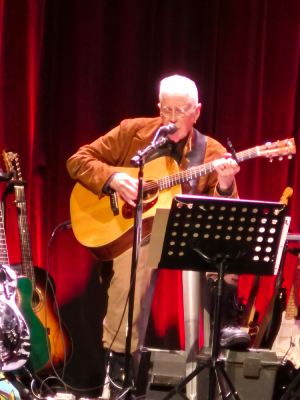
Canadian singer/songwriter/guitarist Bruce Cockburn, 81 years old with a solo recording career that started in 1970 with his eponymous debut album, brought his tour with opener Livingston Taylor to New York City for a concert at The Town Hall on Saturday, October 24.
The mostly acoustic and introspective folkie style of Cockburn’s early work gradually morphed into more of a rock style in the ’80s. His trio at this show, with Jeff Pevar on bass and Ingar Nova on percussion and both adding occasional backing vocals, leaned toward intimacy but at times beefed up its sound for the more rockfish tracks, though never with the density of his mid-‘80s work.
His set kicked off with “Last Night of the World,” from 1999. Fears that age might have diminished his voice were immediately banished (his new album, a collection of covers, including many old blues songs, had some rough singing, but now I assume that was a stylistic choice to match the material). “Night Train” (1996) followed; Nova provided appropriately train-like rhythm, and she and Pevar chipped in backing vocals. Cockburn scatted one verse, even holding a high falsetto note, demonstrating his continued vocal agility.
Cockburn moved into more recent material with “On a Roll” (from his most recent album before the new one, 2023’s O Sun O Moon), boldly proclaiming, “Time takes its toll/But in my soul/I’m on a roll,” and followed it with “King of the Bolero” (a tribute to an unnamed guitarist stumbled on in a bar) from the same LP.
Then we were treated to one of his older classics, the beautiful “All the Diamonds” (1974). Here, there was a tiny sign of vocal aging—some of the high notes were ever so slightly below pitch in a song from when his upper range was perhaps more effortless. Still, I’m just being picky; he put the song across with no trouble.
Finally we got a song from his new album, The Blood of Others: “As Time Goes By,” Herman Hupfeld’s classic from the movie Casablanca (1942). Cockburn warned in advance that the less familiar part of the song before the chorus, contained “archaic references” he’d updated, and his rewrite brought chuckles. In the meat of the song, his sensitive phrasing made for a fine interpretation of this chestnut, and he also dazzled with his guitar skills.
Surprisingly, that was the only song we heard that night from the new album, which is well worth picking up for its look at his early influences and its fond delivery of the beloved material. When he switched to a National Steel guitar for the next song, I’d expected one of the new album’s blues songs, but instead (he said something along the lines of “I’m confusing you”) he played a gospel blues from his 1991 album, Nothing But a Burning Light: Blind Lemon Jefferson’s “Soul of a Man”—which contains the album title. It was one of the most impassioned performances of the night.
After that, Cockburn switched to electric guitar for the first time for “The Whole Night Sky” (another from 1996—his album The Charity of Night was dipped into three times) with Pevar also on guitar and also taking a solo. Noting that it was another night-sky song, Cockburn next played “Lily of the Midnight Sky” (1986), switching to an instrument new to me, a 12-string charango (like a ukelele on steroids). It was one of several songs where he talks through verses rather than singing, as though discussing something with friends.
There was an abrupt change of mood with the most viciously impassioned political song of the night, “Call It Democracy” (the second in a row from World of Wonders), a fervid indictment of the International Monetary Fund that includes such lines as “IMF dirty MF,” “You don’t really give a flying fuck about the people in misery,” and “Keep them on the hook with insupportable debt.” He didn’t play his righteously angry mid-‘80s hit “If I Had a Rocket Launcher,” but this got the same sort of message across—Cockburn, dare I say, is the Canadian Phil Ochs.
The flip side of that, I suppose, came next: “Orders” (2023), a lengthy list of despicable characters, but as Cockburn points out, “A challenge great; as I recall, our orders said to love them all,” because his righteousness comes from his Christian faith, the kind diametrically opposed to Christian Nationalism.
“States I’m In” (2017), another nocturnal song, featured some of his most intricate guitar work. Then came a fan favorite from his brilliant 1984 album Stealing Fire, “Lovers in a Dangerous Time,” which even made an impression on U2: Bono in “God Part II” (Rattle and Hum) sings, “heard a singer on the radio late last night says he’s gonna kick the darkness till it bleeds daylight,” which is a paraphrase from “Lovers in a Dangerous Time.” Cockburn’s song—inspired, one imagines, by his early ’80s time in Nicaragua, is sort of a musical parallel to the ’80s movies Salvador and Under Fire—balances the anxiety and excitement of powering through challenges together. This was one of Cockburn’s best vocal performances of the evening.
Between songs, Cockburn mentioned that he has osteopenia (low bone mineral density), which explained why he walked hunched over and using a cane. Perhaps it wasn’t coincidental that came just before “Pacing the Cage (another song from The Charity of Night), which includes the line “Sometimes you feel like you live too long.” Or maybe it was a random juxtaposition. We’d have to ask Bruce. But I doubt anyone was pondering that once he kicked off his biggest hit of the evening, “Wondering Where the Lions Are,” his 1980 breakthrough into the U.S. market. He invited us to sing along with the response line in the chorus, and many of us gleefully took him up on that.
Things got political again with “If a Tree Falls,” a protest song about irresponsible logging (“parasitic greedhead scam”), which closed the main set. Then it was on to the encores. “Mama Just Wants to Barrelhouse All Night Long” (1973), another fave, featured Nova taking a verse and sounding like the young Bonnie Raitt. Cockburn’s perfect bluesy guitar solo made it even more celebratory, and Pevar’s hollow-body electric bass solo also shone. Then, closing out the evening, came the tender benediction of “Us All” (the fourth song in the show from O Sun O Moon), which in our current situation deserves to be quoted in full:
Here we are, faced with choice
Shutters and walls or open embrace
Like it or not, the human race
Is us all
History is what it is
Scars we inflict on each other don’t die
But slowly soak into the DNA
Of us all
Us all
I pray we not fear to love
I pray we be free of judgment and shame
Open the vein, let kindness rain/reign
O’er us all
Us all
Us all
The evening had opened with a set by the youngster on the bill, 75-year-old Livingston Taylor (brother of James), another excellent finger-picking guitarist. His polished mix of comic banter, original songs, and well-chosen covers was charming, a light touch before the heavy topics of Cockburn.
“I Belong” kicked off the evening, a pleasant ditty from his 1996 album Bicycle. Then came the one hit of his set. Taylor noted that he penned “Carolina Day” when he was sixteen years old. Appearing on his 1970 debut album, it made the Billboard singles chart at #93. He had later hits that charted higher, but none of them were played this evening.
Next, he vamped for a while on what he called “an easy shuffle” before turning it into “If I Only Had a Brain” (from The Wizard of Oz, of course) and then segueing into his own self-deprecatory “I Must Be Doing Something Right.” He continued the covers-of-classics theme with “Getting to Know You” from the musical The King and I (Rodgers & Hammerstein) included a sing-along. “Start All Over Again” by Jerome Kern & Dorothy Fields continued the Broadway musical theme, transitioned into a snippet of the guitar part of Paul McCartney’s “Blackbird,” and then slid into Livingston’s “Look Up and There I’ll Be,” which he said had been inspired by the first song of the medley.
The highlight of his set in a way was a long comic routine imagining that the Olympics included a guitar competition, with him representing the U.S.: as he played a shuffle in A, he provided a sportscaster’s commentary on the performance, a perfect parody of a gymnastics broadcast.
Mentioning that he’d been the voice actor of Winnie the Pooh in a new (post-copyright-expiration) version set up not only jokes about not wearing pants and eating too many sweets, but also a cover of Kenny Loggins’s “House at Pooh Corner.” He closed his set with a delightfully goofy folk song parody about “Railroad Bill” wherein the titular character objected to doing the things the writer was saying he did, only for the singer to write Bill’s grisly death into the end of the ditty.
All I knew about Livingston Taylor’s career when I walked into The Town Hall was “Carolina Day,” but this set made me a fan.