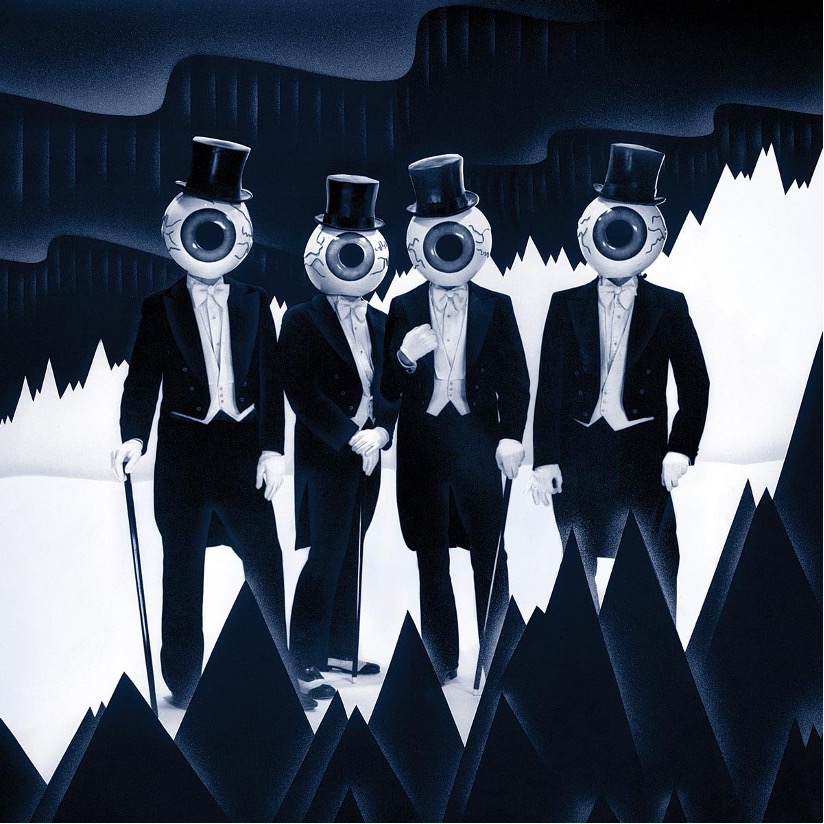
One of the most fascinatingly unusual bands in the history of rock, The Residents have had a policy of deliberate anonymity throughout their 55-year existence (starting the clock in 1971 because that’s when they used a name that included the word “residents,” which they famously chose because the first demo they submitted to Warner Brothers was rejected and sent back to Residents). Fifty years ago, they began recording their most avant-garde album, Eskimo, and this year they released a sequel, Eskimo Folk Tales, and embarked on an anniversary tour.
The original Eskimo operated on several levels. It was ostensibly relating true tales of Inuit life and ritual, but in reality was largely fictional albeit perhaps loosely inspired by some actual bits of ethnography. It was also a radical departure from The Residents’ previous releases, which had satirized rock music; on Eskimo the music was built on synthesizer effects, homemade instruments, non-rock rhythms intended to evoke ethnic-music clichés, and alienating vocals. The result implicitly critiqued popular presentations of alien cultures to the general American public as distorted and othering.
The new EP, we are told, uses authentic tales, but who among us is qualified to evaluate the truth of that? In the live presentation, which uses video projects throughout, certainly the cartoonish videos of the ostensible stories, along with the costumes of the stage performers, accent the visual othering.
Nonetheless, the music—old and new—and the stage presentation are inevitably working with compelling themes of life, death, ritual, and identity that contain elements consistent across most cultures, including our own, and thus are cathartically relatable, and the music is powerful despite or because of its strangeness (varying from listener to listener).
In my opinion, Eskimo is one of the greatest albums in the history of rock, and the concert presentation is one of the greatest spectacles I’ve witnessed.
Officially, Homer Flynn handles art production, such as album covers, for the Cryptic Corporation, the management arm of The Residents. It is widely speculated that he is a band member, and he is the main spokesman for the group. Believe what you want to believe. Residents reality is highly mutable and malleable. Thanks to Jon Bleicher at Prospect PR for setting up our interview and access to the concert presentation at Sony Hall.
Steve Holtje: The big news, of course, is the sequel to Eskimo. What were the difficulties involved in recording the original Eskimo album that led to its release being delayed until 1979?
Homer Flynn: The Residents had two concepts when they started recording the original Eskimo album: they wanted to make an album based on what then called “ethnic” or “foreign” music, and they wanted the music to be based on sounds, not traditional music rules or values. While they felt committed to these ideas, creating compelling or listenable pieces proved to be much more difficult than they expected. Finally after recording many experimental short pieces over 3-1/2 years, they came up with a way of connecting the pieces and the final album came together quickly. The primary connection tool was wind.
SH: Eskimo seems to be the album most closely based on the Theory of Phonetic Organization. Would you agree? Can you elaborate on how that theory influenced the album?
HF: The Theory of Phonetic Organization was certainly instrumental in creating vocals for Eskimo. The Residents used collections of syllables and fragments of words that to them suggested Inuit or Eskimo language but, being The Residents, there is an undercurrent of absurdity when you can understand them. They deliberately kept the vocals somewhat murky and unintelligible so that the listeners would project their own meaning onto the words.
SH: Was N. Senada involved in the creation of Eskimo?
HF: N. Senada was not directly involved in the recording of Eskimo, but he did send the field recordings of Eskimos that were the primary inspiration for the album.
SH: Was the sequel to Eskimo easier to record than the original, particularly given advances in recording technology and equipment?
HF: The sequel was much easier to record for a couple of reasons: I) they knew exactly what they wanted to do so there was little experimentation compared to recording the original album, and 2) the Inuit folk tales that they discovered when researching Eskimos again were so inspirational, it made it fairly easy to create the new songs and videos.
SH: Will the Eskimo Live! Tour be filmed? How elaborate is the stage production, and will it include theatrical enactments of the songs’ narratives?
HF: At this point there are plans to record and shoot video of Eskimo in a couple of places: The Caverns in Pelham, TN; and it’s also looking likely that the show in San Francisco will be shot. While there are no theatrical enactments of the stories on stage, elaborate video segments accompany the live music and illustrate the stories.
SH: Were Karlheinz Stockhausen, Morton Subotnick, Albert Ayler, or Sun Ra influences on The Residents? If so, in what ways? I’m particularly curious because each, in their own way, seems to embrace ideas related to the Theory of Phonetic Organization.
HF: While The Residents were certainly aware of these artists, Sun Ra was definitely the biggest influence. Sun Ra definitely used language in an interesting and compelling way, but it was his live performances that had the biggest effect on the group.
SH: The album that followed Eskimo, Commercial Album, was almost its exact opposite in terms of musical style. What inspired such a dramatic change in direction?
HF: After Eskimo, The Residents very consciously wanted the next album to be as opposite as possible. A lot of the reasoning had to do with the fact that they had spent four years on Eskimo and were anxious to do something new and do it quickly, which they did with the Commercial Album.
SH: The 2019 two-CD edition of Commercial Album included 37 additional tracks. Are there any plans to release an expanded vinyl edition?
HF: Cherry Red Records in London is the one that puts these re-release packages together and I haven’t heard anything from them about an extended vinyl version of the Commercial Album, but I could easily see it happening.
SH: Will the Mole Trilogy ever be revisited and completed? And what does “completion” even mean in The Residents’ world?
HF: “Completion” is indeed curious word in the world of The Residents. There are quite a releases/projects that could easily be developed beyond their current state but in my mind, the Mole Trilogy is probably finished. Personally, I doubt that there will be any more Mole releases.
SH: Are there plans for an expanded release of material from the 13th Anniversary Tour? The original Japanese album contained 13 tracks, while the 1999 East Side Digital edition expanded that to 22. Combined with the Holland (15 tracks) and USA (30 tracks) recordings, there seems to be enough material for a substantial archival release. Is there additional material in the vaults from other locations that could be included? This seems like the kind of project that would be a natural fit for Cherry Red.
HF: As far as I know, there are no plans to release an extended version of the 13TH Anniversary tour, but you are correct that it would be a perfect project for Cherry Red. It seems likely that they will do something with it in the future.
SH: Does any video footage from the 13th Anniversary Tour exist, and might it ever be released?
HF: I couldn’t remember if there was any video of the 13Th Anniversary Tour or not, but a quick Google search showed several videos. Here is a link to a half hour program shot in Norway that I remember as being quite good:
Unfortunately, YouTube has ruined the market for video releases, so I doubt that any of this will be released any time soon.
SH: The Residents’ Ralph Records catalog has been distributed by several labels over the years, most recently Cherry Red. What led to the partnership with Cherry Red, and how has that relationship developed?
HF: This is fairly boring business stuff, but in 2015, Hardy Fox unexpectedly announced his desire to retire. Having no desire to stop working personally, I spent all of 2016 searching for ways to enable Hardy’s retirement along with my ongoing career. The outcome was Cherry Red and MVD (Music Video Distributors) each buying half of Hardy’s 50% of the Cryptic Corp and it’s been a great relationship.
SH: What’s next for The Residents beyond the Eskimo Live! Tour? Are there plans for additional archival releases or new studio albums?
HF: The Residents have just completed a new album called A Lonely Wound. It will be released early in 2027.