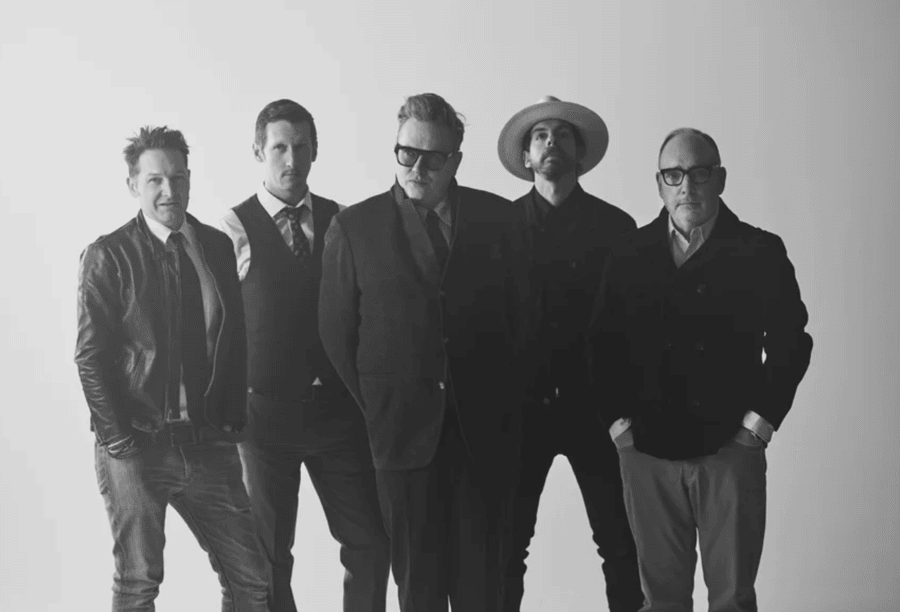
Aaron Perrino joins the Zoom call roughly 12 hours after The Sheila Divine wrapped their record release show in Boston and just a few hours before the band heads to the airport for a run of shows in Belgium, a country that has embraced them for decades, thanks to an A&R rep who landed them radio play there early on.
His voice is a little ragged, but his spirits are high. After a year of personal upheaval — the end of a long-term relationship, a job loss — Perrino has found renewed pleasure in the band he formed in 1997. The lineup has changed over the years, but the songwriting hasn’t wavered: it remains deeply indebted to the British bands Perrino was discovering on MTV in the ’80s, and his enthusiasm for the new album, The Middle Ages, and the musicians who made it is palpable.
My history with Perrino goes back to 1997, when I first interviewed him and The Sheila Divine in a booth at a basement bagel restaurant in Columbus, Ohio, a place that doubled as a live music venue and was known locally as Columbus’s CBGB. We’ve kept in touch across the years and the projects: I caught up with him again after the original Sheila Divine lineup dissolved and he launched Dear Leader, and more recently wrote a print feature for Big Takeover on his project Aaron and the Lord. There’s an ease to these conversations. We’re roughly the same age, and though we didn’t grow up together, we’ve lived enough of the same experiences that it never takes long to find common ground.
You played last night?
AARON: We did, yeah.
How’s that?
AARON: It’s good. I’m a little sore. I still scream my face off, and it’s like, sometimes I’m like, “What am I doing to my body?” It just hurts more and more.
What does the set list look like with a new album? Was it heavy on the new album, or was it a mix?
AARON: There’s definitely, I’d say, half the new album, and then we were doing songs from Secret Society, Where Have My Countrymen Gone, New Parade, and then some Dear Leader songs. The new lineup knows the catalog well, and they’re like, “What if we do this song?” So we’re playing stuff we haven’t played in, like, 20 years.
That’s kind of fun. As you and I probably both know, when new musicians join established bands, there’s usually no room for improv, right? Most of the time you can’t just improvise and play something.
AARON: Andy (Rooney), my bass player, is a psychopath, but he’s literally learned, I think, my entire catalog. Everyone in the band’s just like, “Jesus.” It’s crazy.
Who is playing with you now?
AARON: It’s two of the guys that were in Dear Leader with me, Will Claflin and Paul Buckley, and then this guy, Andy, who was our sound guy from basically the beginning. He was also the tour manager for Dropkick Murphy’s. He’s really taken the band to the next level. We wear in-ears now, he’s taken the production up 10 notches as far as the pro levelness. He advances all our shows. Will works in video and film stuff for advertising, so he makes all our social content and the visuals for the show. And then Paul owns Lunch Records, so he does all the booking and handles a lot of that. Before, not saying we were a nostalgia band, but it kind of was like that, because (former member) Brian (Charles) works seven days a week in a studio, and it would be like, “We can practice on Thursday the 21st from 7 till 8.” It was hard to get anything done. These guys are pushing me.
With the current iteration of the band and where you’re at, what is the balance between just having fun and this being a new chapter?
AARON: New chapter. It feels vital. Long-time fans have been like, “Dude, this new thing is next level.” For the past 15 years it was more like just guys getting together, having a good time, playing “Hum” and “Like a Criminal,” reliving things. Whereas this feels like we’re really doing it. Since the world’s just so messed up and my career is in the tank — I’m 52, you lose your job, you’re kind of screwed, because no one wants to hire an old white dude — I’m just being like, alright, I’m gonna do more music. We’re playing a ton of stuff and going to Europe. I leave tonight, so it’s nice.
Across the Sheila Devine catalog, the first song on each album has been a banger. Can you tell me what you think are the top three first songs?
AARON: Well, “Automatic Buffalo” (from 1998’s New Parade) sort of defines my catalog, I think. On the Dear Leader record, “Nightmare Alleys” — that one is just outrageous. Gotta bring that one back. And I’m digging “Gods of War” (from 2026’s The Middle Ages) a lot. I was trying to do kind of a Cure intro, like how Disintegration is one of my favorite records, so I was like, just let it go, and then it goes into that song. And Countrymen is a good one, too.
In my ranking, I think the “Darkness” is my number one. I actually have “Gods of War” as number two, and “Countrymen” as number three.
AARON: Alright, I dig it. “Darkness” definitely is a great opener.
I read a 2002 interview I did with you, when Dear Leader first started. I had relaunched my website, and you were the first person I interviewed as part of the relaunch. I asked you at the time why you weren’t just keeping the Sheila Devine name and going forward with a new band. You said the other guys might not be happy about that, but also you were kind of getting sick of some of the songs, and this gave you a chance to start new. But now you come back, and…
AARON: You were right. It took me a long time to get there. Unfortunately, people were mad at me. It was a very hard decision, because it has nothing to do with friendships, it has to do with me wanting to do music at the level I want to do it. Brian’s one of my best friends, and he recorded New Parade and Where Have My Countrymen Gone and a bunch of other stuff, but he’s definitely disappointed in me for not being a part of it. He just can’t do it at the clip I want to do it. It was a very hard decision, and I am bummed about that, but I do think it’s the right decision. And the thing I love now is that it’s just Sheila Devine, and I can do anything across my catalog. It makes the setlist fun, because I mean, obviously, we’re always gonna do “Hum” and “Like a Criminal,” but we get to mix it all in. It’s fun putting together set lists, because it’s like 250 songs.
It took me a long time to get to this: I write the songs in every one of the different bands. I’m not saying there isn’t collaboration, because I don’t tell people what they have to play, but it’s still mine. My new process now is I literally learned Logic over COVID, so I make complete songs and then I send them to the band. Then they say, “This one’s great, this one’s great,” and we go record them for real, but they’re already fleshed out.
So everything you’re writing, you’re recording?
AARON: Yeah. I watched that Nick Cave movie, 20,000 Days on Earth, his process of writing was like going to it like an office job. Get up in the morning and write all day. I’m not that crazy, but when I’m in a writing phase, I’ll make coffee and then just sit down and start recording stuff. I’ll put down some fake drums, play some guitar, whatever. I’ll make like 50 songs, and then I go back without lyrics and listen to them another time, and I’m like, “Whoa, that’s crazy.” That’s the second round of inspiration, and then I kind of finish them.
I never have to doubt, when I see you post a new song, new album, new EP, whatever, I know what I’m gonna get, and I know it’s gonna be good. My classic example is Jimmy Eat World. I loved that band when they started. I remember seeing them at Ohio State on the lawn, and my wife and I had drinks with Jim afterwards. I told my wife, “If they ask me to go on the road and sell their merch, I’m ready.” And then three or four albums later, I’m like, “I don’t think this band is making music for me anymore. It’s time to let the next generation of fans enjoy them.”
AARON: I see it with my cousin in Portugal. The Man, where he started out as like emo or whatever, turned into something else, got the hit, and then he’s working with Ryan Tedder from One Republic, doing all this kind of cheesy stuff. It really messed with his creativity. He used to write at a crazy clip. Then he got off his label and now he’s writing like crazy and doing cool stuff again. I think when you get in the machine, they’re like, “Hey, why don’t you work with this person who has a hit,” and all of a sudden it’s like, “We’re gonna put you with Diane Warren,” and you’re just like, “Okay.”
I’m sure you’d be more financially successful had you had a huge hit. But in a way, not having that is a bit of a blessing. I never think you’re gonna go off in a direction like, “What the hell’s Aaron doing?”
AARON: I only wish I got to, like, Spoon level or something, where you can just sort of play all the places, but there’s still no real pressure, and you can go anywhere you want.
As an outside observer, it felt like you were always, at least with “Hum” and “Like a Criminal,” just on that cusp. Like, one more placement somewhere on K-Rock or something that would have catapulted you to that Spoon level.
AARON: Totally. So close, but no cigar.
It sounds like you’re super happy. Do you think this album is a result of working with people that push you? When you sent it to me, I was singing along in my head on the first listen. The song were instantly sticking with me.
AARON: I really stand behind this record more than I have in a while. Brian is a producer, and I do feel like he was always trying to maintain the legacy of the sound of New Parade or something, and I’m kind of into psych rock now, I want to go different places. Now I listen back to the Beginning of the End is Where We’ll Start Again record, I’m like, “It’s really tame.” To listen to this record and then listen to that, it’s almost like that’s an adult contemporary record. When these songs came together, I was just like, “This is a solid bunch of songs.” I really wanted to write a rock record, which I haven’t done in a while.
You’ve talked about a lot of personal stuff going on in your life as you were working on this record. Was this an opportunity to escape from that stuff, or to address it directly?
AARON: I don’t go in like, “I’m gonna write a song about my heartache.” But that’s why I make music. It’s kind of my therapy. That’s the thing where I’m able to express whatever negative thoughts, or trying to be more positive. This past year was rough, so it was definitely a nice escape. I’m finally at a point where, outside of the uncertainty about how I’m gonna have a roof over my head, everything else is great.
I was going back and looking at the videos this morning, and no surprise that somebody on the “No Favors” video was like, “Stick to the music, keep politics out of it.” I do appreciate you…
AARON: It does throw you off. I don’t know, I’m in a bubble in Massachusetts. But the other part was, one of the guys is like, “I’ve been a fan forever,” and I go on their page and it’s definitely a bot, some guy with an Ozzy Osbourne thing, looks like he’s in a motorcycle gang, and I’ve never seen this person at a show. I just don’t buy it.
I want to talk about a couple of songs on the album. “Middle Ages” has a bass intro. Is that a subtle or not-so-subtle nod to Billy Idol’s “White Wedding”?
AARON: It isn’t, but as soon as he did it, we were like, “Dude, that’s basically ‘White Wedding’.” Then we kind of liked it even more. I mean, Billy Idol, for me as a child, one of the first vinyl I actually bought was the Rebel Yell record. And then when we added the chorus part, once we added that, I was like, “Alright, this song is turning into something.” I couldn’t do that on my own, it was just studio magic of everyone doing their thing. That went from an okay song to, to me, a more fun song, because I was like, this is something I haven’t done before.
I find it interesting that you and I are around the same age, have different music tastes, and yet there’s a commonality, like 80s hair metal. I just love the stuff you’ve been influenced by, even when I’m not familiar with it.
AARON: We’re both suburban kids. I watched MTV, and it went into 120 Minutes and Yo! MTV Raps, and so as a suburban kid in the middle of nowhere with no culture, that’s where I got it. Public Enemy, all that stuff.
Oh, me too. Without MTV, who knows what my taste would be.
AARON: My son’s into playlists on Spotify, and his tastes are very eclectic as well. It’s kind of hilarious, he’s in 10th grade and he was like, “You could get me any merch from the Numero Group,” and I’m like, “What? That’s super indie.” So I don’t know, it’s just funny how kids find stuff. I’ll make dinner, we sit at the table, and then I’ll just put on some weird music. It just creates a good dinner vibe.
Tell me about the Trash Casual label.
AARON: AJ is the owner of Trash Casual, but AJ runs Rough Trade Publishing. He’s been a fan and supporter, and we signed a publishing deal with Rough Trade. He just started this new label about a year ago. He came to a show in New Hampshire, because he’s originally from there but he lives in New York, and he was just like, “When are we gonna do something?” So then I was like, “Alright, let’s do it.” That’s the vibe.
You’ve been doing everything on your own for the last ten, fifteen years. Have you started to notice benefits from this?
AARON: I have a publicist in the US and a publicist in Belgium, we’re working it to radio. It’s just a handshake deal and he presses the vinyl, but I do think the more people you can get involved, the more it carries. We recorded with Dave Minehan, who was in The Replacements, and then we worked with Wally Gagel, and all these people are like, “This record’s really good,” and it just sort of pushes things forward. He brought us to South by Southwest, which I hadn’t played in a long time. He got us seven shows, it was kind of outrageous. It’s pushing me to do more stuff.
I’m glad you’re promoting and made a video for “Hurry Up,” because I think that’s such a good song. Even though there’s no MTV, anything you can do to get in front of people, you do it.
AARON: When I wrote that one, it just felt like a 90s MTV thing. I could have seen that on the Buzzbin at 3PM after school.
“Celebrate the End” is another one I really like. And on “Same Old You,” I’ve never heard Baby Jessica mentioned in a song. I love that.
AARON: It’s funny, I really liked that lyric, and Andy was like, “I think you should change that lyric,” and I’m like, “I’m gonna keep it.”
And it’s gonna hit people our age. I distinctly remember being in high school, going out with my friends and then grabbing some food at Burger King. They had a tube television up on the corner wall, and there was live coverage of when she got pulled out of the well. As soon as you mentioned that, I’m like, transported back to Burger King.
AARON: I’ve really been embracing being a Gen X band. I want to use references right from that era. That was always our joke. I’m not gonna write this Blink-182 thing like, “I can’t go to your party, my mama won’t let me.” I’m not trying to do that.
And even the way you end the album with “The Apocalypse Sells”.
AARON: I read this book about how the news cycle is basically just selling an apocalypse to wear you down, and I was like, I gotta write a song.
You talked about getting negativity out in positive songs a little bit. When I read that first interview we did in 1998, we were talking about you writing these fractured love songs; not happy love songs, but the dark side of love and relationships. And yet every time I’ve talked to you, you’re not a mopey, depressed, sad guy. Is it sort of like Clark Kent and Superman between you as a person and you as a songwriter, or do you think you bring your real self to writing and performing?
AARON: No, that’s my real self. Not saying I hide it well, but that’s the outlet for all of that stuff. I definitely have struggled with depression my whole life.
Going back to the first thing you said, do you ever lose your voice? Because you really put everything into it.
AARON: It’s not feasible if I were to go on tour. I’ve got, like, two shows, and then I need a day off or I’m screwed. I’m trying to learn to hold back a little, but it’s hard, because I feel like if I’m not screaming at that level, to me that’s the whole point: dress like this nerdy, preppy, whatever, and then just be totally unhinged. And people are like, “Holy shit, what is that?” I think that’s the magic. I’m not a hardcore guy. That was always the magic: we were nerdy guys in bad suits, and then I’d scream my face off.
Because you’re writing so much, because you’re waking up every morning and trying to write something, do you actively seek out and listen to new music, or do you try to stay away because you don’t want to copy stuff?
AARON: Honestly, my music taste is so weird. I don’t really listen to a lot of new music. On the day-to-day basis, what I’m listening to is mood music. I cook a lot. I make the joke that if I’m making Turkish food, I’ll type in “1960s Turkish psychedelic” and listen to that. Or Italian, then I’ll listen to crooners. I like a lot of 50s, 60s, and 70s world music. Japanese rockabilly from the 50s, stuff where it feels almost like a Tarantino movie. I think that’s where I get a lot of inspiration for sounds. It’s the early days of rock and roll and psychedelic music.
Is there a song, album, or artist that when you hear it, takes you back to something specific, like you close your eyes and you can feel it, you can smell the smells? For me, Tone Lōc’s “Funky Cold Medina” reminds me of getting a fake ID and being very nervous about trying to use it to buy beer.
AARON: I remember Journey’s “Separate Ways.” I had a first crush on this girl, and I was listening to it on my little one-speaker boombox. When I hear that, instantly I think of that memory. Whenever I hear the Replacements, a lot of them, mostly “Bastards of Young” or something, the The Old Pink bar in Buffalo, drunk out of my mind, eating a steak sandwich. It just reminds me of home. When you said Tone Lōc, though, I immediately thought of this girl Kristen, my first girlfriend. She had these purple MC Hammer pants, and we went and saw Young MC, Milli Vanilli, and Seduction in concert. When I hear that music, that’s the first thing that comes to mind.
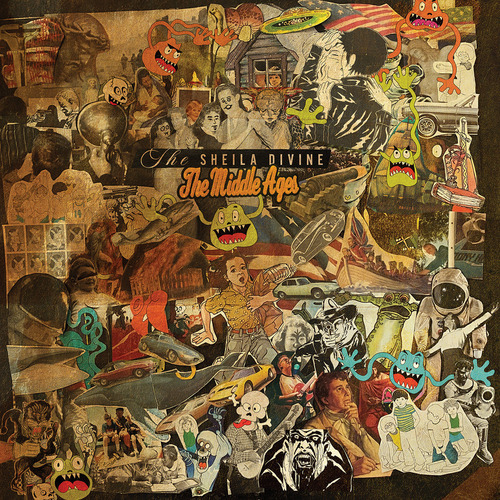
Any Easter eggs on the album cover? Anything that, if I look hard enough, I’ll find?
AARON: I was making a collage, and Liam, my son, drew a couple things in there, and then Jon Sulkow from Tugboat Annie drew stuff, I drew some stuff. There’s no crazy Easter eggs. I wanted it to look like skateboard art from the 80s. But there’s some definite photos from my childhood, like one of my dad. When my parents first got divorced, my dad took my brother and I to Disney World on credit cards, and that’s us on the Twenty Thousand Leagues Under the Sea ride.
You fly tonight?
AARON: I do, yep. Go to Paris for a day, and then we have our biggest show ever in Belgium as a headliner; not the biggest audience, but it’s a huge club. I’m excited.
This album is so good. I’ve listened to the whole thing like five times through. I interviewed someone who mentioned that Robin from Fleet Foxes once said that every album should have a throwaway song and he usually places it right in the middle so the next song pops even more. But there’s no throwaway songs on your new album.
AARON: 10 out of 10.
10 out of 10. Good luck with the flight, and good luck in Europe.
AARON: Alright, great chatting. Good to see you.