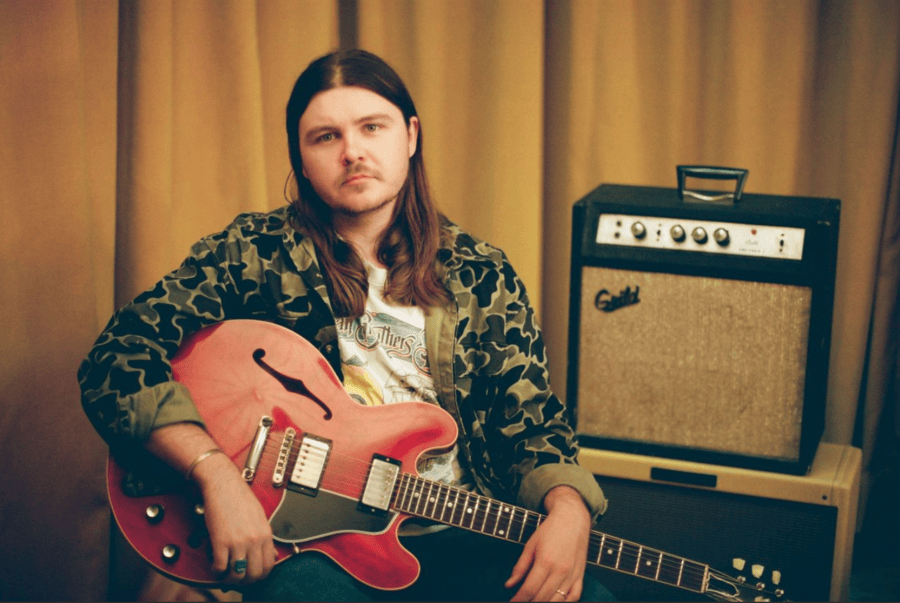
In the last year and a half, as Ben Chapman began contemplating the follow-up to 2024’s Downbeat, the Georgia-born, Tennessee-living songwriter’s life became fuller. After learning just a few days into 2025 that he was going to be a father, Chapman married his partner, both in life and in songwriting, Meg McCree and found a renewed sense of focus and inspiration, which he worked out across 12 slices of American music. Credit producer Dave Cobb for classifying Chapman’s sound that way, because while it might be easiest to slap a “country” label on it and call it a day, that wouldn’t quite be right.
With each successive release, Chapman’s now on full-length number four, he’s able to lean more into his own material than writing for others, and Feet on Fire’s blend of country, Southern rock, folk, blues and funk broadens not only the scope of his potential audience but the type of artists he can tour with. It’s also, as Chapman tells me, the album he’s been working toward without quite knowing it, one that finally matches the live experience. First-time concertgoers have long walked away surprised by the energy in the room, something the previous records never fully captured. Now they won’t have to take anyone’s word for it. That feel owes a lot to the artists who shaped him, The Allman Brothers, Grateful Dead, Pink Floyd, The Beatles, The Black Crowes, and at 28, Chapman wears those influences naturally rather than reverently, producing a record that sounds well-seasoned without being nostalgic for its own sake. Feet on Fire isn’t trendy or of the moment; it’s the kind of album you could throw on a decade from now and get the same thing out of it that you do today which, in 2026, feels like its own quiet accomplishment.
What’s it like trying to launch an album and hit the road when you’ve got a newborn at home?
BEN: Man, it’s a lot to juggle. At some points, a little bit of guilt creeps in, as far as, oh man, I’m gonna be gone for such and such days. But the way Nashville does a lot of touring, it’s a lot of weekend warrioring. I’m gone Thursday through Sunday, and then when I’m here Monday through Wednesday, I’m here at the house with the baby. It’s made me really have purpose on those 3 days, and really focus on spending as much time as possible with him and my wife, and just making it so much more worth it. Because I think if I was here 5 days a week, you’d be getting this kind of mundane thing of, oh, gotta go home and give the baby a bath. It just makes me enjoy every minute that I’m here. And then another way, like I said, the guilt creeps. But I think when he’s my age, he’ll look back and be like, wow, Dad was doing something really cool and chasing his dreams, and it inspires him to do the same thing.
Take me back to writing “Baby Blue.” What was that period like?
BEN: I’m sitting out on the porch where my wife and I wrote that song. It’s just about that time of finding out she was pregnant. We were not married at the time, and we’re thinking, “Oh shit, what are we gonna do? How are we gonna do this? How are we gonna juggle everything?” That song is about the excitement and, at the same time, the anxiety and the worry that comes with expecting something new and not knowing what the fuck is going on. It’s one of my most favorite songs I’ve ever written, just because of how truthful it is. There’s no hiding in that song.
Were the other songs on the album written after you found out you were going to be a dad?
BEN: I think about 5 or 6 were written before we found that news out, and then the rest of the record was kind of written in that time of angst and the waiting period. There’s a lot of reflection from that time period on this record. There’s quite a few songs that are about change, and about what’s to come, and what the hell is going on. And then there’s songs that are from past experiences, or just stories that you read in a newspaper and want to write about.
Did these major life events change you as a songwriter?
BEN: I think it made me a more focused songwriter and a more purposeful songwriter. My wife and I write for people in town, and that’s kind of our day job. I’m a full-time artist, but to make money and keep food on the table, we write songs for other artists. In that room, it’s made me more purposeful and more driven. In my own artist stuff, it hasn’t really changed that much, because I’ve always been obsessed with what I’m gonna cut next. But I would say that this record is kind of an ode to George, and it’s definitely influenced by him, for sure.
And in 20 years, when you look back at this album, you’ll remember it as the album that you made after finding out you were going to be a parent and then becoming one.
BEN: Yeah, this is the George record for sure. I’ve released 3 records, and this is gonna be the 4th one. I’ve been doing music since 13 or 14, but moved to Nashville when I was 21 and started releasing records right after I got up here. The first record took me about 2 years to write while I was in town, and then after that, it’s been a year apart. So professionally, there are a lot of air quotes in that, it’s been about 6 or 7 years.
Can you look back on all those records as timestamps? Do you go back and listen and say, “his is where I was in my headspace, this is where I was living, this is what I was doing every day”?
BEN: Totally. I heard, it was either Joni Mitchell, or James Taylor, or Jackson Browne, one of those artists said that’s what an album is supposed to be. It’s supposed to be just a timestamp of your life at that moment in time. And they totally are. Each record, I can almost tell you what I was doing pretty much every day during that time period, and I remember cutting every record like it was yesterday, just because there are such pivotal moments in my life. But this one is a different beast, just because there was so much going on at the time, and I think that’s sometimes the coolest time to make a record.
Side A has the three singles you’ve released so far. Side A, to me, feels like taking care of business. Side B feels like “now I’m letting loose, now it’s weekend time.”
BEN: A lot of people have said the same thing. I’ve been sending the record around, and everybody says Side A is, top to bottom, very buttoned up, every song has a purpose, every song tells a serious story. And then Side B is like, alright, this is more so our live show. When you come to see us live, we’re gonna rock your face off. Everybody sees us live and they’re like, that’s not what I was expecting, but they loved it. It’s kind of different from what the records sound like. My favorite bands never really sounded like they did on the records as they did live. I’m always trying to evolve old songs. We play a couple off the first record, and they’re completely different than how we cut them. As an artist, you just have to keep evolving, number one, to keep it from getting boring for you, and number two, to keep the fans interested. We don’t veer too far off, but we do keep it interesting.
I think about a band like Jimmy Eat World that started when they were in their early 20s and have been doing this for 30 years. I think it would be cool if they re-recorded their earliest stuff with the experience they’ve got under their belts. In 10 or 20 years, would you consider rerecording some of your early stuff to reflect what a more mature you sounds like?
BEN: Totally. I love it when bands do that. When I made my first record, I did not know what I was doing. I had A-class Nashville musicians, the hit makers, as far as musician-wise, they played on everybody’s record. It sounds good, and I’m happy with the product, but it’s not what I would do now. And that’s only been 5 or 6 years down the road. I would change a lot of things with that first record. So I can only imagine when I’m 45 or 50. I would love to go back and do something like that, and I think fans love that too. Or maybe even rewrite a couple. There’s a couple on there that I’m not happy with the writing, so just maybe go back and dissect a couple lyrics.
Have you had a chance to play these songs live and road test them?
BEN: We have. We haven’t played every one of them, but we’ve probably played 8 out of the 12. We play them pretty religiously on the road, they’re in every set. Everybody’s really digging them.
Are there songs that, even the first or second time you played them live, just felt completely natural, and are there songs you feel you’re still working out how they come together live?
BEN: Yeah, that’s a great question. There are certain songs, like “Feet on Fire,” we’re still trying to get a flow to it. It sounds cool, but we’re just trying to work other stuff out of it. And “Everything’s Different” is another one we’re still trying to get the feel right for, because it’s such a feel song. But then there are other songs, like “So Long” and “Lucy,” we’ve been playing those, and it just felt right right out of the gate. It felt like we’ve been playing those songs for 20 years. But yeah, there are some we’re still trying to get the vibe right on. They sound like the record, so we’re playing them pretty true to the record, but we like to do our own spin live, so we’re just trying to mold it how it should go.
It’s a great album from start to finish but I find myself returning to some of the later tracks like “Missing You” and “Don’t Give it All Away.”
BEN: I really appreciate that, because nobody has said those two. Out of all the interviews and podcasts I’ve been doing for the record release, no one has said those two, and those are some of my favorites. “Don’t Give It All Away” is just this huge song, not as far as a make-me-famous song, but I’m just talking about it’s one of my favorite songs in my catalog. It’s so fun to play, it’s so in your face. And that storyline, I completely made it up. I was reading a book and read a vague story about a guy falling in love with a sex worker, and I was like, man, that’d be a cool song. This guy is literally dropping off his girlfriend to go work in a strip club. I love that story, I love how real it is. Whoever gets it, gets it. Because that is somebody’s life, and it has to be so hard on them. I’m glad you said that, man, because that’s one of my favorites off the record.
And I feel like “Sweetheart” is a great way to close. It sounds like end of the night, last call. I’m assuming when you were putting the track list together, that was always going to be the closer?
BEN: Yeah. I try to make most track listings really intentional, and that one just, like you said, seemed like closure. It gave closure to the record and the story, almost. Sonically, it sounds like the credits in a movie. That’s kind of how I like to look at records. It’s not a concept record, it’s not really telling a cohesive story, but as songs, how they end up sonically, I feel like they tell a story, and to me, that’s just the credits song, the ending song.
As you were growing up, what format were you listening to music on?
BEN: When I was a teenager, I was listening to stuff in my car that I drove to high school. I was listening to CDs, because I’m 28, so I was at that weird turn of CDs being on their way out, everybody going to digital platforms, but Spotify still wasn’t a thing. Apple Music was kind of a thing, but iTunes was the thing. I bought all my music that I listened to in high school, which I still wish people did today. We would be a lot better off. I was also listening to a lot of iPod Nano and iPod Touch.
But when I was a kid, 6th grade, 7th grade, 8th grade, I was obsessed with music from around 1966 to 1978. I still think that’s the best music we’ll ever have. It was at the height of not perfect, but the best audio quality we’ll ever hear, and I think we’re just trying to replicate that now. Everything’s just too clear and too snappy and poppy now, not poppy as a genre, but at the actual recording. I was a vinyl head. I probably have a thousand vinyls, about 500 here and 500 at my home in Georgia. That’s my favorite way to listen to music, and I think that’s the way it’s intended to be listened to. Listening to a whole record. And that’s why it sucks when we’re on a single-based release plan nowadays. Everybody’s like, let me release a single six weeks at a time, and not have a record to follow. Or, I’m gonna put out this EP with 3 songs. That’s not a way to release music, or at least it sucks the life out of how music is supposed to be heard, the way I think it is.
I always try to listen to an album from start to end on the first listen. I was talking to Death from Above 1979 and they mentioned something I hadn’t thought of. They said that they can’t control how someone listens to their music and it’s entirely possible a kid may pull the vinyl out of the sleeve without looking and the very first thing they’ll hear is the first track on Side B. So, they’ve become very intentional about what song opens the second side. Are you intentional in that way?
BEN: Oh, totally. Now that vinyl’s making a comeback, I kind of felt that too. I knew there had to be a killer song to start off Side B or at least a vibey song that just grabbed you. I really didn’t pay attention to that on the last record, but now that vinyl is so back, and everybody’s wanting the color variant I was like, I should probably start paying attention to what starts Side B. I’ve always paid attention to the track listing and tried to make it almost cinematic.
I think I first heard about you when your last album, Downbeat, was released. It has a very ‘70s looking cover and that’s always going to catch my eye. And as I read more about you, I discovered Anderson East produced both Downbeat and this album. I’m a big fan of his and was excited to see his name in the credits.
BEN: Working with Anderson has been a dream come true, because just like you, I was a huge fan before we were friends. I was gonna go make Downbeat down in Texas, with a guy named Beau Bedford. I love his stuff, he does all the Paul Cauthen stuff. But Anderson was like, “Don’t go to Texas to make that, come over to my house.” And I didn’t know that was an option. I told him I’ll be there tomorrow. We set up a date, wrote a couple songs, and he’s been like my musical dad ever since. He’s such a great guy, and we love each other now. He’s like my brother. And he’s always very truthful. He always tells me when a song is shit and when it’s good. I trust him. He’s very good at bringing something out of you.
When you’re writing for other people, does it give you the opportunity to explore a different side of you that you would never pull into your own songs?
BEN: Totally. Not to be too much of a chameleon in the room, but I love getting into other headspaces and trying new things, trying new genres. Sometimes I fail miserably, but sometimes I’m like, man, I really love that, and that is not something I would do at all. I love doing what they’re thinking and trying to make it better, because that’s what people ultimately do for me when I’m bringing a song in that I can’t finish by myself, or that I just haven’t found a way to do the way I want to.
If I go to a record store, I imagine I’ll find your stuff in the “Country” section but I don’t know that I’d consider you a country artist. There’s a lot of different styles in your music. There are other bands like that that I’ve been listening to lately. Are you familiar with the Jack Wharff Band?
BEN: Yeah, I write with them a lot.
That’s amazing. I saw them live recently and was thinking that they probably wouldn’t draw well because I wasn’t familiar with their name. I wound up buying one of the last tickets before it sold out. It was packed, much to my amazement.
BEN: Yeah, dude, they’re blowing up right now. It’s really insane to see. They’re great guys, I know everybody in that band, and they’re all sweethearts who really love music. They’re just as blown away as we are. It’s great to see people who love music taking off. It’s really wild to see some of these young guns do it.
I also hear some Black Crowes in this album.
BEN: Yeah, man. They’re one of my other favorites, for sure.
That’s what I was thinking. That’s why I don’t feel right calling you a country artist, it’s more like a southern rock thing.
BEN: Yeah. I was talking to Dave Cobb the other day, and he said, “I think your music is American music.” And I was like, “That is the best thing I’ve ever heard.” It’s not Americana, that’s kind of the jaded country market. It’s just American music. It’s blues, it’s rock. Country, because I can’t sound not country because of my accent, so anything I sing is gonna sound country. But I’m just a rocker at heart, a classic rocker and southern rocker, and jam band, southern funk type shit. All of that makes sense.
Are there certain albums or artists that you sort of feel are part of your DNA? Things that have made you who you are?
BEN: Totally. Allman Brothers, Live at the Fillmore East. If you see our live show, you can tell it’s so influenced by that record. Grateful Dead Cornell ’77, that’s another staple. Guy Clark’s Old Number 1 as a songwriting record, it’s one of my favorite records of all time, and I try to write every song like Guy Clark. I try to stay true to the art of songwriting, and he is a great teacher of that. I will get shot for saying this, I know I will, but to me, Guy Clark is above John Prine. Hands down. Guy Clark was a genius. Not that John Prine wasn’t, he’s one of my favorites of all time as well, but Guy Clark was just so much more literal, and a little more linear. Everything had a storyline, and he stayed true to it. It wasn’t this tongue-in-cheek thing. It was more so, I’m gonna write a story and you’re gonna feel like you’re there. It was like, oh my god, it’s like reading a Hunter S. Thompson book. Insanely good. Guy Clark is one of my heroes.
So tell me about Peach Jam. It’s a yearly thing?
BEN: We do it quarterly, so four times a year. When we first started, it was once a month. That nearly killed us, because we were learning 5 songs at a time and having 5 or 6 guests come up. What it is, is it’s not necessarily a jam where you bring your instrument and get up with us not knowing what we’re gonna play. It’s a little more organized. It’s our band, our set, and then we have guests come up and do one of their songs, or a cool cover, and we’ll be the backing band for it. It started in 2021 at the Basement, a little venue here in town that holds about 150 people. The past 2 years, it’s moved to the Basement East, which holds around 500 people, and there are 300 or 400 people there every time. It’s just so cool to see how it’s grown.
It’s super community-driven. A lot of Nashville musicians come and just watch the show. It’s a place where I say, there’s no assholes allowed. You know how in Nashville, sometimes a show can have people on the back wall watching to make sure you mess up, so they can be like, huh, I wouldn’t do that. There’s none of that. It’s just the freedom of expression, the freedom of messing up. It’s really cool to see the community that’s built around it.
I’ve been closing every interview I’ve done in the last couple years with this question. Is there a song, artist or album that takes you back to something very specific from your past?
BEN: Yeah. There was this festival in Chattanooga, Tennessee, called Riverbend. Hank Jr. was playing one time, and my whole load of friends from high school were all rednecks, so we said, let’s go see Hank Jr. Somebody scored a bottle of Jack Daniels, and we all got sick as dogs off of it, because we did not know what we were doing. Every time I hear “Family Tradition,” and I think the other one was “Weatherman,” those were the two songs playing while everybody was throwing up behind the porta-potties at Riverbend. Anytime I hear those, it takes me back to that. It’s not a good memory to remember, but I cannot help but remember it.