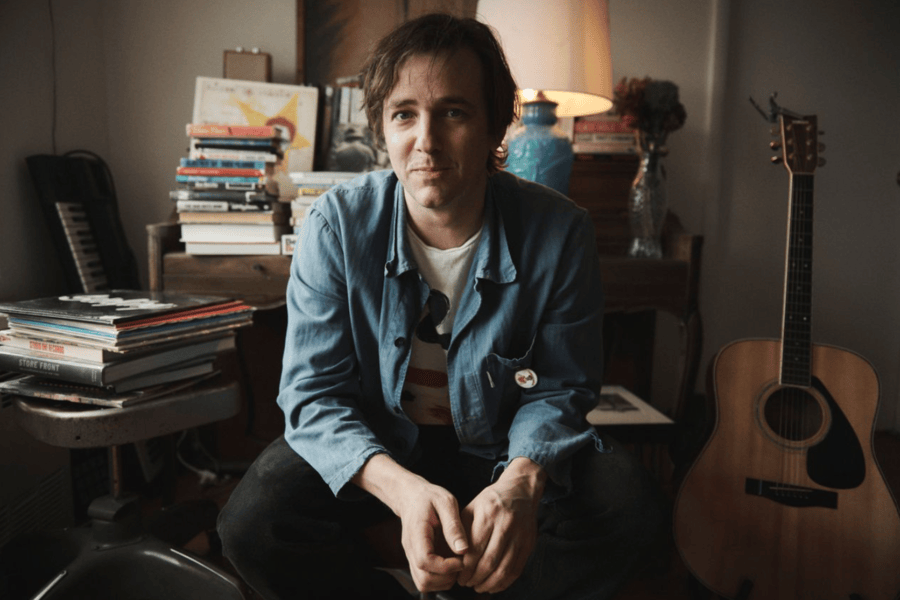
Photo by Kyle de Vre
Three years ago, Skaters frontman Michael Ian Cummings quietly dropped an EP under his own name, the first commercially released music since the band’s 2017 album Rock and Roll Bye Bye. The wild days of youth had given way to more mature sounds, and with life having moved on, Cummings was free from any label pressure. There are certainly advantages to having backing, but there’s a particular freedom in releasing music on your own terms. When I spoke with him in 2023, he told me he wasn’t shooting for the stars with some grand comeback scheme, he simply wanted to keep writing and recording.
This past February, Cummings released his first full-length solo album, Godzilla. His day job, or rather night job, is slinging beers at Victoria!, a NYC bar he co-owns, and the music exists entirely on his own terms. The album’s 11 tracks feel like a natural sequel to the 2023 EP Oldest Troubles, while also marking a clear step forward. Self-releasing again, Cummings harbors no illusions about a second shot at the big time, but he’s genuinely happy, and excited, that he gets to keep making music with friends.
As someone who works in the service industry, Cummings has a gift for conversation. Outside of our “formal” chat to discuss Godzilla, we spent plenty of time off the record talking baseball, AI, and plenty else besides.
I revisited the conversation we had a few years ago and I wanted to ask you the same question I asked you then to see if your answer has changed. Who did you make this record for? Was it for you? Was it for friends? Was it for the world?
MICHAEL: This record’s definitely still pretty introspective, but I did have more of a purpose. There was more of a through-line writing the record, and the reasons why I was making it were more clear to me than previously. The EP I put out a couple years ago was kind of just my dipping my toes back into releasing anything. This process was a little different, because I had the full intention of releasing a record at the end of the year. I was much more inspired by things going well with that EP on whatever micro level it was released on, and I had a really regimented writing process, where I just needed to have two songs that could make the record at the end of every month. I knew it was going to be heard, which probably changed things a little bit subconsciously, as well as consciously while working. It wasn’t just for myself. I think, in turn, you write a little differently. But nothing that I wouldn’t do for myself alone. I was really aware that I wanted there to be a very strong identity to the record, lyrically and sonically. Who each song is for is probably a little different song to song, but as a whole, the record felt like a work that was going to be released for everyone.
Do you identify as a musician who also co-owns a bar or do you identify as a bar owner who is also a musician?
MICHAEL: It’s super weird. There were moments where it would be just easier to say I’m a bartender, because that’s more accurate at that point, but it never felt good. The things I do for money aren’t really my main focus, and the thing I’m interested in is not really the thing people are looking for as an answer to “what do you do.” So I try not to get into many conversations where I have to answer that. But inevitably, yeah, I would have to say, well, I own a bar. It doesn’t represent what I’d like to say I am, which is a musician. But I really have no struggle with that identity. I’ve bartended throughout my whole life making music, even when we were on Warner Brothers. I took a break for a couple of years, but pretty much my whole life I’ve always poured beers, so it doesn’t seem super different. It’s just a lot harder to say I’m a musician when you’re not releasing music. That seems pretty ridiculous to say. So I’ve always kept the same relationship internally, if you’re not putting stuff out, it’s kind of hard to talk about your music.
Making a record that you wanted to put out for people to hear, does that change your identity now? Do you have plans to do shows? Is this a new springboard to what’s coming next?
MICHAEL: I really haven’t tried to think it through too much, but I’d like to start playing out more. I don’t have any plans to tour or anything, but I’m kind of just testing the waters. I’m getting cool response from the first week that it’s been out, some nice radio response, kind of surprising to me. That might dictate how much and what I do next. I’m trying to think of things differently now. I used to always be in a band where I had to get a bunch of people together to do a bunch of XYZ: to play this show, to go on this tour, to do this thing, and you need X amount of dollars. Now I’m just trying to think of ways I can play non-traditional shows just by myself and be comfortable doing that. Having a band is like having armor, you know? You have your best friends around you that can shield some of the attention and intention behind what you’re doing. With this, I’m kind of like, do I really want to play that show? And sometimes I’ll just be like, no. Do I really want to do TikTok content? No, I’m not gonna do that. In a lot of ways, it’s more fun because I’m thinking about what I want to do.
One of the things I’m most excited about is playing three songs at my friend’s art show in this gallery downtown, just alone in a weird, humongous white room with hundreds of thousands of dollars of art. That seems more interesting to me than playing a show at a venue in Bushwick that’s gonna charge me a fee out of my ticket sales to pay bartenders. Things have gotten kind of stale. It’s probably just me, and I know that young people probably won’t feel the same way, but I feel like the whole thing of, you played these venues, there are 8 venues you can play here. I’m kind of sick of being in the same room over and over.
I’m not dissing venues, I’ve played venues my whole life. I’m just saying, for someone who doesn’t want to just play a 45-minute slot, I’m trying to think of a different way for people to hear music and to perform in a way that’s exciting for me and more memorable for other people. That’s kind of where my head’s at.
You’re putting this out on your own, so you don’t have to worry about a release schedule, marketing, all this stuff, and it’s also right now only digital. How do you decide on a release date?
MICHAEL: It was so random. I talked to some friends who do PR, they said “you want to give it 4 to 6 weeks, or 8 weeks, you really want to ramp it up, put a single out, do this or that.” And I’m going, “man, I don’t really want to pick a single. I’m just not gonna do a single.” Okay, so what am I gonna do? Well, I’ll send it out to a lot of people. I got all these lists from my friends, put them all together, made this huge email list, and spent days emailing all these people who I had no illusion were gonna write me back but at least I said I did it. Then I picked a date: February 20th, just arbitrarily. The slowest 4 weeks of my life, just waiting for this totally random, arbitrary date. I didn’t even remember if you put records out on Fridays or Tuesdays, or if there’s a benefit to putting it out on a Friday, whether it would get more attention because other releases weren’t happening. I had no idea. I’m learning as I go along. I always had a label to do it for me.
When was the album finalized? Has it been done for a while, or did you basically finish it February 1st and say, alright, it’s ready, let’s go?
MICHAEL: No, because I’m doing everything myself and asking for favors, the last thing was always the artwork. I really wanted my friend Justin to do the artwork, and he wasn’t dragging his feet or anything, but when friends are doing you a favor, you kind of don’t put pressure or deadlines on people. That was my vibe, because I was asking favors from everyone who helped me work on this record. I’ll pay them back with money one day.
It was recorded in the summer. The session itself took 4 days. Everything’s live, everyone was in the room, it was one of the most fun records I’ve ever made. We only did about two to three takes of each song and then moved on, round-robined the whole thing. We actually finished recording in two and a half days. I did about a day and a half of vocals and a couple guitar overdubs, and that was it. Everything else was just a slow process of getting, you know, “When can Beatriz (Artola), who mixed it, when can she do it?” It didn’t feel like there was a need to rush it, so I just kind of chilled, made it organically, made choices, and if things weren’t right, I fixed them. Even the mastering, something I never would have given notes on, or known what kind of note to give, I had notes. It was nice to just be able to make decisions without a deadline and make the record I wanted to make without any compromise.
Technology is such that you can record a song today and have it online by this evening.
MICHAEL: I think that’s beautiful. I had my old manager put my EP up for me on DistroKid, or whatever it was. And then when I actually started using the platform to do this myself, I was nervous as shit that I put the wrong songs in the wrong order right up until it went live. I was shitting myself. People were like, “it comes out at midnight.” I’m like, “don’t do that to me.” But yeah, I realized there are all these tools now that can help people do exactly that and put things out really quickly that I didn’t even know existed. You can have something mix and master your record on DistroKid, pretty much.
Did the order in which you recorded songs match the final sequence?
MICHAEL: Not at all. One thing I’ve never really been good at is set lists or sequences. It’s just not my strength. Noah (Rubin), who I’ve played with my whole life, has always done every sequence of everything I’ve ever done, so I cannot take credit for the order or anything like that. My order that I put for this record was terrible when I look back at it now. It’s really bad, too heady. The way we recorded was almost based on vibe: the time of day, or what mood we were in. Like, if we ate too much pizza, had a big lunch, we’re gonna play an upbeat song. We need a pizza-take song. Or if we had a lot of coffee, vice versa. We just kept going through all the songs, a couple takes at a time, then listening back to see if we thought something was off once we stepped away from it. Having that space to come back and forth and beat the last take was something I’ve never stuck to. And the only reason we did that is not because of some grand philosophy behind recording, I literally didn’t have any money to do more than four days. I thought it was gonna take four days of tracking and I’d do vocals on my own or whatever, but it turned out the speediness of it just worked.
I’m glad you talked about the pizza take, because I listened to a podcast with Colin Hay from Men at Work, and he was talking about the difference of time of day when he sings. There are certain songs that in the morning sound better when his voice is just warming up, and then certain songs that need that edge later in the day. I’ve never thought about how different you might sound at different times of the day.
MICHAEL: Oh, so much. I always find there’s this magic zone. If you’re singing for 5 hours, which is a hell of a lot of singing, you’ll find a point where you’re in complete control of your voice. You can do all the soft stuff, and then there are cool points where you want to do a quieter song and your voice is kind of already gravelly. It’s cool to be able to know where you’re at in that, but it takes a lot of practice. For the most part, the first stuff is never the best stuff, at least for me.
Throughout my time, back in the late 90s and early 2000s, I started a couple different websites. One had a very consciously chosen name for the image I wanted to give off. The second came from a random nickname generator. I’m curious about the title of the album, Godzilla. Is there a purpose behind it, or is it just a word you threw out for the title?
MICHAEL: That’s an awesome way to put it, the website analogy, because it’s kind of more of a random word generator, but it also coincided with where I was at the time. I was in a Godzilla kick and trying to watch all the Godzilla movies. There are like 38 of them. Godzilla’s a representation, or a manifestation of all of humanity’s bad decisions, the monster that we have made with our poor choices. He feeds on nuclear waste, which we have created, and in turn comes back to haunt us in the form of this misunderstood monster that kind of just wants to be left alone. That was a bit of theorizing after the fact, for sure, but it just felt good. There’s something cool about that name, and mostly it was just a vibe. But I do like all the cuteness and destructiveness. There are so many things attached to that name and so much imagery. I thought it was a good title for that group of songs. It reminded me of when I was a kid, I used to go to Newbury Comics in Boston. Godzilla and rock music, it kind of all just fit in this 14-year-old’s bedroom poster world. It had that youthful, spending-your-allowance vibe.
I was looking at some interviews you had done years ago during Skaters’ time, and you had talked about having something like 70 songs written. Is this album stuff that you wrote specifically for this, or is this stuff you were pulling out of drawers, old snippets or old lyrics?
MICHAEL: I didn’t use any old anything. I did everything fresh, because that was the point of my exercise of getting back into the writing thing. Also, I’ve really had very little success in rehashing or reworking stuff. I’ve never been good at editing school papers, songs, or anything. I’m better off starting from scratch and trying to get one idea done well, and then move on and incrementally work my way through it. So even though that Skaters record did have 72 demos, which is a cool thing to say for an interview, you would never be able to make four Skaters records from those demos. They’re all over the place, there are country songs, there’s definitely not that many records in there. There was one record of that kind, and then there’s like 20 different bands you could make out of those songs. This was more about the thread I wanted to achieve between all the songs, and it had to be done with all new material.
Do you feel like this album is the best you’ve ever made, or is it on par with other things you’ve done? Do you think you’ve gotten better with lyrics, for instance?
MICHAEL: I definitely think I’ve gotten better. And I think even though this might not be the most mold-breaking thing I’ve done personally, and I don’t mean mold like the zeitgeist, I just mean personally, breaking out of my own shell, lyrically, 100%, it’s the strongest stuff I’ve ever written. Musically, it’s different than the Skaters stuff, but it’s more representational of where I am and how I feel now. In that way I think it’s the most honest record I’ve made, because there’s none of that band persona. I really have to just say what I mean, and it’s just me. Unlike a baseball player who has to work against their body breaking down, the thing about this stage of my musical career is that I don’t have to do anything. So whatever I do, I should be doing it because it’s the best thing I’ve made. I just won’t release the bad stuff, I throw away so much stuff. But there are people who get stuck, and it’s actually detrimental to be on a label where you have schedules like that.
Sometimes you know you’re not making your best stuff, but the tour schedule pays the bills. I have friends in bands like that, and I’ve never asked them flat out, “do you really think you’re making the best stuff you’ve ever made? Because I know the answer is no.” But what are they gonna do? They’re not gonna start bartending like me. If you’re a bartender, you got nothing to lose. I feel kind of lucky that I don’t have that pressure, because I can just make stuff I truly think is good. People have been asking, well, would you tour it if the record blows up? I’m like, yeah, I would tour it. It’s just a lifelong thing.
As a 20-year-old, you’re just making what’s fun with your friends, you’re hoping to get a record deal, you’re hoping to tour. When did you figure out where you are today? Or are you still figuring it out? Like, when you were 20, you never probably imagined that 20 years later you’d make a solo record that sounds the way this does. Was that ever a plan, like, get through this part of my career and then go off and try something different”?
MICHAEL: The real irony of this record is it sounds like a record I would have listened to when I was 20 years old, when Yankee Hotel Foxtrot came out, and all these amazing early-aughts indie folk records. Paul Westerberg put out Mono/Stereo, Granddaddy was making records, you had the tail end of Pavement going into the beginning of the Malkmus shit. This record is kind of more like those records than anything I’ve ever made in any of the bands I’ve been in. In a lot of ways it’s back to basics for me. I was not capable of making this record at 20, for sure. I had to do all that, get whatever out of my system, to make this record. I’m sure everything led me in this direction. But it couldn’t have been a master plan, because when I was 20 I thought I was gonna be the one band that recouped on their deal and took over the world, probably a millionaire or something. I don’t have that much foresight. I’m just kind of riding with what’s given to me, playing the hand that’s given to me.
This is a solo album with your name on it, but like you said, you had friends help you out. Tell me a little bit about the friends who helped you out. Was this all your stuff, and you walked in and said, “here’s my vision” or was it a collaborative process?
MICHAEL: It was kind of a little bit of both, a hybrid kind of vibe. Some songs, the earlier ones I demoed, had more of a fleshed-out idea of what they were going to become. And then some of the tracks on the record were written like a week before or the week of the recording. Those were just acoustic guitar and nothing else. Those I trusted more to the room, just getting in and letting people do what they thought, and if it didn’t work, we altered things. But really, the sound of this record is because those guys are who they are. I really cannot take credit for some grand vision when it comes to that, because it could have sounded a million different ways with different people. As well as the studio and the guy, Lucas (Carpenter), who recorded it, huge parts of the sound. I literally didn’t do any of that. I just showed up with songs. Everyone else, a lot of the leads, most of the leads, are all just Oliver (O’Haver), who I had only met maybe a couple months before the recording. He’s just so good, you just let him do what he does. It makes things so much better when you just trust people and let them come up with something you wouldn’t be able to come up with.
Is there any song, because of the other people’s participation, that when you heard it you were like, this is not what I imagined, but this is amazing?
MICHAEL: Yeah, there are two really standout ones. “The Way You Say Goodbye,” which I think is the third or fourth track. James (Hurst) came up with something. It was really kind of a quiet, chugging kind of song, and Noah wanted to speed it up, and the band and James came up with some rhythm that changed the whole entire feel of the song completely. It wasn’t a downer song anymore, it sounded hopeful. The whole song changed.
And then Oliver’s guitar part and Noah’s intro on the cover, the Slickers cover, “Johnny Too Bad,” was a mind-blowing happy accident. We needed something for this song, we can’t just go 1, 2, 3, 4. So we kept doing that throughout the whole record, and on this one, Noah just had this big drum next to him and started doing this thing, and Oliver played guitar, and we’re like, “wow, that sounds like Pink Floyd or something. I don’t know if it fits on the record, but it felt really good.” That was a big one where the band really stole the show, for sure.
We could go through every single song, but you actually just mentioned two of them, “The Way You Say Goodbye” and “Johnny Too Bad.” The other two I wanted to get your take on are “Going Out” and “Clayton Song.” I didn’t know that “Johnny Too Bad” is a cover?
MICHAEL: Yeah, it’s a Slickers song. It was in The Harder They Come movie with Jimmy Cliff. It was an interesting cover because I recognized that the chord changes were the same as this song by Mazzy Star, “Look on Down from The Bridge.” I was like, man, I really want to do this song, but I also kind of wanted it to sound like Spiritualized or something. I just heard it in my head, and everyone’s like, “this is weird, why do you want to do that?” I’m like, “trust me, it’s gonna be cool.” And they went along with it, and it was cool to see that they got it.
“Clayton Song,” that was a friend of mine that passed away. Real shame. He was a big Skaters fan, and I met him through the band. He was friends with a lot of our photographer buddies. That was just a shock and a bummer this year. I wrote that song for Clayton.
“Going Out,” that song’s about Noah, the drummer. He’s my best friend, I’ve known him my whole entire life. When we met each other, we didn’t really like each other, but now he’s kind of like family. It just has a universal kind of quiet comfort in having a best friend.
I’m not saying it sounds just like it, but “Going Out” reminds me of “Learning to Fly” by Tom Petty.
MICHAEL: That was intentional. It was actually not intentional that it was supposed to be a Tom Petty vibe, but the gang vocal, the call-and-response thing, was 100% a nod to Tom Petty. Maybe it’s “Ventura Boulevard” off “Free Falling.” That is a Tom Petty move, and I love Tom Petty a lot.
And “The Way You Say Goodbye?”
MICHAEL: A couple of my friends play in the Vaccines, and we did a songwriting challenge where we had to write 4 songs between 11am and 6pm, just one day. That was one of the songs from that challenge. So it was written in about an hour. I think it’s one of my top two favorite songs on the record.
With the EP and with this record, this feels to me like you’re in your “I’ve settled down” period. Is there still that raging 20-year-old punk in you that’s like, give me the right situation, I’m gonna go out and rage on stage and rage in this music? Or do you feel like, maturity-wise or age-wise, you have sort of settled down?
MICHAEL: I think I’ve calmed down a little bit. I don’t think I’ve settled down. There’s nothing in my life that could point to me having settled down. I live a pretty unstable existence. But I don’t have that feeling of wanting to go out and get in a van and drive 90 miles an hour for 2 months anymore. I’m finding a place where music fits into my energy level and vibe, and it’s much more about thinking than it is about going out and playing lots of shows. That’s how I used to address music: you make a record, hit the road, go, go, go, go. The fruits of that are questionable. You can do the labor, for sure there’s always a venue that’s gonna tell you you should come play, and a booking agent who will want to take a cut of your tour. I’m happy. If that’s settling down, then I’m glad I settled down. I would like to tour. If I could tour in a different way, I would do it in a heartbeat. But it would be very different than those old tours.
I’ve watched some documentaries over time, and watching the 70s New York scene always sort of blows my mind. Debbie Harry and Joey Ramone and David Byrne are all hanging out at clubs, just kids, and nobody realizes they’re gonna someday become Blondie and the Ramones and the Talking Heads. I watched an interview that you and Ryan did from the bar, and one of you mentioned building this community. Do you have regulars, and do you feel like in 10 or 20 or 30 years there might be a documentary where people will recognize the names and faces of people who are your regulars?
MICHAEL: Oh, totally. People getting really famous or big, it’s happened so many times in my life with people that used to hang out. There are always those people. Lady Gaga used to drink on Rivington Street. She was just this guy’s girlfriend that was around. Those people exist all the time. Even that band Geese, Cameron would DJ the bar sometimes. Who knows who’s going to sustain anything, but it’s all creative people. I have no doubt there are tons of relationships like that being created without my knowing, that I’m adjacent to.
As long as I can have a space where people can meet other creative people, the thing that makes me happiest when I’m at Victoria! is seeing a band having a band meeting. A bunch of 23-year-old kids, and they’re there, and their manager shows up, and they’re all just figuring it out. It really reminds me of myself and the shit we used to do. When bands show up and they have guitars, they just came from rehearsal or a show, they have band meetings, I just love that. I feel like we own that place for them. They have a place to come and chill and listen to good music.
Is there a song that takes you back to a very specific time in your life every time you hear it?
MICHAEL: Do you remember, before there were music videos, there used to be these VHS tapes they would sell that had music videos, footage placed to music of bands, before MTV existed? There was this song, “Our House” by Crosby, Stills, Nash and Young. “Our house is very, very fine house, two cats in the yard.” It kind of feels like a cheesy McCartney kind of thing. There’s a fake family by a fireplace, totally actors. And I remember sitting on my parents’ bed with the VHS player playing that song over and over. You never really hear that song too much, so when it does come on it’s super, super powerful. I’m just transported back to being this little kid under a blanket on my parents’ bed. It’s a wild one for me.