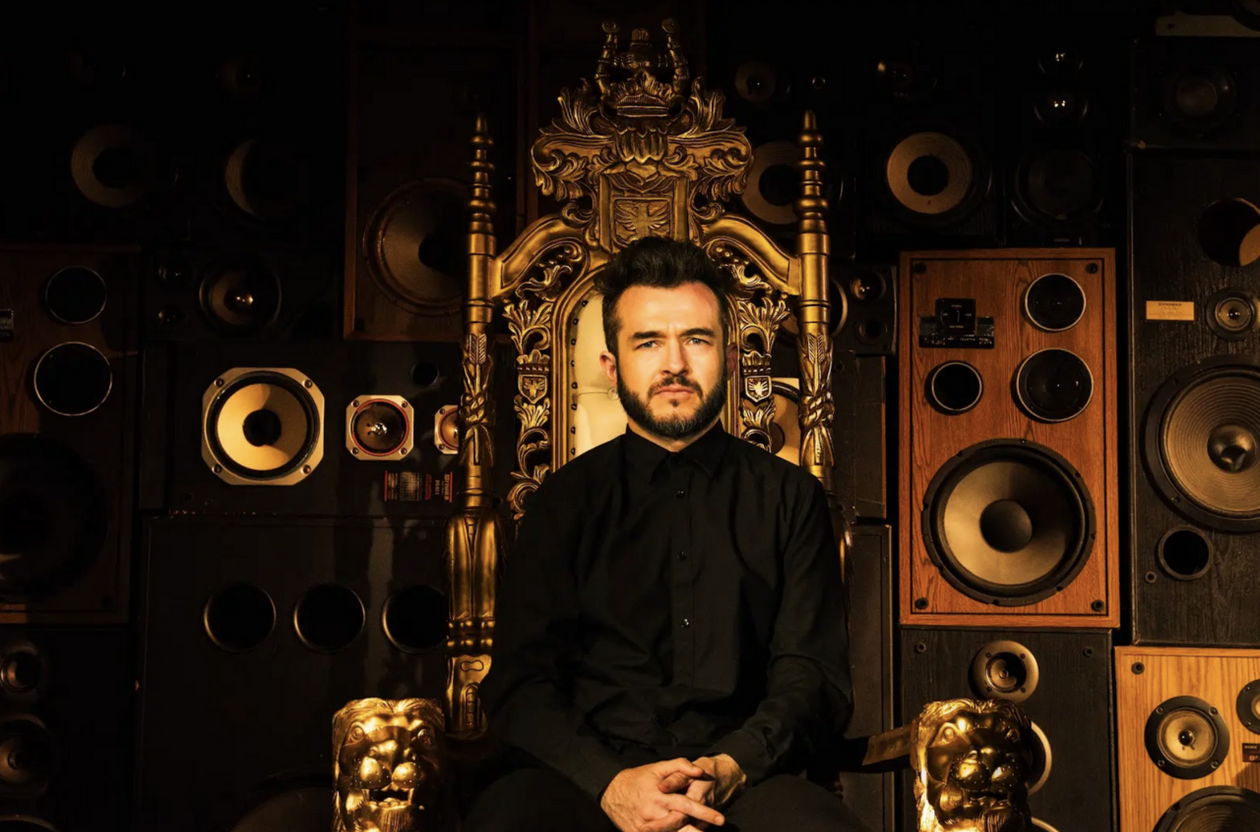
Photo by Milana Burdette
There was a period in the late ’90s and early ’00s when artists raised on industrial pioneers like Ministry, Skinny Puppy and Nine Inch Nails started dragging that sound through trip-hop, jungle, and heavy sampling, and what came out was otherworldly. THIEF’s new album, Sermons from the Pit, lives in that same neighborhood, what Dylan Neal calls “Dungeon Pop,” with echoes of the previously mentioned artists as well as Portishead, Tool and a little Massive Attack. It’s dark, thumping, and best listened to while cruising a city’s underbelly at 3 AM. Neal’s black metal past is in there somewhere too, more in the mood than the sound.
For music this cold and sinister, I went into the conversation with a certain guy in mind: the brooding type lurking at the back of an underground club, avoiding eye contact and radiating menace from the shadows. Instead, I got Neal, a down-to-earth, genuinely normal guy, the kind of person you could easily imagine grabbing a cup of coffee with. He couldn’t be further from the THIEF persona, which makes the darkness on the album that much more interesting. We talked about how the man and the music fit together, along with the record, his roots, and what’s next.
How do you envision this album as a whole in your head? Some artists see colors, others treat music like math equations or filmmaking.
DYLAN: Definitely not as math, I’m not good at math. Whether in the writing process or reflecting on music I’ve already made, it’s all feeling-based and mood. I’m not a very visual person; that’s just not how my mind works. I guess you’d call me a Cancer, it’s all feelings and mood-based.
When I look at this album, it does seem aesthetically black and white, like the album cover. Specific moods come up: menacing, some antagonism, some ennui. It’s feelings that come up in my body more than anything.
Where do the lyrics fit into that? When you’re writing, does the mood dictate the words?
DYLAN: Lyrics are important, though they’re always secondary in my listening experience. I don’t know if that’s because I’m so feeling-based, or because I grew up listening to a lot of metal where you’re not gonna understand what they’re saying. With a good song and a good singer, you don’t have to understand what they’re saying to get the vibe and the feeling, unless it’s some sort of irony they’re doing.
For me, the goal is: I’ve got this skeleton of a song, and the mood’s there. Okay, how do the lyrics then enhance this feeling? The song dictates how I write the lyrics. Obviously, an angry song’s gonna probably have more acidic lyrics. There is humor in the album, too. In “Sun Slasher,” there’s the line, “There’s someone for everyone; even Ted Bundy had his favorite squeeze,” though I think the tone of what’s being communicated is pretty obvious.
Do you consider THIEF a character or do you consider THIEF to be a representation of you? I have to say, having this conversation with you, the type of music you create doesn’t match your real-life personality.
DYLAN: Yeah, I get that a lot. It feels very me; it’s just parts of me blown up to extremes. David Lynch seems like a country boy when you hear him talk. He’s just like, “Gee golly,” and then you watch Blue Velvet and you’re like, “What the fuck?”
I think it’s just taking parts of you that you find interesting, difficult, or inspiring, and magnifying them. It’s kind of like a hammed-up version of a trickster archetype, or a magician. I’ve always been really interested in the left-hand path of spiritual practices, and I think there’s some leaning into that and taking it too far intentionally, taking these religious concepts to the extremes. There’s a bit of transgressiveness in there that I find inspiring.
Everything surrounding THIEF—the album art, the blown-out videos, even the font—feels very deliberate. How did you approach the visual side of this record?
DYLAN: It’s something I’ve had to work on a lot, and I really doubled down for this release. My live bassist was telling me how he uses what I’ll just call a mood board: all decisions, aesthetically and visually, have to fall within these parameters. It has to make sense, the branding.
For this album, I did all the music videos, and I was sort of along on the sidelines for the album cover. I just had to really dial in that focus that everything has to fall into these parameters. That helped a lot, because I’ll see a cool painting, music video, or special effect, and I’m like, “I wanna do that,” even when it’s way off. I have to rein myself in, and having those parameters helps do that.
You once described THIEF as “night music for haunted ballrooms and electric churches.” Does that phrase still hold up for you?
DYLAN: That’s old, I think I made that for the first album. I think that’s why it stuck: it gives you a feeling. A haunted ballroom has a feel to it; electric churches have a feel to it.
Tell me about how the album opens. The very first thing we hear is a spoken-word sample. Was that the seed for the opening track?
DYLAN: No, that was one of the very last things done for the album. The song had been done for a while, though I always like a bit of an opener, and I didn’t have one on the last two albums.
A while ago on social media, I posted this rant about rabies, and people really took it and ran with it. Three or four years ago, I became obsessed with rabies, it became my special interest. I know everything about rabies; I follow rabies news and outbreaks. I don’t know why. I talked about it in a funny way, and I had seen that movie I Drink Your Blood, an old, awful horror film, which is also used in a Mortician song, though much longer.
This first track is pretty rabid lyrically, really acidic and biting, and I remembered that I described the song in the art book as a rabid priest who lost his mind giving a sermon. I thought, “Oh, this is a great way to tie it all together.” The album’s pretty dark, so I like to take opportunities to not be too serious and to have some self-awareness or humor. The second I put it in there, I was like, “Oh, that’s so hard.”
Which track was written first, and how did it set the sonic direction for the rest of the record?
DYLAN: I’m pretty sure it’s “Mirror Mirror.” I might have had bits and pieces of other things, but that was the first song done, and that really helped focus most of the album. The production technique on that relied on what I call “cathedral clipping.”
I saw “cathedral clipping” mentioned in your bio. What does that actually involve?
DYLAN: You take any sound source, a synth, a sample, or whatever, and add some sort of reverb. Depending on the sound you want, I used a lot of short reverb so the sound decays. Then, without even using actual distortion, you turn up the gain 300, 400, 500 percent, which you have to cheat your way to do, because gain knobs only go to 100 percent, so you stack more gain modules. You get this really wild, blown-out sound, and you have to be very precious with it because it can easily turn into white noise. You want the sound to be there and usually kind of short. Because that reverb starts decaying into that really overblown signal chain, it creates all of these artifacts. When you’re doing it with something like chant music, it just sounds so crazy.
On “Mirror Mirror,” you can hear that done with the synth, and across the whole song there’s a loop of a woman singing a Sumerian song. It just sounds different and otherworldly. “Sermons from the Pit” has a lot of that, too. I’ll play for 20 minutes with the sound and record stuff, then go back in and chop something out and place it, or try to recreate it.
There are no credits listed on the album. How much of this record is live instrumentation versus computer-based or sampled elements?
DYLAN: There are no album credits because it’s all me. It’s probably 50-50. Fifty percent is bass guitar, guitar, and actual hardware synths. The other half is the choral samples and electronic elements. Usually when I program drums, it’s in the box, done with the computer and then, of course, singing. Fifty-fifty feels about right for this album. This album had a lot more guitar and outboard gear.
When you’re writing and recording, do you listen on multiple different setups, like computer speakers, your car, just to see how it translates?
DYLAN: The two main sources I use are my mixing monitors, of course, and then my car. I’m just so familiar with both of those speakers because that’s mostly what I use. The mixing monitors are surgical; that’s how I want the album to sound everywhere. My car, I know how so many albums sound on it from driving and listening to music, so it can really show me things that are maybe gonna poke out or aren’t translating well, maybe because of the way my room is acoustically treated or something I just missed. I’ll mix a song, go listen to that mix in the car, come back and tweak, and bounce back and forth. Later is when I’ll check it out in AirPods or open-back headphones. And then hopefully, with a good mastering engineer, anything you miss, they clean up.
Speaking of car music, do you listen to streaming music, or do you still have a CD player?
DYLAN: I have an iPod. So it’s CDs, vinyl, and Bandcamp, and then I’ll put it all on my iPod. I don’t use Spotify because it’s playlist- and shuffle-based. Sure, there’s a time for that, but I’ll shuffle on my iPod and get maybe four songs in before I hear a track and think, “I gotta go hear that album,” and then I’ll listen to the whole album. Also, Spotify is not nice for the world or musicians, so I have that moral high ground.
For me, when I had a car with a CD player, I always kept Tom Petty’s Greatest Hits in my car as a reliable driving record. Did you have a car CD that was always in your car that you never took out?
DYLAN: I always had a CD book, which, oh my god, one time I had to take my mom to the airport, put the CD book on top of my car while helping her load up, forgot, drove off, and never found it again. So I don’t know about one CD, although I had Swans’ Soundtracks for the Blind, the second disc of that double CD, in my car probably for three years. So I guess that’s the one I’ll go with.
If you don’t use Spotify, I’m not sure if you’re cognizant of what came out in 2026 or if you consume music without a date stamp, but is there anything from 2026 that you’re really hyped about and keep returning to?
DYLAN: It’s true, I am very bad at keeping up with new music, I’m often going backwards. New music-wise this year, I really like the new album by Demon Bitch. They’re like speed metal, kind of a thrashier Mercyful Fate. It’s not for everyone, it’s very over-the-top, the vocals are wild, but I think it’s so fun. What else got released this year? I’m so bad at this. Did Burial release this year? Whether it came out this year or last year, the last Burial release is fantastic. That’s all I can think of.
Did you record the entire album at home?
DYLAN: Everything here in my small little studio apartment in Koreatown. Although I did probably 30-ish percent of the vocals here. As I get older, it’s just more difficult for me to sing loudly knowing about neighbors. I care more than I did when I was 25. So this time, I rented a room at a recording studio for about two weeks, where I could scream to my heart’s content at 2 a.m.
Do your neighbors know you’re a musician?
DYLAN: Yeah, they definitely know, and they’re cool with it. The guy below me is the only one that really cares. Usually around 9 or 10 p.m., he’ll text me, “Hey, would you mind putting on headphones?” Luckily, I only share two walls, and the person to the right of me does not care at all. I’m also very close to my neighbors in a communal sense; I know them all pretty well. Otherwise, besides wearing a Bonsai shirt, I’m pretty normal-looking. I have no tattoos.
How did you make it with no tattoos? I’ve got tattoos, come on!
DYLAN: I don’t know. There was one point in my life when I thought I wanted a tattoo, around 22, and then I decided not to do it. That’s my favorite saying: “I’m not gonna put a bumper sticker on a Porsche.”
I also hate needles, and I just never really understood what my relationship to tattoos was. I asked myself: Am I getting it because I want to be ostentatious? Because if that’s the case, I don’t want it. Am I getting it because it means something important to me? I don’t really need it. Am I getting it just aesthetically because it looks cool? That’s maybe too vain for my taste. I’ve never had a good idea for a tattoo.
I lied. Two years ago, I thought about getting a whip or a ball and chain tattooed on the side of my head, so that way I could show it or not show it. Then I realized, “No, I’m not into BDSM, which is what it’s probably gonna look like.” I just liked the imagery, and I figured I’ve come this far, I might as well keep it going.
You’re based in LA. Do you consider this an LA record?
DYLAN: Only one track: “Sun Slasher,” because I specifically mention Koreatown in it. That particular lyric came from a daydream where I saw myself hanging from a light pole, or it was more like a traffic light, in Koreatown. It was strange. I don’t remember why, but there were just no cars. It was dead empty, strangely. I was just in my car at a stoplight, daydreaming. Only that track has it. I don’t feel like my music has a particular locality feel to it, as maybe black metal or sludge metal might.
Beyond the singles, what are the deep cuts on this album that you hope listeners gravitate toward?
DYLAN: I really like the title track, which might be a little too obvious, and the second-to-last track, “Anaphora.” It’s not a catchy song or a single, but I think the mood and the way it turned ou. I’m really happy with that.
And “Sermons from the Pit,” the title track, is also not verse-chorus-bridge like the singles might be, and I really like the way that came out. The lyrics, the tonality, and the production are so wild on that song that I hope people like it as much as I do.
The expanded physical edition includes bonus tracks and an art book. Are those bonus songs leftovers from the sessions, and how does the book tie into the album?
DYLAN: They’re songs that didn’t fit, leftovers. I won’t say throwaways, because every time I write, I write way too much. For this album, I had 30 or 31 songs. I think there are nine bonus tracks on there. They’re side quests. There are some tracks that sound so far off, because what happens to me is I’ll come up with an idea, think, “Oh, this is really cool, though it’s definitely not THIEF,” and then I can’t stop thinking about it until I spend two days finishing it. So there are a couple tracks like that, a couple tracks that almost made it, and a few experiments documenting strange audio stuff.
The label does physical media really well, so it’s a 48-page art book with the CD, the bonus CD, all the lyrics, and track commentary for each song. There’s a bunch of art in it, too. When the album was done, I made a schema for the record where each song has a voice, a color, and a technique. For example, the voice might be Prophet, the color might be white, and the technique might be sword, poison, ligature, or teeth. Every track has a drawing by the cover artist of that technique: a bottle of poison, a gun, a sword. It’s pretty cool.
You come from a metal background. What were the foundational albums that shaped your taste early on?
DYLAN: I would say there are two episodes of that. First, when I was younger, probably fourth grade, maybe even younger, my mom gave me a Björk CD, a Radiohead CD, and a Weezer CD. She saw that I liked them whenever they came on the radio or in the car, so she was sort of like, “Here, just take these.” Those really got me into music, and I’ll thank her forever for that.
Then the first albums I bought of my own volition, I remember a Rage Against the Machine CD. A little later, around eighth grade, I bought Death’s The Sound of Perseverance, Opeth’s first album, Orchid, and Decapitated’s Nihility. I had met my friend’s older sister’s boyfriend, who was super into metal, and right away he was like, “You’re a poser if you don’t listen to this.” I was like, “Okay, sure,” and then I realized, “Wait, this is so good.” From there, I dove headfirst into that world and eventually played in a black metal band called Botanist.
What part of your daily life isn’t reflected in the music at all?
DYLAN: I had a day job for 12 years, and last year I lost it, so it kinda aligned perfectly with finishing the album. I worked in tech. I basically would try to break things. It’s a very heady job and very detail-oriented, which is not me, though I can do it.
My days now are pretty simple: I get up, I usually meditate, work on the album release, and then at night, maybe I’ll see friends, play video games, read, or do something music-related, and that’s that.
Do you have any release-day rituals, or does finishing the record feel more like handing it off to the next phase?
DYLAN: Besides posting, the night before I usually just try to get very, very quiet and centered, because it’s a big letting go. It’s done. Unless you’re Kanye West, there’s no taking it back and changing it. Of course, there’s anticipation and some fear, too: Are people gonna like it? Do I like it? How do I feel now about it? Usually that night is just processing or integrating the whole experience. Then the next day, it’s just like, “Okay, that’s done, move on.” It’ll be old news very soon, and it’s onto what’s next.
At the same time, it’s the start of what was months of preparation: making content, working with PR, announcing the tour and the album release show. Once the album’s done, it’s, “Fucking alright, time to go on tour,” time to do the things that are going to help nourish the album’s development in the world.
What does your touring setup look like right now?
DYLAN: We usually don’t go out for more than a week or two. This upcoming tour is 12 days. We actually start in Canada and make our way down the coast. We’ve done longer ones; we did three weeks back in 2019 from LA to New York.
Now I try to split it up into small chunks. One, because I used to have a job, and my drummer has a job, so it’s harder to take those bigger blocks of time, although I would. Two, I don’t have a US booker, so I can only really manage 10 to 12 shows at a time. Last night I was looking at the email threads for this upcoming tour, and it’s well over 300 emails of just back and forth. Booking a tour is a full-time job, so it’s just about what I can manage.
Looking ahead a year to November 2027, what would make this album cycle a success for you?
DYLAN: Success is so relative to what you make of it. I’ll first give the annoying answer, which is: the album’s released, I’m happy, I’ve succeeded, I’ve made it.
I’ll give you the real answer: the album did great, I haven’t had to get another job, I’m getting more tour opportunities, and people really, really love it. Streaming numbers are important in the industry world, labels and bookers look at your Spotify monthlies, but whatever. It’s really more about how many people are buying the album, how many people are messaging saying they like it, am I seeing it grow, and am I feeling a bigger connection with the world? That’s the big one: is it reaching people?
Finally, is there a specific song or album that acts like a time machine for you, instantly transporting you back to a moment in your life?
DYLAN: Oh my god, yeah, there’s quite a few. I always make it a habit not to listen to my favorite albums with new romantic partners, because I have had albums ruined for years.
Tool’s Undertow is one of my favorite albums, and the song “Bottom” was super hard to listen to for a long time because I was just in the trenches when I was younger, going through stuff. I listened to that song all the time, and it really helped as a healthy mirror for the angst, anger, and fear I was feeling. Later, “The Patient” off Lateralus. I was in this really toxic, codependent relationship in my early 20s that really tanked my mental health, and I listened to that song all the time. Even though she and I are actually cool now and Instagram friends, it still brings up a little bit of that. And A Perfect Circle’s “3 Libras” makes me think of young, painful, unrequited love or being betrayed. That’s the stuff that really stabs me.
One more: the band Isis has a song off Panopticon called “Altered Course,” which, strangely, features Justin Chancellor from Tool, so there’s a thread there. Long story short, I almost died hiking on a glacier alone like an idiot in Norway. I was lost for a long time, and when I finally got back to the little mountain cabin I was staying at, I ate some teriyaki salmon, that song came on, and I was looking out onto the mountains under the midnight sun. I was so happy, grateful, and thankful to be alive. I can’t listen to that song anymore because I don’t want to change that memory. I may have listened to it twice since 2007. It’s crystallized, that was such a special moment in my life.