
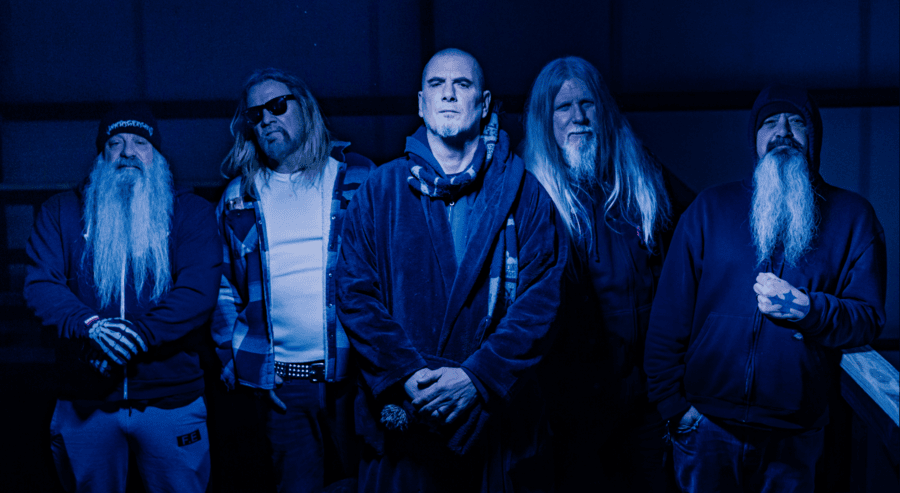
Photo by Danin Drahos
It doesn’t happen often, so when Down puts out a new record, it’s time to take notice. Comprised of Phil Anselmo (Pantera), Pepper Keenan (Corrosion of Conformity), Kirk Windstein (Crowbar), Pat Bruders (Crowbar), and Jimmy Bower (Eyehategod), the NOLA sludge and stoner-metal supergroup has just released its first full-length since 2007’s Down III: Over the Under. The result, Down: Volume V, is a wide-ranging LP that channels the members’ other projects alongside classic metal, Southern rock, and the swampy environment in which it was made.
Bower, who plays drums in Down, checked in from Nottingham, England just a few hours before hitting the stage on guitar with Eyehategod. We talked about how the new album came together after a 19-year gap, the enduring brotherhood of the band, and why releasing music on vinyl still matters.
Volume V is DOWN’s first full-length album in nearly two decades. Where did it start?
JIMMY: First off, we got Kirk back in the band, so that was a big deal. We did a couple of shows, and it started out that we were going to write the third EP. We got in the room, and we got about four or five songs. Then we headed to Phil’s, and he had four or five songs written. Next thing we knew, we had an album’s worth of kick-ass material, and we said, “Let’s just do a full-length.” Considering how long it’s been, it seemed more appropriate.
A band with your history doesn’t have to put out a full-length. You could have just dropped a song.
JIMMY: That ain’t our style.
Were the earlier EPs always meant to be EPs, or was it a matter of how many songs you had and the timing?
JIMMY: We got in the room and wrote with the notion of doing an EP. With those two EPs, it actually didn’t even start out to be an EP; it started out to be a cover EP. We were emailing back and forth, going over what songs we thought we should do, and that’s how you got the whole Dr. John song that was released. But once we got together and really got in the room, it was pretty obvious we were going to do a full LP.
You’ve been together, on and off, for about 35 years. Is the way you write and record today different? Have you found new ways of doing it, or is it still just getting together with buddies and hammering stuff out?
JIMMY: Obviously, each of us will write riffs. I’ll write riffs and think, “Oh, that’d be great for Eyehategod,” or “This would be a good Down riff.” But when we get in the room, it’s just the first dude who picks up his guitar and starts playing a riff. I’m just used to it. It’s easy for a band like Down especially, because the chemistry between us is really good. It makes it really easy, and it makes it really fun, too. You’re not anxious or nervous about doing it.
When you get together, do you still get goosebump moments, where somebody brings in a riff that surprises you and gets you excited?
JIMMY: Absolutely, absolutely. Happens every time, man. I’ve always said Down’s the biggest opportunity I’ve ever had in my life, and I don’t take it lightly at all. If you don’t get nervous anymore, then you’re not really in it. I get nervous out of respect for all the people I play with. I don’t want to let them down. They’re like, “Throw that power on it,” and as cheesy as that sounds, that puts a lot on my shoulders.
At some point, a lot of bands stop writing for the label or the market and start writing for themselves. Is the new Down record for the fans, or is it really just for you guys?
JIMMY: That was for us, dude. Absolutely for us. If we don’t satisfy ourselves, then we’re letting ourselves down. Everybody in the band is super stoked on this release, because I think it really captures Down. You can hear it. I was just playing some kids a song down in the courtyard, and they were like, “Yep, that’s Down.” It’s exciting, man, to have it come out. But I think a band should be happy with what they’re doing first, because if not, I think people can tell. If it’s fake, in our genre of music, people aren’t stupid.
Which song were you playing for them?
JIMMY: “They Walk the Night.” I think there’s something about it. Phil’s always like, “Really?” I’m like, “Yeah, dude, I think it’s my favorite one.” Sounds like old Trouble.
“Blood Oath” is the single, but “They Came From Dust” and “Twice-Told Tales” are the ones that really stuck out to me.
JIMMY: Oh, yes. What’s cool about this record is that it’s kind of like Down II. It’s got a nice, different variety. There’s mellow stuff, there’s heavy, heavy stuff, then there’s Robin Trower-ish kind of stuff. I think we succeeded a lot in that aspect, as far as having variety. I think it’s important for a band like Down.
Down II is my favorite, too. Do you have favorites in the catalog, or does it all feel like just DOWN music?
JIMMY: NOLA was such a big deal when we were doing it. I was just such a young guy, and I knew it was going to be listened to by a lot of people, a lot of my peers. So, obviously, the NOLA record. But Down II is probably my favorite. It was just a cool time and a cool record. I love Down III, dude; I just don’t know if I could play that stuff. I was really, really on top of my playing when we did Down III. But I would have to say Down II is my favorite. I like all of them, though.
I grew up on records where the last three or four songs felt like filler, because you had to fill 72 minutes on a CD. Volume V is long, but it’s really good start to finish.
JIMMY: Thank you. That’s not our style to write filler, man. Definitely not our style.
When I saw you in September at Bogart’s in Cincinnati, there was a line stretched all the way around the block. I don’t go there often, so that was great to see.
JIMMY: Yeah, we were talking about that backstage. Phil was talking about how Pantera used to play there in the ’80s. I can’t remember a tour in the ’90s and the 2000s that didn’t include Bogart’s. It’s always a cool place to play.
Onstage, you guys looked so relaxed, like you were enjoying yourselves. The only other time I’ve seen you in Ohio was at Rock on the Range, when Living Colour got up on stage with you.
JIMMY: Oh, yeah. That’s a cool thing about Down, it’s the most comfortable band I’ve ever played in. It’s my bros, man. I don’t get to play drums much anymore, so it’s always a big thing for me. It’s always fun. So, thank you. That’s how it feels.
Does playing drums take pressure off you, or does it add pressure, since you’re not playing that much?
JIMMY: Physically, of course, I worry if I can do it or not. Sometimes, we’re going home in four days, and we’re headlining the first night of the Trendkill thing, I’m a little nervous about that, because I haven’t played in a while, and I’m not going to have a chance to practice. All I’m going to have is soundcheck. That gets a little nerve-racking, you know?
Let’s go back to the beginning. Did you start as a guitarist and evolve into a drummer, or the other way around?
JIMMY: I started off as a drummer, and Kirk and I started Crowbar. It was actually called The Slugs. Then, in late ’87, I started learning how to play guitar, and we formed Eyehategod in ’88. I only have four strings on my guitar, so… What I do is not brain surgery.
For the style of music you play, that’s all it takes, right? Did you take music classes as a kid?
JIMMY: Not at all. It’s all self-taught. I spent a lot of time with a bunch of Bad Company records and Iron Maiden. Vinny Appice was one of my favorite drummers. Later on, Sabbath and Zeppelin. I’m totally one of those drummers who just learned by influence and by inspiration from other players. Even on drums, as well as guitar, what I’m doing is not that special, but I do try to put feel into it. I think that matters.
You’re from New Orleans. Does your environment shape the way you hear and play music? I listened to this record driving to Cincinnati in the rain, as it was getting dark, and it felt like exactly the right setting.
JIMMY: I’m from New Orleans, dude. We grew up in such a dark atmosphere of a city, and it definitely impacted the way we turned out. You’ve got Mardi Gras and stuff like that, and there are a lot of places in New Orleans where bands play all the time. Growing up with that, and then getting old enough to understand where you live and learn the history of music from New Orleans, I’m very proud to be from there. Back to your question: Yes, yes, yes.
If you could hand this record to somebody and tell them the environment to listen in, what would it be?
JIMMY: Oh, wow, that’s a good question. I’d say get in your car and go on a drive would be the best, because you can’t leave. You have to listen to it. A lot of the time, I listen to music mostly in my truck. I’ll leave band practice, put on what we did at practice, and drive home. It’s a secure place that you can’t leave. That would be my pick right there.
You and I grew up in the album era. Do you still have time to sit down with music today, or are you shuffling playlists?
JIMMY: I’m so behind on the times, I couldn’t tell you a new record to save my life. I make playlists of Skynyrd, Hank Jr., David Allan Coe, Melvins, Trouble. I still listen to the same shit I was listening to in the ’90s. To me, there’s more cool stuff to find that’s already been recorded than has been recorded recently. That’s probably a shitty attitude, but that’s just the way it is with me.
I love going back and discovering old records. Does it feel like something was different about the way music was made then?
JIMMY: Back then, people actually made real records. They made real artwork. It was a tangible thing. Now you’re lucky if these kids will listen to one song, and God forbid artwork. But this new generation is awesome. I can’t speak for Down right now, because we haven’t done that much lately, but with Eyehategod, we’re on tour, and we’re getting kids 16 and up that know their shit, dude. It’s really awesome. They’re Down fans, they’re Crowbar fans, they’re Eyehategod fans, and it’s super, super cool, man. Good parenting.
Are those 16-year-olds there on their own because they discovered the music, or are they coming with their parents?
JIMMY: Absolutely. I met a mother last night who brought her kid, and she came up to me after the show and said, “All my kid does is sit in his room and play your riffs.” I said, “Well, is he any good?” I went over and messed with him a little bit. I said, “You better keep practicing, dude.” He was just like, “Okay, okay.” I think it’s super cool, because I have kids myself. I think music is something you definitely learn from your parents, or the environment you’re in while you’re growing up. You have to acquire that on your own.
The young bands I interview are often listening to their parents’ CDs. That’s how they learned about music.
JIMMY: I used to listen to my dad’s Willie Nelson records over and over. So I completely agree with you.
I have a lot of records, but 90 percent of my listening happens in my car.
JIMMY: But they look cool. It’s as important as buying a 70-inch TV. You gotta have albums. Otherwise, your friends come over and they’re like, “Does this dude listen to music?” And I’m like, “Well, look over there. Look at that lamp right there. Look at my albums.”
Were you obsessed with records the way I was? Did you read the liner notes?
JIMMY: Absolutely. I used to dig doing all that stuff. I just hope kids today are doing that. With vinyl coming back the way it is, at least they have something tangible in their hand. The artwork goes with the record, dude. When we were growing up, that’s exactly how it was. I think it’s important, and I hope that’s retained.
With the new record coming out, will there be more Down dates next year?
JIMMY: Yeah, I’m sure there will be. With Down, it’s always hard to schedule stuff, because everybody’s in other bands. But you’ll definitely be seeing us.
I close every interview with the same question: Is there a song, an artist, or an album that, when you hear it, takes you right back to a specific moment?
JIMMY: Willie Nelson’s Red Headed Stranger album, the “Time of the Preacher” song. It puts me back in my car with my family on our way to go fishing. We used to do a lot of fishing on the weekends. My dad had a boat. I always get a good smile when I hear that song. It puts me in a good place that I remember. That’s a great question, by the way.