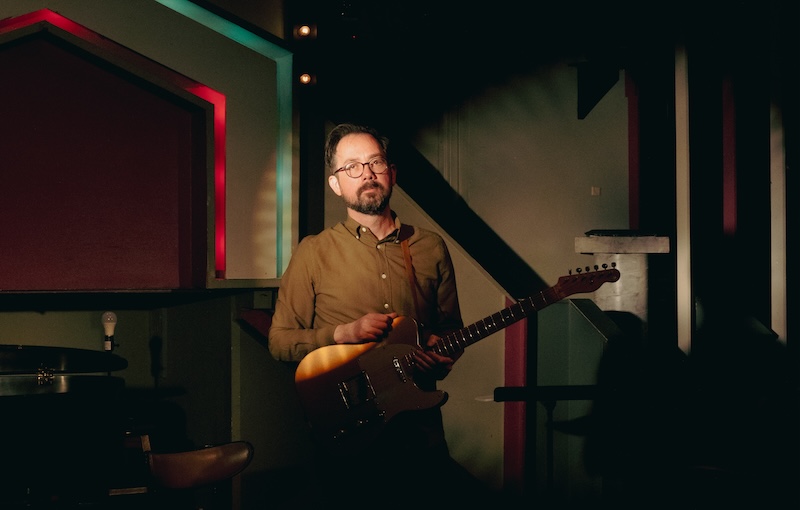
Photo by Daniel Jackson
For a self-described jazz novice like myself, Kelly Doyle’s new album, Thieves, sounds like the kind of record you’d expect to discover in a dimly lit, big-city underground club. But labeling it simply as “jazz” does the music a massive disservice. While several tracks feature a classic trio arrangement (guitar, sax, drums), the album’s sweeping, cinematic scope far exceeds standard genre classifications.
Doyle has spent years on the road as an integral sideman and touring member for a remarkably diverse lineup of artists, lending his guitar to the traditional honky-tonk of Robert Ellis, the atmospheric Americana of Phosphorescent, and the heartland rock of Craig Finn. But on Thieves, his solo material takes center stage, showcasing his guitar playing in its truest, most undeniable voice.
I caught up with Doyle to discuss the journey that led him to Strolling Bones Records, how cinematic directors like Kelly Reichardt shaped the album’s dark, noir-ish textures, and why he believes the most important thing you bring to the guitar is simply yourself.
The YouTube algorithms are always showing me videos of kids playing guitar. Like, I’ll see an eight-year-old kid playing Hendrix in his bedroom. I find that amazing. But, I think there are more resources out there now than when I was a kid. The one thing those kids don’t seem to have developed, at least not yet, is the feel. They can play those songs technically, but they could never get on stage and play in front of people. It’s not the same.
KELLY: It’s definitely not, but I don’t think it’s a hundred percent good or bad. It’s great that you can learn so fast. I’m just old enough that I had to get my mom to drive me to the music store and ask the guy behind the counter how to play something. His name was Phil. He eventually told me: if the guitar’s tuned normal, and it has normal frets and normal strings, your hand’s only so big, you’ve got a pick or you’ve got fingers. He was basically telling me to figure it out myself and quit asking him. But it was like an epiphany: oh, it’s in there, you just have to get it.
A lot of people now have less discovery. You’re interested in something, so you look it up immediately and learn it immediately, which is great, but there isn’t that thing of, “Oh wow, I have this knowledge now, and I can extrapolate it into other things.” They don’t learn a Hendrix song and then think, “What if I move this around, what if I use this in some other way?” When it’s that easy, I think you’re less likely to experiment and put yourself into it. Some of my favorite guitar players are from the fifties: Johnny Smith, Jimmy Bryant, guys who came up in the Depression. Jimmy Bryant played fiddle on the street in LA as a kid; I think there are stories of him and his dad living on the beach when he was little. Back then it was exciting just to see a guitar in person, an electric guitar was this exciting thing. A fifties record was Hank Garland or somebody like that, and they learned to play in the exact opposite way everyone learns now. You’re hearing a personalization of “I play guitar this way,” instead of “I’m mimicking this thing I’m interested in today.”
The other thing that blows my mind: there are only six strings on a guitar. As long as I’m alive, music is never going to stop, and people are always going to create something different with those six strings.
KELLY: It’s what you bring to it that really matters. In guitar there’s this extreme consumerism now, with effects pedals and guitars and modifications. I’ve got a ton of stuff in this studio, and I’ve definitely fallen into that trap. But like we’re saying, it’s not the guitar, it’s not the pedals, it’s you, it’s your hands, your brain, your experience, what you’ve put into it and gotten from it. That’s you, and I think people forget that. You just have to be there. It doesn’t matter what you’re playing through.
I’ve interviewed a few Strolling Bones artists. Your album doesn’t sound like the stuff the label typically puts out. How did the Strolling Bones thing happen for you?
KELLY: I played guitar for Robert Ellis, Johnny Fritz, Phosphorescent, a bunch of people who were on New West or New West-adjacent. When I was in Athens, I’d always end up talking nerd music stuff with (George) Fontaine (Jr). When he’d see me play in a band, backing a singer-songwriter, he’d say things like, “Whenever I see you play, Kelly, I just watch you. I find myself watching you and not even listening to anybody else.” He kept saying stuff like that to me. Once lockdown happened, I really started to buckle down and write a lot of material. I have a couple of hard drives full of Ableton files. As soon as I come up with something, I try to record it fast so I don’t have to remember it. I started self-releasing records, and I put one out through Sig’s Lagoon, a vinyl shop here in Houston.
One day I found myself on the phone with Fontaine, and he said, “Send me some of your stuff.” It’s funny, I had to send a Dropbox link, and then they’d burn a CD for him and he’d play it in his car. We talked for a while, and it was great, because he’s such an avid vinyl nerd. We can talk about anything, Cat Stevens to Grant Green. I sent him the music thinking, “This is going to be the most bizarre thing to him, he’s not going to be into this, I’m never going to hear from him again.” I immediately forgot about it. Then, weeks later, I heard from him, he said he was really loving it, playing it in his car all the time, “Let’s do it.” So that’s the long story of how it happened, and it is strange, it feels like something that would be released on some other label.
Having played with people like Robert Ellis and Phosphorescent, the music you create on your own doesn’t really sound like that either. Do you call what you’re doing jazz?
KELLY: I’ll use that as a default descriptor, but I personally don’t think of it as jazz. There’s a lot of that vocabulary and aesthetic in it, but I don’t necessarily think of it as jazz.
Is the material on this record true to you? Is this what you’ve always been playing when you’re not a side man in somebody else’s band?
KELLY: The guitar playing on this record is very much how I’ve been playing for quite a while now. I’d say this record is essentially recorded live, whereas the last few self-released things I did were basically guitar and Ableton. I use a lot of chance probability, so I’d set it up to play differently every time and then play along to it, and that all went to a tape machine. This is more of a live thing, more interactive with a band. It’s closer to how I’d sound if you saw me play in a bar than a studio-as-a-tool recording project. There’s less of that on this record.
As an instrumental album, is there an overarching theme to this record, or is it more like a series of nine snapshots?
KELLY: It’s intentionally cinematic. I think of all these songs as way more cinematic than my other tunes. I don’t usually think beforehand, I’m writing something in this direction. I’ve known songwriters who decide their next record’s going to be like this, and then write a bunch of songs to match. That’s not at all what I do. In hindsight, I realize what I was doing. I got really into Kelly Reichardt movies. They’re really slow-paced, and a lot of them have hardly any score. I got really into the third season of Twin Peaks, and that vampire movie, Near Dark, from Kathryn Bigelow.
I think a lot of that seeped into these tunes. A tune like “Big Fish,” I’ve learned a lot of French waltzes over the years, and that tune is basically a French waltz. I didn’t realize it at the time, but it really sounds like that. I was watching the third season of Twin Peaks while I wrote that, though I wasn’t consciously trying to channel it. I think some of these things just seep in.
“Thieves” is really just blues, and I think it unintentionally turned very noir, very Inspector Clouseau.
Only a few of them are directly tied to a specific experience. “A Year and a Day” is about my stepdad and my dad dying a year and a day apart. That one’s also a blues; the way the spacing works, it’s all fourths, and it takes two guitars to play right, these stacked chords, so it’s like two things happening at once, in parallel.
But “Pink Houses” was literally me singing a rhythm into my phone, then finding it a year later. That’s how that one was written. It’s really just a groove I liked. So some of them are a simple idea I explored, and some are far more thought out.
“A Year and a Day” makes total sense as a title. Is it difficult to come up with titles, or do the titles help drive the sound?
KELLY: Sometimes I have a working title that’s literally just a random couple of words. Sometimes I land on a title because it has a certain sound I like. I think “Big Fish” sounded like somebody out on the water, so that became the title. A lot of them are working titles, and I keep a notes list of song titles and funny phrases I hear people say. It’s super long at this point, and I can scroll through and see where a title came from. Sometimes I need a title for something and I’ll refer to the list and think, that kind of sounds like this song.
I interviewed a post-rock instrumental band once that created these very cinematic songs that sounded like something out of a Viking movie. I joked that had they named a song “Fun with Clowns” instead of something like “Battle in the Forest,” I might have heard the song completely differently. Do you think if you had named “Big Fish” something like “Skateboard Ramp,” it would change the way people heard the song?
KELLY: I think it would. That’s why, when I have a working title, I try to make it fit or describe the song. To me, it matters. I’ve also had tunes where the title didn’t really go with the song, because the song was some harmonic exploration I was into that day, and I ended up slapping on a title I later regretted. So now I’m more careful about it. “Thieves” wasn’t the original title for that song. The working title was “12 Bars,” kind of a joke, because it’s a blues you could break into twelve bars, except it doesn’t really fit; it’s rhythmically a little weird, so it was a joke to myself, like, “Here, try to play twelve bars.” But “Thieves” turned out to fit the theme of all these songs, that weird, creepy, jazz-ish sound.
With the three songs that came out before the album release, when you post them on YouTube, do you read the comments? Are you starting to get a sense of how people will take the album as a whole?
KELLY: Yes and no. I can’t help but pay attention a little, but I try not to. I try to notice how people are receiving it and what they’re associating it with. A lot of people immediately said it had a weird Twin Peaks sound, which made sense to me. But I don’t look at the comments too much. If anything gets more plays than the rest, I’m always shocked when anyone’s listening or cares. Or if it lands on a Spotify playlist, I think, “Really?” I think “Needlerooser” was second on a Spotify playlist at one point, and it was shocking. I didn’t even know that was a possibility.
When I listen, there’s a natural pull to focus on the songs already out, since you or the label want attention on those. But I like to find what’s past the curtain, you’ve already shown me what’s in front of it. “Thieves” opens the album, so I couldn’t miss it, and as soon as I got a link to stream the album and hit play, I liked it right away. “Found a Knife” is the other one that stood out. I hear a little Game of Thrones theme in that one.
KELLY: Oh yeah, totally. That one was always kind of a slow, Martin Denny exotica type of tune. I’d have to relearn it, I haven’t played it since I recorded it. There’s some weird string-bending in there, bending one string one way and another the opposite direction, and I’d need to get back in the shed and figure it out. I’m glad that one made the record, because it’s really long, really dark, and it never picks up or gets loud.
How is “Cold Open” not the first song on the record, at least from a title perspective?
KELLY: Even when we finished tracking, “Thieves” felt like the first song to me. There’s no real reason, that’s just how it landed. But the take we got of “Cold Open” is really, really nice. I like it a lot, and I’ve played it a bunch at gigs lately, but we caught the best version of it in the studio, it’s never been played quite that well since.
“Lodge Scene” seems like the most non-traditional of the songs on the record.
KELLY: Yeah, definitely. It’s not entirely free jazz, but it has a rubato section, that creepy part with no set time, that’s more avant-garde. Jeremy Bruch does a lot of really out-there drumming on that take, which I love, and gives it some of that avant-garde feel. I wouldn’t say it sounds like John Zorn, but out of everything on the record, it leans most in that direction. It’s one of the few where we used this old drum machine with a footswitch. I was turning it on and off for time, which actually gave Jeremy more room, since the machine kept time and freed him up to do other things. I like how that one turned out.
For a couple of the trio recordings, we audio-to-MIDI’d the bass, so it’s Will Story’s bass performance but played through a Prophet keyboard. Everything with the sax, all the quartet stuff, is from last June. All the trio stuff is from 2023, and it was raining that day; I think in either “Big Fish” or “Lodge Scene,” the song starts and it begins raining, and we were at Steve’s warehouse, so by the end of the song you can hear the rain. It just sounds like tape noise, but once you know it’s there, you’ll always hear the rain.
John Zorn is somebody I need to revisit. I think I bought a John Zorn CD because some association in the early ‘90s. I want to go back and listen now, because at the time it made no sense to me as an alternative-rock kid.
KELLY: Yeah, the Naked City stuff is really cool. That’s the classic one to check out. I think that record has Bill Frisell, Marc Ribot on some of it, Kenny Barron, some of those classic New York guys from that era. That cut-and-paste style is what Mike Patton and that crowd took from him. But if you want to hear John Zorn really play sax, there are the Masada records, a lot of trios with no comping, just sax and drums on some, or sax and trumpet with Don Cherry or somebody like that. Those are really cool, and you get to hear him play and improvise. There’s also Electric Masada, a couple of live records where Marc Ribot plays guitar. It’s awesome, like free jazz Hendrix.
When you’re mixing and mastering, finishing songs, are you listening in your car, on your home stereo, through computer speakers knowing it’ll be played twenty-five different ways?
KELLY: If it’s with Steve (Christensen), at his place, I’ll give it a couple of listens, maybe the next morning. Or if the timing allows and I don’t have to send it anywhere right away, I won’t listen to it for days, I’ll come back to it later. Steve knows the sounds I like, the aesthetic I’m going for. I’ve even copied the tube preamp he uses onto my own gear here. It’s a comfortable setup, so when I’m working there, I’ll often listen through once and not listen back. That’s why I have a couple of old albums with some bad Pro Tools edits where you can hear a pop, because I didn’t listen closely enough. I probably shouldn’t work that way, but I don’t like sitting and listening to myself over and over.
If I’m playing guitar on a singer-songwriter’s song, though, I will listen back repeatedly, because it’s a different kind of thinking. I’m considering how I fit into the mix, whether I’m overplaying. When I’m making my own record, I’m more just being myself, improvising, catching a moment. Especially on this last record, the groove on “Big Fish” is really wide, I’m playing way behind the beat, and I don’t think I’ve played a groove like that with anybody since. That’s just how we played it that one time. So I’d rather record something and let it go, instead of overthinking it.
As you’re recording, do you think about how people will listen, not just headphones, but digitally, on vinyl?
KELLY: There’s always the problem with low end. Everybody listens through their phones, and all the low end disappears. My workaround is usually distorting the bass just enough that some of it pops through the phone speaker. Right after we mix, I’ll listen on headphones, and sometimes in the car, though I have a new car now that’s really boomy and weird, so I’m not sure I’d trust a mix through it. I do think about that and try to fix those issues.
There’s an old tune of mine, “Woman Trouble,” from an EP around 2022 or 2023, that has a rotary phone as a percussion instrument. We ran it through an old Tascam tape machine. I like stripping things down to a few tracks and then running them through tape to let it all glue together. Between the tape and the lack of high end, it basically lopped off the rotary phone entirely; listening back now, you can barely hear it. On a really nice stereo you can hear the rotary phone going, but ultimately, when we listened back, everything else outweighed it. The kick and bass and everything were glued together so well that I thought, “So long, rotary phone.”
Did you want the rotary phone up front, or was it more incidental?
KELLY: No, the rotary phone was pure ear candy. It wasn’t detrimental to the song either way. If I had unlimited studio time and money, we could have EQ’d it before hitting tape and made it pop out more, but I try to find the balance between getting something done and getting it good. Sometimes something just needs to be finished rather than perfect. If a detail doesn’t stand out and it’s not hurting anything, I’m not going to obsess over it.
I think that applies everywhere. I work a corporate day job, and I had a boss who used to say, “done is better than perfect.”
KELLY: Totally agree with that. A lot of times with videos, if I’ve already watched something once and there’s a small edit, I’ll check the very beginning and end and call it fine. I have too many other things going on in my life besides my career to get bogged down in that. I’ve known people who get lost in the weeds and nothing ever gets finished.
So far I’ve listened through earbuds, in the car, and Bluetoothed to speakers in my family room. It’s a great album for drinking coffee on a Sunday morning, or reading when I’d rather do that than watch Netflix, or at the end of the day before bed. I’ve heard that the vinyl sounds amazing.
KELLY: The vinyl sounds really nice, surprisingly loud. I don’t know how they got it that loud, but it’s not a bad loud, and there’s some added top-end EQ, so it is a different experience. If you listen to it enough, you’ll hear the difference.
What are your expectations for the record? Does the label have expectations? Are you touring behind it, or is it more a document of something you recorded live-ish? Where do you see it going?
KELLY: For me, it’s just another step forward. I don’t have huge expectations. I’m fully aware I’m a weirdo guitar player who plays instrumental music, stands there, and doesn’t make orgasm faces, you know what I mean. I’m self-aware that this can only go so far. To me it’s slow and steady: every year I try to put something out and keep it moving forward, because I like looking back and seeing “I did this at this point, I did that at this point.” It’s already opened things up with the videos coming out. I went and played Minneapolis and Milwaukee a couple of weeks ago, played at Berlin in Minneapolis, sat in on a couple of people’s gigs. For me, it’s doing exactly what I’d want it to do, branching out, getting out of Houston, playing Monks in Austin this Sunday. There’s a vinyl-listening night tomorrow at a place in Montrose here in Houston, where we’ll spin the record alongside some other guitar records with friends. To me it’s already a win-win. I’ve quadrupled the number of gigs I’ve done around a release, I’ve gotten out of state, and there’s a lot more interest. I’m taking another step forward, and hopefully the next record I can push it a little further, whatever happens with it.
Is anyone trying to pitch any of the songs for TV or film placements?
KELLY: Strolling Bones works with Sugaroo for syncs, so there is a publishing deal on this record. I was in a tiki-style band in the aughts, more the bass player’s project, though I wrote some of the tunes, and we put out a couple of records through Pravda Records. Not that long ago, one of those songs ended up on the Netflix show Wednesday. Hopefully something like that happens again with this one. It’s something I talked about with the people at Strolling Bones early on. This feels like it’s built for that. Everyone always tells everyone making a record that it should be on some show or another, but this is one of the rare times I actually feel like it would work.
I always end interviews with the same question: what’s the song, artist, or album that, when you hear it and close your eyes, puts you somewhere in your past?
KELLY: A lot of Hendrix stuff reminds me of being a kid with CDs. I had this multi-disc Hendrix set, maybe four CDs, not the whole catalog but a lot of it, and also a CD of the entire Woodstock recording, top to bottom. Listening to it now, you realize it’s all edited down for the record, but there’s a track off that recording, I think it’s called “Jam Back at the House”, this long instrumental, pentatonic thing they just play over and over, and it sounds like things are falling apart, people randomly stop playing, like people are falling over. I shared a room with my brother, and that track always reminds me of that room.
I have a lot of songs that remind me of moments. I remember hanging out with some older kids in high school, I couldn’t drive yet, but they could, and they’d listen to The Specials and stuff like that, which I never really liked. But whenever I hear ska now, it reminds me of being in Conroe, Texas, drinking beer in a car, being completely illegal and stupid. I remember the first time I heard Korn, around 1996, I was in my friend’s truck on I-45, and that “Are You Ready?” song came on. I remember thinking, “What is this?” There wasn’t anything like it before, it was just bizarre. Whenever I hear that band, I remember that exact moment the intro kicked in. It was such a bizarre, not great moment in music, that weird amalgamation of Rage Against the Machine and Faith No More and everyone else doing that thing. But now, when I hear any of it, I think, Korn was the best at it. It’s all kind of bad, but they’re leaps and bounds better than the rest of the bands doing that goofy Bakersfield thing.