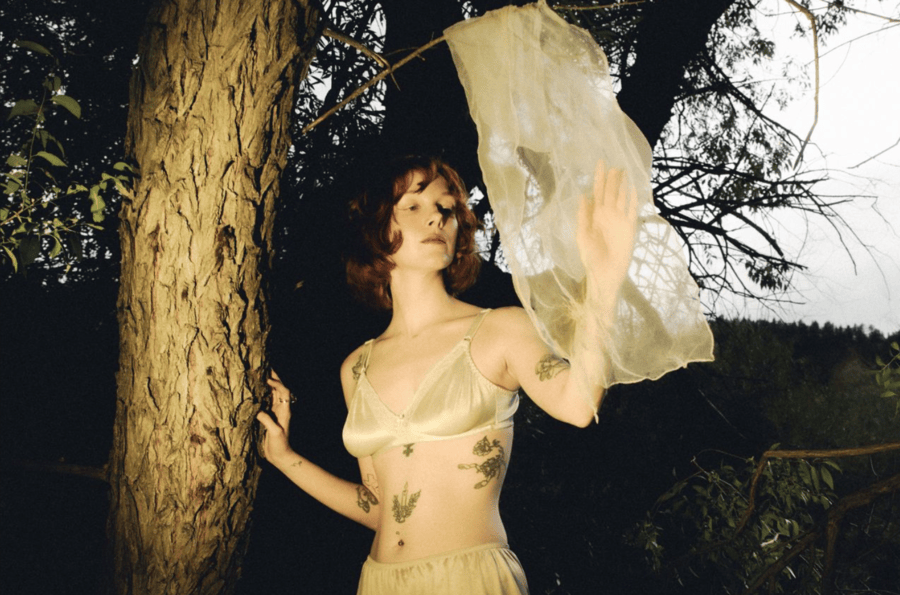
Photo by Chloe Barkley
Maddie Medley has been at this longer than most artists her age. Raised in Nashville, she signed to a major label at the age of 20 and released her debut EP, Coming of Age, Pt. 1, in 2020, just before the world shut down her first tour. It’s single, “Buzz,” has over 3.6 million streams on Spotify.
Now based in Denver and fully independent, she has returned with Fawn’s Enemy, her debut full-length, co-produced with her partner, Luke Krutzke, and written largely during her years in Kansas City. Medley says the record is built on rage but ends up hopeful, a set of short stories from a world she sketched, mapped and, in one case, turned into a puppet.
I caught up with Medley a couple of weeks after Fawn’s Enemy’s release to talk about starting over, working at home, and what a record sounds like when it belongs to one particular place and time.
Now that the album’s been out a couple of weeks and you’ve had a chance to live in it, how are you feeling?
MADDIE: I actually feel pretty chill about it. It’s been a pretty relaxing experience. I haven’t been super keyed up, other than release day and the day or two after that. I feel like I’ve returned to baseline pretty quickly, which has honestly been really nice, because you never know. It’s kind of a gamble with how you’re going to feel after you put something out.
In the Columbus scene I came up in, local bands would play any show they could to raise money to make a CD. When the CD came out, that was the end. For an artist who’s doing this for a living, it feels almost reversed: The album release is the beginning, not the end.
MADDIE: I totally had a conversation with my manager about that exact thing a couple of days before the record came out. It had been a long road to get there, and I was realizing the record coming out wasn’t the end of something. It sounds corny, but it was the start of something.
It’s a lot easier for people to listen to you and know what kind of music you make when you actually have music out. So there’s a big beginning feeling in that, for sure.
Did you play any shows in the year leading up to the release?
MADDIE: I’m from Nashville. I lived in Kansas City for a couple of years, and then I moved to Denver last year. They’re a perfect route. If I need to go to Nashville, I might as well play in Kansas City. I’ve played a handful of shows back and forth in those three cities in the past year, but not a ton, and not a ton outside of those three cities.
Some artists book a tour a year in advance, and because of how long it takes to get a record made, they’re on the road for two months with nothing to sell. They’re playing all new songs for people who don’t know the words. Is it difficult to play material nobody’s heard?
MADDIE: I’ve definitely had that experience. I’ve been playing the songs on this record live for the past two years. I haven’t played older songs for about two years. Almost every time I’ve played a show, it’s been new to the new people. I really don’t mind that, though. I feel like it’s a fun way to introduce myself: “This is how you know me. Nice to meet you.”
David Ramirez, a singer-songwriter from Austin, told me that touring is his job and the records are almost secondary. His fans don’t care whether he’s got something new to play. They just want to come to the live show. I always thought you were touring to promote something. Have you seen anything like that?
MADDIE: I just saw Big Thief at the Ryman in September, and they played a brand-new record. It was two nights. It was like a triple record, a three-hour show of all new songs. It was a really cool experience, because nobody had heard those songs before. It’s definitely a cool thing.
Preparing for this interview, I discovered that I already followed you on some social media sites. I was a little surprised, not remembering how I discovered you but when I re-listened to “Buzz”, I remembered that from when it was released. You’ve been through a major label deal and are now an independent artist. Do people know your background or are you finding that many people think you’re a brand new artist?
MADDIE: I think it’s a good mix of both. In Nashville, or in industry cities, it seems to be a little more understood that I’ve had a ten-ish-year-long career. In other cities, like Denver, I think it’s viewed a little differently, which is cool, because I would say this record has a bit of a different sound.
I was really intentional in putting out this record that it was a hundred percent me, and produced by me and my partner. It’s fun to be able to introduce myself in that way, as, like I said, a hundred percent me.
There’s a noticeable shift in sound from the older music. Do you consider what you’re doing now a continuation of that, or a wiping of the slate clean?
MADDIE: That’s a good question. In some ways, I feel like it’s wiping the slate clean. I was signed to a major label when I put the earlier singles out and my first EP out. Not having the major-label pressure of putting out music has really opened me up creatively. In a lot of ways, I feel like this is just a more authentic version of my music that I’m able to put out now. So I do feel like it’s a little bit of reintroducing myself and wiping the slate clean.
On the podcasts you’ve done recently, you seem to be talking to a lot of middle-aged guys. Has that been the experience for this promotion cycle? I think it’s a good thing. There’s something about the music, your voice, the sound of the record itself that obviously appeals to middle-aged guys. Is that okay with you, or are you hoping your peers and friends listen to it, too?
MADDIE: Yes, it has. I am happy with whoever listens to it, genuinely. I just want people to connect to it, and it doesn’t matter to me where that person comes from. If you connect to it, I’m stoked.
Some of what I’ve read about your earlier work suggests the songs came out of anger. What emotion would you attach to the lyrics on this album?
MADDIE: There’s a lot of anger in some of these songs, but I would say this record is pretty hopeful in a lot of ways. I think I was turning over a new leaf when I wrote a lot of these songs, and I felt hopeful when I wrote them. Even though the core of the record is about rage and anger, the rest of it is hopeful.
It’s musically and vocally interesting, but also beautiful-sounding. I’ve told other artists this before, and I hope you don’t consider it a bad thing, but I use your music a lot to fall asleep to. It’s very soothing.
MADDIE: That’s so cool to me. I love that. The bio writer I talked to said it was a record for the quiet hours that bookend the day. I grew up listening to Norah Jones, and she always kind of put me to sleep in the best way, so I love that.
“Quiet hours” is a great way to put it. I’m a very intentional listener, and it’s interesting to me that certain albums sound different in the daytime than in the evening. If I’m having a super stressful day, running back and forth to meetings, your record might help calm me down, but it doesn’t fit the moment.
Colin Hay from Men at Work once said that the time of day he records changes how his voice sounds. For some songs he wants that waking-up gruffiness, and for others he’ll sing late at night to get the tired part of his voice. Have you ever tried to record a song in the middle of the night, then come back the next morning and found it sounded different?
MADDIE: We recorded the majority of the vocals on this record, actually all of them, at home. When you’re paying for studio time, there’s a lot of pressure. There’s a set time you’ve got to be there and a set time you’ve got to leave, and that doesn’t always yield the best results.
My voice feels best in the evening or later at night. But there were some songs, like “Rocky Loves Whitney,” that we recorded a lot of in the daytime. For some reason, that song vocally felt best in the daytime. I really can’t explain why, but I’ve definitely had that experience.
Recording at home, without the pressure of a studio clock, how do you know when something’s done? I would think you could work on a song forever. Do you and your partner put a stamp on it?
MADDIE: Yes. There was a period of time this past winter when we were finishing. There were a lot of moving parts to the record, and there were some things we really needed to finish, but we didn’t have a deadline. Then we came up with a late-March deadline, and that was the thing that really put us into action.
I think having a deadline is a really good thing, especially when it’s a creative project, because at some point it has to be done. It’s easy to tinker with it. You can beat a dead horse really easily.
Between recording these songs and releasing them, do they always live within you? Are you always hearing them in your head? Are there songs you go back to and think, “I sort of forgot the words to this”?
MADDIE: I will be honest: I listen to my record a lot. I don’t know if that sounds a little self-centered. Because I did co-produce it, it’s fun to go back and revisit some of the production choices. I kind of always have it in my head, and the songs are very personal, so I don’t know that I’ve had that experience with these.
Older songs, for sure. I haven’t played “Buzz” in several years, and I had an experience in Kansas City, maybe in 2023, where I was playing “Buzz” live and completely forgot it. It was like a nightmare, when you just forget a song in the middle of it. But with these songs, that hasn’t happened yet.
If the album were a book, would it be a series of short stories in a compilation, or a story told from beginning to end?
MADDIE: I would say it’s a compilation of short stories. I grappled with whether this record is a concept record in some ways, and ultimately it’s not. But they’re definitely short stories in a compilation, all under the same umbrella.
I’d argue that every album is a concept record, in a way, because it’s all coming from you. The question is whether there’s a through-line story. Would you say this is more of a fiction or nonfiction record?
MADDIE: Yeah, it all shares the same DNA throughout. That is interesting. I would say it’s more of a nonfiction record, but there are definitely some elements of fiction in there. “Rocky Loves Whitney,” for example, is about two little old gay skunks. And “Fawn’s Rage” was kind of built around the Fawn character. But it’s still all from my perspective.
I interviewed an artist who introduced me to the idea of the “unreliable narrator.” He said the songs are stories from his world, but as if somebody else is watching him. Do you write from that perspective, from an outside person looking at you?
MADDIE: I don’t, but I do think that’s really cool. I write from an almost painfully present place inside my own head. But that’s very cool. That’s really interesting.
Do you think this album is a time stamp? Will you look back in 20 years and see it as very much your life in this period, or are there more universal themes?
MADDIE: This is very time-stamped. I wrote the majority of this record when I was living in Kansas City, so this is very much a Kansas City record for me.
My surroundings at the time really shaped what it sounded like, and not even in a sonic way. I think even just colors. I worked at a yoga studio called Yoga Patch that was really beautiful on the inside, with a lot of earthy colors and jewel tones. I feel like that’s what I was seeing every day, and what I was seeing when I was writing. So, definitely time-stamped and location-stamped in Kansas City, Missouri.
Some artists don’t bring their geography into the music at all. Others would say, “If I lived in LA, this record would have sounded completely different.” It sounds like you’re the second kind. Have you started developing a Denver sound?
MADDIE: Not yet. It’s very interesting. Denver, Colorado, looks very different than Tennessee, obviously. The greens are a lot more yellow. In Nashville, the greens are a lot more blue. I don’t know if that makes sense, but it’s something I’m still adjusting to. I love it here. It’s so stunning. But I don’t know quite what that sounds like yet.
What brought you to Denver?
MADDIE: My partner is from here, and we’ve been together for almost nine years. When I first came out here with Luke, I was like, “We’re gonna move here. I like this.”
Is the Colorado sun an adjustment? In Ohio, we’re about to get gray skies until April or May, and I know I’d be a different person if I lived somewhere sunny.
MADDIE: I’ve actually struggled with how sunny it is here. I’m obviously the whitest person on the planet. My eyes are really sensitive, so I do appreciate the gray, cloudy days. I don’t mind that at all.
I read that you created a world within this album, and that you drew something out, a map or something.
MADDIE: An artist named Jean Demarest made a map of Fawn’s Forest.
Is that the way your mind works? Could this world have always lived in your head, or do you have to physically see it on paper? My wife can picture how a room will look painted blue. I need to see it first.
MADDIE: A little bit of both. Throughout the process of making this record, I learned a lot. I’m not a visual artist, but I found that sketching out these little ideas I had in my head really helped me contextualize things.
I made a character for Fawn’s Forest called Teardrop, which is an anagram for “predator.” I had drawn it out, and then we commissioned somebody to make a puppet of Teardrop. I don’t have the practical skills to make some of these things that I see in my head, but I love to sketch them out and then see what somebody else can do with those visuals. That’s very fun to me.
Based on the album cover and the videos, the visual presentation seems like a very important part of who you are. It’s all part of the big package. Are those your ideas, or are other people coming to you with pictures they have in mind? Or is it a collaboration?
MADDIE: It’s a lot of collaboration, and I would say a good mixture of both. For the album cover, for the “Fawn’s Rage” music video, for the “Dan and Me” music video I just put out, a lot of these were sketches of mine to begin with, and then I collaborated with the directors or other artists to bring that to life.
I found it very, very empowering to take the lead on some of those things, or at least the general plot or mood. Being able to take initiative on that has been really, really fun for me. The rest of the work has been done by some really incredible directors and artists.
If I were to see you live, I don’t think I’d want to see you open for somebody. It feels like it should be an evening with Maddie, where you bring us into this world, rather than getting 30 minutes to run through a couple of songs before the headliner comes on. Are you envisioning a live set that brings in visuals and all of that?
MADDIE: I would love to be able to do that. That is a huge dream of mine. I do think it’s difficult. Maybe this is a control thing, but not being able to curate the pieces together myself for a live show is definitely an exercise in understanding that not everything can be in my control, and that’s fine.
Are you eager to get on the road?
MADDIE: I would love to go on the road. The first time I toured was in February of 2020. There were months of build-up. I was so excited, and then that got cut off real quick. So I’m so excited to go on the road.
During COVID, I spent a lot of time on bands’ Instagram pages. First came the “Tour kicks off today” post, then “Our show just got canceled, but we’ll make it up once things get better,” then “We’re headed home,” and then “We don’t know what we’re going to do.” It’s crazy to think we lived through that.
MADDIE: I’ve heard a lot of people, at least musicians, have similar experiences. I know a lot of artists who got dropped, and I know a lot of artists who said, “I’m never gonna do this again.” And then two years later, they’re back to it again.
What a soul-crushing time for the entire population. Not to sound corny, but it is a testament that we will get back to doing what we love, no matter what.
I know you’re a big Fiona Apple fan, so I’ll share a short story. I met her on the Tidal tour. A friend who worked for the record company took me backstage at a meet and greet. When she came around to sign my poster, I asked about an instrument I could hear on the album, the Chamberlin. She told me it’s like a keyboard, but it uses magnetic tape instead of strings, and I think she enjoyed being asked something that wasn’t a standard backstage question. That was my two minutes with her, but I got to ask her something she didn’t mind answering.
MADDIE: Yeah, that’s so cool. I have daydreams about running into her at the grocery store. It’s amazing that you were able to meet her.
The last question I ask everybody: Is there a song, album, or artist that reminds you of something so specific that if you close your eyes, you re-engage all those feelings?
MADDIE: Blake Mills’s record Break Mirrors, which I found in the winter of 2017. I love that record, but the weekend I found it, I had driven to Bowling Green, Kentucky, from Nashville to visit my boyfriend at the time. And I got appendicitis. So we had to drive back to Nashville and go to the hospital. I don’t know why we drove all of it, but we listened to Blake Mills’s Break Mirrors.
I love that record, but I remember drinking a strawberry milkshake the night I started feeling weird and thinking, “Maybe it was a strawberry milkshake.” Anyway, I think about getting appendicitis when I hear that record.
That’s a great story, though I’m sorry it happened to you. I always think it’s cool that five, ten, or twenty years from now, somebody will be asked that same question and say, “I heard Maddie’s record in my mom’s car, streaming on Spotify, and this song reminds me of this thing.” You have a gift, and you’ll never know how good of a gift it is. But you’re giving a gift to people through your music.
MADDIE: I love that. I love that. That’s beautiful.