Photo by Will Cook
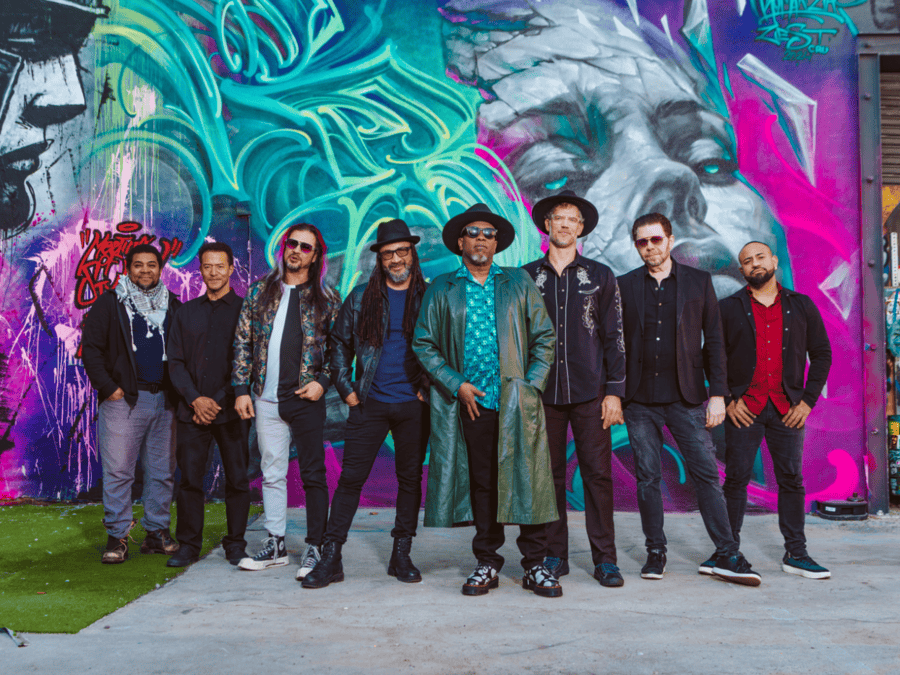
The names may not be household, but the resumes are solid. Michael Sanders formed One Tribe Nation as a way to collaborate with musicians he respected; no pretense, no expectations, just a desire to create something magical. With players who’ve worked with everyone from Zac Brown Band to Santana to Prince to the Goo Goo Dolls, One Tribe Nation’s sound can bounce from soul to rock, jazz to pop, often within the same track.
Most recently, the band recruited Corey Glover of Living Colour to handle vocals. With a world-renowned voice and a solid work ethic, Glover elevates the band’s sound, bringing his own experience to mesh with the talented players. There’s already music in the can waiting for release, and One Tribe Nation just dropped their cover of Black Sabbath’s 1970 track “The Wizard,” recorded live at a David Z Foundation fundraiser earlier this year.
Sanders and Glover joined me via Zoom the day before “The Wizard” was released to talk about why they chose this song to cover, the range of talent in the band, and what people should expect from One Tribe Nation going forward.
One Tribe Nation will perform at The Den Studios (1260 W. 2nd St, Los Angeles, CA) on July 25.
Can you tell me about your history with Black Sabbath and Ozzy? Have you been lifelong fans or is it something you grew into?
MICHAEL: I’m huge fan. I remember hearing “The Wizard” the first time when I was eight, and I was like, “Who the hell are these guys?” Ever since then, Tony Iommi has been my absolute favorite guitar player. I consider him a blues guitar player, and I’m really acutely aware of how much the British musicians of that era understood American blues, arguably better than most Americans. They were reflecting the blues back at us, through the Rolling Stones, through Led Zeppelin, and all those other groups of that era, that’s really when I think Americans started to appreciate an art form that was made in their own backyard. A lot of those blues artists who couldn’t really get arrested here had to go tour over there and did very well for themselves touring in Europe. So I consider Tony Iommi a blues guitar player. If you listen to our music long enough you can hear his influence on me. But yes, Black Sabbath and all things Tony Iommi, I’m completely on board at all times.
COREY: They’ve been on my radar since I’ve been acutely aware of music. Seeing them on television didn’t hurt their process, it didn’t hurt me one bit. I did look at Ozzy and was like, “That guy’s got a problem, but his stance is incredible.” You couldn’t deny his abilities, and the whole band’s abilities. It’s like those singers you hear and you go, “I can’t do that.” For a very long time I wanted to be a rock singer, whatever that was, and my indicators for that were Robert Plant, Ozzy Osbourne, Bon Scott, these guys with really, really high voices, sounded like they were about to explode, and I didn’t want to do that. I wanted to sing rock, but how do I do that without having this high first-tenor kind of voice? Fortunately, I found my way, but they were among the folks I looked at and went, “I like it, I can’t do it, but I like it,” you know?
Ozzy was my gateway into music. When I was maybe 10 or 11 years old, my best friend and I had a crush on a girl. Her older brother liked Ozzy, so we both went out and bought Blizzard of Ozz thinking that if we had something in common with her brother, she would notice us. I’ve always joked that my friend got the girl and I got the love of music out of the whole deal.
MICHAEL: Which lasted the longest?
My love of music, for sure. But I didn’t know about Black Sabbath until I heard Ozzy’s Speak of the Devil, and heard all these songs he’s covering from his old band. That’s when I first heard “The Wizard”.
MICHAEL: Black Sabbath was extremely progressive. The deep cuts on those records that most people don’t know about are brilliant, lots of timing changes, tempo changes, a lot of emotion. I think Ozzy has one of those voices where there’s a kindness and a love that comes out of his voice that everyone feels and relates to. It’s a very rare quality to have. That era of Sabbath was really experimental, almost like the record companies didn’t really know how to completely clamp down on an artist yet. Some of the best music ever came out of the ‘70s. As the ‘80s rolled in, they started to be able to control it a little more, and everything started to become a little more homogenous. I love the Dio Sabbath era as well, but it’s a different thing, for sure. But yeah, Speak of the Devil, and then with the Dio version they put out Live Evil the same year. There were two kind of Black Sabbath live albums.
But us performing “The Wizard,” doing an Ozzy song, was actually the idea of the guy who threw the event we played, Paulie Z. He used to have a show called Z Rock on IFC, excellent show, all the conversations bands have in a van or a bus turned into an improv show. This was a benefit for the David Z Foundation. Corey has worked with them before. They bring music to children all over the world. He wanted us to do a tribute to somebody who had passed that year, and immediately I thought, “Let’s do Black Sabbath, let’s do ‘The Wizard’, and I want to hear Corey sing it.” He was really generous with us, and we got to play the benefit, put on by the David Z Foundation. RCF was the PA company that underwrote the whole thing. That’s how it came about. My love of them was the thing that made me choose the song, but the impetus was really Paulie Z.
COREY: You were talking about how progressive it was. I knew a lot of folks who weren’t particularly fans of that genre of music, but jazz-fusion guys, and thought that stuff was really sort of where it was at, because they were taking it to other places, other time signatures, and were really on the ball with that. That was my interest in the band because the people around me who I looked to, to find out what’s really interesting in music, would say, “Sabbath is doing this odd-time-signature thing, it sounds like Mahavishnu, you need to check it out.”
Now, as far as doing this song, I attempted to do it once, years ago, and was really, really bad at it. Fortunately, I had a second chance, and hopefully it’s a little bit better. They’ve been very accommodating. I gotta say, Mike has been very, very accommodating for me, and has given me a great opportunity, and I’m really thankful for him and Paulie. I’ve done some things with Paulie Z on a charitable nature, and we actually won some awards for it. I am grateful for the people who have faith in me.
”The Wizard” starts ominously. I’ve always thought it was a harmonica that I hear in the opening, but I guess I’m not really sure.
MICHAEL: It’s the only Black Sabbath song with harmonica. They somehow made the harmonica sound like this sinister, demonic instrument in the context of the track, and they never used it in another song again. It’s the sound of that unison harmonica playing along with such a heavy rhythm, it’s a really unique thing. And I feel like Corey’s vocals fit in perfectly, because I think Ozzy was singing the blues back then, and Corey has a very gospel-kind of style among all the other aspects of his style that blend into his music. I think it was just a perfect match, it really, really worked out well.
On the original track it’s even more sinister-sounding than on Speak of the Devil. You’re like, “What is this?”, the way it starts off at the beginning, almost like an air raid siren. There’s this space and you don’t know what’s gonna happen next, and then it doesn’t disappoint. It was exciting to do that, and to see people cheering in between the spaces of the harmonica at the beginning. We had Ben Thomas, who also sings with us, plays trombone, trumpet, harmonica, guitar, legit percussion—he used to be in Zappa Plays Zappa, so he’s just freakishly talented—he took on the harmonica part.
Have either of you guys ever met Ozzy or Tony?
COREY: I met Ozzy once, in England. I met the whole family. They weren’t very hospitable, but I was very happy to see them. This was in the midst of the whole reality TV show thing, so I think they were keeping up appearances for that. And Tony, I don’t think I’ve ever met..
MICHAEL: I met Tony once, and I met Geezer once. Geezer wasn’t really interested in talking, and Tony was just a polite English gentleman. I’ve met a lot of people who’ve been sort of in the Black Sabbath world. We got to jam with Vinny Appice once at a jam night, and I kind of met all the people who were involved with Dio when I moved to LA. Claude Schnell, the keyboard player, was the best man at my wedding, one of my best friends, and a Mensa member. The guy’s a genius. He used to be on my girlfriend’s wall from the old Hit Parader magazine and stuff. He looks like a bad motherfucker, but you meet him and he’s a Mensa-level genius, speaks French fluently, who’ll talk to you and your mother all night long, he’s just an incredibly charming, brilliant person. But if you hang around LA enough, you meet at least somebody who’s been in Black Sabbath.
When I was in college, I went to see Lynch Mob so I could write a review for the student paper. I was in the photo pit taking pictures and glanced over to the backstage area where I saw Ronnie James Dio standing in the wings. Black Sabbath was playing the next night so I guess Ronnie came to check out George Lynch. I asked the security guard if I could talk to Ronnie and Ronnie gave him the thumbs up. Ronnie invited me to see Sabbath the following night and when I arrived at the venue, there was an after-show pass waiting for me. After the show, as I was headed to the dressing room, I passed Tony Iommi. Not knowing what to say, I said, “Welcome back, we’ve missed you,” in reference to Black Sabbath sort of being gone for a while. Tony looked at me and said, “We were never gone” and kept walking. That memory is burned into my brain. And he was right, Black Sabbath hadn’t gone away, they had just had a period of time with Tony Martin on lead vocals and their albums were hard to find in the U.S.
MICHAEL: I was there for all of it, the different singers and everything. He’s just my favorite guitar player. I love Tony Martin too, great singer, Headless Cross is amazing, and Tyr, brilliant record with Cozy Powell, so good.
What is behind releasing “The Wizard” now? Is it a teaser for an album? Is it a way to promote an upcoming show? Is it tied to a charity?
MICHAEL: It’s probably not going to be on the album. It’s to promote the July 25 show and to promote the David Z Foundation. Paulie wanted to do something last month and we said, “Hey, let’s hold off, we’re almost done with this video, let’s hold off and do something together,” because he’s an incredibly positive and thoughtful person, and I really love what he’s doing. I’m just happy that we can shine any light on what he’s doing, and Corey’s already been doing it, they won some awards for the music they’ve created together. Anything we can do to help Paulie, I’m on board. And if it serves to get a few more people to show up at our show at the Den Studios, that would be wonderful.
Before hearing about this cover, I wasn’t familiar with One Tribe Nation. Can you tell me about the band?
MICHAEL: We did our first record in 2005 or 2006. It was just sort of this idea I had to bring together a collective of musicians from other groups. At that time there were no guitar solos anywhere, people were still hungover from the ‘80s, or the ‘90s even, but the idea was to just put a group together, maybe even a revolving-door gig where I could have some of the greatest musicians I’d met and knew come in and out and write with me and play shows with me, and we were able to make that happen on some level. We did two records, and this will be the third. I took about ten years off to be more involved in parenting and my family life. But this time around, when I started putting it all together, it really came together. We’ve got guys from Zac Brown Band, from Living Colour obviously. We’ve got Uriah Duffy, who’s been in Whitesnake but he’s also filled in for Larry Graham in the Family Stone, who can play legit jazz, he’s just a beast. And Christian Pepin, who’s won a couple of Grammys playing real straight-up hardcore salsa. And Ben, from Zappa Plays Zappa. The guy who helped me put this band together was a percussion player for Zappa Plays Zappa, Billy Hulting, who turned me on to Scheila Gonzalez from Zappa Plays Zappa, who’s also on the record; introduced me to Ben; introduced me to Anthony Bonsera, who arranged the horns for me and is playing with us on the 25th. He was in Big Bad Voodoo Daddy.
All of us are friends, and it’s been kind of like a dream project for me. This iteration of it is the best one yet, so far, because everybody is interested in contributing, and everybody is interested in writing and showing up, and it’s just been great. And having Corey show up has just been the icing on the cake. I think the first song we wrote together was “Estado Dorado,” and after a couple hours it sounded like he’d been singing it for ten years. It’s just been an incredible experience, and a lot of magic has happened because of the level of musicians we’ve had along the way.
How did you and Corey hook up? Had you met before?
COREY: We have a mutual friend, the stylist Lisa Balfour, who actually is a stylist for Living Colour on occasion, and she’d mentioned something about this band looking for a singer to do some session work. I’m always open for session work. Session work is bread and butter. And the stuff was really, really good, and fortunately I kind of fit into whatever the vibe was they were trying to convey. When it came down to it, it was like, “Okay, we can do one song.” We had a writing session in New York, with one of my writing partners, and the process just turned out really, really good. So we kept going. The process is really simple, and that’s what’s keeping me around. There’s no animosity, there’s no angst, there’s no hurt feelings to get this done, it just gets it done. And I can’t be happier.
It sounds like a dream scenario where everyone gets along, everyone has fun. But, there’s work to be done. What is the work/fun balance? Do you get together, just sit around and jam and something comes out of it or do you follow a calendar and make sure that deadlines are met?
COREY: For me, there’s no onus on any one of us to come up with something, nothing brilliant has to come out of any session. What little or what more comes out of it is what it is, and then we take that and use it. So that, to me, is much more important than, “We’re going in the studio and genius is going to be produced.” We’re going in and fucking around, basically, let’s see what happens.
MICHAEL: It’s a tremendous thrill to have other people interpret your music and bring it to another level. What I learned at some point, because I used to be in a progressive metal band called Dyoxen that was kind of an underground band, had a deal in Europe but never got over there, and there’s a record out that’s still on some people’s radar as a classic—but every note was planned out in that stuff, very much like *Megadeth*-type stuff, no improvising in the middle of the song. So I was really micromanaging musicians when I first moved to LA, and at some point I figured out, number one, a lot of these guys are better than me, better than anyone I’ve ever played with, and maybe I should just let them—a few of them mentioned this to me—let them be themselves. Hire them for who they are as a person, and then allow that to express itself within the context of your own arrangements. That’s how this whole thing has come about.
With Corey it’s effortless, because there’s probably a certain amount of Living Colour influence in everything I do. As a young Black kid growing up, Living Colour were all of our heroes, and technically and musicianship-wise they were leagues above anything that was out there at the time, and to this day when I see them play it reminds me of how powerful a four-piece can be. Aside from that, everyone else in the group puts their own flavor into it. Maybe I have a note here and there, but I’m really just trying to get to a place where I’m a conduit for really great musicians to express themselves within the context of my songs.
I spend time on YouTube watching these kids, like 10-year-old kids, playing recognizable songs on guitar and they are nailing it, precision-wise. I don’t know that they necessarily have the right feel, but from a technical perspective, they are flawless.
MICHAEL: Oh, yeah. I mean, I’ve seen kids play Yngwie solos note for note, and people often bag on Yngwie for not having any feel. That’s absolute nonsense. You can debate whether his songs are sincere or not. I’ve seen him play the blues, I’ve seen him live, the guy’s got a lot of feel. There’s a lot of kids out there who can just shred, but very few of them have the life experience to get right inside the note, though they understand the mechanics and are able to pull that off. But then again, remember how young Derek Trucks was when he came out? No one could say he didn’t have feel. I’m not sure where that comes from. But if you’re not careful, you can get discouraged watching some of these kids on YouTube.
COREY: I’m very glad I’ve got a secure job.
MICHAEL: Yes, you don’t see it in the vocal arena very often.
COREY: There are tons of—and sometimes they’re not kids—but they have chops for days, and they’re in their own sphere where they’re sort of the big fish, and I’m like, “Do not look for a gig! I’d be out of one if you did.”
To date, One Tribe Nation has released three songs – two covers, “The Wizard” and “I Just Want to Celebrate,” and one original, “Alpha God.” Is that the only original that has been released that Corey has sung on?
MICHAEL: We have two more that are in the can, and I’m actually gonna try to goad him into doing a few more when he comes to town. But we’ll see, we might not have time. We’ll at least listen to something and see.
Everything you’ve talked about up to this point, all the different bands and styles that make up this wonderful salad of what the band is, I hear all that in “Alpha God.” Jazz and soul and hard rock, and I love that because it doesn’t fit a category. That’s why I’m super excited to hear whatever else is coming, because the covers are great, don’t get me wrong, but hearing that original stuff is like taking a bite of a salad and there’s ten different flavors. I hope the rest of the material is like that.
MICHAEL: It absolutely is. It pushes the limits of all my influences. That statement you just made hasn’t necessarily been an asset in the music business, because it’s one of those things where—and I know Corey’s been in this situation before—people hear you and they don’t know what to do with this, they don’t know where to put this, it doesn’t fit in a box. That mentality, I think, is going away a little bit, because the gatekeepers are all but gone, and it really just matters whether you can coalesce people around your music now, which is good for us. But the mentality has been to do that, and not to think like an A&R person, “What’s gonna work? What’s gonna be the hit?” because you can’t really predict that, you’ll just be chasing your tail, and by the time you catch up, something new is coming along.
Do you have a release date for the record?
MICHAEL: This year. That’s all we know so far.
Do either of you have other stuff going on this year that we’ll see or hear?
COREY: Living Colour is gonna be playing out, though we’re not playing as much this year as we have in the past. And believe it or not, we are trying to make an album, which is a process, because we don’t make albums very often. We like to play, we’d rather play than play the same thing over and over again. We’re trying not to reinvent the wheel, but really look for spaces we never got to, on a live stage. So, we’ll see what happens.
You sing with a metal band too, right?
COREY: I’ve been in several metal bands.
I’ve heard some stuff you’ve done with Disciples of Verity.
COREY: I’ve been in Disciples of Verity, I’m not doing that anymore. I’m in another band with Mike Orlando, which is my favorite metal project I’m doing but it has the most unfortunate name, it’s called Corey Glover’s Universe.
MICHAEL: Great record. Love that record.
COREY: I’m glad you like the record, the band’s name is the worst. That’s one of those corporate decisions that really sort of pisses me off.
MICHAEL: I like the name, it didn’t pop out to me as bad.
COREY: I’m going to plead my case, because something needs to happen. My children are my universe, this band isn’t. I love this band, I love the record, I love the writing process with Mike Orlando. But those are the aspects of the game that really bother me.
Not really a question, but Corey, since I’ve never interviewed you, and this might be the only chance to mention it, I just want to tell you that the Ultraphonix record you did with George Lynch, the song “Another Day,” is one of my favorite songs that people don’t know about. I always try to share it with friends who know you from Living Colour or George from Dokken.
COREY: Wow, that was the most experimental sort of—for lack of a better word, the most progressive hard rock record I’ve ever made. The themes just went far afield, and I just enjoyed myself—again, the process was really, really interesting, and the players are all amazing. George was really, really accommodating, not only as a host but his guitar playing was so different than what he does in Dokken, and so different than what he does on his own. It was like he was exploring his own inner blues man. The guitar player and the singer sort of fit in that record. I’ve never been in an experience like that.
MICHAEL: I like that about that record too, because I recognize George Lynch as a great rock guitar player, and I grew up hearing his music, but I was never really a fan of Dokken. But what that record with Corey is, is really out of context, and he did another one with Angelo too, from Fishbone, that was kind of like that as well. This guy has some great ideas, not that I didn’t think he did before, I just thought he was a little more pop metal than I was really interested in. But what a great player, and what a great record that is. When I hear the songs and watch the video from that record you did with him, Corey, I’m just kind of blown away. I would love to hear more of that from George Lynch, that type of style.
COREY: I wasn’t expecting that, that’s the most unexpected thing I got out of it. These songs are singer-driven and enhanced by this amazing guitar player. Never heard that on a record before. Insert singer, insert guitar solo. That was it.
And, Michael, since I’ve got you here. I was scrolling through the One Tribe Nation Instagram account and saw some photos of you with guitarist Doug Aldrich. He’s got a lengthy resume just like all of you guys. I’m familiar with him from his time in bands like Lion, Hurricane, Burning Rain, Revolution Smile, The Dead Daisies.
MICHAEL: He’s the sweetest human being on planet Earth, just a wonderful guy. I met him because my daughter goes to the same school—or used to go to the same school—as his daughter. So we immediately started playing the yearly dad’s band thing at the school, which was great. It was like Doug, and the percussion player from Ziggy Marley, and one of John Fogerty’s guitar players, and a bunch of the other parents, and me—what an elevated dad band. Also, it was just such an LA thing, those people just happened to be there too, at the time. James from *Korn*—that’s how I met him, after that first thing we did with Doug, James’s kid was there, and he came up and we started talking, and he’s another really wonderful guy. That’s how Doug and I became friends. Any chance I ever get to work with Doug professionally, I’m definitely gonna pursue that—he’s a wonderful guy, but I knew him as a dad before I really understood him as a guitar player.
We did a benefit for the school where Marco Mendoza (Blue Murder, Thin Lizzy, Ted Nugent, Journey) fronted the band, kind of an impromptu band he put together. Doug is just a wonderful guy and a friend.
Did Doug play with Whitesnake?
MICHAEL: He did. The show Corey and I were playing, where we did “The Wizard”, there were enough people who have played in Whitesnake backstage to make two Whitesnakes!
Tell me about the song that takes you back to a very specific time and place in your life.
COREY: When I was younger, I literally lived across the street from a church, and I subsequently joined the choir. There was a real youth thing going on at that place, and they’d have these basement parties. There’s a point at which the hormones are raging, and you just want somebody to touch you, and you’re just trying to figure out what you were doing with yourself. There was always a point in the party when the slow song came on, because the night was over and they were gonna kick you out anyway. So, “Always and Forever.” “Always” does that for me. It’s like, “Oh god, I gotta go home, I gotta explain to my parents why I’m coming home late,” when your party was literally across the street. There’s a bunch of those kinds of songs that do that. And “Band of Gold” by Freda Payne reminds me of Coney Island. I don’t know why, I have no idea why. Freda Payne, in particular, “Band of Gold,” just reminds me of Coney Island. But it does.
Michael, before you go, this just hit me. When I was in high school, I had a friend who had a single mom and she would go to Happy Hours on Friday after work and not get home until late. It gave us a place to drink before we went to parties or whatever trouble we got into while in high school. One Friday night, his mom came home early. We were watching MTV and I remember “Cult of Personality” being on as the front door opened and his mom yelled, “What the fuck is going on?” Seeing you today, Corey, unlocked that memory! Now, whenever I hear that song, I’m going to remember that night.
MICHAEL: “The Wizard” brings me back to the first time, when I was eight years old—me and my brother had this crappy little radio, I grew up very poor, and we had this college station in London, Ontario called 6XFM. I remember the harmonica starting, and then everything coming back, and me and my brother looking at each other wide-eyed, like, what the fuck is this? Every single time I hear that opening, it just brings me right back to that spot.
Another one would be “Cisco Kid” by War. It brings me back to when I was about five years old, sitting with my mother at the breakfast table, and my brother, and that song would be playing on the radio sometimes. But really, the most indelible one, I think, oddly enough, is “The Wizard.” That’s one where I remember where I was, what I thought. I don’t remember much from that era, but I remember that. So it’s kind of appropriate that that’s the song we’re doing right now. I don’t think I realized that when I started digging into it again, mixing it. I was like, “Wow, this is a really important track for me. This is the thing that kind of got me into that whole style of music.”
Well, I feel like that’s a perfect way to end this. We went full circle with “The Wizard”.
MICHAEL: Yeah, we did.
******
For more information about One Tribe Nation, visit onetribenation.com.
For more information about the David Z Foundation, visit davidzfoundation.org