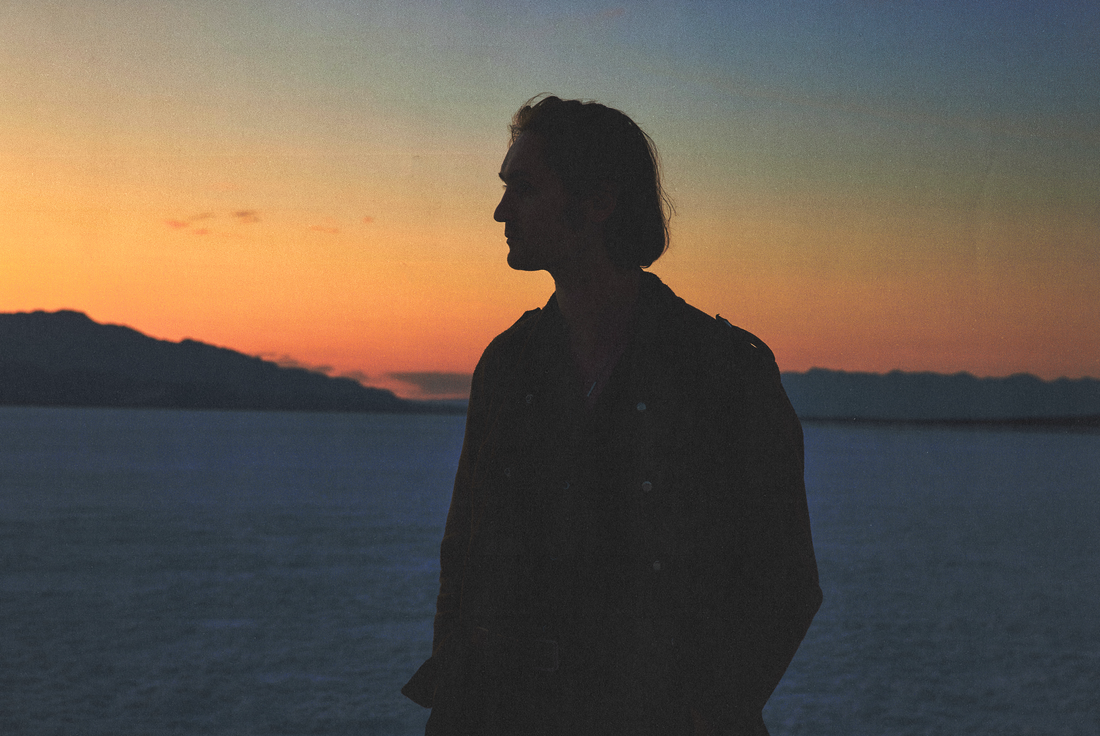
Photo by Wes Ellis
With a tender voice and a poetic heart, Miles Hewitt arrives at the third act of his career as a complex, sharply observant artist; someone who watches the world closely and turns it into music, without much concern for whether that music is built for algorithmic discovery. He reaches for technology sparingly, and always in service of the song, not to sound current, but to sound better. That’s the throughline of a creative soul more interested in craft than trend, more attuned to what a song needs than what a platform rewards.
Hewitt’s story starts in high school, where his music and poetry first marked him as someone worth paying attention to. In college, he found kindred spirits and formed The Solars, a band that described its own sound as folk tradition filtered through studio experimentation, with a pop sensibility that felt older than its years.
Gone solo, Hewitt has leaned into everything that makes folk rock endearing – gently strummed guitar, the warm pluck of bass, drums brushed in almost subliminally – paired with a vocal style that doesn’t sound like anyone else I can place, though Nick Drake and Elliott Smith could be considered touchstones. Vainglory arrives four years after the critically praised Heartfall, and pedal steel haunts many of its longer tracks, giving the record’s beautiful folk rock a cosmic-country pull. Eight songs, 51 minutes, including the sprawling, homestead-sounding 12-minute “Rock Me, Baby,” and yet Vainglory never once drags. If anything, it moves faster than its runtime has any right to.
There’s something genuinely special about this record and the way Hewitt carries it, and it was a real pleasure to sit down with him and talk through the different chapters of his career.
There’s some footage of you on YouTube when you were in high school playing music. And then some footage of you in your college band. I can trace the evolution of your sound from high school to today. The stuff you’re doing now doesn’t sound like what you’ve done in the past. Does each phase of your musical career feel like a chapter in a continual story or do you find yourself starting over with each new thing you do with very little from your past carrying over?
MILES: This is a really good question, and something I think a lot about. As an artist, I think of myself pretty openly and pretty positively as a perfectionist. I think that’s a word that I’ve really come to embrace about my relationship with making music. And so I think the overwhelming feeling when I look back on past work is of horror, and, and sort of, maybe, eventually, a bit of sentimentality, and sort of continuity between then and now. Because, of course, there’s a ton of continuity. It’s been me all along. I think I’m so much more interested in the next thing than I am the past things and where they came from. But yeah, I’m pretty conscious about my own evolution. I think that we live in a time in which we’re encouraged to self-mythologize a lot, and I think I self-mythologize just as much as anybody else does. I have my sense of what a particular record means to me, or, as I’m working on a group of songs, what that is capturing about my life at that particular moment in time, or whatever. And in a lot of ways, I think I’ve been kind of exactly the same guy all along, maybe just with different circumstances that I’m reacting to, or something like that.
I have some cassettes with interviews I did in college. I barely recognize my own voice. Your voice has changed as well. Besides your voice changing naturally, have you absorbed new influences as you’ve gone along that contribute to the way you sing now?
MILES: That’s such a perceptive question. I think when you’re young, your sense of your influences are maybe less visible to you in some ways, because you are just experiencing it all for the first time. You’re forming your relationship with music for the first time. So, in high school, I remember, for a few years there, it was like the Beatles and Dylan were my gods. And then, later in high school, I got really into Jack White, and there’s totally a period where I loved the White Stripes, and the Raconteurs, and all that stuff. So I can definitely hear the things that I was listening to, and the kind of masks or personae I was moving through one at a time, when I’m younger.
I do feel like that around the end of college, probably around the time that I had really started recording a lot, and therefore really hearing my own voice reflected back to me a lot, I’d literally just spent a lot more time listening to my own voice, I think there was a pretty conscious moment when I was like, “I’m not a trained singer. I hear people who grew up singing in the church choir or whatever, and I’m insanely jealous of people who started that young, because they have just a natural way with it,” and that wasn’t me. I got to the end of college, and I was like, “If I’m really gonna make this music that has this kind of depth to it, a real meaning to it, and a real, actual beauty to it — not just the beauty of ugliness or the beauty of casualness — but that was really gonna aspire to be a beautiful instrument, I’m gonna need to put the work in and really hone this thing into something.” So I think that was almost the moment when it was less about sounding like influences, or this kind of unconscious echoing of the things that I had already heard in other people, and I began to really think more about what’s special about this particular thing, and how can I bring that out?
There were a few years, right after college, and right before and as I was making the Heartfall album, when I was really thinking about the sound of my voice a lot, and what it could be as an instrument that would make it its own. And I’m still learning that. I still don’t love the sound of my voice through and through, but I don’t think anyone really does. We’re all hypercritical about that thing, for whatever reason.
You said you never had vocal training, didn’t sing in a church choir. Did standing up in front of people and reading poems give you the confidence to sing in front of people?
MILES: I was actually a singer before I was a poet. Although, we’re talking about high school, so it’s really around the same time. I think confidence is one way of looking at it. Another way of looking at it might be just a kind of mulish determination to cross the finish line, or to get there, which I think is what drives a lot of the art. That’s a lot of my relationship with artistry, it’s just obsession, you know? So, I’m not sure I would say that I was actually all that. I mean, I was confident in a way, because I wasn’t hiding from getting in front of a microphone or whatever. I’m not sure I would have called myself, I’m still not sure I would call myself ultra-confident in how that’s gonna go, or whether it’s gonna be worth — well, I shouldn’t say worth the listener’s time — but I don’t always know how it’s gonna go. I think, in a way, it’s almost more about the kind of repetitive practice, and the trying, and the trying, and the trying of it, in a way.
I watched the trailer for The Solars EP, and even from that I could tell you’re a bit of a perfectionist, not a “record it once and it’s done” guy. Are you someone who can knock out a song in a night and just let it be, or does that perfectionism pull you back in for more takes?
MILES: I don’t think I’ve ever done that, and in some ways I could see that being like a good psychological exercise for me, just to do it a very different way. But I’m also not convinced that I have anything that’s that special or interesting to hear, if it’s just the product of one night’s work or whatever. Maybe the point isn’t that it’s worth it to someone else, maybe that’s more of an exercise for me or whatever, but the Bible wasn’t written in a day. Studying poetry in college, there was a lot of talk about revision, and how you revise. I feel like I learned so much about, like, what if this period is a comma instead? Or what if you break the line here instead of there? There’s very minute-level stuff in poetry that you learn about through studying it, and I think I’ve always just, for better or worse, been drawn to art that is working on that kind of a scale. It’s definitely what I find myself most interested in doing. I love that question. It’s such a good question about, well, why not just crank something out in an evening? I’ll be thinking about that. I’m glad that you asked that.
Aaron Perrino of The Sheila Divine decided during COVID to write and record a song every day and post it for people to hear. It was a way to keep his songwriting chops up. Some were just 30 seconds long, some were a couple minutes, some of them were fully fleshed out. He used it as an exercise to write in different styles, maybe write a punk-influenced song or a country-influenced song. I thought it was an interesting exercise.
MILES: I love that idea because then it’s kind of almost like a theater piece where you’re inhabiting other people’s persona, or what they mean to you. I write that way a lot. I feel like a lot of people must write by thinking, “I hear this song as sung by whatever.” I know Paul McCartney was like, “I thought ‘Let It Be’ would be a great song for Aretha Franklin”, which is insane to think about. I think maybe there’s a maturity that I haven’t attained yet, or something, that would be to truly be that relaxed about songwriting and record making, where it’s just easy come, easy go, I’m just gonna wabi-sabi my way through writing. And for whatever reason, I’m still not that way yet.
It’s a terrible analogy, but it’s what separates McDonald’s from a fine-dining restaurant. You’re not the kind of songwriter who follows a formula, who writes for the masses. You take your time, you learn as you go, and you make sure it’s got the right taste. If it’s a little bit off, you try something different. You’re more fine dining than you are fast food as a songwriter.
MILES: That’s very nice, but we all love McDonald’s, you know? It has its place, too. Yeah, it’s interesting. I really wonder in ten years if I were to think about the same thing, where I’ll be at it, at that point.
Your last album came out four years ago, but you started some of these songs in 2023. Heartfall came out in 2022. Tell me what happens the day after the album drops through the release of this album.
MILES: It’s funny, Heartfall was the first album I made after moving to New York, the first one after finishing college. It took a while partially because of the pandemic, but also because it’s an album of large scope, with a lot going on. There was a lot of pre-production. Stuck at home during the pandemic, I had time to dream up very specific blueprints for exactly how I wanted different instruments to sound. I think of Heartfall as an album that composts a lot of influences and other artists’ work I loved. Not that it’s pastiche but it is mulching all these records I’d fallen in love with during college. Every song has a pretty different style from the others, though there’s a mood in common; sonically, they’re all going in different directions.
That album took probably a year to write and conceptualize, and another year to record, then came out in 2022. I remember thinking, “Okay, I’ve found who I want to work with in New York, I’ve written a bunch of songs in the meantime, I know my process now. The next record will take half as long, cost half as much, it’ll be a slam dunk.” Of course, it wound up taking twice as long and costing twice as much as Heartfall had.
In 2023, I started recording the album. That summer, I decided to do a long solo tour of the West, a very DIY tour, playing bars and DIY spaces, and tried to live that world for a lot of the summer. I went to a lot of places I’d never been, and haven’t been back to since. I loved being on the road, getting to travel that way. It was magical. Then I came back and thought, now it’s time to finish this record. I’d written more things along the way that felt like part of that world, that Western landscape and style. There was a specific feeling I wanted the record to have, and I was extremely perfectionistic and precious about it. Chasing that feeling down took pretty much all of 2024, doing sessions with different people, trying things, figuring out what would stick.
This is technical, but part of it involved recording live during a session, with fewer people in the room as I went on. At the first session back in 2023, the first and last songs on Vainglory were actually recorded when it was a five-piece band all playing live together. By the end of the process, I was recording with just drums, bass, and myself, then overdubbing later. It was a purifying, simplifying, zeroing-in process throughout, until the record finally had this slow, desolate quality I knew the songs wanted. By the end, the musicians were honestly like, “What was wrong with version 3? Why are we doing version 6?” There were many good versions of songs along the way. But if we’re really going to embrace record-making as this thing of artifice, of creating a mood, a real feeling, just because it sounds good doesn’t mean it feels right, or conveys the thing you want it to have.
So it was just a long and kind of meandering recording process, and we were done recording by early last year, and then we mixed it for a while, and now it’s coming out. So the actual recording of it probably took about two years and a half years.
Do you have anybody outside of maybe family, or people who played on the record that you throw music by to get their reaction?
MILES: Definitely. So many amazing friends all over the country, and world, who are really important to that. The very first person who comes to mind is my friend Sophie Strand, who’s a writer, someone I actually met during the recording of this album, who, I think, in a way, because she’s a writer and because I’m a musician, we have a really nice vantage point on each other’s worlds, where we can relate to a lot of the same dynamics and frustrations, and mundane stuff, and sacred stuff, about making art. But she’s been a person who I always really look forward to what she has to say. I just got a really sweet text message, right before this interview, from the friend who I was collaborating with, probably who you saw in that very silly Solars video that you mentioned. He was my co-pilot all the way through college, and we made everything together, and he lives in Los Angeles now, and he was just saying how it’s cool to have made all that music together and hear where it’s at now.
Do you think about writing in terms of days, weeks, months, years, as in, “I have to get something written this week” or it more of a “I’ll start something but not put pressure on myself on when it has to be finished”?
MILES: It’s funny, I’m a perfectionist and very, very, very impatient at the same time, and so there’s kind of a “it can never get done fast enough” thing. I’m most of the way through making another album right now that has come together in a very different way than that one did. And I would say that that has in itself been actually a really nice sort of insight which is, when I made Vainglory, it was the only project that I had, and so when I was doing it, it was very easy to just sort of put all my eggs in the basket of that record, and emotionally, it was so important and all-consuming to me. And now, having one record coming out, another record that I’m in the middle of recording, writing songs for probably some future thing, I’ve learned that it’s really good to have multiple dimensions all going at the same time, so that you’re not all tied to this one thing and feel like it rules you in quite the same way.
I am always really impatient for new stuff to be coming out, and to be finishing and stuff, but I’m starting to make peace with the fact that I can be simultaneously a releaser of music, a recorder of music, a writer of music, and a sleepy, exhausted, non-producer of anything, just to totally have nap time for a while, too. I think that’s part of the process.
What is the hardest part of making an album?
MILES: I think it’s all kind of challenging in its own way, and I think that’s what makes it enjoyable. I think recording is a really profound experience. The act of making a record for me is so many different things. It’s about bringing a particular group of people together to see what they will do. And it’s about simultaneously giving them the freedom to do what only they can do, and then also knowing when to be the boss, and rein it in, and be in charge. I experienced both extremes of that, in good and bad ways, while making this record. Times when it felt like the train was kind of running away with no conductor, and times when I was probably being too uptight about what we were aiming at.
I think recording is like making a movie or something, it’s so complex and multidimensional, and I think that’s what I love about it. I think the hardest part might just be knowing when you’ve got it because it can be a real hall of mirrors, it’s really a heady thing, and you can lose perspective on it. I think defining your goal can be challenging. But it’s also weird, because this record I’m making right now, here in Massachusetts, it actually feels so obvious to me when things are done, so it’s very different from the previous record in that way. It’s almost just like color by numbers, so it’s very weird to generalize about, because it’s sort of different every time. That was what was challenging about the last record, I’ll say.
When I look at track lengths on the album, and as I listen, I realize the songs are long. When songs are repetitive and just repeat the chorus over and over and over, that tends to drive me crazy. But, though your songs are long, they aren’t repetitive and I find myself wishing that some of them would never end. Are the songs long because you want to let them breath, or is it because you’re not good at editing yourself?
MILES: It’s nice to hear that they’re working for you. I think that question is better answered by each listener, probably. Some people are probably gonna be like, “Man, this guy could use a hedge trimmer on this,” and some people might be along for the ride.
I guess I’ll just say: I don’t set out to write long songs, that’s not a goal. One record that’s really important to me is David Bowie’s Station to Station, which begins with like ten minutes of moving through all these different ideas and sections. It’s sort of prog, but it’s also rock and roll at the same time, and it’s urgent. When I got into that record, it gave me some permission, like, you can make long songs that don’t have that later Pink Floyd sort of grandiloquence to them. And I love Pink Floyd, to be clear. But you can do songs that are as long as they need to be, basically, to say what they’re trying to say.
The one song on the record that was sort of half-intentionally long was “Rock Me Baby.” That’s the climax of the album, toward the end. It started out shorter, and then I couldn’t really figure out how to finish it. It sort of became this thing where it kept feeling like the song had more it wanted to say. In order to complete the song, it had to explode, it had to leave behind any polite notion of the listener’s time, and just be like, “We’re gonna do one of those Bob Dylan songs where you zone out, and three minutes later you’re like, oh my god, he’s still going.”
My favorite song on the album, “Throw Wide Your Window,” is seven-and-a-half-minutes but it’s a song that I get lost in and lose time. There’s a band I like called SUSS that plays ambient country and incorporates pedal steel into their music. There are some moments in “Throw Wide Your Window” that sort of remind me of the style of music they create.
MILES: The guy who plays pedal steel, and also electric guitar on most of the lead parts on this album, is Jack McLaughlin, who is a friend of mine in New York. Truly virtuosic, phenomenal musician, can’t say enough good things about him. And he played a lot of electric guitar on the Heartfall album. And I don’t really have much of a relationship with country music, you know? It’s not in my world much at all. But he started, as I understand, when he got to New York, he sort of learned the pedal steel as a second instrument because he wasn’t getting gigs on guitar, because everybody already had a guitarist even though he’s the best. So he learned pedal steel, and rapidly became one of New York’s main pedal steel guys, which just shows you what a freak he is. When we started making Vainglory, I had just sort of expected that he would show up with… it’s funny, he calls it “horizontal guitar” and “vertical guitar,” you know? So I thought he was gonna play vertical guitar, but then he started showing up with the pedal steel, and it just gave the songs this whole other color. I feel like that and my Martin acoustic guitar are almost the two main colors of the album. And that wasn’t something I planned at all, that was just someone bringing something else in, and we had so much fun just exploring what the pedal steel can be, outside of the super licky, honky-tonk thing. It’s like a violin, really. It’s so beautiful and tragic sounding, such a gorgeous instrument.
There are some familiar names in the press material that was sent out about the album – Neil Young, Pink Floyd, Tim Buckley. And then there are some that are a little less familiar to me – Gene Clark, Labi Siffre.
MILES: Gene Clark was in The Byrds, and he’s mostly remembered now for this insane album called No Other, which was one of the most expensive records ever made at its time, and just extreme, it’s so 70s, it’s so decadent, and sort of kind of coked out. It has that darkness to it, in a way, but it’s really beautiful and sublime at the same time. And Andy Cush, my friend, who is the guy who wrote that press release, I think what he was probably hearing was a similar kind of high production value, glossy sound, but also with this kind of melancholy quality in the center of it all.
I wasn’t actually that familiar with Labi Siffre’s work, because this was all Andy’s writing, and he was a London-based songwriter in the 70s who did some very beautiful acoustic music, and some sort of more R&B-like inflected, funkier, blacker kind of music. So I think that was Andy’s reference for “Say Goodbye,” which is kind of an outlier on the record in that way.
Going back to the song lengths, when you’re writing songs and sequencing and all that stuff, are you planning for a physical release? Are you thinking, “I have to put these songs in this order so that I have an equal amount of music on Side A as I do on Side B”?
MILES: You’ve deduced something that happened with this record, which was that when it got finished, it was 52 minutes long. That’s just too long to fit well on a single LP, or so I was told. I thought about this a lot, I agonized over it. I didn’t want to make it a double album. It’s not a double album, it’s eight songs long, you know? So I wound up just sort of forcing it onto a single album.
And I just got the test pressings for it, and I just want to say that side B, which is 26 and a half minutes long, which they tell you is way too long to fit on a single side, sounds great. It might have like 10% more crackles and pops than it would otherwise, but honestly, I think it’s all a myth. I think you could probably put 30 minutes on an album and it would sound okay. I can hear my mastering engineer howling at me for saying that, but I really do think that. So many different people were like, “You can’t do it,” and I was like, “A double album, aesthetically, is wrong, and it’s so expensive to make a double album, and you have to sell it to people for like $50 to make it cost effective.” I didn’t want to do that.
So I don’t think a lot about that kind of thing as I’m making it, and sometimes I wish I did, but you never know.
What’s the song, album or artist that, when you hear, takes you back to something very specific from your past?
MILES: That’s such a good question. This is what’s coming to mind: I’m up here in western Massachusetts right now, making this album and visiting a friend, and I lived here for a little while, right after college and before I moved to New York. And when I was writing a lot of the Heartfall songs, I got really into Radiohead at that time, that was a big influence. But also, the album that I really associate with this era in my life — that no one knows about, because my friends made it, but you should hear, and is truly one of the most remarkable records of the past ten years — is this album called Cousin Moon, by a band called Cousin Moon, who were based in western Mass, and were kind of why I decided to move out here in a lot of ways. It is a truly unique tour de force of songwriting and production. It’s such a world, it’s so green and lush and beautiful, and it does so many different things so well. And I remember driving around — I had it on CD — driving around here and listening to it all the time. I truly think that record is like one of those, like Nick Drake, one of those albums that no one knew about when it was happening, and then, 20 years later, everybody’s gonna be like, “That’s my favorite album ever.” So I’ll say that’s it. The specific memory is driving around western Massachusetts that first year after college, and feeling kind of lost and confused, and having this really beautiful album to listen to.