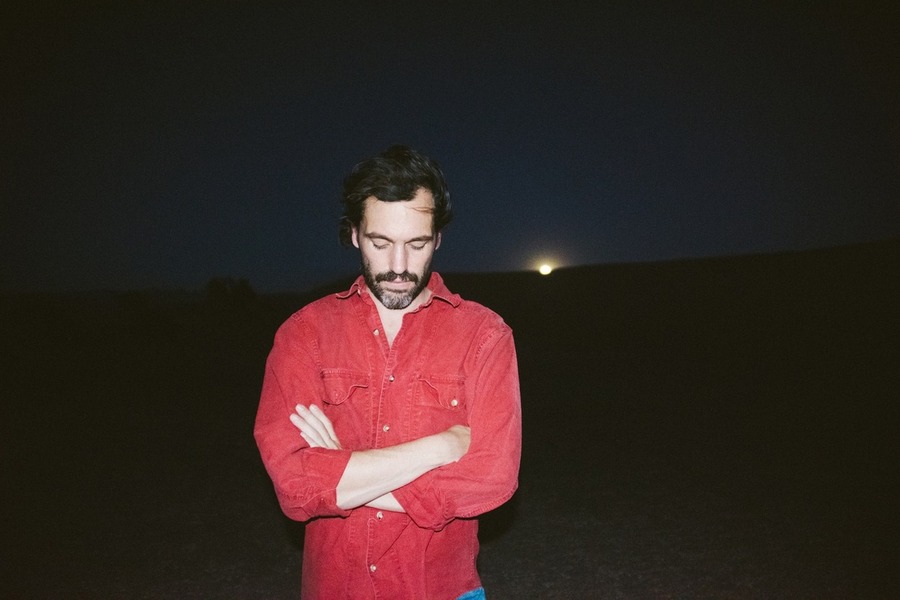
Photo by Julia Brokaw
Robert Francis announced himself early. His 2007 debut One by One, released when Francis was 20 years old, carried the kind of quiet confidence that gets people talking, and sure enough, Atlantic Records came calling. His second album, Before Nightfall, landed a modest hit with “Junebug” and found an audience in Europe, charting at #17 in Germany, but American listeners largely looked the other way.
Still, Francis kept writing. Six more albums on a variety of labels followed over the next decade, the most recent being 2020’s Amaretto, before he eased into fatherhood, into the quieter work of production and let the performing life idle for a while.
He was beginning to stir again, new material taking shape, when the wildfires tore through Southern California in early 2025. The damage reached his family directly: his mother’s house, his sister’s house, both damaged but not destroyed. In the upheaval, Francis’s sister, a devoted collector of analog synthesizers, moved to the East Coast and handed her instruments off to her younger brother. They came to him dirty, smelling of smoke, filmed in soot.
He cleaned them. And somewhere in that process, those synths found their way into the new music in ways Francis hadn’t anticipated, pulling his sound, long rooted in the sun-warmed folk of ’70s Laurel Canyon, somewhere stranger and more exploratory than anything in his catalog. Nine albums in, he’s found a new musical voice.
In the conversation that follows, Francis talks about the long road that brought him here, what the fires took and what, unexpectedly, they left behind, and how a collection of smoke-damaged instruments ended up pointing him toward the most exciting music of his career.
Back in 2010, I compared your songwriting to artists like Springsteen, Pete Yorn, and Ryan Adams, writers who seemed wise beyond their years. This new album, though, really sounds like the work of someone who’s grown into that voice.
ROBERT: That’s a good thing. I was thinking about One by One and Before Nightfall, my first and second record, and how I wouldn’t be able to make those records now if I tried. I would not know how. Some artists are able to replicate something over and over again, but you probably get those kinds of records once or twice, because so much changes.
Who did you consider your peers back in 2010?
ROBERT: My record came out on the same day that Ryan Bingham’s first record came out. There was Dawes, that I sort of grew up with out here, and another band called Chief. That was sort of the thing that was happening back then. But, in retrospect, and I don’t know if it’s my personality or whatever, I was hell-bent on doing it alone, and not leaning on any friends, not leaning on anyone. I think to have proper success in the music industry, especially in those early days, you need to be propped up and going out there with a group of people, like a scene of bands that sort of play together. For whatever reason, I just went it alone.
You grew up playing music. As a teenager, you joined your older sister’s band, Hello Stranger. And, your sister was married to Ry Cooder’s son. It seems like you could have asked for some help as you were starting out your solo career.
ROBERT: That was pretty much my world. It was just my sister and Joachim, and then Ry was this sort of elder statesman who was very opinionated and had strong beliefs that, still to this day, it’s hard not to take what he says as, like, the Bible, the truth. He speaks it very well, it’s very convincing.
Early on, I think I probably ended up saying no to certain opportunities. There used to be such a thing as selling out and having to figure out how to have success. Now, with branding and the way the world is, there’s no shame in doing so. But yeah, I probably could have tapped in a little more, especially with the Ry thing. I went out with him playing bass on the Prodigal Son tour, and I opened up some of the shows solo. People were just looking at me, scratching their heads, so I don’t know.
You have a connection with another band that I thought should have been huge – The Shys. They were L.A. based and I’ve always wondered if they would have had more success if they were part of the New York scene that birthed bands like The Strokes.
ROBERT: Alex (Kweskin), who played bass in The Shys, is still a dear, dear friend of mine. They were just a few years older than me. They got to see the final days of Sire Records, the huge deals. Back then, it was like, “Are you getting a $350,000 record deal, or are you getting a $500,000 record deal?” And then having that totally implode. A lot of bands could not recover from that. For whatever reason, I think that’s what happened with them.
Do you consider what happened in your career around that time an implosion? Did you have to take a couple steps back and figure out what was next, or was it always keep hustling and keep finding whatever’s next?
ROBERT: I think with my career, I was probably just not mature enough, and I really think that’s what it comes down to. A little bit cocksure back then, in a way that you’re not able to really see what’s in front of you, not able to view things as, “This is a great opportunity,” or “This is something that may not happen again.” I was like, “I know my path and this is cut out for me.” Every decision I made, I assumed there would be something else in line waiting behind it to my detriment. There was a bit of naivety coupled with a lot of people just telling me totally different things.
When I delivered my record to Atlantic Records, people did not like it. I remember we played them Before Nightfall and our guy looked like he wanted to cry, not in a good way. They were like, “We wanted another One by One, that’s why we signed you. We wanted this lush landscape thing, and then you went and did this other thing.”
Before Nightfall became a success in Europe, and at least got my foot in the door here, and then people decided that they did like the record. But at that point I was already like, “This means that I have license to go create.”
When I was doing my third record, I was like, “I’ll go back and try to create something more truthful to what I started with.” I probably overproduced that third album like crazy, and then we went through the thing that all bands go through, where you deliver it and they don’t hear the single, and they’re like, “Go back and record more.” At that point I was like, “I will not play ball.”
My manager at that time had clout with Atlantic, and we were able to walk with the record. But that was sort of the beginning of the end of the major label trajectory. And then people started wondering, “If this record was a success for him in Europe, why is he having problems with the label?” They smell blood in the water. If it’s not working, there must be a problem with the artist. I think there was a bit of a problem. I mean, I was pretty out of my mind. But yeah, that’s how it all went down.
Did you take a break around that time? Did you have a moment where you thought that maybe music wasn’t going to sustain you?
ROBERT: Right after I did a record with Vanguard and EMI, this was like 2013-ish, that was really the end of all that. It coincided with meeting a girl and going up to the Upper Peninsula of Michigan, to Copper Harbor, the most northern point you can get on the map and parting ways with my manager, calling everybody, and being like, “This is the end.”
At that point I’d been going for years and years and years, sort of non-stop. It was the first time I could imagine a life outside of music and not having to be on that path anymore. That was sort of the first small break. Then I released a couple records with Aeronaut, but they were very small, just a couple of shows booked here and there, sort of all based around my mental capacity to be able to handle this sort of thing.
Then in 2018, I moved to Nashville and signed with BMG and William Morris. I made a record down there, and it was another sort of classic self-sabotage thing. I’m going down there, everybody expects me to make a record that can cross over, and I ended up buying an 8-track tape machine from Luther Dickinson and made almost what ended up being a lo-fi record. It’s kind of hard to listen to, but I do stand behind some of the songs.
After that, COVID started, and I decided to come back to LA because I thought I should be with my mom after my father passed. During that time, I had kids, and then basically took a real hiatus until now.
Was it a conscious effort to get back into writing, recording and releasing music? What was the inspiration to start a new chapter?
ROBERT: Having kids puts all of it into perspective, in such a way that I realized I was overthinking everything. I had allowed my experience with the music industry to seep in, in some way, to the work. And that experience sort of seeped into my views on success and what success is. After having kids, I felt this feeling of what I suppose I always imagined success was, where all of a sudden I have enough, and I don’t need any external validation. I was able to step into my own shoes again and begin creating without that albatross, that sort of looming feeling in the corner all the time. That, coupled with building a studio and doing a lot of production work, I was finally able to make an album in a way where I’m not burdened, where the clock isn’t like, “Hey, create something genius; time is money.” I was able to take my time to craft something. I’ve come out of it without expectations and been able to dredge up a bit of a flame that burns for myself and no one else.
Do you feel like this is the most real album you’ve ever made?
ROBERT: Every album, when you’re making it, is the best album you’ve ever made. One of the blessings about experience is having gone through it enough that I know now when I’m creating something, I know when I’m going to think it is the best thing I’ve done, I know when I’m going to start hating it. It’s almost the same arc every time. So now when I think it’s the best thing I’ve ever done early, as it’s happening, I’m very careful not to fall into that.
With lyrics, I can go back and I can certainly say these are things that will consistently resonate with me. I can sort of pick them, and they will take me back to a place and time, and I can associate that with moments in my life. That’s become the barometer.
I certainly know this is the best sounding record I’ve done. It’s certainly got the best guitar solos I’ve put on a record. There are some great lyrics, and there’s some weird stuff on the album too. I think a lot of this was an exercise in not overthinking it, and purposely putting things on the album that I, in another life, would have been too insecure to put out, like a weird vocoder, synthesizer-heavy, tube and throat singers track. Time will tell, but I certainly love the album.
The way “State Line” starts, I was thinking, “Am I watching The Exorcist, or some sort of 70s psychological horror movie?” But then as soon as you start singing, it’s like, “Oh, there’s Robert Francis that I remember.” It totally makes sense to me. I like the different stuff. It gives your music a little bit of a different flavor, although at its root it’s still you. The synths on the album are ones your sister gave you. Had you toyed around with them over the years or was this your first time playing them?
ROBERT: I toyed around with them here and there. Along the way, working at certain studios, I would say I’m actually pretty familiar with synths. I’ve played a lot of them over the years, whether working at different studios or just being at my sister’s house. But this was the first time I’d had them in front of me and been able to play them for hours. There are certain instruments — the pedal steel, the Hammond B3, and I would say the Prophet 5 — these are instruments that you can play for hours and sort of get lost in. They do something to the core. They resonate with a lost feeling, and you can get mesmerized by them. I’d never really considered that an analog synthesizer could have that sort of profound effect, but it does. It’s very much alive. These analog synths are very much living, breathing organisms.
I don’t know anything about synths. Could you walk into a store now and buy a modern version of one of the synths you played on the album or are these lost in time?
ROBERT: There are certainly analog synths that are still created. They make a new version of the Prophet 5 that is also analog. I haven’t done my due diligence to play the reissue, and I’m sure they’re fantastic. There’s something about the unpredictable behavior of old synthesizers, or any old instrument. As Ry always says, he wants a guitar that has heard the lonesome whistle blow, that’s been around since the dawn of time. I feel that way with these synths, there are all kinds of happy accidents that occur, and I’m not sure that happens as much with newer gear. People talk about this all the time. There are some fantastic plugins, like VST synths that Arturia makes based on the original synthesizers, fantastic tools for working and writing. But there’s this extra maybe 5% to 10% that I find makes all the difference. It really becomes about how these things live in a track, in the form of a song. You can have the new stuff and it’ll sound perhaps good on its own, but once you start stacking things on top of each other and add a guitar, all of a sudden the new synthesizer, the VST, is not sitting in the mix the way that a real analog synth does. It gives you that little bit extra that has this weight that you cannot replicate. Once you start hearing them within the track, I think that’s where you can really tell the difference.
As you were writing these songs, were they already written and then you added synths after the fact, or did the synths serve as the inspiration for the songs as you were writing?
ROBERT: Most of the songs started off as poems. I’ve been trying to write this book of poetry for probably close to a decade. That is the ultimate war that I go through within myself. I’ve set the bar so high for myself and what I expect from it that I don’t think I’m ever going to be able to release it. But I was able to take a lot of those working poems and craft them into lyrics. I was afforded the luxury of being able to write a lot of these on the synths, and then being able to pull some lyrics over here and tailor them to the orchestration. I probably recorded around 26 songs. These are the ten, maybe more cohesive ones. I plan to release more later, but those other songs would have been maybe a little bit less synth-driven. I feel like these were all very much their own grouping.
Do you feel like each side of the record has a different flavor?
ROBERT: I do. I think it’s front-loaded with some of what I would consider the more traditional tracks. I used to believe that when viewing a record as a whole, you probably want to have some of the more esoteric songs next to a more pop-minded song, so you can go back and forth and don’t have too much of one thing. But for this album, I wanted it to be like the first five songs are a bit more pop-structured, and then the second half of the album is where we ride off into the weird sunsets.
Will touring be part of your life again or has that ship sailed?
ROBERT: I played two shows recently. I hadn’t done it in a second. The amount of work it takes to just play one show, especially if you haven’t been doing it for a minute: teaching everyone the songs, remembering the keys, having to go back into the catalog, remembering lyrics. I went to my sister’s house, she’s in New York, and I found the original touring van that we had when I dropped out of high school and joined her band in, like, 2005 or something. The Econoline, the 15-passenger van. It had been sitting. I think I had to pay three years of registration to get it out of purgatory. It had been sitting at their house, almost abandoned. I got that van up and running, and I was surprised by the amount of joy that it brought me. I never got the feeling that I’m too old for this.
There’s something about piling into a van with your friends and musicians and just hitting the road. Even for the very short time that I moved to a tour bus in my career, I did miss the van. There’s something about it that tunes you into where you feel the miles, and you’re really connected to the road and your surroundings.
I wrote my little team of people and said that I would like to do more. I think I probably missed this summer, everything needs to be booked in advance, so next summer we’re working on stringing a lot of dates together.
You’ve got two young sons. Were they able to see you play at either of the recent shows?
ROBERT: No, they did not come to see me play, but I would like them to. They know what I do from a production standpoint. On our property, down the way, there’s the studio. They come and knock on the door and want to see what’s going on. They know what I do, but they also don’t know what I do, especially as a performer. I suppose I’d want them to know that I had this whole life that existed before them.
Your family was affected by LA fires. I have to imagine that was an emotional toll. Even just watching it on the news, it’s so devastating.
ROBERT: I have so many friends who’ve been directly impacted by it. I hate to think that someone would think I’m trying to capitalize on, or get notoriety from, the fires. But fires have always been such a strange part of growing up here. There was almost like a delayed reaction, from those of us who didn’t lose our homes. You just grow up with this thing that’s always around the corner. I’ve had fires a few miles from my mom’s house growing up. I remember waking up and seeing a huge fire over by the Getty Museum and just going back to bed, not even notifying my mom. And then this happened, and you just remember the sheer power, what nature is capable of, and how fleeting everything is. It’s something that is snowballing, and I’m feeling it more and more, because now there’s so much separation between me and my sister and my family. Her kids and my kids growing up together, and now they’re not because she moved. The more time that passes, I feel like the distance grows larger and the gap is much more vast. It’s not going away. That put a lot of things into perspective for me. It’s almost like a fugue state. Even though it’s right in front of you and happening, you can’t quite understand it.
Did your mom or sister lose their houses?
ROBERT: No. My sister’s house was uninhabitable after the fires. It didn’t burn down, but it was filled to the brim with soot, just caked in everything. It had to essentially have the remediation, all that stuff. They had to go through basically everything and throw out a lot of stuff. And then, of course, it’s just the bizarre way that fires work, where you’ll have a block that’s fine, and then the next block over everything’s gone. Three houses that are totally fine, and then one totally scorched, and then six that are fine, and then just total devastation. Their kids’ school burned down, which is in Altadena. So many friends lost their homes.
Did any of that work its way into your lyrics, or were the lyrics already written?
ROBERT: For the most part, the lyrics were already written, and I don’t think I would have had the capacity to process it all that quickly to write about it. Especially with this album, one of the disciplines or practices I’m trying to utilize going forward is that I want to be careful not to be too topical about songs. In the past, I would have a topic or something on my mind and I’d be like, “I’m going to write about this.” Going forward, I’d like to write less about something, as opposed to letting this thing kind of bubble up beneath, and the subconscious sort of dictates what it is. Once you craft the song and it’s all together, then you’re like, “Oh, now I know what I was writing about.” Now that I’m getting back into writing, I’m seeing a bit of that come up in my writing. On this album, it didn’t really go into the fire stuff so much, but now I’m sort of seeing it, a year later.
The album is called Phantasmagoria and there’s a song called “Phantasmagorical.” What was it about these words that appealed to you?
ROBERT: The word itself is one I’ve always loved. I think there was a point when I dropped out of high school and I didn’t want to fall behind, so I was on this warpath to illuminate myself. I was reading Ask the Dust, and Bandini’s character was reading Schopenhauer and Nietzsche, so I picked up maybe Thus Spoke Zarathustra. There were certain words — brazen, naggish, phantasmagorical — that I loved. This became a working title for a song. Then once we completed the album, I was racking my brain, like, “What few words can sort of encompass this little journey?” That was the only thing I just kept returning to, this phantasmagoria, these ever-shifting, multicolor, multi-faceted, dreamlike scenarios, vicissitudes, things that are ever-changing. That’s sort of how I came to that.
Before we wrap up, I wanted to ask about your work with Marla Moya. I saw a post on your Instagram account about her new record so I checked it out and really love it. How did your relationship with her start?
ROBERT: She came to a show, I think it was the Before Nightfall Tour, maybe 2011 or 2010 at some point. She came to a show in Germany. She was a kid back then, she was about 15. I met her and her parents at that show. She’s a classical cello player, and I think she told me that after that show, she was inspired to write her first song. She had it in her for a long time. When the time was right to make a record together, we connected on Instagram, and she came out and recorded that album here. It’s pretty cool that it goes back that far.
I always hate telling artists this, because it’s not an insult, but I listen to her music a lot when I go to sleep.
ROBERT: I’ve paid that compliment to certain artists as well.
It’s just a good way to settle down at the end of the night and throw that record on. I really like her voice, I just like the sound of the whole record. You talked early on about not taking advantage of certain relationships you had. Is there anybody today that could help you? Do you have anybody in your contacts that you’ve known or crossed paths with? If you don’t want to name the person, that’s totally fine.
ROBERT: One that just immediately came to mind was Taylor Hawkins of the Foo Fighters, but he’s passed away. He was someone who said, “When the time is right, we’re gonna bring you out with us.” He grew up, and went to high school, with my sister Carla’s husband, Hans. I knew him when I was a kid. When I was just starting to play guitar, he invited me to the Malibu Inn when I was in 8th grade to play in his cover band. He played a bit of a paternal role early on.
Is there a song like that, when you hear it, you’re transported back in time to something specific?
ROBERT: The one that is coming to mind is Karen Dalton’s “Something on Your Mind,” off the record In My Own Time. There was just a point in time in which all these things coincided at once. It was my first great heartbreak. It was after dropping out of school. It was right around the time I was writing and recording my first album, and it was a really tender time. I think I’d heard all the music that I could possibly hear, and I dug into all the Springsteen records and the Dylan records and Neil Young and those types of artists. I felt like “well, this is it for music, I guess.” And then someone dropped me a hard drive of all this amazing music of unsung heroes. When I heard that song, the world exploded. I was like, “There’s more out there that I don’t know anything about.” There’s something about her voice that is so raw, and it’s real, and that song takes me back. Every time I hear it, I’m right back there. Sometimes you don’t always want to go back. But when I do, that’s one that is coming to me right now.
Do you get to listen to music now, or are you stuck in a kids’ music world?
ROBERT: That’s funny, because going into being a parent, I sort of was up on my high horse, like, “I’m never going to listen to that music, and never going to subject my kids to this kind of stuff.” And lo and behold, I have Spotify and got my year-end breakdown, and it was just all weirdo children’s Christmas and Halloween playlists.
Now when it comes to music, it’s become a bit more ceremonial. There’s a time, and it’s almost restricted to vinyl. It’s when the kids are asleep. I’ve been listening to a lot more classical music. I have to make it a thing I’m going to do later, music is not casual anymore. I’m also very careful not to listen to music when I’m driving or during the day, because that’s when all the songs and the melodies and thoughts come to me, when I’m in that quiet. Now I have to set aside time and make a date for myself to listen. It’s fun listening that way. My kids have a balance, they do listen to good music as well, but they love the Goosebumps.