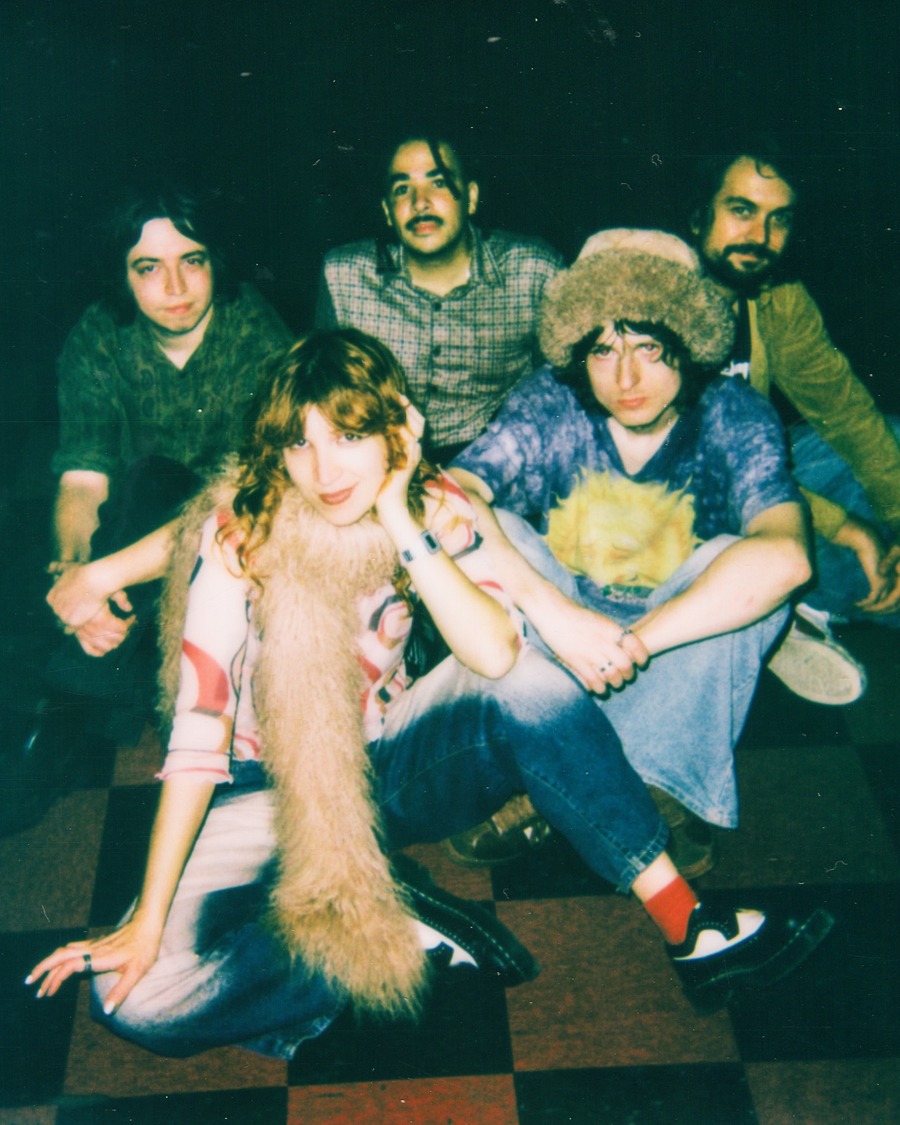
You can often guess a band’s sound by where they come from: a young NYC group with a gritty edge, or a guitar‑driven Alabama act with a Southern Rock feel. But that logic falls apart with Twen, the duo of Jane Fitzsimmons and Ian Jones. After eight years of living a nomadic, van‑based life, they’ve freed themselves from the expectations tied to any one place.
Now marking their tenth year together, Twen has shaped a sound as fluid as their lifestyle. Their newest release, Fate Euphoric, plays like flipping through the Turner Classic Movies channel (a favorite of Fitzsimmons and Jones) where every film tells its own story yet shares a timeless, cohesive aesthetic. The album moves from the dreamy, subtle shoegaze pop of “Godlike,” to the new‑wave groove of “Chase You,” to the funk‑infused, classic‑rock guitars of “Starmaker” to the sunbaked psychedelia of “Tumbleweed.” There’s no obvious entry point; every track feels like it could stand as its own single.
In the ‘90s, a major label with a deep bench of behind‑the‑scenes support could have pushed an eclectic album like this across multiple radio formats and print outlets. But today’s landscape is different, and Twen largely navigates it themselves in true DIY fashion. With only so many hours in the day to handle the administrative load that comes with promoting a band, and without a publicist, Fate Euphoric didn’t benefit from months of advance teasers. As someone who receives dozens of emailed press releases, I’d heard (and loved) “Godlike,” but the album’s November release completely passed me by. Because of that, it was never under consideration for my “Favorites of 2025” list, despite how strong it is.
Despite juggling tour preparations and busy schedules, Fitzsimmons and Jones were quick to respond when I reached out and kindly made time for a Zoom chat about Fate Euphoric.
Do you consider Twen to be a DIY band?
JANE: We’ve set up our own label. I would love to meet the person that could do absolutely every single part of it on their own, but that’s the limitation of DIY. You do have to work with other people; it’s not completely solitary, but I think more community-based or relationship-based. That’s how we like to think about it.
We were booking our shows up until 18 months ago. We have our friend Chris, who Ian went to school with, who is our booking agent. It’s a relationship we have, we even dog-sit for him. Then we just started with a person to help us with the more tech side of Meta and the disgusting inner workings of all of that. He’s based in Canada, and he’s going to come to our show when we play there. It’s very person-to-person based.
IAN: We’ve never been bankrolled by anybody else, so we have done everything ourselves. That means all of the creative aspects, all of the merchandising, all of the financing, the booking, all of the production, the engineering.
For this new record, we did a small PR campaign with somebody who did it on the cheap for us. She has a job at a label but was freelancing for us. Same thing with digital marketing. We’ve been a band for almost 10 years and this is the first time where we’ve ever had a marketing budget.
I’m really thankful our first record was put out on a small-to-mid-sized indie label because it shows you all the inefficiencies of even small bureaucracies and the ways in which organizations spend money that you wouldn’t spend as an individual. Knowing what parts of that budget and that record advance got spent where was a very educational thing. It’s allowed us to make smart decisions with how we spend the little bit of money we do have. I tend to think that we’re pretty fucking efficient compared to most other bands on labels.
The algorithm worked for me; I discovered you when the “Godlike” video was served up to me on YouTube this past summer. That song is such a great way to be introduced to your music. I didn’t realize the record had come out until about three weeks ago.
IAN: It came out November 4th. Year-end “wraps” are such a thing now because of Spotify. I don’t know that it was a good time to release the album because people were already deciding what their year-end lists were. “But you haven’t even heard our record yet, so how could you know what’s in your top ten?”
JANE: I don’t even care. We decide everything by when it’s convenient for us.
IAN: November 4 was an election day; it was a Tuesday. We got several comments from people who said, “I remember when release days were on Tuesday.” That tends to be how we do things. We’re not doing it the way you’re supposed to be doing it.
JANE: People are still discovering our last release, One Stop Shop, which came out in 2022. We’re not caught in the hope of “it needs to do so well in the first week of release.”
IAN: Our ethos tends to be: if it’s good, it’ll reach people in its own time. You don’t really have to worry about doing X amount of singles staggered four or five weeks apart.
I’m paraphrasing a bit here, but there’s a quote I remember by a journalist: “There’s a kid every single day discovering the Beatles for the first time, and for that kid, the Beatles is a brand new band.” The idea of timing reviews and best-of lists around a release date is arbitrary. If it’s new to us, then it’s new.
JANE: Spot on. We hear that so much. It matters more to us whether it is sustainable and convenient for us to make the thing so that we still have our enthusiasm and we’re not burnt out. Waiting for the first record to release when it was “the right time” felt so stale; it felt like it came out too late.
IAN: You get all these middlemen. Lawyers will kick a contract back and forth for six months, while their fees go up, splitting hairs over the legalese. You get managers who think you should do six singles before the record comes out because they have their strategy. By the time the record comes out, it may not feel right.
JANE: No one knows shit anyway because there’s so many outliers that prove the rule wrong. That’s why with “Godlike,” we actually consulted an astrologer for what date it should be released.
IAN: The astrologer said August 12th after she compared both of our charts. She was like, “August 12th is the date to communicate for you guys.” And we did it, and it’s been the fastest-growing single that we’ve ever had, a quarter million hits on YouTube now, and we didn’t put any money into it. It was all organic. The astrologer was fucking right.
What does the phrase “fate euphoric” mean to you? Is it intentional that the album opens with a song that has “fate euphoric” in the lyrics and then closes with a song called “Fate Euphoric”?
JANE: I’m glad you noticed. With everything we do, it’s intentional, though it does feel like it just happens on its own. Similarly to how people say a book or a record is writing itself, I’m just half-present mind and half autonomous.
That phrase, “fate euphoric,” comes from this word-salady, melody-driven place. That phrase, “fate euphoric,” showed up in one song, and then it showed up in another song.
IAN: Jane was just singing along to a loop I had going, and the phrase kind of downloaded for her.
JANE: That’s not an intuitive phrase. We even had some misspellings already, like “Euphoria,” because there’s a very popular show named that. We thought about if it was too close to another word, but we liked using a term that wasn’t so pedestrian.
IAN: In terms of the first and last song, it was like films where you have an overture at the beginning and a closing sequence …
JANE: … that brings you right back to the beginning. That was the concept of the record itself, a wheel.
You mentioned that you had TCM (Turner Classic Movies) on during the writing and recording process. Are there any songs on the album inspired by movies or TV shows?
JANE: There’s this 1971 film called The Boyfriend with Twiggy. It’s set in the 1920s and has these big stage production, chorus girl scenes. It felt like a music video. We used that as an inspiration for the “Allnighter” music video, with the moon shape and that ‘20s feel. We couldn’t replicate the production of that movie, but the video was inspired by it for sure.
When you start writing a new album, is it built from the ground up?
JANE: No, that never really happens for us because there’s always something we left on the table with the last one. There’s a guitar riff or a vocal melody or lyrical concept that’s really cool but we ran out of time or it wasn’t hitting.
IAN: Both of the last two records have had records that preceded them that we scrapped, more or less, and we’d end up wiping it and saying, “Let’s start again.”
JANE: That was the case for “Godlike.” The chorus was actually an outro to another song that I actually hate now. The melody was very repetitive, so we scrapped the song.
IAN: So that outro became its own song. Then the bassline from that song became the bassline for “Starmaker.” We’re always harvesting organs.
IAN: About half of Fate Euphoric had instrumental parts that go back two or three years. “Tapdance in Limbo,” “Keep Your Company,” and “Godlike” are all two or three years old. “Tumbleweed,” “Prelude to Waterloo,” “Allnighter,” “The Center,” and “Fate Euphoric” are brand new. They only took five or six months from start to finish.
Did making the record feel like a struggle, or did the music just fall out of you?
JANE: The writing process is my favorite part; I wish I could be doing that all the time though I love touring and making all the visuals. But the actual recording was a bit painful. We were in many different locations and using our drummer, Forrest Raup, who is in Brooklyn. We’re not in Brooklyn all the time so it was remote, lots of files going back and forth, and just getting the right sound. Ian was taking the brunt of everything. I’d say it was some of the least painful writing, it felt really easy to come up with new things.
IAN: When we get bitchy with each other, it’s not about the music; it’s about patience. One of us wants to get it done and the other needs more time to develop a riff. I start to lose my mind because you’ll be making a demo and just throwing shit down on tape for fun, and then you go back to re-record it and you can’t figure out how you got that original guitar tone. I can’t find the line between what was a demo and what should be the final record. Demos often become the final record. You’re working in the same session for a year as it evolves and grows and it becomes hard to see the forest from the trees.
Jane’s first vocal in the demo will always have this really special something. If she writes something and immediately puts it to tape, it comes out immaculate. If you go back a month later to do the final take, it sounds contrived. There’s a beautiful saying from the Nigerian author Chinua Achebe, a saying among kids that the “first voice” always makes it to God. That makes me think of you, Jane.
Do you ever think of your songs as siblings? For example, “Keep Your Company” feels like it inhabits the same world as “Godlike.”
IAN: I’m glad you noticed that. That’s how I think of songs like the Beatles’ “Day Tripper” and “Paperback Writer.” I don’t know if they were an A-side and B-side on a single, but I know what you mean.
JANE: I tend to think of “Ha Ha Home,” from our last record, and “Godlike” as siblings, even though they’re quite different. There’s also “Tapdance in Limbo” and “One Stop Shop.”
For these past two records, I’ve viewed the track list as a pie graph: you have a funk element, an up-tempo rock element, a groovy loop-based element, and a ballad. I think about how much of each type I’m willing to put on an album so that the listener doesn’t get too much of one thing.
The songs are each rather unique in their own right. Do you think of them as chapters in a book with a common story or are the more like short stories that are part of an anthology?
JANE: Short stories. If I had enough time, I would create a whole visual world for each one.
IAN: Our voices are what links everything together, but I think Twen, as a project, has an incredibly wide and diverse palette. We never want to write the same song twice.
I think of our albums like Sgt. Pepper or the White Album, where each song has its own identity, like a cast of characters. If there are ten songs, there are ten different characters, and each needs to be identifiable. It’s like reading a book where all the characters might have similar pedestrian names, and you’re like, “Wait a minute. Which character are you talking about?” If you read Dickens, every character has a very distinctive name, and you don’t get confused when you’re reading trying to figure out who is who.
JANE: It’s a reaction to the streaming era, where tracks are often pushed forward because they fit into the background or sound like hundreds of other songs with the same tempo and delivery and production style. We want to avoid that; we don’t want you wondering if you’re still listening to the same song ten minutes later.
Are you considering 2026 the kickoff to the album cycle and touring?
IAN: Oh, 100%. We just did a leg in November right after the record came out. We did two and a half weeks in secondary markets and now we have over 50 shows coming up this year. It’s funny; the record came out at the end of 2025, but it’s going to end up being a 2026 record for most people.
Now that you have three albums worth of material, is it becoming harder to decide on a setlist?
JANE: It’s a new problem that we’re getting used to. People send messages ahead of time like, “Can you play ‘Brooklyn Bridge’ or ‘The Center’?”
IAN: “If you don’t, I’ll cry.”
JANE: And sometimes we miss those messages or we don’t put the song into the setlist on the right date.
IAN: The most beautiful part of this band is that everyone’s entry point is a different song. If you polled ten people in the audience, you’d get seven or eight different favorite songs. That is the biggest compliment because the people are not just there for one or two songs. We hear the gasps when we go into a deep cut that wasn’t even a single.
We have 3 records and 3 EPs. We have enough material now that we could easily play for two hours. At our sold-out Nashville show in November, I realized by the end of the night that we had just played an hour and a half of straight bangers. The audience was jazzed up for every song.
Do you find it satisfying to move on from your older material?
JANE: I was happy to move on from some of the songs on the first record because I’ve been doing them for so long. I don’t hate our old songs like some bands do, but I’m a better songwriter now than whoever I was when I wrote those songs. We don’t have room for those songs in the set anymore.
Is there a song or an album you constantly turned back to in 2025?
IAN: I tend to think more about films, to be honest. I have a really hard time listening to contemporary bands or our peers. But for inspirations for the record, one influence on “Godlike” was a record I was into when I was a kid by Nujabes. It’s Japanese ambient hip-hop from the early 2000s and the record was called Modal Soul. He has a song called “Reflection Eternal” that I grew up listening to. With “Godlike,” the way the guitars wind up and the riff interacts with the loop was me trying to put my own spin on that song.
Another artist we listened to last year was Lal Waterson. She was a folk singer in the ‘60s that was sort of parallel to Fairport Convention. She put out a record a few years before she died that’s just her voice and her son on a solo electric guitar.
JANE: It’s very spooky and haunting.
IAN: You don’t always hear an older woman’s solo project stripped down like that; it’s totally bewitching and beautiful, quintessentially English.
I have a theory that certain songs can physically transport you back in time. For me, it’s Tone Loc’s “Wild Thing,” it takes me right back to being 17 and trying to use a fake ID in Cleveland. Do you have a song that does that for you?
IAN: Definitely. Jessica Pratt’s first record takes me straight back to being 19 and first getting together with Jane.
JANE: I close my eyes and I’m back in that 100-person room at the Great Scott in Boston, which sadly isn’t there anymore, just totally mystified by her voice.
IAN: If I hear The Cranberries’ Everybody Else Is Doing It, So Why Can’t We?, I’m immediately in the back of my mom’s car.
JANE: My oldest sister introduced me to a lot of music, specifically the “cool St. Louis” scene at the time. There was a “Three Bens” era: Ben Folds, Ben Lee, and Ben Kweller. Ben Folds holds a really special place in my heart. My sister had all of his CDs, would go to all of his shows. As an 11-year-old, I was like, “This is so cool.” I was hearing these storytelling songs that bring you into this world, like someone taking acid and going into a tree or “Brick,” the abortion song. My adolescent brain would try to figure out what was going on.
——————————————
Visit twenband.com to view all upcoming tour dates.