
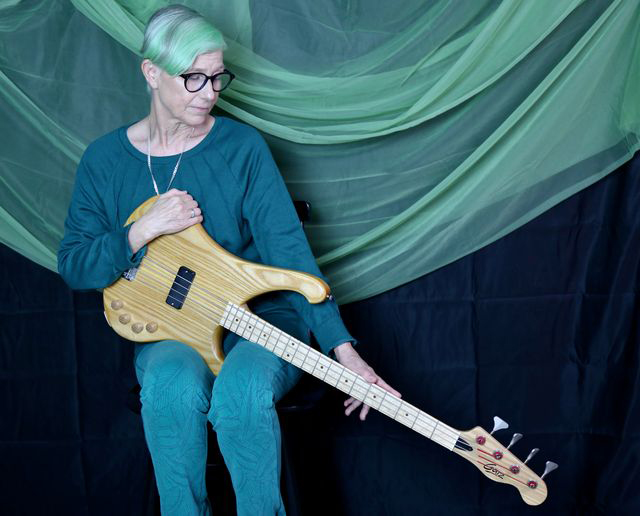
Bassist Kira Roessler remains a staunch advocate for continuously pushing creative boundaries. She has re-imagined the capabilities of her respective instrument by fusing multiple genre nuances within her songwriting to challenge listeners. “Even in rock, bass can do amazing things. I always feel as a player, it was my job to do what was right for the band. Leaving spaces within song allows for more interplay and real opportunities to push your writing limits,” said Roessler.
Her forthcoming solo record, Enigma, is perfectly titled, marking a true superlative for her uncompromising approach to music. With compositions featuring dark interludes, unique melodies, and even an homage to Black Flag’s Drinking and Driving, Kira affirms that giving music time and space to transform naturally remains one of her songwriting goals. Following her 2021 solo debut, Kira demonstrates more precision on Enigma, but retains all her unique songwriting to share a more cohesive, organically flowing record. “This record has more groove, Kira groove,” laughed Roessler.
Best known as Black Flag’s bassist during their evolution from hardcore punk to a more innovative, sonic assault built on guitarist Greg Ginn’s free jazz writings, Kira was tasked with helping propel the group forward during its most divisive time. Long-time fans were perplexed by Ginn’s stylistic shift and singer Henry Rollins’ beginning path toward spoken word, starting with his more active role as a lyricist. “It’s funny because I was blamed for changing the band, even though Greg had a lot of those new songs written before I joined,” said Roessler.
Her first record with Black Flag was 1984’s Slip It In, which already featured slower and dark dirges that were in marked contrast to the hardcore the band had been credited for building. “It was Greg’s band, and he steered the ship, but I had the chops to bring his writing forward, and I knew my role and knew what he wanted,” she said. “We knew playing the new material live would evoke strong reactions, and it’s what we wanted; we were ready for that. Punk is non-conformist, and it doesn’t have to be restricted to sound a certain way,” stated Roessler.
Black Flag maintained grueling tour schedules, which Kira said the band was nice enough to accommodate her class schedules while she attended UCLA for engineering. It wasn’t uncommon for the band to be on the road for several months, and often playing multiple sets daily. “Greg was absolutely dedicated. Even during soundchecks, he would push to attempt playing a full set,” laughed Roessler.She stated Greg was motivated to share Black Flag’s music with as many people as possible, and if it took playing cities ‘off the beaten path’ multiple times, he would embrace the challenge. “He was driven to bring his music to them. There were tours where we would play the same cities multiple times because Greg wanted people to experience Black Flag,” recalled Roessler.
The band would ultimately suffer from a clash of egos between Ginn and Rollins, but their creative evolution was not readily embraced by the subculture they arguably helped build and propel, leading to fans claiming Black Flag has a mixed legacy. “What we were doing felt right to me. I understood people looked at us like scum beneath their shoes and I didn’t care because we were working to blaze a trail and do something different,” said Roessler.
Black Flag would go on an unprecedented creative tear, releasing new records in rapid succession, and record The Process of Weeding Out, an all-instrumental album without their most recognizable member, singer Henry Rollins. Within the liner notes, Ginn clearly made a statement of intent: Black Flag was going to find out which members of the punk subculture were ready to embrace a new change, and despite legal resistance to the band’s music, convictions, and artwork, they were willing to move forward on their own, uncompromising terms. “It was a challenge to fans, but Greg was once again willing to take a risk. I know people always wanted to hear the old songs and we got a lot of flak, because they wanted faster songs and we would just go out and play six-minute dirges,” laughed Kira. Black Flag ended when Greg abruptly called Rollins to quit his own group in ‘86 and focus more on his post-Black Flag songwriting with Gone. Kira likens bands to a multi-person marriage, with the likelihood of everything working out to be quite slim. She reflected on Black Flag’s final tour and the group’s impending disbandment by Ginn. “Before the last tour, I knew I was going to get kicked out because I saw Greg do it to our drummer, Bill Stevenson. That was a big loss because he’s an excellent, rock-solid drummer and he was my emotional support system. I was told by their manager, former bassist and co-founder Chuck Dukowski, that they didn’t wanna play with me anymore. I was fine with the decision, and it was no surprise. I just wanted my bass amp back. I never regretted a thing, and it was an awesome and unique experience,” reflected Roessler.Ginn has often been described as mercurial, and Roessler said she believes he prefers solitude. “We all had our moments on tour, for sure. I could have my own bitchy moments because on tour, there’s just no privacy. Henry wanted to be left alone a lot, and if it were up to Greg, he would just be alone playing guitar for like 12 hours a day; that was just him,” laughed Roessler.
Her post-Black Flag years proved to be rewarding, but much like her tenure in the band, Kira had to show relentless dedication. “After graduating from UCLA, I worked within computers and as an analyst. It was challenging, but then it became disheartening because I felt there was no appreciation. I eventually met someone working within student films back in 1997, and he had this tiny sound company that I worked hard to get my way into,” recalled Roessler. She laughed when saying she willingly accepted $8/hr. to do ‘grunt work’ such as billing and advertising, but she leveraged that to create an opportunity to learn more about film dialogue editing.
“That is what really helped me move forward. People are not as willing to mentor now as they were years ago, in my opinion. I learned those skills and was later introduced to other alumni who were working on bigger projects. That is how I got into film dialogue editing, and I would bust my ass to do editing and chop scenes to make sure everything flowed seamlessly.”
Working within the film industry, she said now and then someone would mention there was a woman with the same name that played in a punk band. “Yeah, I would sheepishly laugh and say, umm, yeah, that was me. I played in Black Flag. They would pause and say, ‘You’re THAT Kira?’ It can be funny when that still happens, and it actually allows for a chance to make a connection with someone younger, and I find that important.”
Roessler never turned her back on music or songwriting, and having met and ultimately married Mike Watt of Minutemen in 1987 gave her a new opportunity to create a different songwriting path. Initially meeting Watt during her tenure in Black Flag, they had already engaged in songwriting together, and formally began their project Dos back in ‘85. Both bassists leveraged their versatility to create an all-instrumental record in ‘86, followed by an EP in 1989. “That was a good transition phase, and I had a good partner in crime,” laughed Roessler.
“We were together in the trenches playing shows and seeing different reactions to the crazy stuff we were playing. I would find myself always writing, even if I wasn’t in a group.” The couple separated in 1994 but remained passionate about Dos, releasing Justamente Tres two years later on Kill Rock Stars Records and Dos Y Dos in 2011.
Mad Max: Fury Road earned an Oscar award in 2015. “I approach it like a puzzle. How can I work to fit these pieces together to salvage the work and make the client happy? Music challenges my emotions, and this work challenges my brain.”
She also shares she maintains the same rage and fire inside that motivated her during those extensive and grueling Black Flag tours. “Those feelings haven’t changed, but I express them differently now. I express sadness and anger in my new music. To me, music is always about making people feel something. The fun part for me is digging within myself and finding new ways to evoke a reaction while saying something that can still move me when I am creating it.”
https://orgmusic.com/blogs/news/kira-roessler-enigma
https://www.instagram.com/kira_bassplayer/
Photo: Rachel Roessler