Author Steven Blush is acclaimed for American Hardcore, widely considered an authoritative voice that chronicled the Punk sub-genre, but his latest book, When Rock Met Hip-Hop completes his ambitious trilogy exploring rock music’s crossover to different genres and cultures. His new title demonstrates how the sharply contrasting genres of rock and hip-hop successfully transcended strict cultural and musical boundaries.
“I really feel the shift of both genres coming together marked the merging and melding of creativity and culture, and this is key to what I wanted to highlight,” said Blush.Critics cite the Blues as the main foundation for Rock’s impetus, but the artists responsible for propelling their respective genres forward were not always intimately involved in creating side-by-side. Blush works to show how rock and hip-hop artists were more creatively intertwined, sharing similar goals of capturing unrest, the disaffection of their youth fan bases, and challenging creative idleness with new sonic responses to accepted cultural norms. The Clash created an entirely new fan base by incorporating reggae and funk into their politically charged songwriting, and embraced hip-hop in its earliest incarnation by collaborating with graffiti artist and rapper Futura 2000 during the early ‘80s. Blondie earned commercial success with her 1981 single, Rapture, featuring her collaboration with Bronx-based hip-hop artist Fab 5 Freddy. The Bronx enabled early hip-hop to flourish. Backgrounds of urban decay, the explosion of graffiti street art, economic recession, and youth unrest helped propel the emerging genre forward. Did rock’s fan base share the same social outlooks as hip-hop?
“I think the genres share similarities in some of the lyrical content. Completing this book gave me a stronger appreciation for hip-hop,” shared Blush.
Blush uses Rick Rubin and Russell Simmons for the foundation of When Rock Met Hip-Hop, due to their legacy of beginning Def Jam Recordings in 1984, which became home to trailblazing artists such as Beastie Boys, Public Enemy, and LL Cool J. Simmons brother, Joseph Simmons co-founded legendary hip-hop group Run-DMC under his stage name Run (DJ Run), whom Blush celebrates for playing an integral role of uniting hip-rock and rock.
“Rock Box by Run-DMC was groundbreaking because it featured an electric guitar with rap songwriting. It was also heavily played on MTV, and that gave hip-hop a crossover exposure to rock fans,” recalled Blush.
Perhaps the most pivotal, mainstream moments for rock crossing over to hip-hop took place in 1986. Rock group Aerosmith continued to experience a decline in mainstream sales and the support of critics, further driven by substance abuse. Run-DMC were on an opposite trajectory, with their ‘85 record King of Rock being certified platinum, and they performed to an audience of 100,000 during an appearance for Live Aid in Philadelphia, with music journalists crediting them for being the first mainstream hip-hop group. Rubin had reached out to Aerosmith’s management about collaborating for a re-recording of the group’s song Walk This Way, originally appearing on 1975’s Toys In The Attic.
“When Aerosmith got together with Run-DMC, it was groundbreaking. Walk This Way was very powerful, and it helped Aerosmith get back on track while further pushing Run-DMC to new heights. The song undeniably further introduced hip-hop to the mainstream,” stated Blush.
1986 also marked another pivotal moment as the collaboration between hip-hop group Beastie Boys and thrash metal guitarist Kerry King from Slayer powering No Sleep Till Brooklyn. The Beastie Boys were already enjoying mainstream success by touring with pop icon Madonna, and sparring with media outlets critical of the group’s lyrical themes of adolescence, partying, and sexuality. Their debut record, Licensed to Ill, was released in 1986, and No Sleep Till Brooklyn surprisingly united thrash metal and hip-hop.
“Rap was at the intersection of fashion and art, and the ongoing rise of b-boy culture, competitive dancing on the street, was showing how powerful and diverse hip-hop was. Slayer was the only thrash metal group on Def Jam, and Rick Rubin worked closely with them. Guitarist Kerry King played on No Sleep Till Brooklyn, which was kind of a full-circle thing because the Beastie Boys began by briefly playing hardcore,” said Blush.
Licensed To Ill became a massive success, but Blush shared a funny anecdote regarding King’s compensation for No Sleep Till Brooklyn. “King was paid like $250 for his contribution or a point on the record. Obviously, knowing what we do now, he probably should have taken more,” laughed Blush.
When Rock Met Hip-Hop also chronicles the relationship between the thrash metal band, Anthrax, and hip-hop icons, Public Enemy. Public Enemy’s front man and lyricist Chuck D. noted Anthrax guitarist Scott Ian was a fan, often wearing a Public Enemy tee while stomping onstage. Public Enemy’s track, Bring The Noise first appeared on their 1988 record, It Takes a Nation of Millions to Hold Us Back, and it featured a verse shout-out to Anthrax. Three years later, Anthrax and Public Enemy collaborated for a new edition of Bring The Noise, and a highly successful co-headlining tour. The re-recording of Bring The Noise, titled Bring Tha Noize closed out Public Enemy’s ’91 record, Apocalypse 91…The Enemy Strikes Black.
“That was such an important connection because thrash metal did not have a strong crossover to hip-hop before Public Enemy and Anthrax. Anthrax explored hip-hop before with their 1987 I’m The Man EP, but collaborating with Public Enemy was huge because of the intensity of Anthrax and the political themes of Public Enemy. They created a whole new audience,” reflected Blush.
Blush’s appreciation for rock and hip-hop crossover extends to the West Coast, where he celebrates impactful groups such as Faith No More, Rage Against The Machine, and Ice-T’s group, Body Count. Ice-T maintained he always had an affinity for punk, metal, and hardcore, and appeared on the 1993 Judgment Night soundtrack with Slayer to cover a mash-up of Exploited songs, beginning with War.
“Not everything on Judgment Night worked for me, personally, but it was important because at the time, there really wasn’t anything like it. It had so many diverse bands working together to meld rock and hip-hop, and a lot of it was intense,” said Blush.
In retrospect, Blush has worked to build a prolific writing career, despite admitting he failed English in high school. “I was actually told I couldn’t write, but in college, I did contribute to the alternative paper and got good responses. My path into hardcore was great, I enjoyed it, and I would book shows in DC. When I eventually went on to write American Hardcore, I really had no idea how successful that book would be 25 years later,” said Blush.
American Hardcore evolved into an acclaimed documentary directed by Paul Rachman, premiering at the Sundance Film Festival in 2006. Blush’s book has since been expanded into a second edition, published in six languages. He remains committed to the written word, challenging himself to complete new titles at a rather frenetic pace, while his music journalism pieces have appeared in over 25 major publications.
“I do believe in the power of the written word. Reading and writing are the core of civilization, and if they are not practiced or preserved, that is the death knell. I am worried about AI and the ability to have writing completed automatically because to me, that’s not true writing,” he stated.
Asked if he ever feels concerned that his debut, American Hardcore, will still overshadow his newest titles, he remains grateful for the accolades and continued support.
“That book has certainly gotten the most attention, but I never see that negatively. If people choose to remember me and my work just from that book, so be it. All you have is your best work and the ability to evolve it. I wanna believe the written word will prevail in this so-called digital age, and writing has been a wild and incredible ride in my life,” concluded Blush.
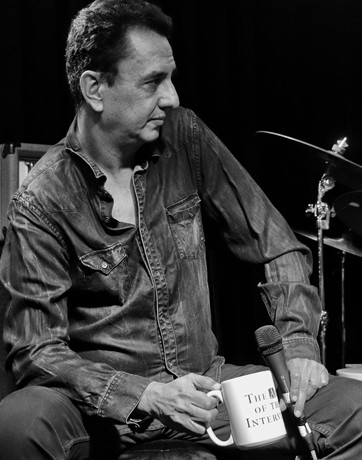
Photo: Steven J. Messina