Going back at least a decade now, Zev Feldman, AKA the Jazz Detective, has been displaying, indeed, practically flaunting his ability to find superb live shows from various jazz (and, sometimes, blue and soul) legends and luminaries across fifty-plus years. Thanks to the familial labels Resonance and Elemental, and his own Jazz Detective and Time Traveler imprints, he continues to unleash these concerts upon both a grateful populace and jazz fanatics. For Record Store Day (and a week later on CD), a veritable tidal wave of releases have washed over us, including this fine quartet by jazz pianists of different visions.
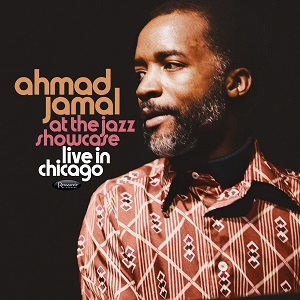
In many ways the granddaddy of modern jazz piano, Ahmad Jamal stood on the foundation built by Art Tatum, Bud Powell, Lil Armstrong, Jelly Roll Morton, and the other early pioneers, and erected an edifice only he could have designed. Jamal had the amazing ability to perform lines and melodies that most people would refer to as “busy,” while making every note choice, every distinctive chord inversion, sound smooth, logical, and even necessary. His powers blaze away on At the Jazz Showcase: Live in Chicago, a sterling set recorded in 1976 at the titular club. By this point, Jamal had not only inspired new generations of pianists (not to mention, famously, Miles Davis), but had listened carefully to them as well. Thus he attacks the standards and originals here with both unusual (for him) ferocity and the same care he’s always given craft and tuneship. That means he gives beloved standards like Duke Ellington’s “Prelude to a Kiss” and Rodgers and Hart’s “Have You Met Miss Jones” a fresh modern shine while staying true to the spirit of the originals, as well as implanting himself firmly in the seventies with crackling takes on Antonio Carlos Jobim’s “Wave,” his massively epic original “Swahililand” (and its clever interpolations), and, of all things, “Theme From M*A*S*H*.” An essential release for Jamal and piano jazz fans.
Bill Evans established himself as a jazz titan almost immediately after arriving on the scene, and for good reason. Besides a seemingly inexhaustible library of standards in his bespectacled head (like Jamal, he wrote his own tunes, but generally preferred to play other people’s), Evans was a near-matchless improviser – he could play the same song six times in a row, and it would be both different and still instantly recognizable every time. Thus live Evans albums have been the backbone of Feldman’s work, with at least seven out there already; At the BBC makes number eight. Joined in 1965 by his mid-sixities rhythm section of Chuck Israels on bass and Larry Bunker on drums, plus BBC announcer Humphrey Lyttleton adding commentary between tracks, Evans performs what for him was a typical show – filled with tunes familiar to his fanbase, but still unique until itself. Check out this take on the leader’s “Re: Person I Knew,” one of his prettiest tunes – the band lovingly infiltrates it, shaping their improvisations into new countermelodies, or this version of Evans fave “My Foolish Heart,” an already gorgeous tune made more so here. The trio swings delightedly through “Someday My Prince Will Come” and “Israel,” burns through Miles Davis’ “Nardis,” and dances with ease through the Evans classic “Waltz For Debby.” It’s a superb performance; as Israels says in one of the CD booklet interviews, “We were damn near perfect at the BBC.” Clearly.
Mal Waldron played with Abbey Lincoln, Steve Lacy, and Charles Mingus, as well as accompanying Billie Holiday in the last years of her career. He brings all of that experience to bear on the 1979 set caught on Stardust & Starlight, his first at Jazz Showcase. He kicks off the show solo with a take on his Holiday co-write “All Alone” that’s so beautiful it’s spine-chilling. Joined by Wilbur Campbell on drums and a pre-*Pat Metheny Group* Steve Rodby on bass, Waldron cranks up the intensity on “Fire Waltz” and Ivie Anderson’s “All God’s Chillun Got Rhythm” (from the Marx Brothers’ A Day At the Races, of all places), painting a perfect watercolor of tuneful improvisation and fiery group interplay. Later solo performances of Johnny Mercer and Jimmy Van Heusen standards “I Thought About You” and “It Could Happen to You” and Thelonious Monk’s “‘Round Midnight” rely less on firepower than on Waldron’s attention to melody – he strips his technique down very nearly to the basics, oozing soul along the way. Decks thus cleared, he brings the rhythm section back for a winding, swinging, joyous run through “Stella By Starlight,” giving new life to one of the most recorded and performed standards of all time. Maverick saxophonist Sonny Stitt takes the stage for the final tunes, helping Waldron wrap up with some seriously romantic playing on “Old Folks” and “Stardust.” This is the kind of show you hear and think, “Ah, now that’s jazz.” Wonderful.
After three masters who consistently pushed themselves beyond the edge of their envelopes while still remaining within the tradition, an album by the Cecil Taylor Unit could come as quite a shock. But Fragments: The Complete 1969 Salle Pleyel Concerts contains just as much sonority, skill, and soul as the Evans and Jamal albums. A revised reissue of the beloved live LP Nuits De La Fondation Maeght, Fragments documents two hours of thematic improvisation by a short-lived Unit featuring saxophonists Jimmy Lyons and Sam Rivers and stalwart Taylor beatkeeper Andrew Cyrille. The quartet rampages through three different versions of “Fragments of a Dedication to Duke Ellington” as if it was the last time they’d ever play the piece – Taylor ripping across his keyboard like he wants to hit every note before the measure ends, Cyrille bashing away as if he’s trying to capture the beat before it escapes, and the horn players adding melodies and countermelodies over the top like they were just trying to hang on, man. Themes do emerge from the controlled chaos – whether those themes have anything to do with the titular genius, only Taylor can say. But there’s a throughline here, rather than just random explosions and sudden cracks in the dimensional wall. These guys are listening to each other, pushing Taylor’s vision forward, backward, and side-to-side, while the leader keeps the momentum roiling. Fragments may not sound much like the other albums in this series, but it truly is of a piece with them.