
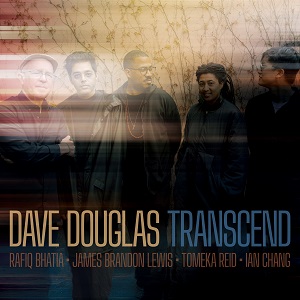
Clearly Dave Douglas is feeling it in 2026. The trumpeter/composer has already released the remarkable Four Freedoms this year, and now he’s lined up album #2. Transcend reunites the band with whom he recorded the exceptional Gifts: saxophonist James Brandon Lewis, guitarist Rafiq Bhatia, and drummer Ian Chang, adding the extraordinary Tomeka Reid on cello. While Gifts paid tribute to Duke Ellington’s co-composer Billy Strayhorn, Transcend salutes the man himself, with a similar blend of challenging originals and Ellington classics.
As on Gifts, Douglas takes advantage of his players’ unique skills. As members of experimental rock band Son Lux, Chang and Bhatia know how to casually kick holes in musical boxes – the latter in particular draws sonics out of his set-up that don’t sound merely like a pick on strings. Lewis has spent the last twenty years forging an adventurous, personal vision as a musician, and his boss encourages him to exploit even while taking direction. Similarly, Reid has quietly and determinedly redefined the role of her instrument in jazz, understanding exactly when to add virtuosic riffs or shimmering atmosphere – or to blemish the boundary between those approaches.
Douglas and the band perfectly illustrate the album’s vision on “Energy Fields.” The expansive tune folds in the leader’s sonorous tone, Reid’s pointed countermelodies, Chang’s bashing rhythms, and Lewis’ circular harmonies, tying it all together with Bhatia’s dreamlike web of textures. It’s a nearly eight-minute tour de force, a masterclass of how to lead a band by using your musicians’ best, most exclusive qualities – exactly how the Duke would’ve done it. The equally epic “Curious Species” takes a similar, near-orchestral approach, adding a swath of free jazz into its bracing middle passage. “Argle-Bargle” adds a shot of cheeky fun to the program, its bent New Orleans rhythm and unison riffing accessible to anyone, but especially to listeners with a sense of humor.
When the band essays actual Duke tunes, the results shine as brightly as on the Douglas originals. “Come Sunday” adopts the proper elegiac tone, “Heaven” luxuriates in the beauty of its melody, and “Oclupaca” swings exactly as its composer intended. The Douglas piece “Slabs” follows “Oclupaca” and acts as an extension of it. “Slabs” doesn’t swing as hard, but it sounds like a natural outgrowth of its predecessor – at least until the distorted guitar, pizzicato cello, and freeform drumming take over.
The quintet ends Transcend with the title track, a less intense, but still compelling flow through jazz harmony, experimental ambience, and tight musicianship wielded like watercolors on a canvas. Douglas clearly understands what makes the music created by his inspiration great, while not being slavish to the qualities that tie it to its time. Transcend may pay tribute to a past titan, but it’s a modern jazz album through and through.