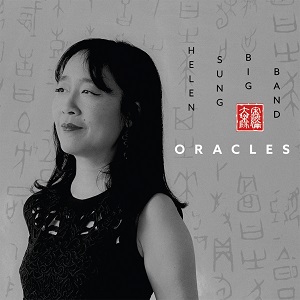
Back when she was in the augural class of the Thelonious Monk Institute of Jazz Performance (now the Herbie Hancock Institute), pianist Helen Sung had an incredible gang of mentors: Clark Terry, Ron Carter, Wayne Shorter, Jimmy Heath, Barry Harris, Kenny Barron, Herbie Hancock and Sir Roland Hanna. Twenty-plus years into her career, she pays tribute to those forces in her life with Oracles, which doubles as her first album leading a big band.
She opens with “Convergence,” a tune she originally recorded on 2018’s Sung With Words, and it’s easy to see why. Taken at a brisk and breezy place, the tune serves as an emotional overture of sorts, setting a tone of both reverence and fun. From there she tips her hat to many of her teachers with both originals and classics, often back-to-back. For example, she and the band nod to bassist supreme Ron Carter – the Institute’s artistic director at the time of Sung’s studies – with her frisky, sprawling “Mr. Virtuoso,” before slipping into said virtuoso’s own tune “R.J.” She uses the same method in reverse for Shorter, starting off with his gorgeous ballad “Diana” and segueing into her own richly harmonic tribute “Wayne’s World.” (She clearly couldn’t resist.) Sung hits the same notes in the same order for Terry, but sticks to only one piece for Heath with “A Little Bird Watching,” which cannily nods to Heath’s own influence from Charlie Parker. Being the dynamic pianist she is, Sung big-ups the keyboardists in her life with a three part suite entitled “Pianism,” shouting out Harris, Barron (to whom her own melody-first playing bears the most resemblance), and Hancock with swinging melodies and clear affection for each. Sticking with the piano theme, she closes the album with the granddaddy of hard bop, the innovative Horace Silver, and his soulful, shimmering standard “Peace.”
Sung brings all of this devotion to her formative influences to life with a flair for big band arrangements that speaks of a deep love of that method of delivery. She sounds like she’s been leading big bands all her life, with a strong understanding of the way a large ensemble works and the ability to write music that suits it. That means that even if the larger concept of Oracles passes you by, you can still appreciate the skill and dedication that went into making it, and enjoy it for the excellent big band jazz record it is.