
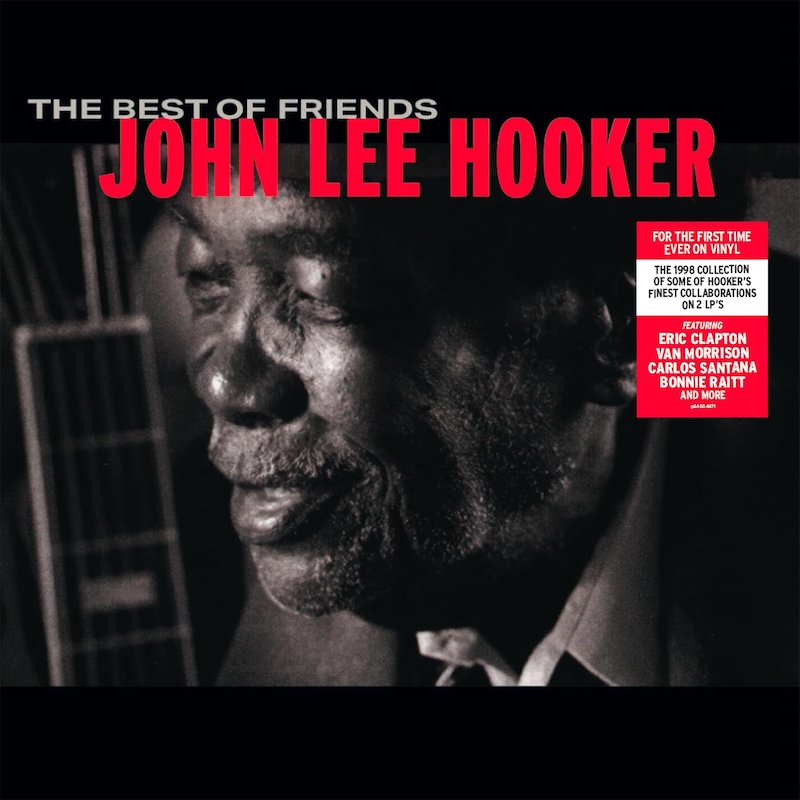
The set begins with a new version of “Boogie Chillen,” in which Hooker describes his own history as a newcomer to Detroit. Eric Clapton adds his British blues guitar alongside Little Feat keyboardist Bill Payne’s deft touch on piano and drummer Jim Keltner’s sturdy backbeat. “This is Hip” features the sound of Ry Cooder’s ace tone, slide guitar, and gospel-infused harmony vocal arrangement. Nick Lowe adds reliable bass, and Chuck Berry sideman Johnnie Johnson plays sparkling piano. With Keltner’s drumming alongside Lowe and Cooder, the song included the backbone of Little Village.
The title track to The Healer championed the blues as a balm against stress, and its parent album offered life-altering success to Hooker. The song itself suffers somewhat from the period-specific production choices of Hooker’s guest. Carlos Santana’s spark-shooting guitar dances alongside Hooker’s vocal ad libs, and both ride a percussion-heavy latin-pop groove like a subdued version of “Oye Como Va.” That’s good fun. Chester Thompson’s light and airy synthesizers, however, suck the blues out of the sound and would be more appropriate in a “quiet storm” lite-jazz arrangement. Booker T. Washington’s soothing gospel organ brings the set back to earth for the hymnal “I Cover the Waterfront” from Mr. Lucky and the song’s portrait of a man pining at the dock for his lover’s return by ship. The song also features Van Morrison’s soulful take on the melody and an intertwining duet with Hooker. Morrison reappears on the title track from Don’t Look Back, leaning into his improvisational style of mellow but potent Irish jazz.
Guitarist Jimmie Vaughan, recently departed from the Fabulous Thunderbirds, lashes into Hooker’s bristling classic (and 1992 title track) “Boom Boom.” The set follows with the simmering Grammy winner “I’m in the Mood” from The Healer. Hooker and Bonnie Raitt remake the 1959 single with hot-blooded vocals with amorous soul moaning. Raitt’s stinging slide guitar licks add spice throughout.
“Burnin’ Hell” is the set’s second newly-recorded track. Guests Ben Harper and Charlie Musselwhite offer spirited assistance with as much personality as possible on lap steel and harmonica, respectively. However, despite the song’s pedigree from albums including 1971’s Hooker ‘N Heat (with Canned Heat) and 1964’s original Burning Hell, there’s not really much of a tune underneath the propulsive but monochromatic two-beat blues groove that is newly grafted to the song. Hooker’s musings on the hereafter remain best represented by his solo acoustic treatment from 1964.
The updated version of “Tupelo” drawn from 1995’s Chill Out, however, makes a spellbinding companion to the song originally included as “Tupelo Blues” on 1960’s The Country Blues of John Lee Hooker. Hooker accompanies himself on guitar sans guests, with his tapping foot heard as percussion in the story of a small Mississippi town devastated by torrential rain. The song carries even more grim weight with 35 years added to Hooker’s voice.
Robert Cray adds his streamlined blues style to “Baby Lee” atop Scott Matthews’ rumbling drums. 1956 Vee-Jay classic “Dimples” was originally recorded with Jimmy Reed’s band. The quintessential delta blues is remade with the unmistakable sound of Los Lobos. David Hidalgo and Cesar Rosas weave guitar lines while Conrad Lozano plays a beatific walking blues bass line. Steve Berlin unleashes fat baritone saxophone licks, trading with John “Juke” Logan’s wailing harmonica.
Santana returns for “Chill Out (Things Gonna Change),” again with Thompson’s fairy-dusted synthesizers. Cooder’s reappearance on “Big Legs Tight Skirt” alongside Ike Turner’s delta-inspired piano is more fun. The set closes with bonus track “Up and Down” from 1991, further highlighting Johnnie Johnson and his piano. Hooker sings that he doesn’t want to beg anymore on account of his bad knees.
Despite a couple of mixed results along the way, The Best of Friends is an engaging single-artist jukebox with several clever reinventions of old blues favorites. It presents a broad range of sound within the blues framework, drawing contemporary listeners in 1998 back to Hooker’s influential roots. With this new vinyl LP reissue, the collection is poised to do the same in a new century.