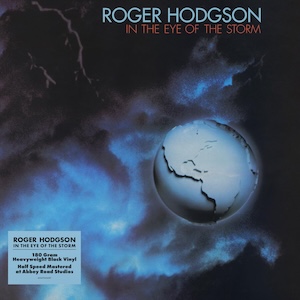
Even without the intuitive interplay of the musically stellar Supertramp ensemble, Hodgson’s solo debut In the Eye of the Storm is in many ways a more satisfying follow-up to the band’s pop-rock peak Breakfast in America than its 1982 hodgepodge successor …famous last words…
Signified by the driving “Had a Dream (Sleeping with the Enemy),” the album features Hodgson’s recognizable stacked harmonies made memorable on Breakfast in America hits like “Take the Long Way Home” and “The Logical Song,” as well as earlier favorites like “Dreamer” and “Give a Little Bit.” The woodwind sounds of reeds player John Helliwell may have been a welcome addition to some songs, but Hodgson paints elegantly from a modified palette on fare including the piano piece “Lovers in the Wind.” He does bring in saxophonist Scott Page to add familiar texture to swinging 6/8 “Hooked on a Problem,” a catchy song that had been held over from …famous last words… Hodgson’s lyric finds him chained by worry and looking for help.
Hodgson indulges his penchant for progressive pop and expansive arrangements. In the Eye of the Storm tops 47 minutes despite featuring only seven songs. “Had a Dream (Sleeping with the Enemy)” runs eight and half minutes on album while teetering between existential dread, social conditioning and resolve. The song is a natural thematic successor to Supertramp singles including “The Logical Song” and Crime of the Century critique of indoctrination “School.” The anxious “In Jeopardy” is one of the album’s shorter tracks at six minutes. Both songs made splashes at radio with edited arrangements.
The gentle demands in “Give Me Love, Give Me Life” can’t help but remind listeners of George Harrison’s “Give Me Love (Give Me Peace on Earth),” but the song strikes a balance between Crime of the Century and the restless keyboard pop on Pete Townshend’s solo work in the ‘80s. “I’m Not Afraid” is defiant and bluesy, with growling guitar power chords balanced against elecrtric piano riffs reminiscent of the Alan Parsons Project’s instrumental “I Robot.” Ken Allardyce’s harmonica adds additional spice. Interestingly, Hodgson’s vocal coda echoes the brassy outro of Pete Townshend’s 1980 single “Rough Boys.” The song itself serves as an antidote to the paranoia and fear exorcised in “Had a Dream (Sleeping with the Enemy)” and “Hooked on a Problem.” Closing epic “Only Because of You” approaches nine minutes, building from meditative tones toward a grand crescendo while Hodgson sings a hymn of spiritual seeking and gratitude. Claire Diament delivers a soaring guest vocal.
Hodgson handles the bulk of the album’s instrumentation, driving “Had a Dream (Sleeping with the Enemy)” with sparkling piano and shimmering acoustic guitar, although Santana drummer Michael Shrieve supports many of the arrangements. Jimmy Johnson’s fretless bass adds character to “Lovers in the Wind” and “Only Because of You.”
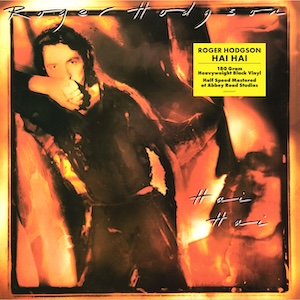
While In the Eye of the Storm sold nearly two million copies worldwide, 1987 successor Hai Hai was hampered by Hodgson’s inability to tour after sustaining serious injuries to both wrists in a bad fall. The album is slightly longer than its predecessor, populated by songs that are more compact compared to Hodgson’s prog-pop pedigree. All 10 songs fall within four minutes and five and a half minutes.
Hai Hai finds co-producer Jack Joseph Puig enlisting numerous L.A. session musicians and leaning into synthesizer pop textures. Top-flight contributors include Omar Hakim and Jeff Porcaro on drums, Nathan East and Leland Sklar on bass, David Paich and Robbie Buchanan on keyboards, and Dan Huff on guitar. Hodgson was clearly trying a new direction; many fans of Supertramp and In the Eye of the Storm did not readily accept the results. Songs like “Who’s Afraid” were meticulously made and expertly played but lacking in organic character or rock ‘n’ roll edge. “Right Place” launches the album energetically with an intense vocal, but the vibe soon becomes glossy and slick. The sparkling and starry-eyed “You Make Me Love You” clearly had its sights set on the pop charts. Its feel-good sentiment may have seemed primed to find broader appeal than “Had a Dream (Sleeping with the Enemy),” but the goal was not attained.
Closing track “Puppet Dance” is perhaps the album’s most moving song, as Hodgson admits trouble handling the loss of a loved one. It’s not clearly stated whether a love affair has ended or someone has passed on, but the emotional weight in Hodgson’s voice makes it seem like the latter.
“Land Ho” is a notable inclusion, sharing a co-writing credit with former Supertramp partner Rick Davies. The song had first been recorded as a single in 1974 by the band’s classic lineup. Its inclusion on Hai Hai is a bit more relaxed and certainly not charmless, but it naturally invites comparison to a band that the album doesn’t otherwise sound like – and a band that early listeners to Hodgson’s solo material would surely have been missing.