
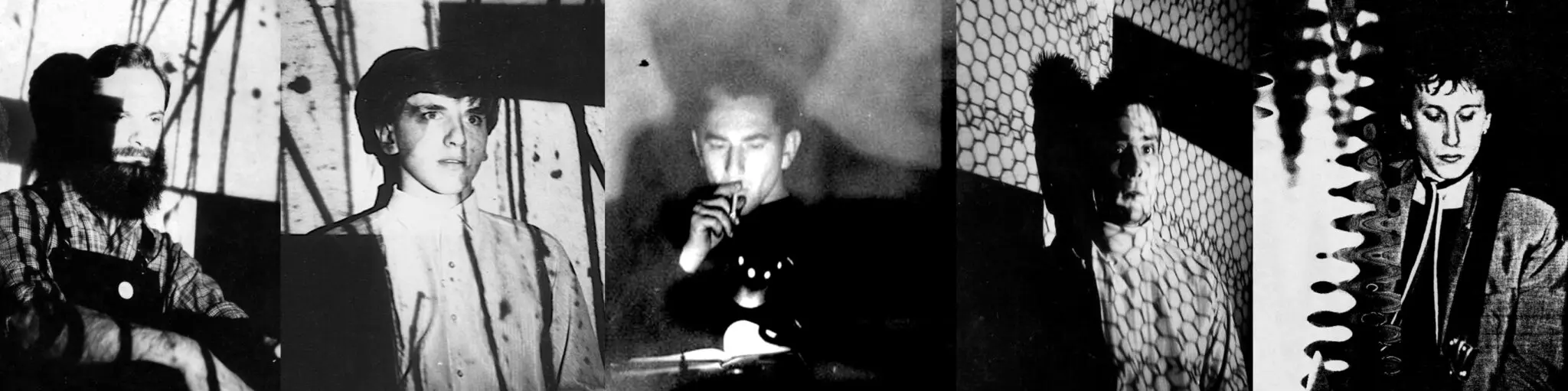
All photos courtesy of Mute Records
Adi Newton never thought of himself as a musician who picked up visuals along the way. Starting out as a painter in Sheffield, Newton drifted into an anarchic arts theatre collective called Meatwhistle and it was there that he ended up with a pair of old education department tape recorders. He met two contemporaries, Martyn Ware and Ian Craig Marsh, while there who went on to form The Human League. Newton, without solely focusing on melody alone, wanted something harsher and more uncompromising: tape loops, musique concrète, and sound built up in layers. Treating his approach to audio similar to a blank canvas in painting, Newton constructed dense, unpredictable soundscapes that depended less on structure and more on experimentation and abstraction.
Clock DVA grew out of that unique methodology. Largely improvised, ‘White Souls in Black Suits’ (Industrial Records, 1980), was captured in a few days with a mobile unit with visiting engineer in Jon Mills in tow. Recorded with no overdubs and little polish, it captured a band that rehearsed daily with an uncanny ability to learn how to think ahead of itself. Arriving on Fetish Records in 1981, ‘Thirst’ features a more produced sonic shift; a set of tracks exploring dreams, appetite and the struggle between control and chaos. This visionary release bridged avant-garde electronics with conventional instrumentation and song structures. ‘Thirst’ also features sleeve notes penned by Genesis P-Orridge (1950-2020) and artwork designed by Neville Brody. Two years later came ‘Advantage’ on Polydor, and with it the machinery of a major label, which Newton found suffocating. He walked away in Paris and went back to the more experimental work of The Anti Group.
Four decades on, the catalog is being rebuilt with care. The Grey Area of Mute has issued a remastered ‘White Souls in Black Suits’, cut from archive masters at Alchemy, with detail in the bass and the top end that earlier pressings only hinted at. The double-vinyl ‘Thirst’ marks its forty-fifth anniversary and carries two additions: fresh versions of “4 Hours” and “Sensorium,” recorded by the current DVAtion lineup of Newton, TeZ and saxophonist Michael Somerset Ward. More is lined up, including ‘Sign’ (Contempo Records, 1993), ‘Noesis’ (Rizosfera / Armcomm Europe, 2023), and a sprawling ambisonic reissue of The Anti Group’s ‘Digitaria’ (Sweatbox, 1986).
None of this has made Newton nostalgic. He is working on a new Sōon record with Jack Dangers (of Meat Beat Manifesto), and his Matar project has been digging into archaeoacoustics and resonant frequencies. Always candid and unsparing about the present. science fiction, he argues, imagined our dystopia long ago, and we have moved in without noticing. He sees a culture that accepts the copy as the original, algorithms standing in for intuition, and governments pouring billions into cybernetic systems built mostly for nefarious intent. He is just as pointed about the people at the top who profit from all of it. Machines possess no morality, only efficiency, and to mistake that clinical optimization for “progress” is to miss the danger entirely.
What he offers against it is organic and a little radical: imperfection, chance, and the undeniable human presence behind the process. For Newton, improvisation borders on something close to channeling, a method of painting with a sonic palette while insulating his creative will from the noise around him. Whether or not you share his gloom, the argument gains force from the records themselves. ‘Thirst,’ in particular, sounds less like a period piece than a prediction, one that has had forty-five years to prove itself. What follows is a wide-ranging conversation over two days about Sheffield’s thin early scene, the economics of being ignored by labels, the ego trouble that undid a band, and why Newton believes some work is ahead of its time while other work lands exactly when it should.
Massive thanks to Zoe Miller at Mute Records for the coordination and much appreciation to Adi for the two extensive conversations.
James Broscheid: Unfortunately I missed your last tour in the states. Any plans to come back?
Adi Newton: Yeah, definitely. They’re looking into it at the moment, so I don’t know what’s happening now at this precise time, but I’m sure, yeah, will arrange something.
JB: Yeah, I hope you can make it out west. I’m over in Arizona, but I’d be glad to go to California if that’s the only place you went near me.
AN: Yeah, we’ve played San Francisco. That was the first show. I was there for about a week before that with Jack Dangers working on a new Sōon album. We’ve made 13 new tracks for the next edition. Have you heard of the project Sōon?
JB: No, I haven’t.
JB: It’s a Japanese word (meaning noise, clamor, or cacophony). Anyway, we released two albums already. We released an album earlier this year (‘Actions Made Audible’). Have you heard of Electronic Sound magazine?
JB: Yes.
AN: It was via their label. It came out on LP and CD because the CD has a lot more extra tracks on it. We couldn’t get everything on the LP because of time restrictions. It was done really well, I think. I keep getting good reviews and bits. I can send a link.
JB: Digital is fine, but it seems to detract from quality sound for me. Especially this Clock DVA reissue of ‘White Souls In Black Suits.’ I want to hear it on my Hi-Fi and not in tiny computer speakers or headphones. Yeah, yeah,
AN: Yeah, I agree. It sounds good on vinyl LP. The quality is really good. The remaster was really excellent, and it’s really brought out the details. The bass, the warmth, the mid and top end. I mean, there really is a lot more detail. You can hear it properly for the first time.
JB: Did you have a hand in the remastering process?
AN: Yeah. I went to Alchemy (Mastering) with a guy … this was pre-pandemic, so this was quite a few years, and he did a fantastic job of it all. He did this remaster and ‘Thirst’ (Fetish Records, 1981), as well. That’s coming out in April 2026, I think.
JB: Oh, great! That’s right up there as one of my favorite industrial, experimental records of all time.
AN: Yeah, that again will be a Mute addition. It’ll be a double vinyl and on CD as well. There’s a couple of new tracks we made. When we were compiling it onto the vinyl we realized we’ve got only one side to the second album so three sides total. With everything we had, we still had space on the D side so we remade a version of “4 Hours” and “Sensorium” for it. It sounds fantastic. Sounds great. So we’re going to do that for next year. We’re going to probably play those live in with a set of stuff. They came out really well. You’ll hear it anyway.
JB: That’s great news.
AN: Yeah. In my opinion, they’re great versions. I mean, they keep the structures of each one and the lyrics, and so on but with newer & added electronics along with the production we’ve done to bring it up to a new kind of version for 2026 or whatever. It will be good for people buying the LP because they’ll get those extra tracks as well as a real exclusive bonus.
JB: With all the talk of vinyl and its resurgence, what do you think of it?
AN: I think it’s great. I always worked with vinyl originally, until we saw the advent of CDs. I mean, it was always vinyl. It’s a media and I always thought it was a better one because the sound was always great, and also the artwork was always nice, because it was like a full, 12-inch sized piece of artwork. Covers could be really good. When you’re squeezing them down to a CD size, you’re minimizing all the detail. Vinyl is great and I’m glad it’s got a revision.
JB: Yeah, I couldn’t take the CDs with their little booklets and small print. I have trouble reading it now, even with glasses.
AN: That’s true. Yeah, because the formats changed as well. When technology advanced, you moved on to digital-recorded via the first FM-type digital recorders that became available. They were good because they captured a lot of frequencies, so in some ways, they were good for certain things. For more frequency-based music, like The Anti Group’s, ‘Teste Tones,’ (‘Meontological Research Recording Record 2’Side Effects, 1988), ‘Digitaria,’ (Sweatbox, 1986), ambisonics, all that kind of stuff. The LP versions are always good as well, I think. That’s going to be reissued next year too, ‘Digitaria.’ It has been remastered from the original 10” reels off tracks. When I got those transferred, the sound is brilliant. It’s back to how it should be. There was a lot of material on there that we didn’t release at the time because of restrictions on time and formats. It would have taken more LPs to do, more than a double album. So, now, we reissuing it on vinyl, but I think it’s going to be a four LP set. It might even be more, I don’t know. I’ve got to time it out in the next week or two to see. Whatever it turns out to be, it will be as a vinyl release. There’s like an album’s worth of material that’s really good. It’s extra because it’s the complete ambisonic recordings for ‘Digitaria’ … everything. It will be a nice packet if we were doing it like a folio with a booklet and everything. You know really nice.
JB: Is that going to be with Mute too?
AN: No, that’s going to be on our own Rizosfera through ARMComm in Europe because it was signed before that anyway. So, it was sort of pursuing it on that. We’ve got plans to do more stuff with Mute. The last (Clock DVA) album, ‘Noesis’ (Rizosfera / ARMComm, 2023), is going to be reissued next year, again on vinyl and CD. And also ‘Sign’ (Contempo Records, 1993), that will, because that’s already signed up for reissue. So, that’ll come out, but we’ve got to work then. Then, we’ll be working on getting the contracts for ‘Buried Dreams’ (Interfisch Records, 1989), and ‘Advantage’ (Polydor, 1983), and a couple other albums. So, yeah, they should all eventually be available on Mute.
JB: Let’s talk about ‘White Souls In Black Suits.’ I think its title is indicative of the times lately (Adi agrees). You stated the goal back then was to combine acoustics and electronics by merging German electronic wave with the edge of the Stooges, avante garde and French GRM musique concrète, along with the audio/visual creativity of the Velvet Underground. That’s one hell of a combination! (Adi laughs) Could you elaborate on how those seemingly disparate elements were practically brought together and reconciled in the studio for this record?
AN: Sure, for ‘White Souls’? Before that there was material that was recorded before that that eventually saw release on Vinyl-On-Demand as editions called ‘Horology 1, 2 & 3’ that came out (‘Horology – Anthology Vol. 1-3 1978-1980’ in 2012, ‘Horology 2: The Future & Radiophonic DVAtions,’ in 2015 and ‘Horology 3: Tape, Reel,’ in 2019).
‘Horology 2’ was the future and radiophonic deviations, which is probably the earliest material I was working on in between the transition from The Future to Clock DVA. So, there was a lot of experimental solo pieces I was working on and also with my founding partner of Steven James Turner who passed away (1956 – 1981). It has got those kind of elements of Kraftwerk, The Velvet Underground and all that kind of Stooges stuff, everything we were into at that time, we’re talking 1976-77, that period. Yeah, we were inspired by that, obviously, there was a fantastic wave of material that came. We were listening to that stuff quite heavily through the 70s, some even earlier, 1974-75, were going on. Kraftwerk, Stooges, Velvet Underground, they were like a mainspring for inspiration really. It was a matter of combining those sorts of influences and forging something new with it. Especially on ‘Horology 1,’ you can hear in all those early tracks like “Edge,” “1958,” that kind of guitar combined with the electronics. You can pick out those elements early on. They were never released as they should have been. The EP (‘Sex Works Beyond Entanglement…’ intended for 1979), which was to go to Small Wonder (Records) was never released due to some internal issue. I don’t know why, but anyway, it didn’t get released. I mean, we actually got the masters back, so they’ve been added to ‘Horology 1’ to help build that foundation and history because it kind of jumps to ‘White Souls.’ There were a couple of releases, perhaps before that. A compilation here, a compilation there, like “You’re Without Sound” (from ‘Hicks In The Sticks’ on Antilles / Rockburgh Records, 1980) or something like that. And so it kind of jumps into ‘White Souls’ which is very experimental, very early kind of improvisational Jazz stuff because there was quite an early scene. I think Tony Oxley (English improvising drummer and electronic musician), and Fred Frith (Henry Cow, Art Bears, Massacre, Skeleton Crew), and people like that who were working at that time, the early 70s, on avant garde-jazz stuff. So, it was there. That kind of movement was there. So, we took that as a jump off point. ‘White Souls’ is really an improvisational piece. There are no overdubs or anything like that. Everything is sort of as it was. There was nothing added to it, it was edited down really from the other works. It has a very fluid feel , The Art Ensemble Of Chicago, these kinds of influences were within the elements we were working with. It’s got that kind of feel. The new release of it has more detail and you can hear a lot more. I think it still has its potency.
JB: Yeah, I think so, too.
AN: After all these years, it still sounds pretty fresh. A lot of it, I mean. Some great pieces on that album definitely.
JB: Yeah, you know, to say it sounds fresh now, even back then it didn’t sound like anything else. With Stooges and Velvet Underground being mentioned, ‘White Souls’ sounds nothing like any of that. I could see those bands being an example of how to do it from a creative/garage-y perspective, but sound wise, you know, I? I couldn’t make those connections.
AN: Yeah. That’s why I was saying earlier about ‘Horology’ because the ‘Horology’ is more towards that experimental sound on those albums that were never released. Very few people knew about that very early stuff. I mean, John Balance (Geoffrey Rushton, 1962-2004, co-founder of experimental group Coil), when he was doing reviews in (British DIY music & cultural fanzine) Stabmental, he was a really big fan and big supporter of what we were doing. He got it. He got what we were trying to do. We were changing a lot. We were moving from one thing to another. We never really stayed in one area. After ‘Thirst’ there was another change to ‘Advantage’ which is a totally different production.
JB: And that’s what the better bands do anyway. They don’t stagnate and stay in the same sound. They’re constantly evolving.
AN: Sure. Yeah, that’s where a lot of groups have gone wrong. They’ve kind of kept that formula and kept going with that formula and it’s never really shifted to anything new. I think music has to evolve. It has to move forward in some ways. It gets difficult, obviously, because you’ve got a Democratic system of technological creation now. Anybody can just … there’s so many programs that are out now, people use it to create. I always think that it’s who’s behind it. It’s not the technology. It’s the soul, the human behind the machine that makes the difference. A lot of this stuff has become simulacrum, where the copy is defined as the original, which is totally crazy, really. But this is how people work on a level, where they don’t go back to look at things to assume this is the sound and its original. It’s not, you know?
JB: I agree. With everything at artists’ disposal nowadays with technology and software tools the question always is what are you doing with it to be different or unique?
AN: Absolutely. I’m always trying to push forward with material in different ways on my solo stuff, T.A.G. and the Matar project I’ve been doing for the last four years. We did an album (Sleepers Records, 2024) that’s all based on Archeoacoustics (studies the role and perception of sound in past cultures), and use of resonant frequencies like 110 Hertz, 111 Hertz. It was an interesting project to do. I’m working on new material now for it, but that album took quite a while to do using field recordings and all kinds of stuff. A kind of merge of electronic cool acoustics and so on. I think it brought something new out as well. You’ve got to push forward. There’s so much stuff coming out every day and a lot of it sounds the same really.
JB: Yeah, people can record in their bedrooms now, put it on Bandcamp and off it goes. Some of it’s good, some of it I can take or leave.
AN: Yeah, that’s what I said about the individual behind it. That’s the thing you might find, a guy or a girl or whatever, who gives it something different. Who’s got that genius to put in and then you recognize that, connect to it, and you can tell it’s something different. It’s worthy and pure. Whereas a lot is simulacrum and disposable.
JB: You also combined a love of science fiction, Russian constructivism and beat literature. Looking at the non-musical/conceptual influences, how did they manifest in the soundscapes of ‘White Souls’?
AN: Well, I started off as a painter. I mean, I still do a lot of painting. Now, I’m doing more work with visuals, because that’s how I started. I didn’t really come to music as a … I wasn’t a musician. I just came at it from that point of view as a visual artist. I was interested in the GRM (Groupe de Recherches Musicales), (John) Cage and Earle Brown, (Pierre) Schaeffer and so on. The first thing that I can do is using tapes in the future. Using the tape recorder to be processed and recordings to be synthesized. I came on as a visual artist, making soundscapes. Tonal pictures really. It’s kind of similar to painting in a way. Building up colors, tones and layers to create atmospheres.
So, I came at it like that with my side is from the visual side. I’m always trying to use it in that way, like a painter. I think production and sound overall can be manipulated, produced, processed in a way that takes it to another level. Obviously, the way you play the instrument and how you can process that instrument, that’s an interesting part of it for me. To take it into a different kind of area. So, with ‘White Souls,’ it has got that element, like the song “Still/Silent.” That’s about images, painting and Francis Bacon (1909-1992, Irish-born figurative painter known for unsettling imagery), within all that kind of area. It’s in there, it’s integral to those pieces like “Film Soundtrack (Keyboards Assemble Themselves At Dawn).” Things like this of going back to the surrealists and people like (Antonin) Artaud (1896-1948) and collaborations like Artaud and (Germaine) Dulac (filmmaker, 1882-1942), ‘The Seashell and the Clergyman’ (1928 French experimental film), that they made. I mean, the delivery, the tad ones, based on all that kind of stuff, Alma and so on. It was the visual elements, like (Kazimir) Malevich (Russian avant-garde artist and art theorist, 1879-1935), and constructivist material that utilized (then) modern materials and technology. The ideas at that time were very advanced. They were doing really interesting things with visuals and sound as well through making instruments and electronics.
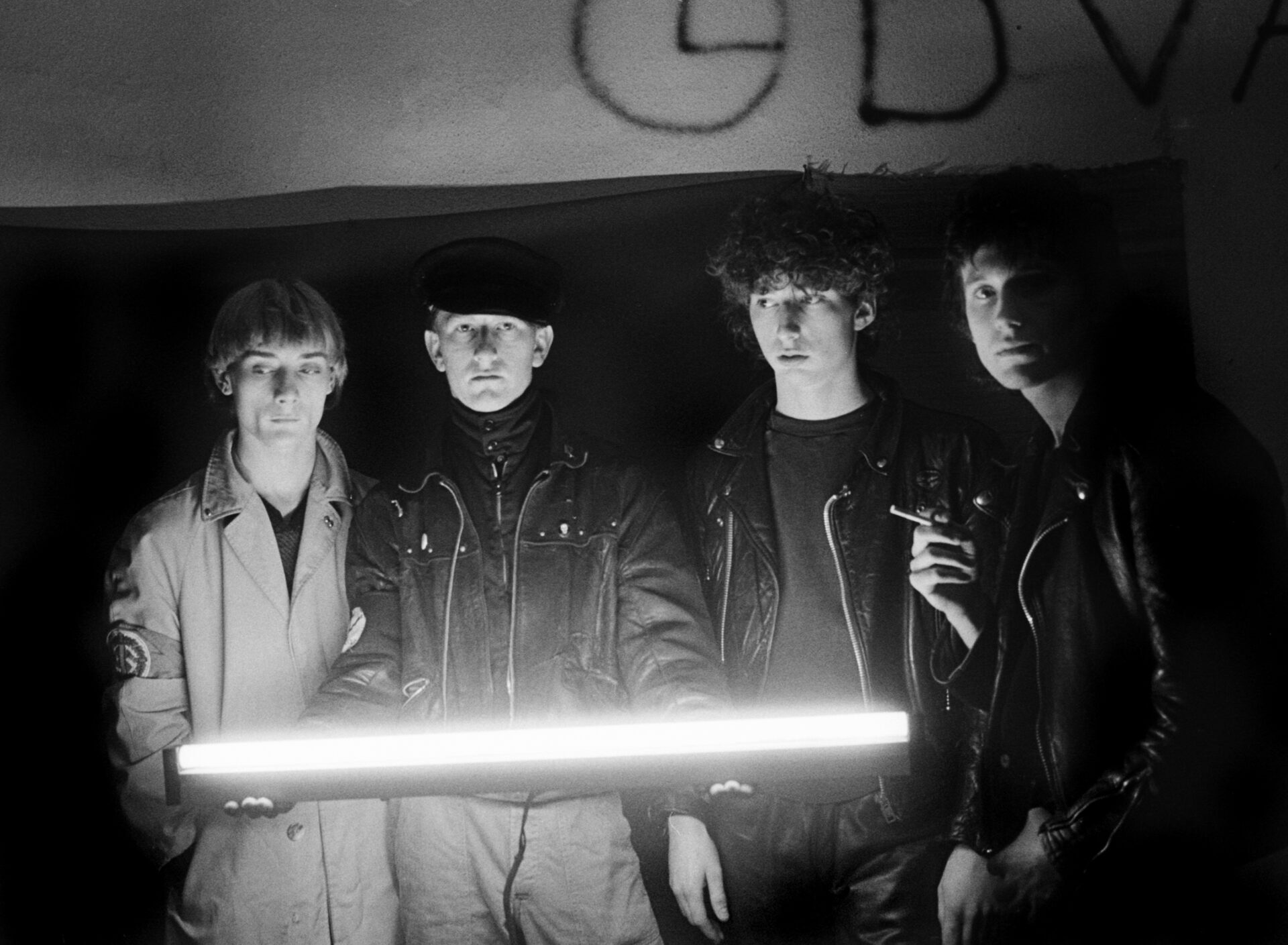
JB: You mentioned starting as a visual artist through painting. Was there a specific moment when you turned to music?
AN: Yeah, when I got involved with a theatre group called Meatwhistle in Sheffield. Just like a kind of arts theatre, very anarchic set up. When I got involved with that, I met a lot of people there including Martyn Ware and Ian Craig Marsh. We would experiment with different forms of things. We used to put on plays and theatre improvisational things. Then we started thinking about doing some music because someone asked about doing some music for a party. We got an ensemble together, which was myself. I was just using the tape recorders. The Meatwhistle had some old photograph reels which were used in the educational department. So, I got to use those. I started processing tapes and tape loops and stuff like that. Martin had a theremin (electronic instrument invented by Russian physicist Leon Theremin in 1920) kind of thing. But Martyn had a bigger one, it was a super-duper one (both laugh). It had more expanded control. So, he had that and he was building a modular synth from diagrams in Practical Electronics (UK hobby electronics magazine), or something like that. We were just really experimenting and doing stuff. So, we did this first performance of it at this party. God knows what we did because there’s no actual recordings, so it’s really early experiments. But afterwards, we thought, “Man, maybe we could develop this a little bit further and start building on this.” I think Martyn invested in one of those first Korg synthesizers (miniKORG 700, 1973), the first one that became available. There were quite expensive at the time. They were certainly cheaper than an ARP or a Moog or something like that. He bought that and then Ian bought the Roland system with the sequencer. I was still doing tapes really. I bought some new and different types of tape recorders to record, produce and add stuff into it. So that was the earliest kind time when I started exploring music. Martyn in particular, wanted to make, I would say, more accessible music. He was into melody and more melodic kind of work. So, it wasn’t going to work out with me doing these avant garde tape loops, and musique concrete type of electronics. So, we had to go in a separate way because it wasn’t going to work out. Then afterwards, I bought an EMS suitcase (portable modular analog synthesizer), when I left which, I could apply input to output through the modules so I could treat it and change it. I spent a year just working with that, doing experiments. All that stuff is on the second ‘Horology’ compilation I mentioned called ‘The Future & Radiophonic DVAtions.’ That bridges that period. People assume ‘White Souls…’ is the first album, which it’s not really. It is because it’s the first release of an album in a recognizable format, but we were doing things on cassette, and we were performing live, but there was a limited audience because of the way we were doing things. Cassettes were hand-duplicated, so you could only do so many, and we did them ourselves. It was pretty limited. John Balance and people like that were the only people really who heard the very early material and how it evolved so. The ‘Horology’ series are all historical documents showing the progression from the very earliest up to the industrial age I would say.
JB: How do you feel that atmosphere spoke to the social cultural climate of Sheffield in the UK at that time?
AN: In Sheffield, at the time when we started, there was really a handful of people doing stuff, Cabaret Voltaire for instance, but not so many of us really. The Future came and then that changed after about a year when they went on to form the Human League. Then they produced “Being Boiled” (7” single, 1978) and all that stuff on Fast (Product). Then the area started to become more interesting with Throbbing Gristle, and obviously they were ahead, they were doing stuff like “United” (7” single, 1978) and all those kind of things. The first album came out on Fetish (Records), ‘The First Annual Report,’ (on Industrial Records, 1977 – reissued on Fetish in 1978). With Sheffield, it wasn’t like there were many promoters there, not so many people doing things in terms of music venues or setting up spaces for live performance, so those early days were very tentative beginnings. So, we really had to try to do our own things, just do-it-yourself kind of thing, like a punk attitude. When Punk came out, one of the things I really liked about it was it didn’t care about the technique. You had to be resourceful with what you had. We (Newton and Paul Bower) started the magazine The Gun Rubber and did a couple editions of that before getting more involved in doing the actual music side of it. So, we were making things happen. We would find places. We’d approach night clubs and organize something if they were willing. In that way, we built up this scene, I guess, over a couple of years or more. Then you know people who were not interested in it suddenly thought, “Oh, hang on, I can make some money out of this!,” letting people play in the clubs that normally they wouldn’t have passed on a couple years earlier. We were like two ahead at a time, and then it. Caught up with that, and then people started exploiting it and offering space. So, from the beginning, where there was no real kind of structure, it became more and more structured and accessible because of the things we’ve done earlier. We proved there was an audience there. There people that wanted to hear people wanted to buy this stuff. People’s minds were changing.
JB: Bands like Clock DVA, Throbbing Gristle, The Pop Group, Cabaret Voltaire, and the Human League, especially their early stuff, I always thought those bands were there to challenge listeners by NOT being immediately accessible. Then it became another genre of music where people start getting involved by realizing they could make money out of it. It evolved like you were saying. I wouldn’t say it stripped the identity from the genre, but it changed things.
AN: Definitely. Absolutely! I think after magazines, like the NME, Sounds and all that kind of stuff, they got involved by doing more reviews and articles. And record labels as well started coming out offering to do an album, and so on. That did change the energy of it to some degree. I mean, the first two Human League albums are good. They still stand the test of time. And then later, they developed two or more accessible pop kind of LPs. The Human League then split into the B.E.F. (British Electric Foundation) and Heaven 17 which became more commercial. For me, I kept on with that trajectory of making music primarily for myself, out of my own sort of desires. So, I didn’t really compromise those things at all. So, I never really tried to pursue record labels. It was through Throbbing Gristle that we got the first album out, ‘White Souls…’, and then through that, it was that connection/friendship with Fetish and Rod Pearce. Rod said he wanted to do a new album with us. He said, “Someone’s going to do this, so it may as well be me!” We did, and we organized to do ‘Thirst’. ‘Thirst’ did really well and after that, you’re right, the change in accessibility with the way record companies were coming on and signing people up. Stevo (Pearce, founder of Some Bizarre Records), came up to Sheffield one time very early on and he came to see me, and I thought, “What’s this guy about? I didn’t really go for him as such. But then, he did go on to do all the other stuff. He had a bit of a reputation, you know, I’m glad I didn’t get involved from what I know now. What he got involved in and what he did, which was not good. So, there was all these people were exploiting it. Definitely! But it was opening doors as well, I think. And so, when the big majors were throwing money at things, I decided to do a production with a major company, but also, I wanted to do something which kept an element of noir underground and make something that penetrated into accessibility. Like an experiment for me. And it got a bit out of hand, really, because then you know they were starting to line us up as some kind of stadium band.
JB: Oh God!
AN: Yeah! You’re gonna do an album, then you do a t-shirt, and you do a tour. It got to be too much for me. After ‘Advantage,’ we did a whole bunch of shows and it came to a point in Paris, where I couldn’t take it any more, so I left and revived the work I was doing earlier with The Anti Group. I focused on that because it was far more experimental, it’s a far more interesting thing for me to pursue and something I wanted to do. I felt I’d got to a point with this (Clock DVA) as it was and I didn’t like it.
JB: You had mentioned earlier about the soul behind the music and bringing up Stevo. Adi, could you apply the same kind of instinct with company people? Obviously, you can tell an arsehole from a mile away (Adi laughs). Some business people are known to be slick and fast-talking.
AN: Yeah, totally! With The Future we made some demos. There’s been a documentary recently (‘A Film About Studio Electrophonique’), about this guy (Ken Patton) in Sheffield and his studio. There is a book out now too (“Studio Electrophonique: The Sheffield Space Age, from The Human League to Pulp” by Jamie Taylor, 2025), along with the documentary that was made. We recorded these demos, very early demos, the first stuff we ever made using multi-tracks, which we couldn’t do multi-track recording. We didn’t have the capacity at that time, so we went to the studio, made these recordings, and then we sent a letter out saying we were coming to London to do some interviews. We didn’t send any tapes or anything. Pretty arrogant I guess (both laugh). It kind of worked because we got a lot of replies and eventually, we did go down. We saw like eight major labels.
JB: Wow!
AN: Yeah, and all of them were from Ireland. They were a bit more progressive and got the idea a little bit, but not totally. The rest were completely like, “What the hell is this?” They never heard anything like it. They just didn’t get it so we didn’t get any kind of further response. Island (Records) were interested, but then it never went anywhere. By that time, we shifted focus and, like I said, then we had to go our own ways. So, the record labels? Definitely full of assholes (both laugh).
JB: Even back then, when Island was good …
AN: Yeah. Well, the plan was to just throw money at stuff. Pour money in it and see if they get anything back.
JB: Which corrupts the art.
AN: Yeah, it does. That’s one of the things you don’t get at that time is every penny you spend is going to be taken back out of the contract. They’re not giving you anything. They’re not giving you a thing really. They’re just advancing you on possibilities or potential and that’s it. Then you’ve got to pay it all back. You spend a hell of a lot of money in studios and that takes all the money, the profit, everything (laughs). It’s crazy, really.
JB: Speaking of studios, Roger Quayle recalled something you said back then, “Keep moving, don’t stand still.” (Adi agrees) With ‘White Souls…’ considering the album was largely improvised and recorded in a remarkably short time, closer to eight hours is what I read?
AN: Yeah, I mean the exact time I think was over a few days. We did these two sessions with a mobile unit and an engineer who came. Yeah, it was a pretty short time, I guess … considering.
JB: How important was that kinetic urgency and restlessness to the final release?
AN: I think it’s there, it definitely works. We were pretty tight as a unit because we rehearsed a lot and we used to improvise a lot. So, it was how we worked at that time. To record fresh, new things was a natural thing for us to do. We’d been working together for a while, and also we used to rehearse pretty much every day. We fed each other through improvisation. Improvisation is kind of psychic I think, it’s kind of precognitive because you’re always thinking ahead. As you change, people change. So, I always thought it was a great way to work. I always remember a surrealist documentary I listened to on Radio 4 back in the 70s or something. I listened to a lot of radio because there was a lot of good programs about music and documentaries about subjects, I liked which I used to record. I still have a lot of those tapes. And this guy was an English surrealist writer, I’m trying to think of his name. He was there, in the 20s or 30s, and he said jazz was like pure psychical traumatism. It’s like, (Aleister) Crowley said he was a feeble transmitter for forces outside, that he channeled as they came through. I think it’s true. That ability, intuitive ability is something very human that we do, collectively, through improvisation of other techniques. So, it’s channeling that kind of energy into the creation of music, painting or whatever. Sometimes things change, new ideas come, accidents happen. Something that suggests something else and it’s the same in music with improvisation. You’re working together, and you’re playing on a theme and then it changes and everybody flows into that. It’s like a flaw.
JB: That’s remarkable because you would think improvisation in the studio would be a harder way to record, right? A lot of great bands will rehearse, rehearse, rehearse to get it down then they go and record it. But improvised, like you mentioned, that’s relying on a whole intuitive unit. I would think it would be tough, so that’s why I was surprised that the recording for ‘White Souls…’ didn’t really take all that long in studio.
AN: Yeah, I think we were a good ensemble. We all had the ability to come together as a unit. So, it was very natural, it wasn’t forced or anything so we could improvise pretty much there and then. We could do stuff like that. That’s how we’d work when anyone started with a basic bassline, or some sound, or pattern, or some drum or whatever. Then we could build on that. That’s probably why it sounds the way it does because we were accomplished musicians in that sense on those things. Very intuitive when it came to improvisation.
JB: The band had a reputation for being wild and unpredictable, which is like the recordings if you ask me. You said that gave the band an edge live. Looking back, how crucial was that live intensity and unpredictability in establishing Clock DVA’s identity amongst all the industrial and electronic music being made by your peers?
AN: Yeah, I think the early stuff we did in ’78 – 79 when we did live shows, it was really fierce, it had that edge. It had that aggression like Neu!, like Pulp, like the Stooges, so it had that element along with the other elements that were there. The live performances energized our situation and intensified it with lots of adrenaline and everything else. And on stage we used a lot of strobes and visual things like slide projections, so it was an assemblage of all these images and sounds coexisting. That does alienate the audience in some sense because you know they weren’t used to that kind of thing. It was new. People were expecting to see four guys on stage or whatever with instruments playing a whole selection of tracks or songs or whatever and that was it. We used to do a lot more with it. So, the accidents and chance elements were always there for us as well, which came in and fed the whole thing. Sometimes a track would take on a different tangent live than it would in a rehearsal studio because of the set-up of the stage. I always thought it was more like theatre. You create the staging and be consciously adaptable to reinforce the music. You look at the projections and make by the stance or by the actions on stage, it was like a theater performance in some sense rather than some guys getting up on stage with the guitars and figuring out what they’re going to do. It was more focused towards a total vision. Sometimes you go one way and then go another way and sometimes you end up doing crazy things (laughs).
JB: Have you seen the documentary called ‘Desolation Center’ (2018)?
AN: Oh yeah. Stuart Swezey (director), is a friend of mine. We met a couple of weeks ago because they did a presentation of it in Peckham in London. They showed the film and had Jack Sargent (author of ‘Flesh & Excess’, ‘Against Control’, ‘Deathtripping’,’Naked Lens’), and Stuart doing a Q&A Exactly! Yeah, exactly. It was kind of parallel to that, I guess. The way we were making and doing our own things. People like the Final Solution (promotions company, 1978-1984), in London at that time, who put on really great shows with groups like The Cabs (Cabaret Voltaire), Throbbing Gristle, (Clock) DVA and Pop Group, and all these sorts of bands at different venues in interesting places. Having that focus on that kind of element in that they wanted to be involved with all those groups under that kind of umbrella. Which was good because it gave a focus to the whole thing.
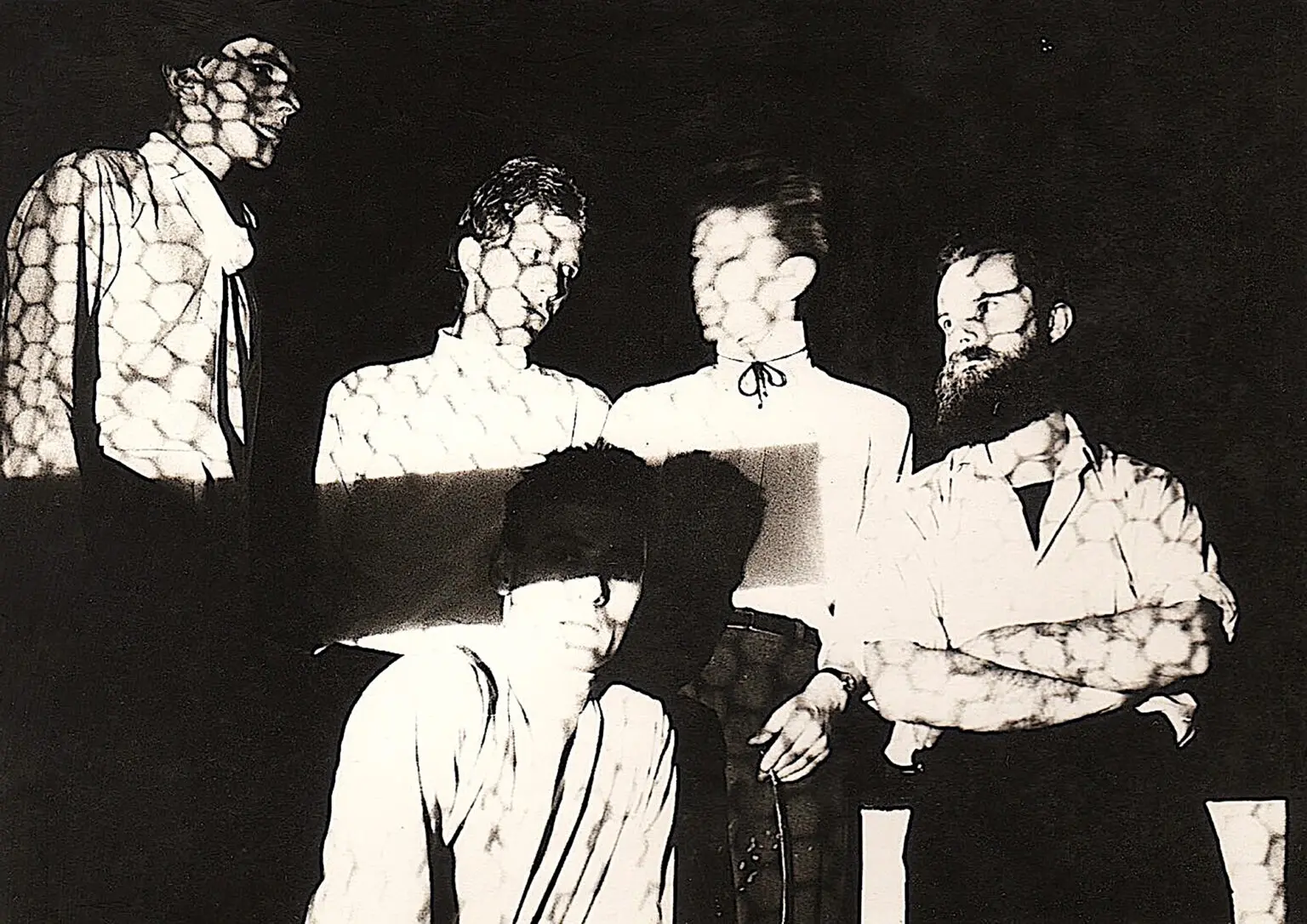
JB: I always thought I always thought groups like Clock, DVA, This Heat and Pop Group would have been great bands playing in that Desolation Center environment. Einstürzende Neubauten even came over from Germany for the first one.
AN: Yeah, definitely. The American new wave of Devo, Pere Ubu and bands like that were influential on some other stuff in England for sure. Pere Ubu were very, very good, especially their first releases.
JB: Definitely one of the best bands that ever came out of my hometown of Cleveland.
AN: Oh, great! They were great. So, they were definitely an influence during that period. I believe they came over and did some stuff with Final Solution as well. It was a good time then.
JB: In combining visuals with the music in live settings, how has that role of the visual and cinematic elements of Clock DBA evolved over the decades and how do you see it informing its music today?
AN: I think it’s tremendously important in regard to visualizations. I don’t see them as something separate. I think that it is one thing working combined. So, yeah, we take a lot of care of all those visual elements. We’ve developed it over the years and we’re developing it now. I mean, we remade a whole bunch of videos for these latest shows that we’re doing now. We’re constantly refining it and changing it and bringing more involved stagings to live shows. With The Anti Group, we did the neon box, you know, the neon cube which was a site-specific set up. The cube is made of semi-transparent screens, and we are in the middle of it. You must have a stage that is plinth-built to elevate it up off the ground and support the frame and everything. We had four projectors, one for each side. We did a staging of it at The Gothic Wave Festival maybe 10 years ago or so at The Pantheon (within the Volkspalast complex in Leipzig, Germany), which is a very old circular building, so we had all the projectors set up and we were in the middle. You could walk around it and what you see is all these images like a montage, and as you moved, the images would change. We had surround sound with a Ambisonic system as well. So, the music and the visuals are all changing.
It is in the ‘Meon’ book (‘Meontological Research Recording II: Transmission from the Trans Yuggothian Broadcast Station,’ 2021), and I think there are eight tracks or eight pieces and the chapters of the book explore each piece, conceptually in the text, with the audio. The book comes with an USB card which contains a live edit of the actual presentation in the cube and then there’s the individual mattes of each film and .wavs of each track, so you’ve got everything. You can listen to it with or without visuals and you’ve got a book which really expands the concepts of each track and investigates magic, esoteric, or science, and different factors. There’s stuff on (Jack) Parsons (American scientist and occultist who practiced Aleister Crowley’s “Thelema”), stuff on Crowley and (English novelist, Kenneth) Grant and other kinds of things. There are all kinds of science stuff on sounds like biological communications. It’s pretty expansive! That’s the kind of thing I do anyway with albums. Even with the DVA, the early material always had context with the tracks that connect you to the inspiration of that track. It also gave people some references to other things so they could go and explore and find out a bit more about the context and history of it.
JB: I find it difficult to label songs from Clock DVA as tracks or songs because they’re more, like you said, pieces. Especially with ‘White Souls…’ and ‘Thirst,’ when you were recording the albums did the band have visualizations in mind while they were working in studio, or was that something that that came after an album was completed?
AN: No. I mean, with writing the lyrics, and so on, the words are vital elements in the tracks, so the music really had to represent that lyrical context for the idea or the concept. All those sorts of things came from my direction and we’d follow that. Yeah, I mean the album sleeves, the words, the production, everything like that, I’ve always sort of had a directional position in them. Like a film director. It’s the same kind of thing. You bring in different elements and different people to do different things. You work with capable people who can bring that in and I help guide it or facilitate that directional thing. It’s like in The Anti Group and changes in different personnel, but the directional input is always central, which comes from me, and is fundamental to the project, I initiate it. I think it’s like Miles Davis, you know? Miles Davis brought in different people for different elements, but it’s always Miles Davis. You can tell when you listen to it, you know it’s Miles Davis. The fantastic players on those recordings and it all combines somehow; he brings it all together. So, like I say, I think it’s the human behind the machine or behind the process or the technique or whatever. There’s someone, I don’t want to say controlling it, that sounds too strict, you facilitate the process. You bring out possibilities. Ego in groups is always a difficult thing, because people start thinking they call the shots or they think they suddenly they get ideas. Particularly during that ‘Advantage’ period (with Clock DVA), people are brought in and then suddenly you’ve got all this exposure. People are writing and it goes to people’s heads, you know, and then the ego will comes in and that kind of destroys things. When I did The Anti Group, I didn’t want to have that kind of ego involved, so I worked with people that were really on the same level of working as me, so that so that element doesn’t destroy it.
JB: Was that why you walked away in Paris?
AN: Yeah. Really, yeah. It was through dissent on things and attitudes. I decided, “Well, no, I don’t want part of that.” I’m not interested in getting into the dynamics of egos. I brought individuals in to do a specific thing and that’s where it stays. Someone thinking, “Oh, I want to shift it this way,” or “Shift it that way.” I’m not interested unless it was something good, I’d agree then. If it’s opposed, if it’s not what I feel is relevant or interesting, then I won’t because I don’t compromise like that, I never have and I never will. I try to work with people who are on my level. Like, TeZ. He is an independent guy and has his own ideas and does stuff on his own, but when we work together it’s a surety, we’re on the same platform and have the same interest in the work, without tension, without those dynamics of ego. That’s the best way. Then you work, accomplish stuff, and you satisfy that feeling within for whoever’s involved, and you’re happy with that. Then you carry on and you do more. It’s always a thing of balance, I think as well. The balance of people and the situation, and so on. It’s a difficult thing to target.
JB: Doesn’t seem like there are too many souls like that these days.
AN: Yeah! Since ‘Advantage,’ I worked in a different way, to try and prevent that from happening again. It’s just a lot of stress and unnecessary drama. You want it to work well and you want it to flow without having to sign a contract or something that says, “I do this, you do that.” So that’s it’s a difficult balance, but it can be achieved for sure.
JB: Often your works is described as a process of evolution rather than reinvention. Like, kind of what we discussed quite a bit last time we spoke. Listeners experience albums like White Souls, Thirst, Advantage, and Buried Dreams as almost separate identities. Looking back now, do you see a continuous thread running through all those transformations, or are there periods of your work that feel genuinely alien to the person you are today?
AN: It is all interconnected in some way, like everything in the world, through lines and connections. We begin our journey focused on you as your identity takes shape. From there, it gets more expansive and connects with other artists and creative areas, showing how everything continually evolves through a unified, connective formula and informs you as you move along. It certainly informed my interests over all those albums, maybe under a different guise perhaps but still under the surface. It is a continual process as you evolve, you make more connections. Other people might be involved too, but my underlying goals remain the same. It is an ongoing process that keeps moving forward. As you evolve, you hopefully learn more.
JB: Over your body of work, you strike me as someone perpetually curious. You’re not an artist who is dead set in their ways. You’re constantly looking for ways to reinvent yourself. You’re not comfortable if you’re not challenging yourself.
AN: I think it’s important to change. Move forward. Move things forward as much as possible. JB: One of the key themes we talked about the last time we spoke was improvisation (Adi agrees). With your art, it seems almost like it’s psychic or precognitive channeling process, rather than a compositional one and I wanted to get your take on that concept. Now, that’s increasingly shaped by algorithms and AI-generated art.
JB: Do you think there are aspects of intuition or collective consciousness that machines can never replicate, or do you see that boundary becoming less clear?
AN: I think, intermittently, we access and synthesize those raw currents of lived experience, establishing a empirical foundation for our sonic research. We are systematically mapping parapsychological phenomena, validating a realm that, while dismissed as unscientific, is quickly being verified by frontier science by actively validating phenomena once deemed beyond its own boundaries, uncovering a causal reality where the past and future mutually reshape one another. Modern research is expanding beyond typical constraints, demonstrating non-linear temporal dynamics where the past and the future exist in a state of mutual influence.
There is proof showing that these things can have effect over massive distances. Something happening in another part of the universe can affect the other part of that universe or even a different one. The idea of what we believe to be fact will change, become different. We are getting to see many other possible ideas and concepts that are really beyond what we currently understand. Artificial intelligence is not a definitive resolution, but just another technique; the existential dilemma of true machine consciousness lies in its inability to replicate innate human empathy, sensory perception, and the spontaneous empirical data that is limited only by the data a person puts into it.
(Ray) Kurzweil (American author, computer scientist, entrepreneur, futurist, and inventor), suggested moving toward robotics due to the inherent, positive limitations of organic life, especially regarding longevity. However, cybernetics and robotics are actually moving toward the organic; they follow a different trajectory. The future is increasingly becoming exactly what we predicted, and the realm of possibility remains wide open. Changes we once thought impossible have materialized in just ten, twenty, or thirty years. This is especially true with AI, though I am finding that artificial intelligence is ultimately only as good as the information it collects.
Where the robotic moves toward the organic, everything is accelerating its potential at an exponential rate. Because things are moving so quickly, it is incredibly difficult to predict what will happen in the next few years, let alone the next twenty. However, there is no doubt that governments are acutely aware of these advancements, given the billions they are pouring into cybernetic systems. Unfortunately, from the absolute horror of war, we see that this funding is not directed toward the betterment of mankind. Instead, it is being spent on finding increasingly efficient ways to destroy and kill.
JB: That focus seems to be moving faster in development by the day.
AN: That is where all the money goes. It sucks resources away from the poor; the people who have no clean water, who live in shacks, and who must forage through garbage piles just to survive. Instead, the focus remains entirely on mass destruction and profit. The world is run by a select few hundred multi-billionaires at the top echelon who are calling the shots.
History shows us that all civilizations eventually face a climactic collapse, usually triggered by wars over ownership and control. That appears to be the current trajectory of our civilization, unless we reach a tipping point of mass revolution where people wake up and demand a different path. Will that happen? I am doubtful. People are kept in the dark and isolated from the truth, so they essentially sleepwalk through life until it is too late. Ultimately, technology is a double-edged sword. On one hand, it holds incredible medical potential for new drugs and lifesaving procedures. On the other hand, it remains entirely under the control of those at the top, rather than serving humanity as a whole.
JB: I live in the desert Southwest of the U.S. and our community opposed the building of a massive data center because, of course, this is a desert. Water is not an abundant resource. The community protested, there were legal challenges and the city rejected it. Their work-around was to move the project to unincorporated county land where zoning approvals were already in place. AN: Yeah, well, it’s typical of self-serving companies and governments. They just take over. Like I was saying, technology is a double-edged sword. On one hand, it can be profoundly effective and open up incredible possibilities for humankind. But the philosophy driving it is deeply selfish. It is all about control and keeping people in their place. They don’t actually want everyone to be healthy because there is so much money to be made by selling drugs. As long as that keeps going on, we will always be stuck in this situation where we aren’t truly valued. We are just a means to an end, essentially slaves. People like to think they are free, but they aren’t. If you actually try to be free, you get crushed. True freedom is just an illusion, a kind of cover-up. JB: That’s exactly what’s going on in this country right now.
AN: It’s terrible. It’s happening here as well. This is happening everywhere right now, and the rise of right-wing politics is deeply disturbing. We thought we would have moved on since the Second World War and grown past this culture of narcissism, but we haven’t. The fact is that we are seeing genocide today in Palestine and other places around the world. Societies and indigenous peoples are being systematically diminished and controlled by their governments, pushed into walled areas and controlled zones. It’s happening globally. It’s not a new idea, either. This is exactly what the Nazis wanted to do, they wanted to put dissenters and anyone who opposed them onto an island to control them. Eventually, they turned to other means: mass destruction. It’s truly unbelievable.
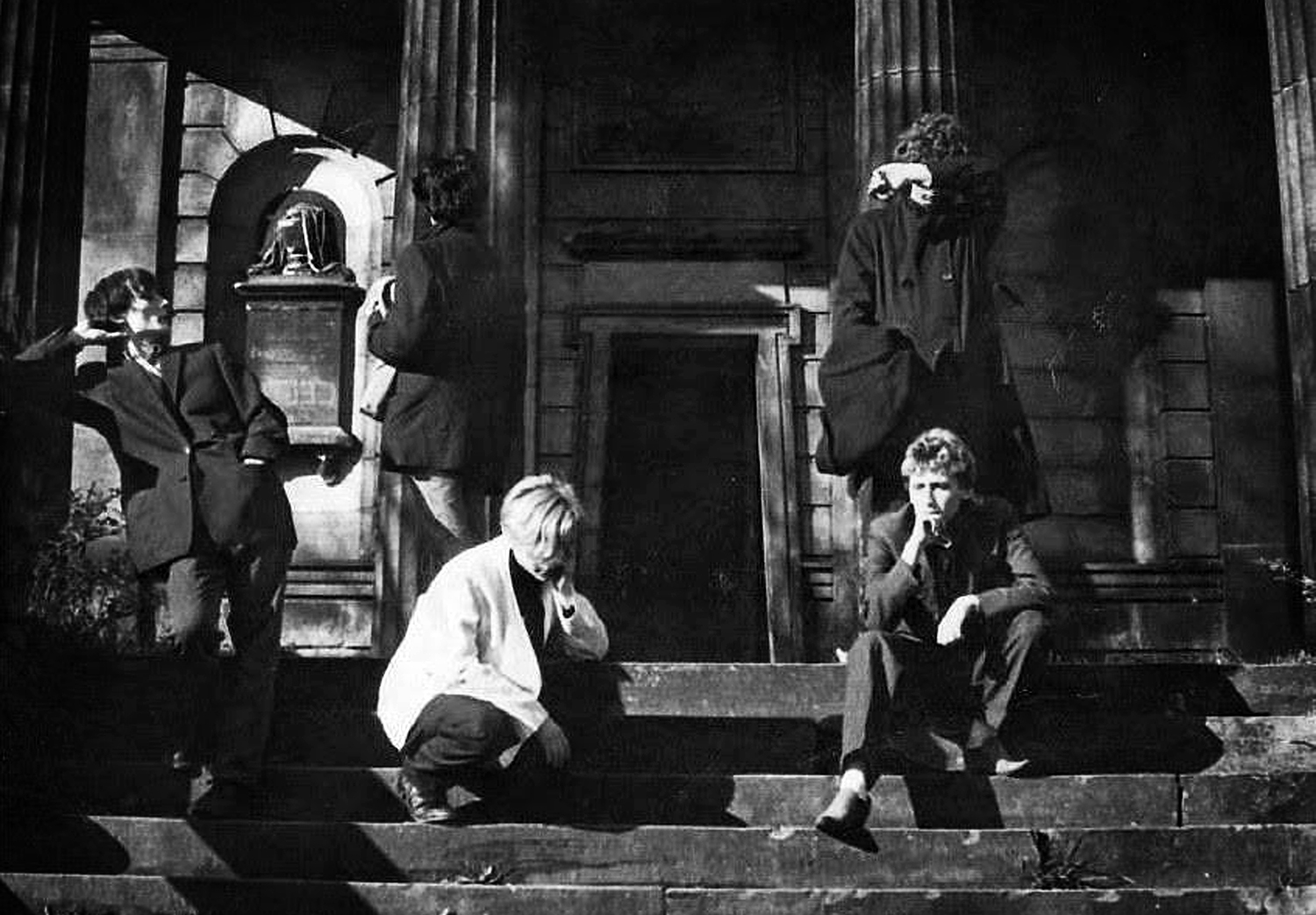
JB: When we spoke last, it was interesting when you were telling me about how Clock DVA came to a moment when greater commercial success seemed possible. Basically, that coincided around the time you were done with the band. Decades later, when you look at our contemporary culture and its obsession with visibility and branding, do you feel vindicated by that decision, or do you ever wonder what might have happened had you stayed on?
AN: No. It is always better to stay true to yourself. You should focus entirely on creating the things you want to create. Making money should never be the primary goal; if it happens, it should simply be viewed as a bonus. Fundamentally, an artist should create because they feel an internal, willful necessity to do so. That is what truly matters. At the end of the day, compromising your vision to produce something you do not 100% believe in is a mistake. You will only regret it later because it is not what you genuinely wanted to achieve. If you give maximum effort and maintain total creative control, you can move forward with pride. Looking back, I am grateful that I never made compromises for the sake of popularity or material gain. You must stay true to your art and your unique process, drawing strength directly from that work. Creating itself is the real reward.
JB: Agreed. That’s where I get frustrated when I think about a vast majority of the population who won’t know of a vast majority of music out there because they’ve never heard the band’s name or heard the music before. So, they instantly dismiss it without hearing a note. If it’s not popular, it is ignored and I think that is counterintuitive to any art.
AN: People often stay inside their comfort zones and remain closed off to new things. But if you never give yourself the chance to explore alternative ideas, you will never know what you might actually enjoy. JB: Let’s talk about the remastered edition of ‘Thirst.’ I think that record still remains one of the best post-punk albums of all time, so I am delighted with the reissue/remastered release. I wanted to ask about the transition from ‘White Souls In Black Suits’ which was more on the improvising side of Clock DVA. Then comes ‘Thirst’ where it seemed like the band moved more toward a more structured and song-oriented approach and. Did that transition feel radical from within the band at that time or did it seem like a natural evolution of ideas?
AN: ‘White Souls in Black Suits’ was a unique approach for us because it was built entirely from improvisations rather than pre-arranged tracking. In that sense, it was a bit of a mutant album. ‘Thirst,’ on the other hand, was a continuation of our earlier work where we focused on shorter, song-based tracks—something we were already doing before ‘White Souls.’ It was simply an evolution of a style we were already practicing.
‘Thirst’ was obviously much more produced. We also had to work within the physical limitations of an LP, which only gave us about 21 minutes per side. We had to approach it conceptually as a series of individual songs, concepts, and ideas that all fell in line to create a cohesive whole. Conceptually and structurally, the two albums are entirely different.
JB: Completely different! ‘Thirst’ has been described as a foundational document for industrial, dark wave and electronic music. Yet, back in 1981, those genres hadn’t fully crystallized. When you revisit the album today, do you hear a group consciously creating something new, or do you hear a band just simply pursuing its own interests without any concern for genre or future influence?
AN: Definitely more concerned with the latter. I have never really cared about genres or specific movements. I have always believed in a deeply individual approach to creating art, making it fundamentally from your own internal perspective rather than being concerned with external trends. The real focus should be on carving out something entirely new and unique to yourself, without worrying about how it will be perceived in the future. You just create what you do at the time, and then people make of it what they want once it is released. Often, time reevaluates the work or allows people to see it more clearly. Some things are ahead of their time, while other things are exactly on time.
You try to make work that lasts so it can be listened to far into the future. You want it to reach further, even if it is not fully understood in its own time. As time moves forward and other contexts take shape, people often return to reevaluate the work and understand it more deeply.
That has frequently been the case with the things I make. Music-wise, they possess a longevity that allows them to carry on and have a life beyond the immediate moment. Look at how Stanley Kubrick used classical music in ‘2001: A Space Odyssey’ (1968), it completely works. It demonstrates that music can seamlessly travel into the future; even what is classified as ‘old’ classical music still retains its impact and atmosphere. That is the most important thing: creating content with a powerful feel and an emotional resonance that people can always connect to that goes forward in time. If music’s got that content, that feel, that emotion, that power and statement, and so on, it captures that spirit, it can go on. You can listen to it in 30 years or 50 years’ time, and it’s still got that element that connects to people.
JB: With the benefit of hindsight, do you think ‘Thirst’ was a more future looking album?
AN: Yeah, I guess. You try to infuse each track with a distinct emotion or a specific soul. If you put that into it, the music gains a quality of life that allows it to carry on. In a sense, making music is like painting with a sonic palette, projecting tonality and texture. Ultimately, music is quite difficult to talk about because it is an auditory experience connected through raw emotion and feeling, though it frequently conjures up vivid visual imagery as well. It is hard to tie it down with mere words, because music is an art form that completely transcends language. It is a universal medium.
JB: I wanted to ask about the 2026 versions of “Four Hours” and “Sensorium” included with the remaster. It creates a really fascinating dialogue between Clock DVA of 1981 and today. When you’re approaching those reinterpretations, what aspects of the original compositions do you consider untouchable and where did you feel there was room to challenge or expand the intentions of your younger self in those tracks?
AN: The reason we decided to make this a double album is due to the physical limitations of vinyl. Vinyl capacity is much tighter now than it used to be. Originally, you could squeeze more than 20 minutes onto a side, but today, if you exceed 14 or 15 minutes, the sound quality suffers and it tends to distort. To make a double disc release viable, we needed extra tracks.
Because we didn’t have any unreleased, authentic material left over from that specific period, we decided to record brand-new, updated DVAtion (Adi Newton – vocals and electronics, TeZ Maurizio Martinucci – electric bass, guitar, and electronics, & Michael Somerset Ward – baritone and soprano saxophones – JB), versions of “4 Hours” and “Sensorium.” There have been a few different interpretations of “4 Hours” over the years; David J from Bauhaus made a version, and a friend of mine recently recorded a completely different, highly emotional rendition featuring just piano and vocals for an upcoming album.
We didn’t want to just copy the originals, that would have been a mistake anyway because the original versions still work perfectly on their own. Instead, these new recordings act as contemporary bonus pieces. I really like how they turned out, and the new music video for “4 Hours” is excellent. It shows that these tracks can easily be updated into a modern context and still feel completely relevant with a fresh sound.
JB: Did any of the past members have a hand in these remasters?
AN: The albums were remastered using original material compiled directly from my archive masters, with everyone involved carefully auditioning the tracks. When it was sent it to a mastering engineer, it actually had to go back a couple of times. There were some adjustments required because I wasn’t happy with a bit of distortion I heard on a few things.
A major problem with modern mastering is that they over compress everything nowadays. It heavily impacts the volume dynamics. When audio is uncompressed, you get natural variation in the waveform, but heavy compression just flattens everything and normalizes the volume levels so it’s continuously loud. While you don’t necessarily lose the extreme highs or lows, it squeezes everything into a single, uniform block of sound, which isn’t ideal.
I don’t like too much compression because it strips away the dynamic range. Music is naturally loud and quiet; it rises and falls depending on the dynamics of the instrumentation and timbres. If you compress it all into one flat line, it just becomes exhausting and overly loud.
JB: Yeah, and that that goes that leads right into my next question regarding this day and age, when everything can be digitally recreated. Do you think there remains something distinct about the tension and unpredictability that emerges from working with imperfections and limitations as far as recording technologies that were available during the recording of ‘Thirst’?
AN: The physical interplay between musicians is incredibly important. On an album like ‘Thirst,’ you have incredible musicians playing together, feeding off one another’s energy, improvising, and taking real creative risks. You simply cannot program that kind of magic. Even when utilizing new technologies, it remains vital to preserve elements of chance and the indeterminate.
This is exactly where AI-generated music and images fail. They lack a core element that humans can instantly perceive, there is a missing soul because there is too much technical perfection. Real life isn’t perfectly symmetrical or Euclidean; it doesn’t exist within strict mathematical parameters. True art requires expression, soulfulness, and raw human emotion. If those are absent, you won’t enjoy or get as much out of it because it feels bound to a predictable formula. Anyone striving for pure perfection in art is entirely missing the point.
Nature demonstrates this beautifully. On one hand, there is order, but on the other, there is decay, unpredictability, and chaos, like a storm or a tree shedding its leaves. These volatile, non-mathematical elements are what make things profound. The more abstract art is, the freer it becomes, precisely because it transcends the boundaries of the easily conceivable. This is the profound limitation of AI: it is always just calculating a path toward a sterile, “perfect” result, completely locking out the beautiful possibilities of human abstraction and chaos.
Personally, I prefer things that are imperfect. The true value lies in the spirit, the expression, and the voice behind the work because they convey genuine human emotion. This is especially true in cinema and drama; it is the human element, the personal stories, and the lived dynamics of the people involved that truly matter. While AI can produce visually correct material and make everything look spectacular, which certainly has its place though without that human dynamic, it is ultimately just a series of nice, grand images. Beautiful visuals alone aren’t particularly impactful. It is the authenticity of the human person, the storytelling, and the emotional weight of what is happening on screen that actually draws you in and connects with you.
JB: One of the things I like about what Mute is doing with these remasters is exposing younger listeners to a band like Clock DVA? If someone in their late teens or early 20s were to hear ‘Thirst’ these days without any knowledge of its place in post-punk and or industrial music history, what aspects of the record do you believe would still feel most relevant challenging or contemporary today?
AN: People connect to music on an emotional level and through raw intuition. In most cases, you know almost instantly whether you like a piece of music or not the moment you hear it. Of course, some music takes time to reflect upon, and you grow to appreciate it more over time. It’s like listening to an album: you start out with your immediate favorite tracks, but years later, the songs you initially overlooked often become the most important ones to you. It comes down to a feeling. People connect to a piece of music the very second they hear it, provided it possesses that genuine emotional quality. When it does, a completely new audience can connect with it instantly—even without any prior knowledge of the band’s history or where the music came from. That is the beauty of discovery.
JB: It’s great discovering an album that you come to find much later. Still making connections like that is pretty neat.
AN: Yeah. A lot of albums go under the radar, so we are intentionally working through these projects one by one, treating each reissue as its own distinct album. That was always our plan, rather than rushing everything out all at once, we are taking our time to carefully curate the mastering, the artwork, and the historical context. We want to build each release around its own unique history, concept and story. That is the strategy we are pursuing: building the catalog back up thoughtfully, bit by bit.
JB: I’m still enjoying the record’s balance between discipline and instability. The rhythms often feel precise and mechanical with varied instrumentation like saxophone, guitar, and vocals that introduce a sense of unpredictability. I wanted to ask you particularly about that tension. Was the record a conscious reflection of the social political atmosphere of early 80s Britain, or did those contrasts emerge more instinctively from within the personalities that made up the group then?
AN: A number of individual factors shaped that sound, alongside what was happening in England at the time. It was the era of the Thatcher regime, the rise of the Conservatives, and a looming sense of corporate fascism. That political climate created an intense social tension, and people naturally expressed that anger and anxiety through their creativity and their instruments. There were definitely a few factors that came through on the album. It was really an amalgam of different influences coming together. We were acutely aware of everything going on around us, and that anger inevitably comes through in the expression of things, whether you are making music, theater, film, or writing books. That’s what tends to drive things along really.
JB: You speak a lot about the importance of context, visual art and conceptual frameworks in your work and now revisiting ‘Thirst’ for its 45th anniversary, has your understanding of the album’s underlying themes changed at all?
AN: The concepts present on ‘Thirst’ were already there in embryonic form on tracks like “4 Hours” to some degree. They explore fundamental ideas: the nature of dreams, self-expression, and the notion of control versus decontrol. The emotion of love and these psychological states are universal maxims that continue to endure.
We simply re-interpret them in different ways over time. At the end of the day, everyone experiences the exact same emotional ups and downs. While our individual circumstances are unique, these experiences possess a universal resonance that gives the music its depth.
JB: Are there any ideas embedded in the album that seem clearer to you now than when it was originally created?
AN: Yeah, to some degree. I think with tracks like “Moments” and “White Cell” for instance, seem to come by a new feeling at this point, listening back to them. I particularly like the fluidity of “Moments” with the lyric, especially. It’s quite a complex lyric based on elements of historic changes and developments that we’ve gone through but ultimately remain the same in many senses. There’s a line in “Moments” of “New chapter beginning / Same page unfolds.” It’s relevant to what’s happening now, you know, it’s the same. “We ate his body we drank his blood,” is another line in the song referring to Christ and cannibalism. We’re still doing that. We’re still eating and controlling people. We’re still spilling the blood or drinking the blood in a sense. Things are the same, but we carry on even though one moment expands forever. One moment is all I need. We are just a moment in the time scale. We’re very tiny things. You come to contemplate time or infinity and you can’t, because it’s just unbelievably vast, you can’t get your head around it. These are things That was. These are things we contemplate and have contemplated for thousands of years, since beginning of time. And they still will continue to be things we will contemplate because they’re beyond us. So, they’re more towards God. This mythical answer of God. That’s all it is. A way of being able to answer things. Not fully but kind of like a mechanism.
JB: A way to try and comprehend the incomprehensible.
AN: Yeah, exactly. And “White Cell” is about (Marquis) de Sade (1740-1814), being against the will of society, you know, against moralities, and so on. Was really a big deal in a sense that he was really out on his own carving out this area that was unique to him, formulating this philosophy, which is not what people think of it or people get the wrong idea saying, “It’s just a sexual sadisticness.” And it’s not because he talks about nature and how nature doesn’t contemplate a consciousness of morality. It just acts and does, like a tsunami. It’s not a conscious act of, “Oh, I’m going to make a giant wave and kill a lot of people.” It just does it. A volcano erupts or animals attacking people, and so on. We don’t think about it in our terms. It’s on a different level. You have to take in this concept that life is cruel, it can be savage. This is what it is, you know? It’s not all tasteful. We’re all slaves of necessity. We have to do things in order to live. We can’t escape nature. He was all about these kinds of things and he used analogies to try and explain, or to put things into a more understandable framework. The idea of the id. The thing that’s there all the time. It does drive things and it is a matter of trying to control that in a way but being aware of it at the same time. All these themes will continue in our thinking anyway. How do you place morality into AI? It doesn’t think like we think. It’s a question of efficiency with machines. It’s a matter of questioning things and what’s the goal of things. In knowing this, do we pursue it? We know that there is no morality in a machine and that it just acts in the way that it’s programmed. Or even acts from its own form of knowledge. Which is free of any kind of morality. It’s a dangerous thing and this is an important issue, and it cannot be put aside as, “It’s just progress.” No, it’s not, it’s destructive. It’s going to be the end of things. Why would you want that?
JB: I was thinking about AI and when are we going to reach the point where it starts acting in its own best interests?
AN: Yeah, for sure. It will, it’s a fact. Seems to me that that’s what will go forward, like it’s all evolution which is beyond the one we have as humans. It’s very dangerous. Science fiction has always seen a dystopia from the beginning and we’re living in dystopia now. We’re not thinking about it, we’re actually living in it. All these kinds of factors are becoming more and more overt and more important. We can’t continue like there’s no problem there. Which is crazy.
JB: I spoke to Anya Huwe not too long ago and it got me thinking about people like her, Ken Thomas (engineer/producer), Neville Brody (graphic designer), Genesis P-Orridge (Throbbing Gristle, Psychic TV). There was a wide network of artists surrounding Clock DVA and they all contributed to a period when music, design, performance, and cultural theory seemed deeply interconnected. Do you feel something has been lost in the way contemporary music is consumed and presented, or do you see new forms of interdisciplinary creativity emerging?
AN: Yeah, I mean. At that point in time, Gen-O did the sleeve notes for ‘Thirst’ which are still very impactful. Then the artwork with Neville and Fetish, it was a very important era. People like Gen and Throbbing Gristle were doing great work experimenting. Now, I think with the expansion of all the technologies has revolutionized how we make things. The fact that anybody can create with virtual programs and machines and there is only so much, it’s like shifting through what’s good and what’s bad. You have to be Democratic. People can express whatever whenever. In the end, there is a qualitative effect in what you perceive and what’s distinctive about it. You have to sift through these things like a sieve. You sift through the rocks and retain the gold or getting to the marrow in the bone. You have to be discriminative, to some degree, anyway. It’s very hard these days to understand where things are going. There’s a lot of kind of simulacrum, like (Jean) Baudrillard (French sociologist, 1929-2007), and the copy without an original. We lose the original and accept the copy as being the original. Like a simulation. We forget where it came from and actually where it came from is far more interesting. I think that’s where we are a little bit. We’re now where there are masses of information available and you must dig through it all to find the truth and what’s real and what isn’t. By doing so, you discover things, important things. Confronting total knowledge is a volatile process that requires boundaries or you’ll go insane. That is why, as a creator, you must isolate your will. Do not look at what other people are doing and stop worrying about commercializing or exposing your work. Just create it, move on, and build the next thing. People will eventually find you and feel that connection. Today, technology is expanding the volume of art to a manic degree, but a true artist doesn’t worry about the competition, they just keep expressing themselves through their art. Do the thing you want to do, project yourself, follow through, and get on with it. JB: I think that leads into the album’s title. The word “thirst” suggests desire or longing or hunger, or pursuit of something (Adi agrees). In the context of the record, what do you think the album was truly thirsting for?
AN: I think it’s the thirst for knowledge, creativity and expression. A thirst to create something unique. Discover more. Research more. Find out more. Look at things more deeply. All those things.
JB: It’s interesting to me all this time later, after the album first came out, it’s more relevant today as it was when it came out.
AN: Yeah, definitely. It stood to test the time for sure, I agree with you. Those elements continue decade after decade. So, it’s always necessary to think and seek answers to things. Constantly trying to understand the world and our place in it.
For more information, please visit Mute Records | Adi Newton | Bandcamp