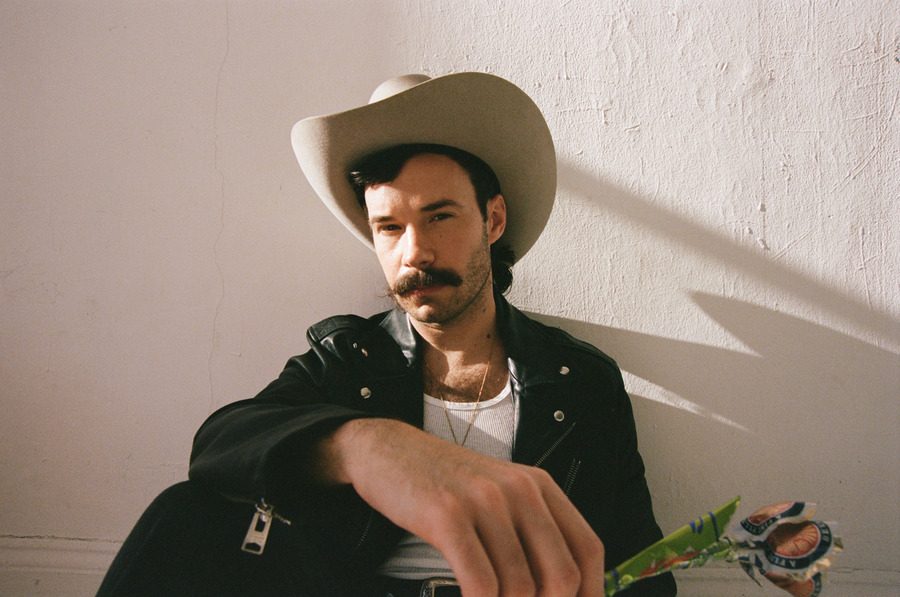
Photo by Alexa Viscius
As Pride Month comes to a close, Andrew Sa is poised and ready to make sure it ends with an exclamation point. The songwriter’s long-overdue debut, American Rough, is rooted in old school country music, the kind your parents or grandparents listened to on their living room hi-fi systems, while incorporating more modern reflections and, at times, some light soul and R&B rhythms. With artists like Rufus Wainwright, Elton John, and Jeff Buckley providing songwriting inspiration, Sa’s vision came into focus while hosting the Cosmic Country Showcase in Chicago. It was there that he was introduced to Patrick Haggerty of Lavender Country, who gave Sa the agency to be a gay artist playing country music.
With ideas and morsels dating back to 2018, Sa spent the early part of this decade working with HC McEntire and Missy Thangs on the material that would make up the heartfelt romantic country music heard on American Rough. Like Elvis Presley and Roy Orbison, Sa’s music doesn’t sound like it was created in a Nashville country music lab, rather, it builds off a base that keeps the rural cowboys happy while also appealing to people who feel well-written, well-presented music in their bones, with moments that embody the “tear in my beer” sentiment Hank Williams sang about in the late ’50s.
Saddle on up for this conversation with Sa and learn about how American Rough was created with a little help from his friends.
I read that you grew up on the west coast and then you came to Chicago for the Old Town School of Folk Music. Is that what led you to Chicago?
ANDREW: I had lived in Portland, Oregon for a couple of years before I moved to Chicago. I loved Portland, and I still love Portland, but it wasn’t really challenging me artistically in the ways that I wanted to be. And I had friends that lived in Chicago. And then my partner at the time also had friends who lived in Chicago. So it just seemed like a good idea for us to move there. But when we started dreaming up the idea of moving, it was then that I started looking at the Old Town School’s website and planting the seed to take songwriting classes there. So I wouldn’t say that it’s the reason that I came, but it’s definitely one of the things that’s kept me here.
Are you still West Coast Andrew? Are you now Chicago Andrew — personality wise?
ANDREW: Oh, that’s a good question. I think I still am very West Coast Andrew. The reason I say that is because people comment on how I take my time with things, that I’m soft-spoken — these things aren’t necessarily Chicagoan.
I was scrolling through some Instagram stuff and it looked like you started working on this album almost five years ago?
ANDREW: Yeah, Heather (HC McEntire) and I started talking — I want to say it was the summertime of 2021. That’s when me and my manager first thought we should ask her to produce the record. But it feels like we’ve been working on this album even longer than that. I mean, I started writing one of the songs on the album — “Gorgeous Things” — that song’s probably from 2018, or started in 2018, and then my friend Liam Kazar and I finished it. But it was December of 2022 that we had the first session for this record. We chatted in July and started the thing July of 2022.
What is the challenging thing, the behind-the-scenes stuff that the listeners of your record won’t know about the making of this record?
ANDREW: The way that Heather and I wrote a bunch of the songs together — the way that we collaborated for the most part was I would send her the seedlings, the ideas that I’d play on my tenor guitar as just a voice memo with some lyrics. And she would take it, ask me a bunch of questions, adjust, and then send it back. And for the most part, that worked brilliantly. Very Postal Service kind of vibes — over the airwaves, but not in the same room necessarily. Which I think a lot of people think, you know, co-writers, oh, you obviously are sitting there together making it. And that is true for “Lavender Cowboy.” The chorus of “Lavender Cowboy,” we sat down and we worked out together at the very last session — that was the last song that we put together.
This co-writing — because you’re not in a room and you don’t have a deadline of ‘we’ve got to get this done by five today,’ it’s based on your schedules back and forth and based on when Heather’s available to take the time and sit down with the song and put full attention to it, based on when you have time to receive it back — that collaboration, while meaningful, can take time.
ANDREW: And that speaks directly to what you said earlier. This album took many years, and I’m very grateful for the amount of time that we got to take with it. I have always taken my time. I wouldn’t necessarily call myself a late bloomer — but maybe, right. I’ve been writing songs since I was 18, or at least dabbling in writing songs since I was 18. And it’s taken me until now to finally feel confident in the writing, to want to put it down on something that could exist forever. I know that’s not a lot of people’s journey. I know a lot of people have confidence to spare in the beginning, but it’s taken me a long time.
Do you feel like the universe is giving you this June release date as the right time? Or do you really wish it had come out earlier?
ANDREW: Bloodshot Records approached me. We were shopping it for about a year before we locked in with Bloodshot. And we had some interest from some labels that I would have been happy with, but we were kind of holding out for, for lack of a better expression, a better deal. And so ultimately, I’m very happy that we waited and that we took the amount of time that we had. And I would agree with that sentiment of the timing kind of aligning at the right time. Would I say that I wasn’t frustrated throughout the process? No, I would not say that. I can really understand someone being impatient and wanting to release something on their own. But I do think the reason the collaboration worked so well is because Heather is very similar — she takes her time, she allows herself the space to make the right decision for herself. She’s not impulsive.
Liam Kazar co-wrote the lyrics for “Under You,” right?
ANDREW: He wrote that song entirely. For me. It was during the pandemic. Liam and I had a lot of time on our hands and we decided that we would get together and do a writing retreat at our friend’s house — one of the guys from the band Twin Peaks owned a house in Gary, Indiana. He was like, “Sure, you can have it for the week.” And so we went out there and wrote some songs. But in preparation for that, Liam had written “Under You” for me while he was living in Kansas City. That would have been in 2020.
How did the two of you connect?
ANDREW: I sang backup for him in his band for a few years when he was just starting the Liam Kazar project — that would have been 2018 into 2019. I sang backup for him and that’s why he wrote a song that would be a duet that we put on his first record. Liam and I are both romantics. And I think that that’s kind of hard to find. I guess it shouldn’t be — I think of songwriters, probably a lot of them would consider themselves romantics — but we really understood the way that each other wants to use their voice and captivate an audience through an expressive vocal performance. We just became fast friends.
Chicago seems really ripe with talent right now. There are artists like Friko, Free Range, Liam Kazar, The Sharp Pins that I’m really into.
ANDREW: Chicago — we really look out for each other. We really care about each other. Everyone’s success benefits everyone is kind of the way that I like to look at it. That’s not to say that we don’t compete for certain things — that’s just natural. But we’re not competitive, necessarily, if that makes sense. Every time I have a friend who comes in from out of town, whether it’s folks from North Carolina who worked on the record with me, like Missy Thangs and Heather, or friends from New Orleans or New York or whatever, they always compliment our scene. They speak so highly about how supportive we are of each other.
When you think about artists of your generation who you would aspire to be, or an amount of fan base that you would aspire to, who comes to mind?
ANDREW: I think of someone like Fruit Bats or Rufus Wainwright. I should have mentioned Andrew Bird earlier too. I’m a huge fan of Andrew Bird.
I was not at all familiar with Patrick Haggerty until I was reading about your song “Lavender Cowboy”. Tell me about Patrick Haggerty: your relationship, how he inspired you as a musician or as a person.
ANDREW: I was raised on country music and Southern rock and pop, but my mom was really obsessed with country. In my teens, I left it for obvious reasons — it doesn’t have the cool factor, especially being in the Bay Area, California, listening to country music. I remember very vividly my brother saying, “You’ve got a nice voice, but if you could just take the twang out of your voice.” So I kind of left it behind for a long time. When I moved to Chicago, I started dabbling in folk music because I started working at the Old Town School and I had an all-acoustic band. The guy that books the Hideout — his name is Sulli Davis, he’s now my manager — he was having Patrick come play, Lavender Country, and he asked me to open for them. This was April of 2018. That’s when I learned about Lavender Country and started listening to his music in preparation for this gig. If you’ve had a chance to listen to that record, it’s really unabashed — it’s so joyful at times and triumphant at times and broken and brave and bold. It just blew me away. But seeing Patrick live really took the cake, because he was able to tell stories like no one I’d ever seen live. And I come from a theater background. But for him to speak on his own life and have you in tears one minute and laughing hysterically the next — there was no one like him.
From that night on, we became very close friends and spoke on the phone often. And every time he came to Chicago, I opened for him. We had him out to play our Cosmic Country showcase a couple of times, which is a seasonal show we do. He gave me permission to come back to country — that’s the way I like to look at it. And it was because I could see myself in country through him. I think of that when I think of Rufus too — when I was a teenager and came across Rufus, I thought, wait, I can do that? It’s possible to be an openly gay artist singing about the things that he wants to sing about? I felt that similar feeling with Patrick: wait a second, I’m gonna return to country music.
You’ve heard the record — it definitely has country leanings. It’s also very indie. It has some real soul and R&B moments. It feels very much like the culmination of the person that I am now and not just country. And it was really Heather and Missy that helped me create that sound.
Patrick was, as he would often describe himself, a screaming Marxist bitch. He would proclaim that on stage. He was very loud about his political beliefs, and I think that’s one of the reasons why a lot of people are attracted to Patrick and his music. But for Patrick and I, he was like a gentle patriarch — the sweet father figure, grandfather figure, comforting, supportive, but also flirty, person in my life. We don’t have a lot of that generation of elders in the gay community, for many reasons, but I cherished our relationship on many levels.
I didn’t mean to imply earlier that you’re just a country artist. You’ve got horns, saxophone on the record. As you mentioned, there’s some R&B.
ANDREW: Some people are kind of expecting me to come out with a straight-up country record, and I’m very happy to deliver something different. I’ve had so many people say to me, “You made me like country music,” or “I didn’t think I liked country music until I heard…” And I swear that is gold. That sounds like mission complete, or at least, you know, check.
I started listening to country music because when I was in college, Uncle Tupelo were starting to make a name for themselves. I didn’t listen to them – at least not right away – but I picked up a copy of Wilco’s first CD at a record show a few weeks before it was officially released and loved it. It made me go back to Uncle Tupelo and then I read about some of their influences and went further back.
ANDREW: That’s the way I found so many artists as well. That’s the way I found Nina Simone back when I was 18. It was through Jeff Buckley. I had fallen in love with Grace and was looking who his influences were and found Nina Simone. That’s one of the best ways to find music.
”Under You,” “Follow,” and “Your Whisper” are the three that most recently have really risen above the rest for me. “Your Whisper,” I think, is an illustration of not necessarily a country-sounding song. There’s a sax in it — some sort of sexy, intimate, soulful feel to that song.
ANDREW: Thank you. That’s Hunter Diamond on the sax. Those are all very romantic songs. “Your Whisper” I wrote myself, but “Follow” — Heather and I wrote together. “Follow” was directly related to “Under You” because Liam really got me into this poet, Arthur Rimbaud. And I was trying to write with “Follow” something that still had the same amount of big, huge, cinematic emotions — to paint a story, to be really playful with the lyrics and colorful in any way.
”You Turned Me On” has this ‘50s kind of classic sound to it. Was there anything in particular you were channeling as you wrote that song?
ANDREW: When I started that song, it’s a culmination of things I had said to my partner. There’s a classic soul song called “Turn Me On” — Nina Simone, I prefer her version, but Norah Jones even had a version on, I think, her first record. I kept saying to my partner, “I wish I’d have written this song. It’s so perfect.” And he said, “just write your own.” So that gave me the idea to talk about turning someone on in a song, and then put it in the same sonic space — that ‘50s, early ‘60s, six-eight, kind of sultry feel. I call that our burlesque number, honestly, because by the end of it you’re just swinging around here. The reason that song exists is because of a sexual fantasy that came true. And then my thought is, well, what then? That thing that you’ve fantasized about forever has been realized — and then what? So that’s kind of what that song’s about.
I’ll pick out a lyric that has nothing to actually do with what you’re trying to say in the song, but it hits me at the right moment. I was out throwing the ball with my dog this morning, listening to “Gorgeous Things,” and the line about “just like the first bloom of spring — I don’t want you out of my sight” — in Columbus today it’s like 65, 70 degrees, it’s a beautiful day, and that line hit me. That’s the beautiful thing about music.
ANDREW: To speak to that — we spoke about pop country earlier. I think what I’m trying to do, and what I’ve really learned from Liam and Heather’s songwriting, is allowing your audience moments to enter in and create for themselves, as opposed to dictating what they should be thinking or feeling. A lot of pop country — and this is obviously intentional — is very straightforward and simple. And that’s not what I was going for. So I’m happy you have that.
If I talk to you in December and you say to me, “I sort of met my goals, things worked the way I was dreaming them to be” — what are those goals? And also, what is something that you think is within reach but is going to take some work — a stretch goal?
ANDREW: I would be reaching a goal by December in that I’ve wanted to play New York and I’ve wanted to play LA — and those are on the horizon. And I’m so excited to go back to Nashville with a full band for Americana Fest. I wouldn’t say I’m trying to keep low expectations but because this is my first time around, I’m feeling very happy with how it’s going so far.
I would love to get on a tour as support for someone that I admire. I know we’re in talks of something small with someone, but I don’t know that it’s going to happen. But that would be my sweet-spot dream.
I think the more unattainable goal, as of now, that I would really love is to get a song on a soundtrack for a film. Because I’ve always found new music that way — that’s how I found Rufus Wainwright, from the Moulin Rouge soundtrack. He has this random song in French. The idea that one of my songs would be used to enhance something cinematic would be an amazing career goal to achieve. And then of course, the way for people to find me.
I heard Paul Simon say on a podcast that the music we hear when we’re kids will be the music that we can always return to, regardless of how our tastes change — that sweet spot of 11 to 14, it’s something that will always be in us. Those songs from my childhood — I can sing along to every one. Those songs are part of me.
ANDREW: That is cool. It reminds me — I work at the front desk at the Old Town School, and every now and then we have what’s called a Music Memory Experience, where elderly people who are suffering from different memory-loss conditions come in and they sing together and make music together. And music is the one thing… Have you seen Coco, the Disney movie? I’m not usually someone who’s like, go out and watch Disney movies at my age. But that movie — it’s about a young man who wants to play music but his family forbids him, and the lengths that he goes to as an incredible musician. One of the characters has Alzheimer’s and he reaches them through the music. It’s very emotional.
My wife and I were talking about what brings me joy and I told her music. I said that I feel it in my blood, I feel it in my bones. Music is there for the good and the bad, and it never lets me down the way that people do.
ANDREW: Yeah, for real. My parents split up when I was very young. And I was actually talking with some of the teens at the Old Town School — leading a talk — and they asked me how I got into music, when did I know I really loved it? And it was when I found that I could escape into it. So many of them said, “Me too, me too.”
Escape is the right word, but it’s escaping into a world that you want to be in.
ANDREW: It may have started in a position that I was trying to escape out of something. But it’s a superpower. Now I get to give that to other people.
What’s a song, an artist, or an album that when you listen to it and close your eyes, you’re transported to a specific time and place in your life to the point where you can smell the smells or feel the feelings you had. Is there something that takes you back to something super specific?
ANDREW: Can I give you two? They both exist in our family pickup truck. We had a Ford F-150 from 1986. The first is when I was a kid — I’ve got an older brother and a younger sister. When my parents were still together, all five of us would cram into this pickup truck. It was before bucket seats — just a bench, like a couch. I remember so vividly, in our Sunday best, listening to “Pretty Woman” by Roy Orbison. That song always brings me back to that very specific moment, driving around Fremont.
And then when I inherited that truck, and I was down in Santa Maria, California, going to acting school — the town is split up into the old part and the new part, and there are these strawberry fields that separate them and this long stretch of road between. Every time I hear “Pink Moon” by Nick Drake, I think about that long stretch of road and the strawberry fields at nighttime, driving home in that pickup truck.