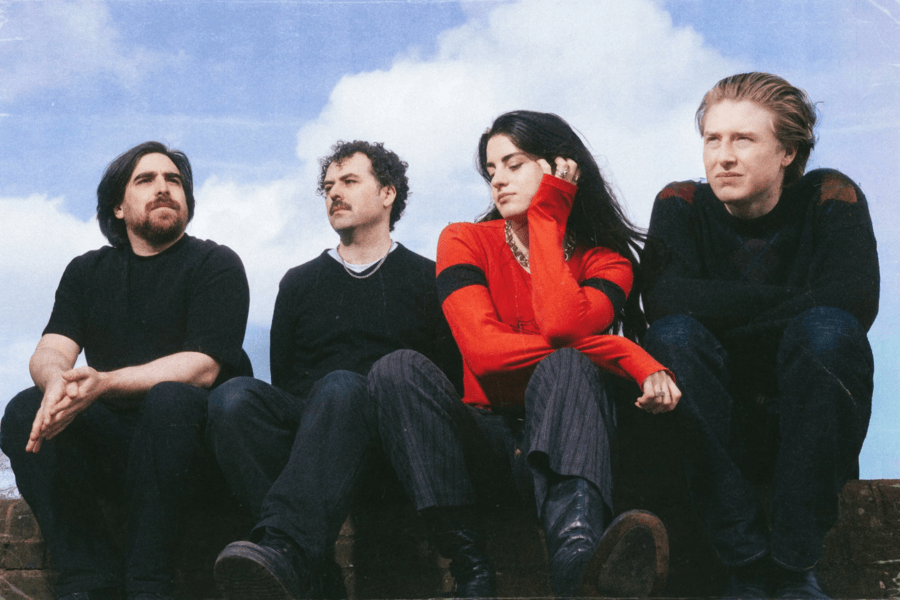
Photo by Sal Redpath
The distance between a solo intimate songwriter with a poetry background and an art-rock frontperson is not a small one, but Sophie Harris has found a way to inhabit both without sacrificing either. On Johnny’s Dreamworld, the full-length debut from Harris’s band Modern Woman, the tension between those two worlds – the careful and the chaotic, the lyrics and the noise – is the whole point. Harris sings like someone who has always thought hard about words while the band plays like they’re trying to make her forget them.
In this email interview, Harris considers the weight behind the band name, reflects on how collaborating with bassist Juan Brint-Gutiérrez, multi-instrumentalist David Denyer and drummer Adam Blackhurst transforms her words into something louder and stranger, and shares the song she hopes people find on the album.
The album’s been out for a month. Have you had the opportunity to catch your breath and relax, or is it already, “okay, what’s next?”?
SOPHIE: A bit of both really – because this record was finished a while ago, we’ve been thinking about the next one for a while. I’ve been considering what direction we want to go in next, and hopefully we’ll be recording some new stuff soon. But I did take a break for a couple of weeks after the record came out. I went walking in Scotland, the guys went on holiday to various different places. I think it’s important to fully step away before starting something new.
Is Modern Woman just a band name, or does the album feel pressure to define what that means?
SOPHIE: It’s just a band name, but I’m a woman, so the things I write about are about are in some way about my personal experiences or things that interest me, I can never separate myself from them
Does the album present modern woman as a fixed identity, or as something the listener pieces together track by track?
SOPHIE: I would hope something the listener pieces together, I think we always wanted this record to have a bit of variation, and when writing it, we were excited by the prospect of experimenting with different ideas. But essentially, we just go with what we think sounds good in the moment, and the album is a culmination of those experiments. I always wanted the songs on the album to feel like little stories within themselves, though.
The title track opens the album and was the first single; it’s doing a lot of work. What made you feel like this was the song that had to represent Modern Woman to someone who might never hear anything else?
SOPHIE: It was actually the last single, the first single was “Dashboard Mary” – which we chose because it felt like the song that stood out the most to me on the album. It sort of tied together a lot of the stuff we wanted to achieve as a band.
Then “Johnny’s Dreamworld” (the song) actually came out last, simply because it was the last one for us to fully finish. That one feels a lot more fun for me, because we experimented a bit with the arrangement, layering different ideas, removing many – keeping some. It does its job.
As I scrolled through the comments on the “Johnny’s Dreamworld” video, there were comparisons to artists like Kate Bush, Pixies, Joy Division, Gang of Four, Dry Cleaning, Faith No More. Do those feel like influences you’d claim, or is it more interesting to you what those comparisons say about your listening audience?
SOPHIE: They’re very nice comparisons – I was surprised about Joy Division though, I love them.
I believe I read that your early forays into music were as a solo folk musician, perhaps by necessity because you hadn’t yet met anyone who played instruments. Did meeting musicians who shared your vision change what your vision actually was, or did it just give you new tools to execute it?
SOPHIE: I did have an idea of the direction I wanted the band to go in, because I had these songs kicking about, and some ideas on how they could be translated. I knew I always wanted to have a slightly folkloric element to some of the music, but I wanted it to be on the heavier side – and I think that also helped me when finding other band members that shared that same inclination. However, I think that meeting the guys was unprecedented in the sense that they are all amazing musicians in their own right, and so, in ways both large and small, their ideas and what they brought to the project evolved the band into something that would absolutely not be the same if they weren’t in it.
The Dogs Fighting in My Dream EP from 2021 seems to be the earliest Modern Woman material out there. Does the evolution since then feel natural, or do you look back at that band and barely recognize them?
SOPHIE: It feels natural – it seems a long time ago, but some of the songs on the album were written around that time – it was more for logistical and financial reasons that we were unable to record these straight after Dogs Fighting in My Dream. Many things happened that delayed that album being recorded and released – to the point that I think we all didn’t know if we could continue at a few points.
But, I do think, during that time, we wrote some new songs and our mentality changed towards the project – in a way that I think made Johnny’s Dreamworld what it is.
The tension between conflicting things – tender and harsh, loud and quiet, scrappy and polished – is really apparent when you listen to the album front to back. A song like “Fork/Heart” embodies that within a single track, the way it starts is not the way it ends. Are you more drawn to creating that conflict within a song, or in how the songs push and pull against each other across the sequence?
SOPHIE: I think within a song – we are drawn to shock in music and major shifts that demand attention – I don’t think our music is that listenable in the background – and I think we had conscious attention on that when creating a lot of the songs on this record.
I do wonder whether that might change, though, I love music that is shocking and demanding, but I do think sometimes, some of the best songs are those that can articulate those feelings delicately or purely lyrically too.
Which lyric on the album are you most proud of? And when you got there, was it something that spilled out, or did you agonize over every word?
SOPHIE: I don’t think there’s one in particular – I do find it hard to re-read my lyrics, watch us perform, even listen to us sometimes. I’m not sure why. Some of the lyrics came really easy, I seemed to have a strong visual idea of what I wanted to say in the song/ what the song felt like – and they seemed to fit, though I wasn’t always sure why – “Dashboard Mary,” “Killing a Dog” were those – then others took a longer time.
You’ve released four videos, the focus tracks, the ones designed to pull people in and inspire them to explore the rest of the album. But outside the singles, is there a song that you think of as an in-plain-sight secret, one you really hope people find on their own without being led to it? For me that song is either “Killing Dog” or “Blessed Day.”
SOPHIE: A lot of people like “Blessed Day,” and seem to be finding it on their own accord, that’s David’s favourite, and I think was a potential single for a while. I do like the song a lot, it’s very fun to play and I like the guitar parts I wrote – but the reason we didn’t release it as a single was because it felt like it captured a part of us and not the whole – if that makes sense. “Killing a Dog” is one of my favourites, and a very old one, so I would say that’s one I hope people find on the record.
You’re the songwriter, but David, Adam, Juan, and Joel are clearly essential to what these songs become. Are you at the point where you know what each of them will bring, or do they still catch you off guard in ways you didn’t expect?
SOPHIE: Absolutely catch me off guard. They’re all great musicians. Juan is an incredible bassist, for example, we were working on a new song recently and the way he approaches songs is really interesting – bass is so important to a track, and he knows when to keep it simple of make it complex, sometimes he can make a song feel completely different just with the parts he chooses to play.
Pulling it all together – the band name, the lyrics, the conflict within the songs, the videos, the album title, the cover – what do you hope someone is left with when they’ve taken in everything you put into this?
SOPHIE: All I want is that they aren’t bored
To close, tell me about a song that, when you hear it and close your eyes, works like a time machine back to something specific from your past. Where does it take you and what do you see?
SOPHIE: “Incomprehensible” – Big Thief, sat on the hill in the dark at Green Man Festival – it was before they released it, and I thought it was some of the greatest lyrics I’d heard in a long time.