Photo by Sean Mathis
In a world where most music arrives in bite-sized pieces via social media platforms like TikTok and Instagram, time may be the most underrated luxury. Leon III’s Candy Cigarettes asks for 41 minutes of the listener’s attention and gives plenty back. The songs flow into one another, and even when the lyrics don’t tell a story, the music does. There’s the slow, dusty crawl of “Phantom Train,” the lonely guitars and space-frequency buzz of the title track, the unhurried gray-sky highway drive of “Invisible Ink,” and “Brushstrokes,” which opens on hovering, phaser-soaked sounds before building into a late ’60s/early ’70s jam. It’s a journey, and one best taken front to back.
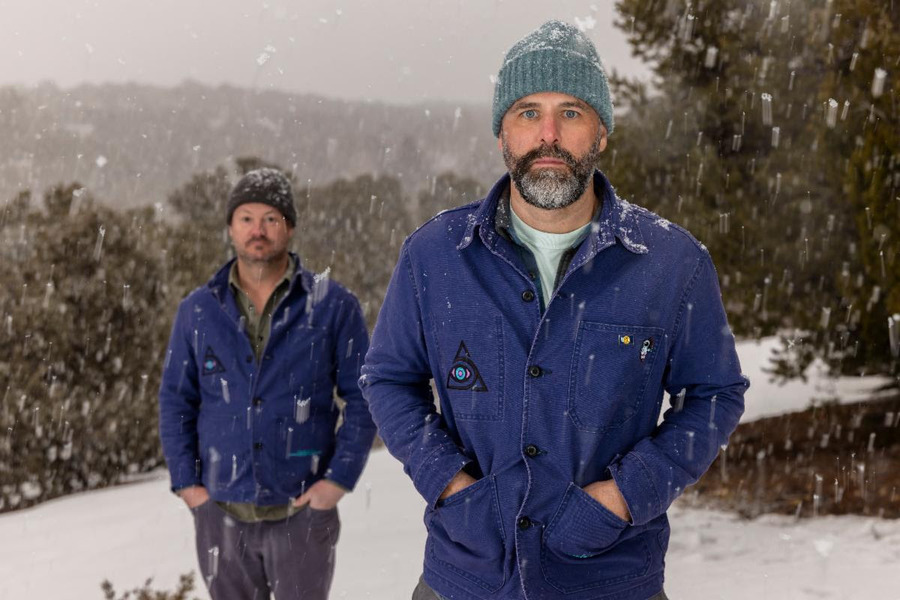
A press release calling the band a “Southern Pink Floyd” is what first drew me in, and the description does makes sense, to a point: the twang and desert dust are the Southern part, the patience and space are the Floyd. But it sells the band short. There’s a sun-baked psychedelia here closer to Neil Young and the Meat Puppets, and a nod to the Grateful Dead that stops short of becoming a jam band. Leon III is really two people, Andy Stepanian and Mason Brent, with other musicians joining them in the studio and on the road. I spoke with Andy about how they build these worlds, and about the female backing vocals that sneak up on you when you least expect them.
Somewhere in your bio it mentions “Southern Pink Floyd,” and that was the hook that got me to listen in the first place. Does that comparison actually fit?
ANDY: Well, thanks. Someone, I think it was Relix Magazine, that was kind of a quote from two albums ago. I’ll take it, right? I do feel like we worked hard to create full album concepts that have themes going through them, and that feel cohesive, and that link together. There’s a big, sort of, sonic landscape going on, and so in that regard, Pink Floyd is as good a comparison as any, I guess.
If I bring two records up to the record-store clerk, a guy who knows his stuff, and he says, “If you’re buying these albums, you should definitely check out the new Leon III record,” what two albums am I holding?
ANDY: So, as strange as it might sound, maybe Goodbye Yellow Brick Road by Elton John, which is sort of a genre-less thing that is expansive and connected, and has songs that range from having country ornamentation all the way to sort of rock. We rock a lot harder than Goodbye Yellow Brick Road, but it’s one that comes to mind. And then, I guess… honestly, something like Dark Side of the Moon.
Makes sense to me. Elton John, Pink Floyd. Recognizable names, people kind of know what they’re getting. Somebody who’s buying both of those has a wider music palette than somebody who’s buying whatever the hot new pop albums are.
ANDY: Yeah, other things that come to mind, like Morning Phase by Beck, or Mutations by Beck. I can’t think of a Grateful Dead studio album that would be a perfect analog, but something like that.
For what it’s worth, I hear more Grateful Dead than Pink Floyd in your music. It doesn’t sound like the Dead to me, but it sounds more like them than Floyd.
ANDY: I’m a bigger fan of the Grateful Dead, just as a listener. The one thing that I think is lost on some people, maybe you included, growing up, or even now, is that the Grateful Dead has become almost a parody of themselves at times, with the rehash acts and the amount of commercial… they’ve become this commercial juggernaut, almost, which is so weird. But one thing that’s lost is they had really good songs. If you dig into their catalog, despite all the jam trappings, the songs were really good for the most part. They were written with care, they had melody and I think that’s something we like to do. We really try to make good songs first, and the rest of it is just… everything served the song, I guess.
Having never seen you live, do you stick close to the recordings on stage, or do the songs go in different directions depending on how you’re feeling?
ANDY: Yeah, I think if you saw us live, it’s definitely more of the latter, more open, and the songs take on a different life and tone live. Mason, in particular, is a really talented and expansive guitar player, and sometimes that is a little suppressed on the recordings, but it comes out live. So I think you’d find that the band is more expansive and actually rocks a lot more than you may think by listening to the recordings. We hit pretty hard live.
Is there an album you turn to just to shut out the world for a while, something you put on and disappear into, rather than listen to with purpose?
ANDY: Oh, yeah, sure. That’s the whole listening thing for me. There’s different relationships with music; there’s the superficial, and then there’s the deep and dense. I’m looking around my space here at albums, and one that I see right here that is probably the one that has moved me the most in the last decade is an album called Wild God by Nick Cave and the Bad Seeds. It’s basically like a gospel, emotional, cathartic experience, top to bottom, and it’s one I just return to all the time. I’ve also always been a big fan of Will Oldham, who records under the name Bonnie Prince Billy, and I go back to a lot of his albums. We work with a guy named Mark Nevers on the production side, and Mark produced a lot of Will’s albums, like Master and Everyone, which is a Will Oldham album that is very sparse, like a whisper of an album. I just love it, and it feels cohesive, not just like an acoustic guitar guy. So yes, very much so.
The record plays like a continuous piece rather than a stack of singles. Was that sequencing intentional, and how do you think about the album as a top-to-bottom listen in a streaming age?
ANDY: Yeah, although we do sequence them as a side A and a side B. There’s a little instrumental interlude, like a reprise, at the end of side A, and then “Brushstrokes” is the beginning of side B, and it’s really designed to hit you pretty hard, like, “Whoa, side B is something different, something new’s going on here.” But generally speaking, we sequence them together. The songs, when we first sequence them, are all capable of blending together, and there aren’t a lot of hard stops. Sometimes there are hard stops by design, but we try to blend them together so you really feel like you’re listening to one long string of music, as opposed to a bunch of songs that just so happen to be on an album.
And the same is true for digital, right? You don’t know what people are going to choose to listen to. I would bet that very, very few people listen from song one to song, in this case, nine. Today’s world is very much an à la carte listening experience, and so we try to really have good songs, and each song can also stand on its own and has moments of emotion that people can feel, and all that stuff.
Bands like us, or artists like us, are a dying breed also. We find that the average consumer doesn’t have that sort of 44- or 55-minute appetite to consume a whole album. We hope they do. In terms of Leon III, the fans, the people that tend to like us, are people that do have that.
”Brushstrokes” opens side B. Tell me about that song: how it originated, and what your process was putting it together.
ANDY: I build the skeleton of the song and do a lot of demoing right here in this little studio space that I’m in now, on my own, over the course of however long I’m building songs for a potential album. And I play probably too many things. I’m not super skilled at everything, but I’ll put together a fairly well-built-out demo: me, multiple guitars, multiple vocals, bass, lots of different keyboard sections, sometimes some percussion or drums or digital drums. So I kind of go overboard on it. In the case of “Brushstrokes,” the demo was probably four and a half or five minutes long. Then those demos get conveyed to the band in one way or another before we go in for the sessions, and people come in with a thought on what they want to do. The way Mark Nevers tends to work is that he’s not prescriptive. We don’t want him to be prescriptive about turning it into an eight-minute song that’s gonna sound like this. It’s kind of like the band gets in the room, we learn the song, we start messing around with it and running it, and it ultimately leads to something. In the case of “Brushstrokes,” it didn’t really hit very hard at first, because we were trying to be more succinct with it, we weren’t letting go. And finally we let go, and that led to a really long intro, a long outro, some of which got edited later into an almost electronic section that I created here. In the end, I think 90% of the song is really the sound of Leon III’s live band going after it. It rocks quite a bit, it has a lot of different moments, and to me it’s probably the best representation of what the current iteration of the band sounds like, and where we’ve evolved since album one.
There’s a lot buried in these songs that you’d miss on a quick listen: horns on “Habits of Creature,” something like space-laser sounds on “Gravity Waits Patiently.” What’s going on underneath the guitar, bass, and drums?
ANDY: Yeah, some people accuse us of doing too much of that. There’s a lot going on on a Leon III recording, and if you put it on headphones, you’ll find a lot of little nuggets of music and things that are sort of planted in there. Most of this stuff is kind of happy mistakes. Mark lets us go, we do a bunch of stuff, some gets stripped away, and then some stuff is like, “whoa, that was unintentional but super cool, let’s highlight that,” you know?
There’s a lot of female vocals on the whole album, too. A girl named Katie Rushing, who performs with us live now and has for the last couple of years, she’s effectively in the band, does a tremendous job on the whole album of really being this sort of siren that goes through the whole thing, a counterpoint to my gravelly and sometimes inarticulate singing.
The album took two years to make. Is that a normal timeline for you, or were there extenuating circumstances?
ANDY: Well, it took too long, and I generally don’t like to work that way, because it’s nice when material is fresh. you have the most energy when it’s new, and the more you jack with things, it kind of becomes… you start digging into the hole and you can’t see the forest for the trees. This album happened in two different sessions: one big session at Mark Nevers’ place in South Carolina, and another big session at a studio called Spacebomb in Richmond, Virginia and those happened to be, geez, nine months or so apart, for whatever reason. The songs were all fresh at the time of the sessions, but by the time we got some overdubs and edits done, everything stalled out on the business end, on the label side, and we actually had to restructure that. That part is a total drag, but it took, like, a year to work out. We’re lucky to be independent. in our case, it was a distribution matter. We were fearful that if we tried to fire the shot when it wasn’t ready, it just was gonna be a waste of an album. We wanted to maximize the opportunity, because we feel like we’ve got something really cool that people want to hear. So we had to wait. Even a song like “Count Backwards from Zero,” the last song on this album, we recorded most of it for the last album, and it didn’t end up there. I’m glad, because it fits really well here. That song’s been sitting around for, geez, four or five years.
You don’t tour anywhere close to 150 days a year. How deliberate is that?
ANDY: No, not even close. In general, we have some other creative endeavors that we’re involved in, we have families, and so we’ll have some dates coming soon that we’re gonna announce for the fall and early winter. But yeah, we kind of come do some shows and then we sort of vanish for a little while. Unfortunately, our lives tend to get kind of booked up, so we have to look pretty far out in advance to record and to tour, although we love touring, and it’s something we want to do more of than we have been. If you ask Mason, or if you asked me, “hey, would you rather go record or tour,” we would say we’d give the time to recording and creating. We’re more like Steely Dan, more like a recording project.
You’ve toured with Futurebirds. What do you admire about them?
ANDY: They’re good friends, awesome guys, and I’ve had a lot of chance to spend time with them. Musically, they’ve been gracious enough to put us on a bunch of tours, and hopefully they’ll do it again at some point. One thing about them that I really admire, because, being a performing musician, some performers, or even I’m guilty of it sometimes, it’s all about being cool, or whatever, they are sort of unabashedly fun and unabashedly inclusive to the audience. That has resulted in creating a real community around their band, of people that really love it and find it to be just fun. So it’s a good lesson to remember sometimes: don’t forget that this is supposed to be fun.
Tell me about what you do outside of creating music as Leon III.
ANDY: Mason and I spent a long, long time in another band, Wrinkle Neck Mules, that technically still exists but rarely plays. I think we’ve played three shows in five years. It was a pretty big band in the Southeast and the Mid-Atlantic back in the early-to-mid 2000s, and we had some moderate successes, we could fill up rooms. Strangely, that led to us creating a clothing business with one of our Wrinkle Neck Mules bandmates, a guy named Chase Hurd, called Howler Brothers, that has become a real business, a real brand. We spend, admittedly, a bunch of time on that. That’s our primary occupation, that’s what keeps our kids fed. The good news is that it’s mostly a creative endeavor too, we get to create stuff and interact together on a different creative project. So Leon III kind of gets slotted in when we can. Mason and I luckily have autonomy over our own schedules, so we always put aside the time to do it. But to say, “oh, we’re leaving for six weeks,” that’s a little harder for us to do at this stage of our lives.
Do your neighbors know you as the Howler Brothers guy, or the Leon III guy, or the musician?
ANDY: It’s hard to say, I’d have to ask them. I think I’m kind of known for all those things. In Texas, where I live, Howler Brothers is a big thing, so I think the thing that causes my kids’ friends to be excited to meet me is Howler Brothers, and then some of them find out, “Oh, I didn’t know you did this other stuff.”
Can you tell me more about Howler Brothers? What type of clothing is it?
ANDY: It’s an apparel company that fits in the outdoor space. Our retailers are the same people that carry Arc’teryx, or Patagonia, or brands like that. But there’s a lot of western influence, a lot of surfing influence, surf wear and vintage surf wear. I grew up surfing, grew up in Virginia on the East Coast, and Chase, who I started with, also grew up in Florida, so there’s a coastal vein to it. It’s not technical, we don’t make stuff for ice climbing. Honestly, we have a ton of musicians that wear our Howler Brothers stuff all the time. It’s not super technical outdoor apparel, it’s more like a lifestyle thing.
Last question, one I ask everyone: what’s a song, album, or artist that instantly puts you somewhere specific the moment you hear it?
ANDY: Mason – for context, Leon III is technically a duo; there are a bunch of musicians involved, but we could strip away to just a duo, Mason and me – Mason and I went to the same school, K through 12, and he’s probably four or five classes younger than I am. I remember being in 10th grade, or maybe 9th, and Pearl Jam’s Ten had just come out, and it was only just starting to crest, at least we thought so. Like, the cool people who knew about it. I remember walking down, because Mason’s sixth-grade band was playing on the blacktop at the middle school. We were gonna walk down there because I was friends with Mason’s sister, and we were going to watch them play during recess. I saw them, these little sixth-grade kids with squeaky voices playing “Alive” by Pearl Jam, right when it had just come out. I thought that was the coolest thing, and I remember Mason just tearing up the solos, and I was like, “man, I wanna make music with that dude one day.” So to this day, if I hear “Alive” by Pearl Jam, which is a lot, if you exist in this world, I’ll always think about how funny it was to watch little Mason’s sixth-grade band playing it.
When you hear that song now, are you hearing Mason’s band, or are you hearing Pearl Jam and just remembering Mason’s band?
ANDY: I’m hearing Pearl Jam, but I’m seeing these little kids in prep school uniforms. It was pretty awesome.