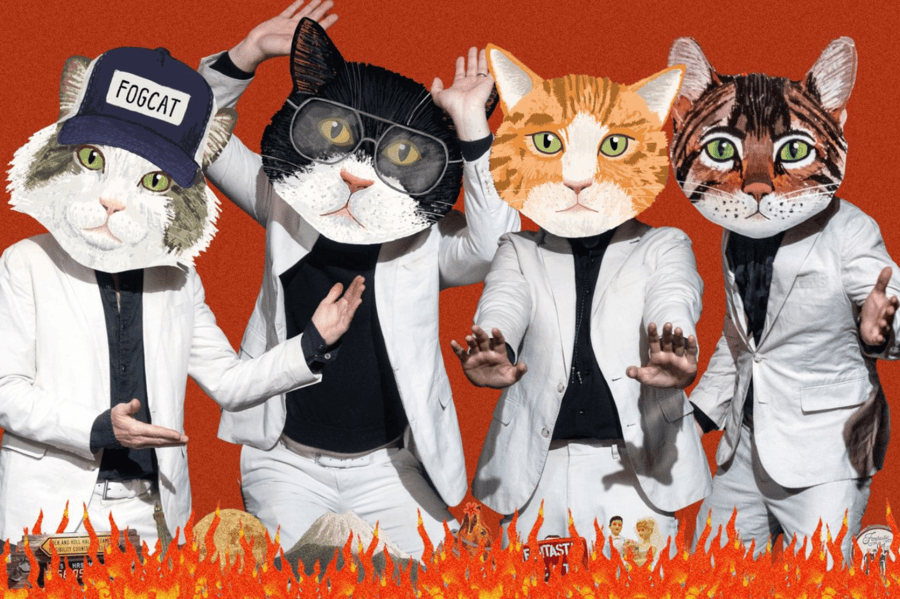
Image by Vivian Wang & Fikri Abdurakhman
Supergroups are typically named so due to the convergence of recognizable members of various bands who come together to start something new. In the case of Fantastic Cat, while the four songwriters may not be household names, the talents they each possess and contribute could be considered pretty super, so yeah, let’s just go ahead and call the band made up of Brian Dunne, Anthony D’Amato, Don DiLego, and Mike Montali a supergroup.
With the release of their third album, Cat Out of Hell (one thing you should know about the group, if you don’t already, is they lean heavily into cat themes and puns, the title is a nod to Meat Loaf’s Bat Out of Hell), Fantastic Cat has taken what was originally just supposed to be a songwriting exercise for solo artists and turned it into something far bigger than any of them anticipated. What began as a casual creative experiment has evolved into a tight-knit band with a genuine sound: warm, harmony-driven indie folk rock with wit and wisdom.
While it may have been more common in the ’60s and ’70s to have groups with multiple singers and songwriters, it’s rarer these days, which makes Fantastic Cat all the more special. It also helps that each member continues to do serious work on their own. Dunne, for instance, recently released his fourth solo album, Clams Casino, to strong reviews. If anything, the solo careers make the collaboration feel more intentional, not less.
It’s clear that Fantastic Cat is not only surprised by the success they’ve had thus far but have formed a brotherly bond that allows for some light-hearted teasing, as D’Amato and DiLego demonstrated throughout my recent conversation with two of them.
When the four of you started writing together, did everything become real and formal once you picked Fantastic Cat as the name of the group?
ANTHONY: Everything about this project kind of happened backwards. There was never an intention that we were going to make a record, we were never going to be a band that toured, or anything like that. It literally started out as, “let’s go to Don’s studio out in the Poconos and have a long weekend of collaborative writing and recording for fun, because we’re all off the road at the same time.”
Needing a name came about later, when we decided we should try to play these songs live. Once we had recorded what we had, and we felt good about it, we’re like, it’d be fun to do a show with this, and to share these songs, and maybe put out a little EP. We decided we gotta have a name if we’re gonna book a show. And when that waitress says “Fantastic Cat,” it wasn’t even like we’d been kicking around ideas. We were literally just like, “this is the first and only suggestion we are taking. Whatever she says is it,” because every band name is stupid until it’s the name of the band you like. So when we heard that, we were just like, “That’s what we’re calling it for this one show that we’re doing. We’ll deal with the rest later.” And then because of that, we kind of fell backwards into all the associated cat stuff, the Folk Rock for Pussies merch and all that. We got lucky with all of that. It wasn’t planned.
Are you guys all cat owners or have cats growing up?
ANTHONY: No. Mike and I are both allergic. Don and Brian are both cat guys, but it wasn’t like we all love cats so much, we gotta do this. It was just pure chance and luck of the draw that that waitress happened to say Fantastic Cat. And I don’t even know who she is.
So the fact that you guys all got together to do some songwriting, and you’re all individual artists, I can’t imagine that this is the first time you’ve gotten together with other songwriters and done something that, in some essence, could have been Fantastic Cat. Is that fair to say? Have you done these songwriting things with other people before?
ANTHONY: Not really. I was never much of a collaborative writer. There were times that I would bring a partially written song over to somebody’s place, and we’d kick it around and finish it off. But there was never the idea of, let’s write together and record together as a group. I can’t speak for all the other guys. I think Mike was probably more into co-writing than I was. I never really did well with that, because I was always a very slow writer who spent weeks working on a verse, rewriting and rewriting. I was never the guy who could sit there in the room and suddenly just be like, “I got it, here’s the hook.” When we did the band together the very first time, we all kind of brought in songs that we had written, either for the project or that we had sitting around and didn’t have a home. That first record was a lot of, like, a Brian song, a Don song, an Anthony song, a Mike song. As we’ve progressed, now we write a lot more together, and all the songs kind of have all of our fingerprints on them.
Is that the same for you Don? Did you ever get together with other songwriters and do something that could have been Fantastic Cat had the situation been right?
DON: I don’t know if you remember a band called Golden Smog, sort of an alt-country supergroup in the 90s. I was such a big fan of all those acts, especially early on, like the Jayhawks, and Wilco, and Jeff Tweedy. At the time, for me, it seemed like a novelty: how could these people possibly have the time to get together and do this thing? So that was a seed that was planted in my head for a long time, and I always wanted to do this. Over the years I would just rifle off this idea, “Wouldn’t this be great?” But everyone is busy, and it’s hard to find the time.
I had talked to Mike from Hollis Brown, a number of times. Mike’s definitely a guy who’s like, “Alright, let’s do it.” He wants to get stuff done. I remember I had talked to him enough years about it that one time he literally called and said, “Why don’t we just do it next weekend? Let’s just put it on the calendar, or it’ll never get done.”
That’s kind of what we did. That’s the genesis of Fantastic Cat, which wasn’t Fantastic Cat, it was just a bunch of people. Me and Anthony had known each other and played a bunch of shows. I don’t like him as a person, but I can tolerate some of his music, and I thought he would be a good addition. We were stuck without a guitar player, and I had just done a show where Brian, I never knew him previously, had opened up for me, and I thought he was fantastic. Anthony said, yeah, “He’s actually a really good guitar player, too,” so I’m like, “We need that.” That’s how Brian came in, and that’s the start of it.
Are the show you’re talking about, where Brian opened, are we talking about New York shows or did any of you guys cross paths on the road?
DON: Yeah, definitely New York.
ANTHONY: I met Brian on the road, a couple years prior. He was playing guitar in a band that I was opening up for as a solo artist. Mike I probably initially met in New York, but the first time we did anything together on stage was at a show in Nashville when we were both down there at the same time. It kind of has seeds all over the place.
Musically, your four personalities all work well together. Was there ever a fifth or sixth person? Like, if Anthony can’t make it, or Brian can’t make it, we’ve got someone else? Or was it always just the four of you?
ANTHONY: I’m trying to replace Don right now.
DON: I was literally going to say the same thing, so just quote us both as having said that about each other. We’re all imprisoned in this band at this stage, it’s the four of us. There was Michael Hesslein, Hess, he’s been playing keys with us. He was originally maybe the unofficial fifth member, and a lot of people got to know him as that. But in terms of actually adding someone on, it was just always the four of us.
You mentioned the sort of progress, how it came together, and some of the difficulties of getting four people in a room at the same time. I’m assuming it’s gotten easier — or is it still, like, you have to plan months in advance to get together? Are you guys getting together every week, every month? Is it very scheduled?
DON: We all orbited around New York, and still mostly do, but Anthony spends a lot of time in New Orleans now, and I’m out in Northeast PA a lot. So there is a measure of scheduling that we do have to be careful of.
ANTHONY: On top of that, we all still have solo touring and things like that going on, and working on solo records in the meantime. We have a color-coded calendar of who’s available when, and when it all lines up, we’re like, “alright, we should probably get together and do something.”
On the color-coded calendar, when you get together, do you guys walk in with ideas and say, “here’s what I’ve been working on, I want to bring it to the band?” Or is it like you walk in the door and everything is starting from the ground up?
ANTHONY: It can happen both ways. Early on, when we first started, I brought in a song, Don brought in a song, Mike brings in a song, Brian brings in a song, and we figure out how to play those songs. On the second record, it was a bit more of Don sending around a voice memo of, like, “I’ve got this idea for a chorus, what can we build around it?” Or, “here’s some music, we need lyrics.” We got a lot more collaborative with it as time has gone on. There was a song on the first record that we all wrote in the moment together, too. So it’s happened both ways on all the records. But in general, we’re all bringing in at least the seed of an idea and going to the guys and saying, “where can we take this that would make it a Fantastic Cat song versus just a solo song that one of us might put on our own records?”
DON: I think that’s a big point now. On the first record, everyone just brought something in finished. The reason everyone’s in this band is they’re songwriters who, at least from my perspective, I knew could bring in a completed song. So the getting together for a couple weekends and making an album wasn’t going to be a big lift, because everything would kind of be laid out for us. But we never thought there would be one record, let alone three. I think we’ve gotten to the point where, when we’re all writing, it changes our approach a little bit. I know for me, if I’m writing a song, I’m trying to un-Dilego-ify it as much as I can, so that it makes a little bit more sense in the groundwork of the band. I think everyone tends to do that now.
In terms of recording, is it all recording together in a room at the same time? Is it whoever’s available comes in and does their parts? Are you recording together?
DON: There’s no way that anybody in this band would let one person record without their presence being felt or known, so yes, we try to always be together when we’re doing any recordings.
To me, it sounds that way. It sounds very together in a room, in a studio. Would you ever what to try to record in a way where you are all in different places and sending files to each other?
ANTHONY: The biggest difference in how we recorded this album, to me, was that the first two records we did at Don’s studio out in the Poconos, which is a slightly smaller space. Because we were both playing the music and Don was simultaneously engineering the session, or one of us would be manning Pro Tools while he was in there doing his part, we would layer things up a little bit. We might have the rhythm section recording live, and then dub the acoustic guitar on top of it, and the electric, and the vocals.
But this record, we went down to Virginia, right outside of Charlottesville, and we worked at a friend’s studio, which had a much larger space. We brought in a friend to engineer, and that allowed the four of us to go in and play the core of all these songs live together at once which was the first time we’d done that. It was a big thing for us, because the live show has become such an important piece of what this band is and what people respond to and gravitate towards. We wanted to find a way to really capture that on this record. So this is the most live we’ve ever had a record be.
How early on did you figure out what a Fantastic Cat show was going to be? Was that right from the get-go, or was it you had played a couple of shows and then, “wait a minute, we’re going to keep doing this, we better figure some more things out?”
DON: Everything that we do has been very organic in its development. I think anybody in their right mind wouldn’t have suggested any one of us play the drums, or have half the instruments that we’re playing. Our first show was just for family and friends. “Hey, look, we did this thing, come check it out.” Because we had nothing at stake. No career, no record deal, no build our popularity. We were literally thinking, get in a room with some friends, have some drinks, play these songs, and be done with it. We didn’t want to have four white dudes sitting on a stool strumming their acoustics. We said, “well, let’s just have fun. I’ve always wanted to play drums live on a song. I can’t do it, but it’d be fun, and since it doesn’t matter, I’ll try.” And then Mike said, “well, I’ll try on this song,” and Anthony said, “well, I’ll switch to bass on this song.”
The switching was never a decision we made as a gimmick or a bit. It was just out of organic happenstance. Same with the cat masks. We went to take one photo to promote that one show, and when we looked at it, we said, “no, we can’t do that. No one wants to see another Americana guys’ photo on a brick wall or a chain-link fence.” That’s where the mask came in, just a way to say, “this is something fun, a little different.” And it just kind of developed that way.
I remember there was that sort of mythology around it, you weren’t self-identified on album covers. It’s kind of like, who are these guys? Like KISS, who’s the guy behind the mask? You sort of carry that forward, even now, like the video for “Donnie Takes the Bus” where actors are playing you. In your mind, is that all playing into this mythology of who you are, and how you have alter egos?
ANTHONY: For us, it was probably less about mythology and more about just finding ways to have fun with what we were doing. Coming from being solo artists, where it’s your name on the album cover and your name on the marquee outside the venue, not intentionally, but you start to become really precious about, “I’ve gotta look cool, I’ve gotta be serious.” You’re watching Bruce Springsteen and Bob Dylan and Neil Young and these guys, and they’re just larger-than-life figures, and you’re like, “I have to carry myself in such a way.” And all of a sudden, for us to not have our names or faces associated with it was like this permission slip to try all of the ridiculous, absurd ideas we had had in the past, or ways we wanted to just kind of take the piss out of the self-seriousness of the music business. It was less about, “let’s create these alter egos who can be mysterious characters or whatever.” For us, it was like, “hey, nobody’s looking right now. What if we try the dumbest idea we’ve ever had?” And it turned out that all those dumb ideas were the things that connected with people, because they could tell we weren’t holding it so tightly, and being so precious, and we were having fun. And when you’re having fun, I feel like that gives permission to everyone else to have fun with it, too.
You’ve all been doing this for a while. Maybe shocking is not the right word, but is it surprising the levels of success that this project has had? The press clippings, appearances, soundtrack placements, all that kind of stuff. Going from playing your first show just for family and friends, not really thinking this was going to be a long-term thing. After you played that first show and started writing and recording, did you have that feeling like, this could be something special?
DON: I think we had the same feeling after that first show that we have after every show to date, which is, “I can’t believe people like this. Like, were they actually listening?” And there’s a version of that, because I think in some ways we don’t feel like a real band. It’s not a normal band, in the sense that someone was a studied, dedicated drummer with a history, and a stationed bass player, with people sticking to their stations and what they’re comfortable with. Every night we play, inevitably, at some point during the show, one of us is going to be uncomfortable in the position that we find ourselves in in a song. But it also informs the energy that we’re bringing to the stage. That looseness carries over to the audience, where they feel that we’re on a wire ourselves, and anything could happen at any moment. That wire could break, but that’s what brings that energy to it. It doesn’t feel like it’s a preordained show they’re gonna see. You just don’t know what’s gonna happen.
ANTHONY: When we switch off of our primary instruments, we’re also forced to operate at the edge of our abilities. It’s a funny thing that people will come up after the show and say, “that groove you were doing on drums on that song was, like, such a tasteful, restrained thing.” And to us, we’re like, “that is the most I can do.” I’m trying to be a maximalist, but in the scheme of drums, it ends up being a very minimalist thing that you probably wouldn’t hear a trained drummer do on that song. I think people respond to the unintentional choices we are making which aren’t necessarily us actively saying, “I’m gonna do something differently than a trained drummer would do.” It’s just, “this is what I can do.” And it clicks with people because it’s not what they’re used to hearing. It’s not the traditional choices you would hear somebody make on bass or drums on that particular song.
How studied are you in ’60s and ’70s kind of music? It seems like maybe in the ’60s and ’70s there was a lot more switching instruments and freedom, and these days you don’t see that a whole lot. Do you sort of pattern what you do, either intentionally or unintentionally, after that era?
DON: I think we all have a lot in common musically, in terms of where our roots flow from. That certainly is an era that a lot of us gravitate toward, especially the late ’60s, early ’70s, and on. There’s a version of a musicologist in everyone in the band, maybe slightly more focused in different areas, but there’s significant common ground in where we all share backgrounds. And anytime something clicks in one of our songs, it’s not a specific reference we took from that era, but if what we did harkens back to that era, we kind of feel like, “oh yeah, we’re doing the right thing.” We’re not trying to be on the edge of what’s cool or new. I think we’re all trying to get this authenticity of an era that happened before, whether it’s the way we record it or play it. A good measure of that was all playing together on this record and tracking it live, so that we had that looseness that I don’t think a lot of people are used to anymore. It almost seems like it’s wrong if everyone’s not playing to a very specific grid. We really wanted to have some measure of there’s a flow of tempo and elusiveness in there that says this is a band playing. Poorly.
I’ll be 55 this summer, and I interview a lot of young bands. I’ll say, “yeah, I’ll be the old guy at the show” and they’ll say, “no, it’s cool when these middle-aged guys come out.” Is the reverse true? Are there younger people, 20-somethings, coming out to see you live?
ANTHONY: It’s starting to happen more now that we’re finding ourselves with more radio play than we’ve ever had before. The new single “Donnie Take the Bus” just hit the top 40 at AAA on the Billboard chart. I don’t think we’ve ever been a streaming juggernaut of a band. We don’t necessarily make the study-and-chill background music, and it’s not dance music or anything. Originally we were building our audience the very old-fashioned way, word of mouth, coming through town, opening for an artist, and peeling off some of their fans. Then we did a couple of TV appearances, and network TV isn’t necessarily reaching the youngest demographics. But we’re finding with the increased radio exposure that it’s starting to reach younger audiences. When we play a festival and there’s younger people in the crowd, it’s really exciting to see. The kids still love this kind of music. It’s just a matter of getting it in front of them.
DON: It’s just exposure to them, yeah.
ANTHONY: The internet gets a bad rap sometimes for the homogenization of everything, and everybody just listening to what the algorithm tells you to listen to. But it’s also an incredible tool for accessing the entire history of recorded music. It’s easier than ever for young people to go back and find Jackson Browne, or wherever it is, and get their hands on some vinyl.
Is every song credited to the band, or does each of you have the songwriting credit clearly printed out — or is it credited as a band?
DON: We treat everything as a band. Everything’s just written by Fantastic Cat.
I know there are different singers, and I can hear different singers, but I can’t tell who’s singing what. I’ll tell you the songs that are hitting with me right now, and I have no idea if it’s the two of you or Mike or Brian singing them. “The Waiting Room?”
ANTHONY: That’s a Brian lead vocal.
“Don’t Let Go?”
ANTHONY: That’s a Brian lead vocal.
DON: We’re sensing a trend.
“Mona Be Still” and Turn Off the Lights?”
ANTHONY: “Mona” is me, and “Turn Off the Lights” is Don.
Pretty evenly spread out. When you’re writing and sequencing, trying to figure out the balance of stuff, is there a conscious effort to cover different tempos, different sounds?
DON: Maybe we both hesitated there for a second, because it’s not a crystal clear answer. We usually come at it on the back end, at what you’re asking. We first front-load with whatever we’re feeling in the moment. Everybody comes to the table with their song ideas. We haven’t said collectively at the very beginning, “everyone write a song like this,” or “Anthony, we need a slow one from you, and Don, we need a middle tempo.” We don’t come at it like that. But once the process starts and we get that first round of tunes going, then the album starts to have a life unto itself. It has the album title, and it becomes this amoeba, this shapeless thing that’s starting to take form. That’s when we say, “okay, maybe we could use a little kick in the ass here at the end of the record, or maybe we need a moment of breath at some point.” We usually get most of the bases covered just as a natural thing, because there’s four of us writing multiple songs, and usually it’s all there. But at the end is where we really zoom out a little bit and say, “oh, this is what’s missing, this is what might be helpful to finish the record off.”
With the three records, how often has it happened that you need that one extra song? Or have you pretty much decided there’s going to be this many songs. Has there been a situation where you’ve got an album just about done and somebody at the last minute throws something in, or is it pretty well set in place before you start recording?
ANTHONY: The first two were very much, we were recording as we were writing, so you could kind of in real time sort of sense where it was headed, and we’d go away for a little bit, then come back together for the next session. While you’re away, you’d be like, “okay, I know that this record needs X, Y, or Z, and I’m gonna work on that and try to bring that back for the next session.” This album, because we recorded it live and at someone else’s studio, where we just had a set 10 days to do it, we came in with pretty much everything written and arranged. We knew how we wanted to play it. The only thing we didn’t know was, like, “okay, we’re gonna go down there and record 15 songs, I don’t know which of them will end up on the record, but I know we have enough of a spread of material that we’re gonna be fine.” Things evolve a little bit as you’re recording, so there’s always some surprises. But we kind of had a sense of it, and by the time we were done recording, it was clear that these are gonna be the songs. The other ones that didn’t end up on this record, it’s not for lack of quality. It was, “well, we kind of have that base covered already, so this might be something that can cover that base for us on the next record.”
With the name and with the identity now, does it become easier to do album titles, album covers, merch, because you’ve sort of got a theme going? Or is it still, every time, like, how do we take this and do something different with it?
DON: Anthony’s our list keeper, but we have a running list of album titles and ideas, and a lot of the stupider ones are mine. As Anthony said earlier, when you’re a solo artist, your name’s literally on it. An Anthony D’Amato shirt has his name on it, a Don Dilego shirt has his name on it. With Fantastic Cat, sometimes, and I don’t think I’ve ever verbalized it, but sometimes I’m on stage, or if I’m thinking about what could go wrong in a show, I just feel like the other guys are gonna get blamed. It’s not on me, it’s just on Fantastic Cat. And that kind of frees you up to not worry about some of the things that may, in a solo career, feel stupid. In the band, you’re emboldened to just give them a shot. We have probably 3 or 4 album titles we’re already throwing around for the next one. Fantastic Cat has been a blessing for us. That has helped inform a lot of what we feel we can do.
From a tour perspective and a merch perspective, what do you find moves the most units? Is it vinyl? Is it t-shirts? Is there other stuff you have besides t-shirts and vinyl?
ANTHONY: The t-shirts were always, right out of the gate, a surprising hit, because it turns out people just like cats. We started off just with that, and then kind of moved into, okay, well, how much further can we push it? That’s when we had the Folk Rock for Pussies shirt. We felt like we were a shirt business that also plays concerts, because people just loved those so much. Then we had the Rock and Roll Hall of Fame Eligible 2047 shirts. Now we’ve got a shirt that’s like those ’90s cheesy graphics of the wolves howling at the moon, but it’s the four cats. Every time we’re like, “okay, people can’t possibly have an appetite for more cat stuff.” And then each one we introduce is somehow even more popular than the last one. We’ve got catnip socks coming, we’ve got a little bit of everything. We’ve got the Fantastic Hat, which is a Fantastic Cat hat, but it just says Fantastic Hat on it and if you say it fast enough, it sounds the same. Every time we’re like, “okay, nobody’s gonna buy this, this is just a joke for us,” and then we’re instantly sold out.
It’s so funny you say that. I interviewed White Reaper, and the singer, kind of jokingly but not so jokingly, said that when they tour he considers them a merch company that happens to play music, because they make all their money selling the merch. He said he tells his family, “I’m a clothing designer, a merchandise salesperson who plays music for the people who are buying my clothes.”
ANTHONY: That’s a common story for bands out there these days, especially with the cost of gas and the cost of food. Touring is more expensive than it has ever been. Merch is one of the places where you can kind of cover that gap. Unless you’re doing stadium shows with tickets in the thousands of dollars. We try to keep ticket prices fair, low, and reasonable so that people can come out, come to multiple shows, and have a good time. Merch is one of the places that we can kind of make up those gaps and keep everybody fed.
As solo artists, I’m sure you’re used to playing all kinds of venues. The Columbus, Ohio show is at Natalie’s, a seated venue where you can order pizza, and I find that a little bit not rock and roll.
ANTHONY: We sold that out last time. This time around, we worked with them to take out a lot of tables, so there’ll be standing room in the front, and then tables in the back. I don’t want to sound negative about any venue, any venue that has us, we’re so grateful. But sometimes when you’re playing and people are digging into dinner, or they’re in chairs facing perpendicular to the stage, it can take a little while for the show to feel like it really gets going. Whereas if they’re all facing you, standing, pushed forward up against the stage, you hit the ground running. As we’re growing those audiences in places and selling out the seated versions of clubs, now we’re coming back through and being like, “what if we take out half those tables and chairs and let people stand up and dance and have a good time.”
To finish things up, is there a song that, when you listen, takes you back to a specific time and place in your life?
ANTHONY: I have a very vivid memory of the Jesse Malin first solo record, The Fine Art of Self-Destruction. When that came out, I was just obsessed with it, and I can remember listening to it on my Walkman in the backseat of my parents’ car. We were driving into Queens from New Jersey to go see Bruce Springsteen at Shea Stadium. I was in the backseat listening to, like, “Queen of the Underworld” or something from that record, and there’s the elevated subways going past. I remember thinking I really liked music, but I hadn’t thought about necessarily becoming a songwriter or anything up until that point. I remember listening to that record and thinking, “this guy made these songs that sound so happy and so sad at the same time.” I didn’t quite realize you could do that, or how to do that. I remember having that moment of, like, “oh, that’s what I want to do. I want to write songs like this.” I can listen to that record and I’m instantly 15 again in the backseat of my parents’ car, driving into Queens.
DON: The things that really have glue and stick with you are really from when you’re at your most impressionable state, when you’re younger, with less at stake in the world and eyes more wide open. There’s a song called “Life in a Northern Town” by Dream Academy which, in the context of the ’80s where there was a lot of keyboard pop that maybe felt very rigid, that song was so ethereal and weird and out of nowhere. It just felt like it came down from a mountain. I always get a really visceral reaction when I hear that.
But I want to throw one more in. My father was very strict, and I didn’t have an older brother or family member saying “you need to listen to Led Zeppelin, and Simon and Garfunkel, and even the Beatles.” There wasn’t really a lot of music in my house, other than Frank Sinatra and Nat King Cole. I do remember when I first got a radio in my room, and I happened to click it on one day, and “Jump” by Van Halen came on, and it just seemed like something from outer space. It literally jumped out of the speakers. And obviously that’s a big hit song, so it’s gonna connect with a lot of people, but it hits me differently than a catchy song. It hits me as something that I flash back to, literally where I was sitting on my bed, and the excitement I felt about wanting to do music because of that. It felt like such a real, live thing in that moment, and it doesn’t happen a lot anymore. Those times where you’re just stopped in your tracks. And I wasn’t even a Van Halen fan. It was just that moment of what this thing was coming out of those speakers, that spoke to me in a way that I knew I wanted to be in that world somehow.