
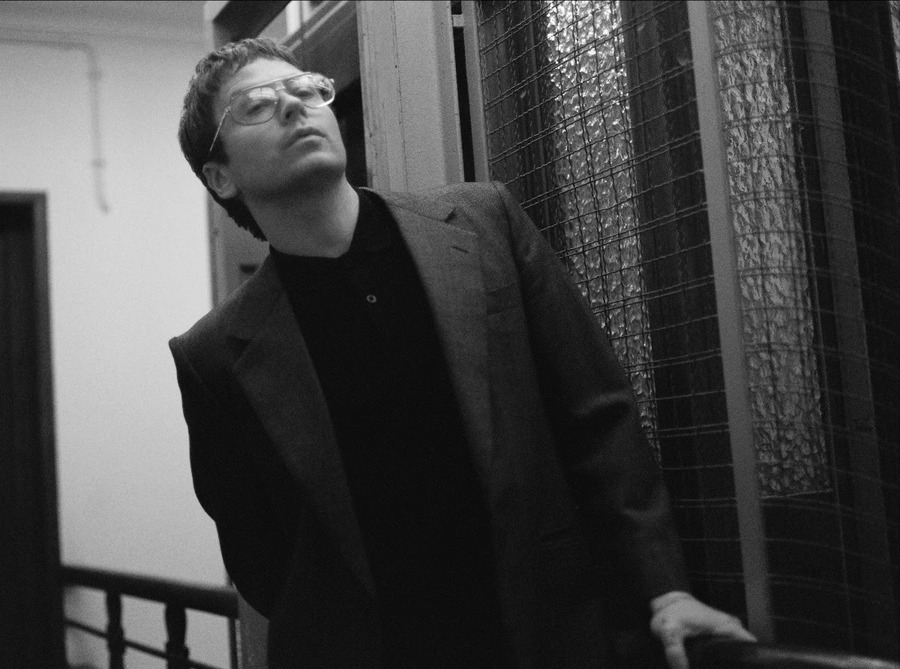
Photo by Victoria Prestes
After a creative break he nearly made permanent, Ben Cook has delivered his most consistent and satisfying release yet, Warmer Than Gold. The album marks a subtle rebranding; he’s officially dropped the ‘Young’ from his Young Guv alias, noting that he’s no longer young and doesn’t want to be confused for a rapper. While his previous four albums (compiled into Guv I&II and Guv III&IV) centered on Posies and Teenage Fanclub-style power-pop, the former child actor (Goosebumps) has now leaned into his dual upbringing in London and Toronto. The result is a record that mid-90s NME and Melody Maker editors would have championed.
Cook’s solo output is a sharp pivot from the punk rock he pioneered with No Warning and Fucked Up, though he’s the first to admit his palette is vast. To him, a good song is a good song, regardless of the genre.
We began our Zoom call discussing a photo Cook had posted to his Instagram story just days before this conversation.
I saw an Instagram story you posted with a picture of you and Max Cavelera (Sepultura, Soulfly, Nailbomb).
BEN: Yeah, I saw Nailbomb two nights ago. I randomly did a guest spot on Max’s Soulfly record that just came out because my friend Arthur, who does Power Trip and a bunch of other relevant metal stuff, is the Soulfly producer now. He has been for the last couple of albums. He clocked that I was going to be in Philly right when he was doing the record and he said, “I keep hearing you on this one song.” It was really strange because I was literally getting off a flight from Brazil, where they are from, so I was like, this is very strange timing, but of course I’ll do it.
Then a friend of mine’s band called Purist Form in LA, who are incredible, kind of industrial, metal, female-fronted, super new, super good, they opened. I wanted to see Nailbomb as well, so I hit up Arthur and I was like, “Yo, I’m going to the show, can I meet Max?” Because, obviously, I can’t get back there without any sort of help. Max’s son Zyon, who also plays in Soulfly, him and I have kept in touch. He’s a really big music fan outside of metal. He likes all this rap stuff that sometimes I work with. So yeah, he helped me get backstage and I met Max and it was super cool. It was cool because I just got back from Brazil last week, again. I was like, “Hey Max, I just went to Brazil,” and he’s like, “Holy shit, man.” The show was fire, it was great.
When I got the press release about the album, it had the “recommended if you like” at the top of the email, and it was Primal Scream, Charlatans, Chapterhouse. That’s what inspired me to right away click. Oftentimes, bands will be like, “We’re a mix of My Bloody Valentine and The Flaming Lips,” and you click it and you’re like, “Yeah, this is nothing like that.” You nailed it. I think those are perfect bands for you in terms of recommended listening. I’m curious, though, were those bands that you listened to during those formative music years, or were those bands that came to you later as you broadened your scope?
BEN: I think they came to me a little later. When I was 12, getting into Oasis and getting into punk, you’re kind of just seeing what’s on TV a little bit. I do remember The Charlatans, actually, because I was back and forth between the UK and Canada for a lot of my life. I had a radio in the UK, and music and Top of the Pops and all that stuff is completely different than what you’re hearing on the radio or on TV in Canada. I was glued to MuchMusic growing up. I did have some base knowledge of the bands, that they existed, but I don’t think I was a fully formed musical mind enough to actually get into them until I was in my 20s.
Then, of course, Primal Scream, Charlatans, and just the whole Brit rock vibe. Especially when the Strokes started coming out, the whole original indie sleaze wave, that was kind of the time I started to really embrace my Britpop, Brit-rock guy vibe. Even bands like The Doves. For some reason I really loved The Doves, but that’s a little more of a softer, kind of like when Travis and Coldplay were really starting to come out when they were new bands. With this record, I was definitely exploring my English side a little bit more, as opposed to the more American power pop stuff of the last shit. I was aware, but not as aware as my musical tastes matured.
In the Napster days, I was checking out a lot of UK bands that hadn’t made it to the U.S. That’s where I discovered Coldplay, The Doves, Starsailor, Athlete. A lot of it was that nice, strummy, folk-based music. It wasn’t shoegazy or loud.
BEN: Yeah, those bands were definitely trying to be on the British radio, whereas the shoegaze loud shit was just cool indie guys. It was cool to just go back and explore. Even The Doves’ The Last Broadcast, that’s a really good record and it’s stayed with me in this really weird way. When I was young and I’m watching The OC, they always had the indie rock of the moment bands on it, like Rooney and all that stuff. I was channeling a lot of the way The Doves would deliver a vocal in a way that was very soft. I was, in fact, not channeling Manchester at all; I was more channeling The Doves and Field Mice and shit.
I saw a Field Mice reference; I don’t think I’ve ever heard them.
BEN: Super good, you will love it. They’re from Surrey, which is weirdly where my mom is from. Their most played song is probably this song called “If You Need Someone,” and it’s just a really beautiful true twee moment. It’s a banging hit. If I heard that any year, any time, anywhere, I’d be like, “Wow, that’s a hit.” If I was an A&R guy, I would have signed that band based on that song. I love that shit so much, so I based a lot of the record and the delivery off of that.
I grew up on ‘80s metal. It wasn’t until I went to college that I started listening to indie rock and that’s what led me to flipping through NME at the local bookstore and discovering UK bands. But, really, I can trace it all back to see Nirvana play a club show shortly after Nevermind came out.
BEN: Sick. I was a lot younger, but I was into gangster rap, West Coast. And then my friend brought over Nirvana and he brought over a guitar and he’s like, “Yo, check out this track, I know how to play it.” I’m like, “Give me that shit, let me play that, that looks so easy.” And then I played it, and that was it. I was like, “I’m a musician.” And then I grew my hair and I was into punk. I didn’t really go super grunge, I just liked Nirvana, Soundgarden, and Alice in Chains. I went from there right to punk and hardcore.
I was reading through the bio and it says you were on a creative break before this album. Was it the writing for this record that got you out of that? Did you start working on stuff and think, “Maybe I should start doing it again,” or did you consciously say, “I need to start this”?
BEN: Good question. I came out of COVID trying to do exactly as I always did, just go back on a tour, and I really went on a tour, and it didn’t feel the same. The world had changed. The relationship to music and listening and going to shows and enjoying a show had changed. I never had a breakdown or any horrible dark moments during COVID like some people did locked in their cribs; we lived in New Mexico in a sustainable thing, we were outside, we were making records, living like a rock and roll cliché.
But once I came back to the real world, so to speak, I broke down. I guess a midlife crisis. I ended up in hospital for some depression shit and was going to get medicated, but I never did.
I had to rebuild myself. I was thinking that I can’t be doing this touring shit anymore. I don’t really want to be an artist anymore. I’ve been a freelance coasting player, touring musician for 25 years. I completely was just like, “I’m not doing this shit anymore, I don’t want to make a record.”
I got into management properly, I started working with other artists, started helping them. I’m pretty good at coaching others or encouraging people. That started to fill the musical hole in myself, and I just ignored the fact that I was a creative person. I ignored it. I was like, “Fuck it, I’ve done a lot, I have a lot of records under my belt. I’m done. I’m retired.” As dramatic as it is, I kind of have to be that way sometimes, kind of extreme with it.
I never announced that, but I did in my mind. It wasn’t an intentional thing to come back to do another GUV record, it was more like reconnecting with James Matthew Seven, who took the role as producer in the classical sense of this record. He was like, “Yo, I want to start sending you some ideas and actually be a producer on this and not just a homie that you make records with.” I was like, “Alright, cool, that’s your role.” It was nice to have somebody like him really be the other member of the group, not just me.
I took the role of the blase artist on this record, which worked really well. I was more hands-off, I let things flow way more. Not hands-off in the way that I didn’t care, but I just let the little things slide and it really worked. We got into some rooms with each other and just wrote really on the spot. It took a minute, there was a rough start. We started in Lisbon and he flew over to work, and we didn’t do shit. I just wanted to drink wine with my girlfriend and go to the beach, and he was pissed. I’ve known this guy since I was 15, so he was pissed and he left. He was like, “I’m leaving, fuck this, I’m going back to LA, you don’t want to work,” and I’m like, “Sorry, I fucked up.”
But we did have one lingering idea from that session, and I ended up just randomly finishing it one day in my apartment in Lisbon just with my phone. I made the whole idea with my phone and I recorded using my phone as a mic. That’s the song “Hello, Miss Blue.” That’s still the iPhone vocals on that song. I sent it to James Matthew Seven and I was like, “This is kind of a dope vibe.” And he was just like, “Oh shit, this is sick.” It’s like Manchester breaks with a Kinks melody vocal, Oasis delivery, loud, almost has a Stooges bass sound. That was the starting point of how we wanted to make it—sample-based, remotely made, and with a British swag. I ended up in London for 6 months and then it really kicked off.
I basically quit music, and weirdly, slowly, somehow got into making this record. Once it started to go, I like to finish things, so I was like, “We’re gonna make this a record.” Matt (James Matthew Seven) taking on the role as producer in the classic sense of the word, he took that role very seriously. It became our number one creative thing for many months. I appreciate that he did that for me because he’s a big reason why this sounds the way it does and is as cohesive as it is. In some of my other records, all of a sudden there’ll be an 80s dance song and then a Tom Petty or jangly Byrds thing, so there’s not a lot of cohesion. This one, he helped keep it cohesive. I asked him to. I was like, “Bro, if I start trying to do some other shit, say no. Keep the shit in line; I want to make a cohesive record with a cohesive theme.” And we did it. I think it’s the best one I’ve made in terms of what an album should be. It’s not just a collection of cool songs. It’s an actual album with a theme and a purpose, and it was made by my best friend when I was 15. It kind of took me out of a creative hole, which is fire.
It’s not necessarily only two styles, but there is the Manchester stuff, the Primal Scream vibe, and then you mentioned Field Mice. I took notes next to each song and I wrote “twee” for a lot of them. There are sort of two sides to the stuff. My favorite song is “Crash Down Feeling,” but then “Chasing Love” has a different vibe; that’s more twee-sounding. I love how it stays within the same ballpark, but it’s different sides of stuff.
BEN: It’s not all one style. There has always been a sensitive, nostalgic, very melodic side to the project, and that’s very much me. I also wanted to make this a record that we could play live that rocked,that was going to be loud. That’s why we sandwiched it with “Crash Down Feeling” and the first song, “Let Your Hands Go.” These are big songs that are going to blow your face off live with a nice breakbeat. There are definitely some Manchester moments and some baggy beats, but a lot of the record is quite soft and quite twee. I consider it a rock record, but salt-and-peppered with twee all over it, which is something that I resonate with. I could be a greasy rocker, but at heart, I’m a twee guy.
When you were making that first song, did you know that this was going to evolve into an album project, or was it just like, “I gotta get the first song out of the way”?
BEN: There was no intent. It was just like, “Oh, we made a cool song, finally.” After doing all this experimenting, we were wondering what we wanted the next GUV album to be. I knew I didn’t want to do a power pop record. I didn’t want to do anything jangly in that American sense again. We wanted to experiment with electronics and laptop production; we wanted to make samples work. After we made that, we were like, “This is cool. We could make a kind of British rock record, but if it was produced by the Beastie Boys.” That’s what we stuck to. We made it like you would make rap beats, and then I just spit over top in the apartment. We got our homie to mix it.
You collaborated with a lot of people on the album. I recognized a few names but others were new to me, like Max Epstein.
BEN: Max Epstein, we used his studio and he helped engineer, so he’s a producer, but he’s a player, too. He didn’t play on it, but mostly everyone else named in the bio played on it. If they were in a session, they likely touched an instrument. Sometimes maybe it was just someone doing the computer work, but at this point in music, that is also an instrument. Everyone except Max was playing on it.
I watched an interview you did where you told the story about winding up in Taos, New Mexico. When I was reading through the names of the collaborators, I saw Noah Kohll’s name. I interviewed him when the Color Green album, Fool’s Parade, came out. He told me the story about hanging out in New Mexico and he mentioned you. All of a sudden, these two worlds collided. I love that Color Green record.
BEN: I mixed that. I vocal produced it and mixed it, the first LP (2022’s self-titled album). Noah and me became friends three days before COVID. We were on tour; I got him on bass for the GUV band on recommendation. Then we got canned during COVID, the tour was cancelled, and we all ended up living together for a year in the desert. We trauma-bonded in this crazy way. He’s one of my best friends, and Noah helped a lot on this record. He’s in the live band. Corey from Color Green is the other guitar player in the live GUV band right now.
Do you move around a lot because you feel like your tank is empty and you want to refill it, or do you just wind up staying in cities you like? You seem to be a globetrotter: Toronto, London, New York, Lisbon, LA.
BEN: I think I’m itchy. I never really settle down, which is fucked. I have this weird ADHD, but with places. I can’t seem to settle. I’ve been a touring musician since my early 20s, hence me dropping the term “Young” from Young Guv. Also, it sounds like a rapper, and I’m sick of that shit. I’ve been touring since I was 18. My dad was a trucker and I was in his truck doing trips when I was 8 across America. My grandfather was an engineer for British intelligence and he had a very interesting life around the world. It’s bred into my DNA to be this wandering, traveling, exploring person who loves experiencing all this new energy.
On the other side of things, I feel like it’s all I know. I had my own place in Toronto for a long time in my 20s. I had an apartment, a normal routine, a car, a gym membership. But once I got into my 30s, touring with Fucked Up, I just started to like this way of bopping around. I haven’t figured out how to stop it. It’s a habit now that I enjoy. Because of all the touring experience, I’m really good at making it work. I have a crash pad in LA, an apartment in Lisbon that is really nice and affordable, and I have family in London that have an apartment that’s not used for half of the year. These things are available to me; why don’t I live this interesting life while I still can? Eventually, I will have a dog and a cat and a regular gym membership in an apartment that I don’t want to leave. But now I’m just still cruising the world. I work as a tour manager now in electronic music and that doesn’t help. I’m going back to South America in one month. I’m a music guy.
I’m envious of touring musicians. I’m sure at points it feels like a grind, but the things you get to see, I don’t know many other professions that would have those opportunities.
BEN: Super blessed, it’s amazing. I know that I’ll look back on it all and have so many stories to tell. From touring and also being a part of coming up in a subculture like hardcore, which is super connected worldwide, I can land in Chile and be stranded in an airport and have someone pick me up in five minutes. That’s what makes me a good tour manager, too, because I’m incredibly resourceful no matter where I am. If I land in a city and I’m spending a few days there, I’m not alone. Even though the road can be lonely and sometimes you’re just going back to your hotel room every night, I do like that. I’m a bit of a loner anyway, so sometimes I like that.
That’s what I got out of reading about you. You may be a loner, but it seems like you’ve got pockets of friends that maybe don’t overlap, but you can go anywhere and know somebody. Your hardcore friends might not be the same as your electronic friends, but you’ve got a wider group than a lot of people who have narrowed into just one scene.
BEN: I have a lot of connections and friends. I’ll dip into London, they’ll see me for two months, and then they won’t see me for the rest of the year. People are used to it. Everyone’s first question when they see me is, “So where are you living now? What are you doing, Ben?” Because everyone else is just going to work and living mostly normal lives, and I’m always like, “I’m spending a lot of time in Brazil these days,” or living in Lisbon. At some point, I really need to cut this shit out and be normal, but I don’t know how to be normal.
Is it fair to say that you don’t necessarily look that far in advance because you’re always bouncing around and taking opportunities, or do you have the year mapped out?
BEN: I have the year mapped out for my tour manager job, so luckily I can see where I’m going to be. If I have shows in the US, I base myself in LA; if I have shows all summer in Europe, I’ll be in Lisbon. I’m blessed in that way that I’m able to headquarter myself in all these places. I’ve basically set myself up perfectly to do this type of job, but like I said, at some point I’ll run out of gas and we’ll just go back to the day-to-day management and making records.
Being transient doesn’t always lend well to making records. I write my records when I’m on a plane or on a bus. I don’t have a home studio. I go to a city where I know my friends have a studio and I pull up on them and say, “Yo, let me use your studio for a bit.” I don’t have any equipment. It’s all in my mom’s basement in storage in Canada; I haven’t touched it in years. I use other people’s shit to make these records. All the vocals and the lyrics are made literally on the fly. Except “Chasing Luv,” that’s the only one we wrote right at the end. I wrote that shit on the spot as soon as those guys left the studio. I’m like, “Alright, if I don’t make these vocals and record them right now, I’m never gonna do it. So everyone leave, give me three hours.” It didn’t take me three hours; it took me 30 minutes, and then it was done. I sent it to the group chat and everyone was like, “Holy shit.” Then we got the other Corey (Corey Rose) from Color Green to come drum on it. That’s one of my favorite songs we’ve ever done. I’m definitely living a unique, weird, transient way. It concerns some people, but it doesn’t really concern me.