Photo by Brian Harding
A good album will transport you to an alternate universe. My first listen of Futurebirds’ latest record, Far Out Country I & II, took place on a beautiful spring morning about a month ago while I was mowing the lawn. It was the kind of blue-sky day that hinted at warmer weather to come but was still just chilly enough to warrant a hoodie. As soon as “Sienna Life” kicked in, I found myself dreaming of watching Futurebirds play live; an afternoon set, beach-side stage, nothing but blue sky above and endless miles of sand beneath my feet.
And as the album continued, that feeling persisted. I could picture the concert so clearly it was as if I were standing ten feet from the stage, watching the band run through their summery Americana rock, a sound that weaves in threads of alt-country, folk, indie, and jam band DNA.
While not exactly what I was picturing, this comes pretty close.
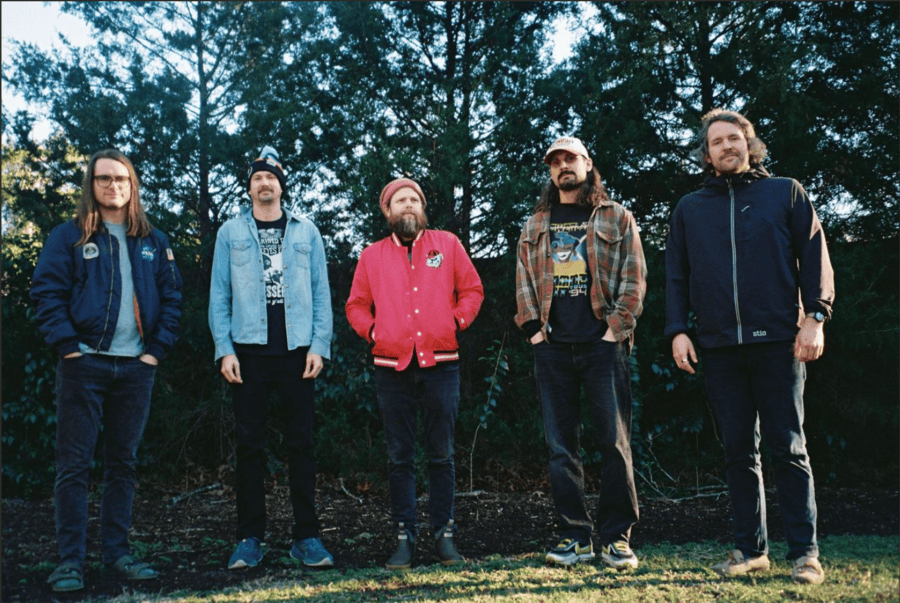
Core members Carter King, Daniel (Womz) Womack, and Thomas (Tojo) Johnson formed Futurebirds in 2008 while studying in Athens, Georgia. Six full-lengths and a handful of EPs later, the band has built a well-earned reputation as a live act. Their loose, free-flowing shows feature all three singer/songwriters rotating roles throughout the set, and as devotees of bands like the Grateful Dead, they’re known to overhaul their setlists night after night keeping both themselves and the audience on their toes.
The story behind Far Out Country I & II is an interesting one. The band recorded enough material for a double album, and in my conversation with King, he walks through the release strategy: both records out on vinyl today, but only the first hitting digital platforms now, with the second following in September. It’s too early to call it a success, but for fans of physical media, it feels like something special.
Futurebirds have a full summer ahead: outdoor festival sets of exactly the kind I was picturing on that first listen, plus a run of club shows (dates at the end of this piece). Balancing the demands of a newborn and his role as Futurebirds singer/guitarist, King joined me on a video call from the front yard of his new home in Nashville.
This summer you’ve doing a mix of outdoor shows, festivals, and club shows. Do you have a preference?
CARTER: No, not really. I think that getting to change scenario and setting is what helps keep it fresh and interesting for us. The daytime, afternoon festival slot, where a bunch of people have no idea who we are, let’s just hit them with the upbeat, fun ones, the summery tunes. And then I love going into a big, long night show in a club with the lights on, and play the darker, weirder jams, and stretch it out a little more. There’s not an ideal show. I like spreading it out and getting to change gears. We do a lot of acoustic duo and trio shows as well, and that’s a whole different muscle: small crowd, super intimate, more storytelling, and no guitar pedals to hide behind. I love just being able to change it up. I think we all do, just to keep all those muscles fresh.
Outside of the South, is there another part of the country that you feel sort of at home in?
CARTER: Yeah, absolutely. A lot of them. We always joke that we have, like, a thousand hometowns. But we love being in the western mountain states, just because we’re all pretty active and enjoy the outdoors: fishing and hiking, finding swimming holes and getting on rivers and stuff. We’ve garnered a pretty great little following in Colorado, and I think that comes from just a decade and a half of wanting to be out there. We’re just gonna keep coming and bashing y’all in the head with our music until you accept us, because this is where we want to be hanging out. Denver is a great music town, always a fun time there. And then we love getting into New England, we don’t get up there much past New York, and especially when it’s the dead of summer in the South and just so oppressively hot. We played on Nantucket a few times over the past few years, and I feel like everyone’s on nitrous, just all smiles all the time. The Mid-Atlantic has always been great to us. We’re in North Carolina and Virginia a whole bunch. We love getting all over this continental U.S.
You do a lot of dates when you tour.
CARTER: Yeah, we stay busy every year for sure. Now that we’re getting on a little bit more, and there are a few kids in the band, we don’t do the behemoth six-week runs that we used to. We try to keep the actual runs a little more concise. This summer we’re doing a handful of three-week runs, and then some shorter one-off stuff and weekend stuff. But yeah, we stay busy. This is how we all pay the bills, so we get after it.
How do you travel on the road?
CARTER: We’ll be traveling in a van. We’ve done some bus tours, which is just great elegance. But most of the time we’re road-dogging it in van and trailer.
From that perspective, is it autopilot? Like, when you get in the van, is it just muscle memory? “We’re going to New York, I can do this with my eyes closed” or is it, “Oh god, we’ve got to get in the van again and it’s another 8 or 10 hours”?
CARTER: It kind of goes both ways, depending on where you are in the tour, how the shows have been going, and all those variables. But yeah, it’s pretty motor memory at this point. We know what to expect and how to get in the right headspace, that meditative, all-things-must-pass kind of headspace.
Far Out Country I & II is a double album, the first time you’ve done a double album. It’s out physically in June and then getting split digitally with the second part coming out in September. Is that a nod and a thank-you to people who are buying physical stuff?
CARTER: Absolutely. You saying earlier that you like to listen to albums top to bottom, you’re a rare breed. I like to do the same. With the way things are these days, attention spans being so short and just the blast of content online, in the digital world, let’s stretch this out. Don’t dump 18 songs on people’s heads at once and then two weeks later be going, “Hey, remember that record we put out?” On the digital side, let’s stretch it out and give the bite-sized people a chance to take it in over a longer period of time. And then, yeah, let’s reward the people who want to buy their record and listen to the whole thing. You get it before everyone else. We’re gonna be playing songs off both on the summer tour, so if you’re the one in the crowd who knows the words to one of the songs while everyone else is looking confused, you get those street cred points.
And it’s still such a fresh, new environment and landscape, so it is just experimentation, see what works, and the best way to service all your different levels of fans, whether it’s the people that just want to listen to a couple Futurebirds songs in a big playlist, or the people that are die-hards and want to go top to bottom. We’re just trying to play with the space a little bit and see what works.
Did you grow up in the era of digital music, or was it CDs?
CARTER: CDs, for sure. And then in high school, we kind of hit the Napster era, and that was a fun, wild world to be in at that age where you’re getting into music and you can just go online, find stuff, and download live jam bands and whatever else, everything’s mislabeled, and then burn those to CDs to listen to in the car. But yeah, compact discs. I still have a pretty good CD collection. I’ve just been holding onto them in storage. I don’t have a CD player right now, but it’s kind of like, man, these were the records of our day. I need to get them all dusted off and get a good player set up, find an old Sony Walkman online.
I have thousands of CDs but, currently, no way to play them. Many of them hold a personal memory, like remembering where I was when I bought the CD, remembering listening to it for the first time, that kind of thing.
CARTER: You’re right, and the physical object ties you to the place where you were, and those memories and that experience of discovering that music. What I find is with the streaming services, I’m not good about saving albums and having a collection. I’ve been using Bandcamp as well, trying to a fair amount, and that’s kind of like the digital version of a CD collection. You go buy the record, and then it’s in your collection. This past week, we’ve been moving, so I’m finding all these stored boxes. I brought CDs and a DVD collection as well, and they’re just in boxes, but then you go in and see something, and you’re like, “Oh man, I haven’t listened to that in forever.” Just having the thing in front of you reminds you that you want to listen to it. I collect records as well, not with any sort of sickness or anything, but I think just flipping through your collection and being like, “Oh yeah, man, I forgot about this record, let’s put that on” is just a totally different experience than opening up the search bar on the streaming platform, or getting delivered a daily mix that plays you stuff you’ve been listening to a bunch. I think the digital world does need more of that: I got this album at this time, it brings up these memories and these feelings, whatever relationship you were in at the time, or the car you were driving, all those things that kind of tie you to the rest of your life. I think those are really special.
I grew up in the cassette era. When I moved from cassettes to CDs, I did a lot of rebuying of stuff because I wanted to have it on the most current format. It’s weird for me to go back and listen to tapes I had in high school and realize that a lot of them, I never even made it to the second side. You’d listen to the first side, go to school, and then rewind to hear those songs again. With CDs, that’s where I really got in the habit of listening top to bottom, because I didn’t have to flip anything over. You’d put the CD in the car, and the next time you got in the car it picked up on track 7, then track 9. Maybe that’s where it was born in me to listen to full albums.
CARTER: That’s a good point. I feel like I kind of have that same experience now with the streaming stuff. I want to listen to that record and start from the top, and you’re engaged for a few songs, and then you start doing whatever, and then you leave the house, and you just lose track of it. You’re like, “Oh yeah, I need to listen to that again” and you start it from the top again, so it takes a while to get to the back tracks of the record.
Futurebirds is unique in that there are three singer/songwriters in the band. Do you all write the same way, or do you have different writing styles?
CARTER: Well, we do have different styles of songwriting, for sure. But also, especially 15-plus years into doing this, there’s definitely a groupthink that happens. You’re heavily influencing each other because you get so invested in the other guy’s songs. “What can I bring to that?”, or “How can I try to make this better?”, or “Stay out of it” and not step on the toes of something that’s already doing great. These guys are still to this day blowing me away with, you know, either turns of phrases, or how they string some chords and a melody line together, and you’re kind of like, “Oh man, wish I had done that.” And then you find yourself a few weeks later with something that sounds, you know, not the same, but maybe a little subconsciously influenced by what they were doing. So there’s definite overlap.
We’ve got Daniel Womack, Womz, and he’s our hit machine. He’s got all the songs that everyone loves to sing along to, and he loves an upbeat sing-along chorus that everyone can latch onto. And then Tojo on the other side, Thomas Johnson, he’s our bummer jam guy. He’ll be the first to tell you he’s got some awesome heavy rock and roll songs as well, but yeah, he’s coming from the more serious place, like, “I’m gonna make you work for it a little bit” on the listening side. And I’m maybe somewhere in the middle between the two.
Our individual influences are what we grew up on. There’s a lot of shared stuff there for sure, and then in the last 20 years we’ve been friends, you’re sharing music, listening to stuff together in the van, so those influences come more and more together. But you can definitely hear our core influences a little bit differently, underneath everything.
When we get together and start recording these songs, it was early in the band’s history that I learned you have to kind of get over being too precious with your own material. When you’re recording it with the band, you can show up with a fully fleshed-out demo — here are all the guitar parts, here’s how this part goes, this is what you’re playing — but everyone still puts their own spin on it, maybe twists the melody a little bit. And I think that’s what makes it special, getting everyone’s individual flavors in the pot. That’s what makes it a Futurebirds record at the end of the day.
You’ve been doing it long enough that you seem to be pretty evenly split on songs too.
CARTER: Yeah, and that’s ebbed and flowed through the years. But more recently, everyone’s output has just increased in a big way. I think we made a point on Easy Company because we’d never put it front and center like, “Hey, we’re a three-headed monster, we’ve got three lead singers.” On Easy Company, we were like, “Alright, let’s really showcase that and make it a front-and-center aspect of this record.” So that was even stevens between all of us.
This one is close, but yeah, there’s no shortage of material, and it’s really nice. To be in a band with three songwriters, if you can figure it out, because it’s obviously a double-edged sword, figuring out the egos and everything and getting to where you can coexist in that world, it’s really nice to be able to say, “Hey, we’re gonna make a new record, and really all I need is three or four of the best songs I’m working on.” It’s not like, “Oh my god, I need 12 songs.” We have a running demo folder of all the ideas, and some of them stretch way, way back and haven’t seen their day yet, but they still exist. There’s no shortage of material to start from, which is really comforting. And on stage, it’s the same way. I’m singing this song, driving the train, doing the thing, and then on the next song I just get to sit back and be a guitar player in the band. It’s good to be able to switch gears there as well.
When you came into the new record, was the idea that it was gonna be a double record, or did you just have so many ideas that you didn’t know where to cut?
CARTER: Yeah, that was pretty much it. A lot of this stuff was still left over from when we made Easy Company. We were thinking about making that a big double record because I think we recorded 20-something songs out in Texas. And then we were working with Dualtone for the first time, and their advice was that in this new world, more concise is better than just dumping a whole bunch of awesome material on ears that are only gonna take in so much of it. So we kept that one shorter, and then kept recording songs for this next one, and ended up with another 20-plus songs. We’re like, “Alright, let’s figure out a way we can do the double record this time, and not have stuff that’s just gonna have been sitting around for five years.” Because you’ve gotta get stuff out there when it’s still fresh and meaningful to you too. We’re the ones who have to go out and get people excited about it and talk about these songs and play them with energy and enthusiasm for a crowd. I don’t want to be singing a quote-unquote new song about a relationship I got out of 10 years ago.
As a consumer of music, in my head I always think that you record in January, you mix in February, you send out in March. The album gets pressed in April and it’s released in May. I know that’s not the way it works, but I’ve talked to some artists who tell me that the album they just released was finished five years ago but that other things got in the way. As you mentioned, it seems like releasing an album with songs written five years ago would be strange as you might not be in the same headspace when the album finally comes out.
CARTER: That’s just how it goes a lot of times. It’s not a hard line that “oh, this song doesn’t mean anything to me anymore.” There’s one song on the new record, “Nervous Ground,” that I think we recorded a first version of in 2014. The song’s been around a long time, and the lyrics have changed and been edited and updated as the years went by, but I was thinking, “Man, this song has actually never made more sense to me than it does right now” in my life. Sometimes it’ll hit you years later, like, “Oh wow, I understand this song. I finally understand this song, and I wrote it 10 years ago.”
In what I believe is a running joke, Daniel said this is the best album Futurebirds has released. The joke being that he says that every time a new album comes out. I’m not going to ask you to sell me on that premise, but I am curious about the quality control within the band that you practice to make sure that the songs you put on an album are the best songs you’ve got rather than putting on some filler or some songs that you’re not as proud of.
CARTER: It is a democratic process for sure. In terms of song selection, there’s a little bit of telepathy between us all. You can read the room when you’re pushing a song you think has a lot of promise and you see the blank stares around the room, and you’re like, “Alright, maybe this isn’t as good as I thought it was.” You’ve gotta have a real-time sounding board. There’s also been the situation with all three of us where it’s like, “No, you guys just don’t see it yet, I’m gonna drag you through the mud on this,” and then at the end of the day, people are like, “That actually turned out really awesome, didn’t think that was gonna go that way.”
As far as the new record being the best record, obviously it’s the newest thing, it’s the thing you’re most excited about. I’m so excited we’re going down to rehearse for the summer and get all these songs in their live forms. It’s just so exciting because it’s like, alright, we’ve got all this fresh blood for the stage. The songs we’ve been playing, we’ve got tons and tons of songs, but, you know, we’ve played some of them, like, 5,000 times. You can find yourself on autopilot on stage, and not on that tightrope of “is this gonna pan out, or are we gonna end up with our faces on the floor?” That makes it really exciting for us.
I think all our records are the best records. It’s like picking your favorite child. There are probably ones I think are more important to our history than others. But if the idea is that we’re getting better, we’re growing as musicians, as people, our bonds together — we feel like we’re in a place where, alright, we’ve got this machine cooking with gas right now. We’re better than we’ve ever been as a band, so the output we’re making right now is reflecting that, in our opinion. Who knows if the world will agree, and there are tons of other variables that go into that. But yeah, this one is absolutely the best record (laughs).
You’ve written and released so many songs over the Futurebirds history. Are there songs on the records that you’ve never played live?
CARTER: Yeah, absolutely. That happens for a lot of different reasons. I feel like we’ve taken at least a stab at everything live, especially right after the records come out. But yeah, there’s stuff where it’s like, “Man, that was a really cool thing we did in the studio,” just a different palette, and doing it on stage just doesn’t click for whatever reason, or you just lose excitement about it. And there are songs that we used to play every night for five years straight that we don’t really play anymore. They just fell out of the loop, and you’ve got so much other material. We try to bring stuff back here and there, and I think that’s gonna be a focus of this summer, keeping it fresh. But we want to get as many of these new tunes up to speed as possible and really get to explore those in the lab space.
I was just listening back to a lot of our old records a few weeks ago, just trying to get inspiration, and I hadn’t listened to some of it in a decade. To go back and hear these songs, they get you really excited, and you’re like, “Man, why don’t we play this one live? This is awesome, this is great. No one will probably know this, they’ll probably think it’s one of the new songs, but I think they’ll like it.”
You mentioned download live jam band albums on Napster. Do you keep your setlist pretty loose? If someone sees you two nights in a row, will they have two different experiences?
CARTER: We like to switch it up for sure. There’s a handful of songs that are kind of go-to’s every night. If we’re playing two nights in the same place, it’ll definitely be more variant than if you came and saw us from two different cities four or five hours away, where they might be more similar. But even still, there’s a lot of variability in our setlists. We’ve done some opening support tours for bigger bands, and we’re like, “Alright, we’ve got 45 minutes, let’s stick to a setlist, keep it tight every night, minimal changeover time between songs, get the most music in those 45 minutes.” We’re playing for people who probably don’t know who we are anyway, so it’s kind of a sampler set. Then a week into doing that, we’re like, “Alright, screw this, let’s change it up. I’m feeling stale on stage, we’re not showing our best selves.”
There are a lot of great bands that play the same set every night, and it’s always exciting, and they have the lights and audio-visual stuff all timed up to it. We’re not opposed to that, and we’ve been working on some aspects of our show for the summer. But there’s no getting around that we’re gonna wanna be changing up the setlist every night. When you’ve got 18 new songs to play, and maybe 20 songs that you’re gonna play in a night, you’ve just gotta keep it fresh to get all of it out there.
In the liner notes, the band has listed as Futurebirds 6.0. Have you had different versions of the band because people decided jobs and/or kids were the focus and they had to step aside?
CARTER: It’s been all over the map, and that’s kind of an inside running joke too, the version 6.0, like, keep updating. But yeah, we’ve had plenty of people come and go since the beginning. Four of us are still core members, but Tom, who plays drums, has been playing with us since 2020, so it’s not like he’s just some hired gun or whatever. And then we’ve had plenty of other friends on steel, keys, etc. So there’s kind of a base five of us right now, which has been that way since about 2021. We’ll have Luke Schneider out playing some pedal steel with us this first run, and I think maybe Cannon Rogers playing some pedal steel with us in July.
But the members coming and going, most of the time it’s a natural thing, and someone just wants to focus on their own stuff, because it is a huge time and energy commitment to be in this band that’s touring and playing between 80 and 100 shows a year. And that doesn’t count travel days, recording days, and rehearsal days. It’s a big ask, so it’s always understood when people are like, “Alright, I need to go focus on my own life, and get myself out of this cult.”
Going back to the earlier stuff and trying to get your music in front of people, does having Katie Crutchfield of Waxahatchee sing on some of the songs give those songs better streaming numbers, or more attention from people trying to track down everything she’s worked on?
CARTER: Yeah, Easy Company, right out of the gates, had a lot of streaming attention, and I have no doubt that’s why. Katie is just so awesome and talented, and she’s become a buddy. We’re all huge, huge fans of hers. Those were born more out of just getting excited — hearing that song and thinking, “Man, this would be awesome with a really cool female vocal on it.” We were working with Brad Cook, who makes all her records too, and he was just gracious, and yeah, we were just happy to have her be a part, for sure.
Tell me about Johnny Delaware’s name in the credits. He’s somewhere on the record?
CARTER: Yeah, so Johnny and Womack and Daniel have written a bunch of songs together. They have another project currently called Starboro. Daniel and Johnny started that project with a crew out of Charleston, where the Susto crew is from, and we’re all deep friends with them. We’ve recorded down there with Wolfie Zimmerman. Some of those songs of Womack’s, I think, came out of some of those sessions where they had kind of written them together. So yeah, Johnny and Wolfie, I believe, have some writing credit on the record.
I was on the “Fly On” video reading the comments. One comment said something like, “Picking up Dinosaur Jr, Weezer, 90s vibes,” and then the next comment was, “I’m picking up Grateful Dead vibes.” I’m curious — in your mind, what is the Futurebirds intersection? If you were to describe it from a cross-street intersection, what would you describe it as?
CARTER: It would be a traffic circle you could never get out of. It’d be like that National Lampoon: European Vacation scene. Following them around. Yeah, no, it’s all over the map, and song to song it’s different. The Dead thing, that was big growing up for me, and Brannen Miles, the bass player, and I and everyone else are fans as well. That was the thing when we were younger and learning guitar, and I had an older sister who was always on tour and going to see the band. So that one’s hard to escape, I guess, on more songs than not. And then kids growing up in the late 90s and early 2000s are also gonna have all that 90s alt-rock. That’s all high praise, in my opinion. It sounds like Dinosaur Jr. meets the Grateful Dead? Alright, we did it.
You said the four of you that have known each other the longest have a common ground of influences. Is there anything anyone in the band listens to that you’re just like, “I don’t get it, I don’t understand why you like this”?
CARTER: Yeah, okay. Tojo, Thomas, he grew up heavy into, like, the Midwestern emo stuff. So there are some bands, and it’s not like he’s pushing it on the van, but there are a few things where you’ll hear it on the radio and he’s singing every word, and it’s like, “Interesting, you know?” I don’t think loving anything is below loving anything else when it comes to music or art. But I think there’s a window in your life where if that doesn’t take, it won’t later. You have to have a certain amount of teenage angst still in your blood for that to catch, and I just missed that window. But nothing that’s like, “Oh, you need to turn this off.”
There’s no secret Slipknot or Korn fan in the band?
CARTER: We’re all Korn fans. “Freak on a Leash.”
Okay, so the last question I’ve been asking every band goes back to what you said about flipping through CDs and remembering stuff. Is there a song that, when you hear it, you’re right back in a certain moment?
CARTER: A physiological response that happens without even active remembering? Yes. There are a thousand of those, and I’m just scanning to find one. But that’s actually one of the ideas on the record, in that song “Fly On.” Part of what that’s about is: you know, if you walk outside and it’s a certain temperature and it hits you, when you actively try to remember things or points in your life, it’s so hard, and the movies are really fuzzy. But then there are certain things that happen, like hearing a song, or walking out for the first warm day of spring, and it just zaps you to a feeling that was exactly the same as the first time you had it. I’m glad you asked that, but I might have to get back to you on the specific physiological response.
Linda Ronstadt’s Greatest Hits, driving to the beach with the family, alright, we’re on spring break, yeah absolutely. And I think that comes from when you’re hearing stuff for the first time. I guess all the wellness apps and meditation stuff say try to have that beginner’s mind and experience everything for the first time, but you just can’t the way you can when you’re young. When you hear that Allman Brothers riff for the first time, you’re like, “What is that?” So I get why all those memories trigger from childhood, for sure. Pink Floyd’s Dark Side of the Moon, hearing that for the first time takes me back to my buddy Patrick’s upstairs room, turning all the lights off and jamming it real loud. And we’ll still, to this day, every once in a while, be driving a few hours after a show, it’s a night drive, you’re out in the country, most people are asleep in the back, someone’s up, and it’s like, “Let’s do Dark Side of the Moon, top to bottom.” And it’ll take you back there. I just had a kid recently, a few months ago, and there was one early morning feeding him, just the two of us up, the sun was about to rise, and it was like, “We’re doing Dark Side of the Moon, buddy. Here we go. Top to bottom.” And it still hit like the first time.
I love that. That’s a great way to end this, because in a few hours I’m going to a Brit Floyd concert.
CARTER: Oh, nice. Dude, that’ll be awesome. I’ve seen some clips of their stuff. Me and that same buddy who takes me back to being upstairs at his house, we went to the Fox Theater in Atlanta because they were doing Dark Side of the Moon laser show played over The Wizard of Oz. I remember being like, “They’re onto something here. It’s a little more than coincidence.”
*****************************
Futurebirds 2026 Tour
06/05 – Greensboro, NC – The Pyrle
06/06 – Richmond, VA – The National
06/08 – Washington, DC – 9:30 Club
06/09 – Ardmore, PA – Ardmore Music Hall
06/11 – Boston, MA – Royale
06/12 – Woodstock, NY – Levon Helm Studios
06/13 – New York, NY – Irving Plaza
06/16 – Cleveland, OH – Beachland Ballroom & Tavern
06/18 – Madison, WI – High Noon Saloon
06/19 – Minneapolis, MN – Fine Line
06/20 – Winnetka, IL – Winnetka Music Festival
07/08 – Kansas City, MO – recordBar
07/10 – Denver, CO – Gothic Theatre
07/11 – Beaver Creek, CO – Vilar Performing Arts Center
07/14 – Phoenix, AZ – Crescent Ballroom
07/15 – San Diego, CA – Music Box
07/17 – Los Angeles, CA – Teragram Ballroom
07/18 – San Francisco, CA – August Hall
07/19 – Camino, CA – Delfino Farms
07/22 – Seattle, WA – Tractor Tavern
07/23 – Portland, OR – Mississippi Studios
07/24 – Bend, OR – Volcanic Theatre Courtyard
07/25 – Boise, ID – Shrine Social Club Ballroom
07/28 – Teton Village, WY – Mangy Moose
07/30 – Lander, WY – Lander Presents: Summer Concert Series
07/31–08/01 – Livingston, MT – Pine Creek Lodge
09/02 – Nantucket, MA – The Muse
09/06 – Portland, ME – Ghostland
11/14 – Wilmington, NC – BAD Day Music & Arts Festival