
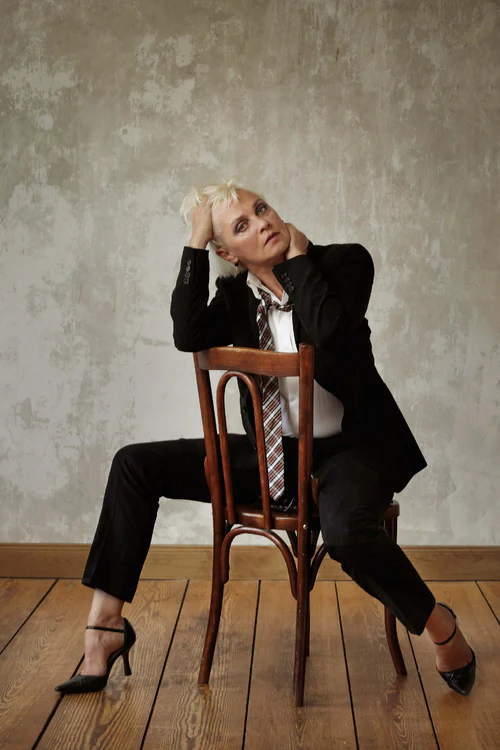
All photos courtesy of Anja Huwe.com unless otherwise noted
For decades, Anja Huwe occupied a rare space in alternative music history: a figure whose influence continued to expand even in absence. As the unmistakable voice and creative force behind Xmal Deutschland, she helped redefine the possibilities of post-punk during the 1980s, forging a sound that was both confrontational and hypnotic, fierce yet deeply evocative. While many artists spend years chasing mythology, Huwe inadvertently created her own by stepping away from music at the height of her creative powers and devoting herself to a celebrated career in visual art.
Yet artistic identities are rarely confined to a single medium. Long after Xmal Deutschland’s recordings became touchstones for successive generations of musicians and listeners, the questions embedded within Huwe’s work, questions of transformation, survival, memory and emotional extremity, continued to evolve beneath the surface. What appeared to be a permanent departure from music was, in retrospect, a prolonged period of incubation.
The catalyst for her return emerged through friendship and creative trust. Reconnecting with musician and longtime confidante Mona Mur in Berlin, Huwe embarked upon an intensive collaborative process that unfolded over eighteen months. Together they constructed an entirely new body of work from the ground up, writing, performing and producing material that would eventually become ‘Codes’ (4AD, 2024), an album that feels neither nostalgic nor concerned with revisiting former glories. Instead, it stands as the work of an artist re-engaging with sound on her own terms, carrying the wisdom of experience while retaining the restless spirit that first distinguished her voice.
Inspired in part by the wartime diary of Moshe Shnitzki, a teenager who fled into the forests of Eastern Europe to survive unimaginable circumstances, ‘Codes’ explores the fragile boundaries between fear and hope, destruction and endurance, isolation and connection. Across its immersive landscapes, forests become psychological terrains, memories transform into living presences, and survival emerges not as triumph but as an ongoing act of resistance. The album’s atmosphere is at once expansive and claustrophobic, beautiful and unsettling, driven by elegant electronic textures, dramatic momentum and the distinctive guitar work of Manuela Rickers, whose contributions deepen its emotional and sonic reach.
The timing of ‘Codes’ is particularly striking given the renewed attention surrounding Xmal Deutschland’s legacy. The recent release of ‘Gift (The 4AD Years),’ a comprehensive retrospective gathering newly remastered editions of the band’s ‘Fetisch’ and ‘Tocsin’ LPs alongside key singles and EP material from the band’s influential early period, has reintroduced the group’s singular vision to a new generation while reaffirming its importance to longtime listeners. The RSD 2026 release ‘Peel (The Complete Peel Sessions)’ further illuminates the raw intensity and immediacy that made Xmal Deutschland such a formidable live and studio presence. Together, these archival releases do more than commemorate a celebrated past; they reveal how remarkably contemporary the band’s work remains. In that context, ‘Codes’ arrives not as an isolated return but as part of a larger reappraisal of an artist whose creative influence has continued to resonate across decades, genres and generations.
Rather than presenting a simple comeback narrative, ‘Codes’ feels like the continuation of a story interrupted but never concluded. The same fearless instinct that propelled Xmal Deutschland into the front ranks of post-punk remains intact, now filtered through decades of artistic exploration and lived experience. Huwe returns not as a relic of a celebrated past, but as a vital contemporary artist whose work continues to challenge, provoke and resonate. In a cultural landscape increasingly preoccupied with reinvention, ‘Codes’ offers something far rarer: the sound of an artist reclaiming unfinished conversations and transforming them into something urgent, expansive and profoundly human.
Special thanks to Erin Christie at 4AD for the coordination and to Anja for her time and the great conversation.
James Broscheid: I was on your website earlier and saw your artwork projected on the side of a snow-covered hill and was impressed by its scale. It looked amazing!
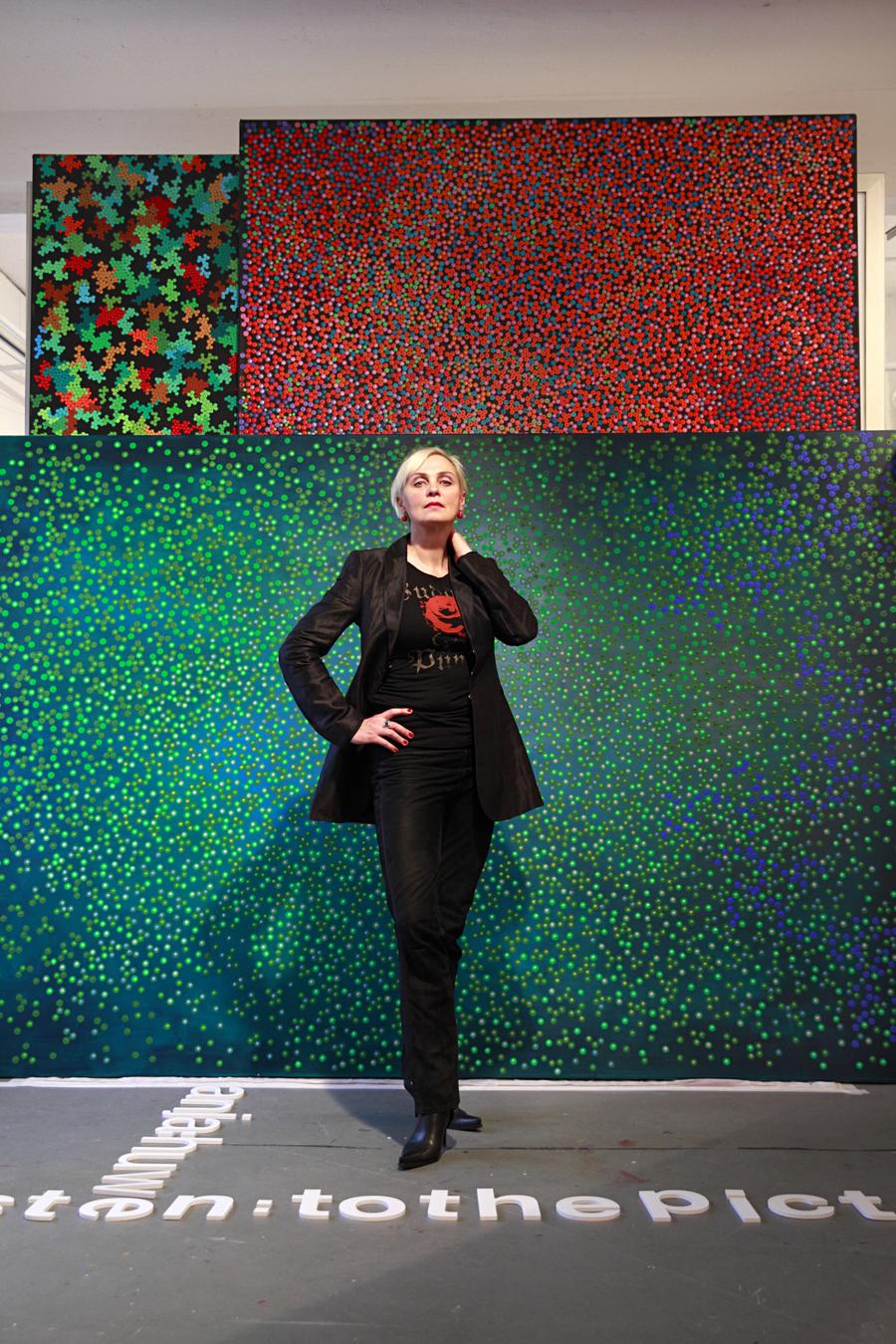
Anja Huwe: Yeah, well, that’s a few years ago. That was a friend of mine, she is originally from Germany, but she now lives in Vienna, and she does big events. She did this kind of event once every year in the Austrian Alps (Lech, Arlberg, Austria), which was like very high up, above like 2,000 meters (~6,500 feet) or something and there is a museum with a terrace. As you can imagine, it is snowing and everyone is there skiing and stuff, and they always did these kind of projections on mountains with a projector they got from the Opera in Vienna, because after the war, they didn’t have the material to paint screens, so they projected really big ones on glass onto walls and this is what they used for the mountain. I had to bring my artwork on glass, really big pieces, and they protected it. What you see on my website is only three pictures, because when I went up there, we had lots of snow and fog … nothing to work with. I was shocked. I thought, “Shit!” (Both laugh) I have pictures in this museum and the projections, you know, and then, for just a minute or something, the sky opened up, and you could really take clear pictures of it. After that the snow started falling again. Only these pieces were there, but they look amazing, don’t they?
JB: Yes, very beautiful.
AH: It is something. (Laughs) Spectacular!

JB: It’s a very clever use of art, if the weather cooperates (both laugh). I definitely want to ask about your solo record ‘Codes’ (Sacred Bones, 2024), and the Xmal Deutschland Peel Sessions collection recently released on Record Store Day. You mentioned that if you lose your codes, you lose yourself (Anja agrees). In creating ‘Codes’ after such a long time away from music and being wrapped up in art for a very long time, did you find yourself rediscovering old personal codes, or were you intentionally writing a new one for the solo phase of your career?
AH: Well, I think generally, it’s me as a person, and it’s me, myself, and I really, but you always develop in terms of having a theme, and then you can work on that. But in general, I think everyone has codes in society. I mean, we talk to each other and we do have codes. Everything is based on codes. If you research it, we all have our languages and codes, of course, and the same in art and in music so, I just picked up what I had and what I am, you know? Doing this solo album for example, no one expected me to do a solo album. No one! I worked on it with my friend Mona (Mur) in Berlin here and there, went to the studio and when it was finished, I looked for a label and everyone was saying, “A solo album?” (Exasperated voice) “Uggghhh!” Then Sacred Bones took it but it was clever, they got the earlier one (‘Early Singles – 1981–1982,’ by Xmal Deutschland) and mine, so that was very clever (laughs).
JB: It is interesting to see how people react to your solo album. They expect a “different” version of you, but as you said, you’re still the same person. You’ve always been a musician and artist, whether you’re in a band or on your own. Reading other interviews is fascinating because it seems like people forget that the core of the music, me, myself, and I, hasn’t actually changed.
AH: Yeah, then again, it’s all based on what I like. For example, when we started working on it, which took a while to get into it, you know, we started with “Skuggornas” (Swedish for “of the shadows” – JB), the first track, that was sent by a friend from Tel Aviv, and it was semi-written by a guy from Sweden. So, I started with that, and then we jumped into the whole story of words and disappearing and all this kind of stuff. It was more kind of lyrical sort of thing to get into and I read lots of books about it, and what happens to you. When you as a you disappear or the metaphorical idea of things or people “vanishing in the shadows” or becoming shadows of their former selves. Then the Ukraine thing started and it all came together. It’s like sometimes if you look back you think it’s no surprise.
And then, when we started working on more, Mona said, “Let’s maybe think about an album.” She has always suggested that, but I was never up for it. It was very interesting and intellectual work getting this together. But then I said, “I would like to really get Manuela Rickers in,” because I love the sound and the guitars that she plays really inspires me. So, we brought her in for the recordings and then it really made sense, you know, because it was electronic, but then again, had this Xmal Deutschland sound. Which we also do when I play live because I do play songs from the early Xmal Deutschland days, the very early stuff that is on ‘Gift,’ those 4AD albums that were remastered, so they are very strong because they have this electronic sound underneath and newer guitar sounds over top. So, I like that, to be able to retouch things. They’re super simple songs, but you can therefore work with them and change them a bit, you can build on them. Same with singing because it was a very basic kind of singing, but I developed it. Of course, I sing differently these days, I mean, better (both laugh).
JB: Did you find it difficult to step back into music with ‘Codes’ because of your involvement in other things like painting and visual arts?
AH: No, otherwise, I wouldn’t have done it. I enjoyed it going into lyrics and I very much like sounds, you know? I’m not the one to have some words together and then we build a song around it. I mean, I’m inspired by sounds and that really gives me ideas for lyrics and phrasing, and then I put things together. It’s like a kaleidoscope. Others are very straight working on structure and stuff and that’s not really my sort of thing, you know. That’s why it’s sometimes a bit difficult and weird. It’s like two and five and four, always mixed up and it gets difficult for me because I have to count (both laugh)! It’s really out of the belly sometimes. It’s emotional.
JB: I was interviewing a local artist here in Tucson and he approaches songwriting in similar fashion. Some musicians get very busy working on structure and he is more sound/melody based first.
AH: In Germany, even they do that, you know, they sing along using non-lexical vocable, so it’s a give and take. I like it much better, the real structure. I mean, some will say, “But where are the words? We need to build up a song” or something then I’m out. It’s not my way of working.
JB: That makes a lot of sense. I liked the fact that you mentioned that your paintings are like music on canvas, which I thought was interesting. Were there any specific visual codes or colors from your paintings that helped dictate the electronic textures for ‘Codes’?
AH: Well, no, it was a bit of a different work, more or less. I left the art behind for that time, so if I would see it in colors, of course, I do have colors like dark blue and greenish and these wooden colors I would say, but it was pretty doomy here and there. Also, the lyrics because it is based on disappearing and finding new ways of surviving. Maybe the times were right for that album really. It is shocking in a way, but it is.
JB: I find myself doing that very thing these days, becoming more insular or wanting to disappear. The less people the better (Anja agrees). The level of disappointment in humanity knows no limit it seems. We’re going backwards, we’re not progressing.
AH: Yeah, it’s the same in Europe, you know? Europe is so small, and you have so much right-wing and aggression around, and every day, things happen. I think, as an artist, it’s good to have statements and things, but, then again, if your work is creativity, you need to distance yourself in a way. It doesn’t mean you’re not interested, but art can bring joy to people, too. I have that when I play live, because people expect something. It’s very different compared to the early days on stage, when there was more distance between us and the audience. But today, they love it, you know? The are in tears sometimes because they are so happy and can feel the emotions. I’ve found that very interesting, so I’m really looking forward to the shows that we do in the U.S hopefully!
JB: I am happy to see you playing some dates over here. Some Canadian bands are choosing not to come down here and play. I thought it was pretty fascinating to learn that ‘Codes’ was inspired by the (Moshe) Schnitzki diary, (a then 17-year old partisan living in the White Russian Forests of Belarus during World War II that served as a base for Soviet partisan activity behind German lines – JB), and you mentioned it earlier about forests and escape. Beyond that historical context, what about his specific experience of isolation and extremes mirrored your own feelings during the years away from the music industry?
AH: I was always very active and involved in things with traveling and having jobs here and there, like in art teams and stuff, but I keep away from things because I am very open. I absorb everything so distance to various things is important for me to work creatively really, in a way. In the early days, I was going out partying and meeting people and stuff, but I’m more inside now. I work in my studio, or like tomorrow, I go to Berlin and work there again. It’s not too far, it’s like two hours. I like to be creative, but I have been through various things and that does something to you. I experience things, but that doesn’t mean that I keep away from things you know? I am constantly learning, which I like, so I don’t stand still. Even now, I’m always working on things.
JB: What struck you about Schnitzki’s work?
AH: It was more of a coincidence, really, because Yishai (Sweartz) came up with a track (from the ‘Clouds Of War’ album with Mona Mur on Soleil Moon Recordings, 2024) and asked me if I wanted to sing on it, that was at the start of COVID. It was more or less me asking him about his family roots and where he was from. So, he was talking about his family, and that the whole family had died but his grandfather (Moshe Shnitzki) was the only one to survive, and he went into the partisan group. I don’t think he was such a nice guy, to be honest, I mean, those guys were tough! Then I started seeing films and reading books and got more into the life these people had, the Jews that lived in this area. I found so many, there was thousands of people, families of women and kids that lived in the Belarusian forests. They are very deep and dark woods, you can get lost in there if you don’t know where the swamps are located, it’s really tough terrain. At the same time while I was learning about that, I worked with refugees coming over from Afghanistan and all these other countries. I worked with them on learning how to speak German and getting them into the social system. I heard many stories about how to get into Europe and what happened to these people. So many things came up, and I started getting really deep into that. Mona and I talked about it quite a bit about how tough it was to hear stories of people coming from Israel from Afghanistan from Syria from everywhere. To me, the time was right to jump into this theme, you know? To do something with these emotions that came up for both of us.
At some point we asked Yishai, because at some point, he told us his grandfather wrote a diary shortly before he died. He never wanted to talk about it, but at the end he did, and I think it’s also at Yad Vashem (world-famous museum complex that is officially designated as Israel’s national memorial and authority for the Holocaust), so he, during those days, spoke words into his iPhone when he was sitting in the bunker as the Arabs bombed Tel Aviv, the first time that week. He spoke these words in there, like, very silent. And we said in the studio in Berlin, “What is this? This is crazy!” We then thought, “Yeah, we should use bits and pieces and maybe work on an album on this. We chose to take some, originals, like, “Codes” of course. This is his main word. But Mona at some point took the original pieces into an album which she released (recorded at Studio KATANA, in Berlin, Germany, and a bunker in Tel Aviv, Israel – JB). So, it was an interesting work. It was very emotional, and we said in the studio working on things after two days, I said, “Oh, we have to quit this now because it’s too much. I have to go home for a few days, and then we can come back.” It was really, really intense. If you listen to what he spoke into his phone it is just crazy.
JB: When I visited Berlin I took the S-Bahn to Oranienburg in Brandenburg and I went to Sachsenhausen. I remember being told that it could be the most beautiful day, you’ll be hearing birds chirping, but as soon as you cross that gate, it’s going to turn completely silent. He was right. As soon as I crossed the Arbeit Macht Frei gate, it was so quiet. When I got back to Berlin and was lying in bed, I started crying, just knowing that all those people perished and for what?
AH: I know. You have that in many places, you know, even if you go to the East part of Berlin. There is this huge Russian statue (Soviet War Memorial Treptow), it looks beautiful there, but it’s a graveyard with 5,000 to 7,000 Russians there. You can really feel it too, I think. For people who are sensitive, those places are good to go there and get it in a way, but it does something to you. Maybe it’s the aura of those types of places, there is something and that’s why I was so impressed by Yishai’s words, and also because our generation and our fathers were very young when they were in war, you know. So, we know all these stories and where they have been and what happened. My father used to be a journalist and he wrote everything down his last month of war, and it’s hard to read. It is no surprise why this generation always says, “No more wars!” We need United Nations; we need NATO and things like that. No more war, but it’s all forgotten as we see now. I mean, even in language and stuff, there is a lot of aggression and it is difficult to handle sometimes, so that’s maybe why artists just turn into their own sort of holes, do art and go out here and there. It’s tough.
JB: Definitely. I think from an artist’s perspective, if people are not learning from history or objectively listening to what’s going on in the world, artists can help expose it in a different way through music and other art forms. Get people to think. In this day and age with social media, people seem bent on reinforcing their own ideologies or latch on to worlds that don’t exist.
AH: Yeah, but then again when you’re an artist you have your followers, people who are very sensitive anyway. And to reach the arts out there at the street level or something is difficult and social media, of course, does something to people. I use it, but not because I like it. I have to use it here and there, but I find that it does something to people. It’s all scrolling and stuff, but it is expected to be used. Record companies expect it, promoters expect it, post about concerts, you know? They’re the promoters, not me. It is really sort of like an insult or something. I’m not 20, so I don’t have to.
JB: You’ve recently noted that your early work was pure analog. With ‘Codes’ being digital, did you find digital recording to be more precise, allowing you to paint with sound more accurately than the raw, chaotic energy of the 80s allowed?
AH: It all depends on what you want. I personally tend to like to learn things with analog music. I knew how it worked. I know how it works, the same with color. I know how color works, so then I easily get bored. So, through that, it was interesting to get in in touch with people who work with electronic music. For example, Mona also writes music for films. That is a completely different way of working. You support pictures and enhance visuals; it is a different way of communication. Like Xmal Deutschland as a band, five people in a band, we’ve were in the rehearsal room every day, like a family. That is completely different, but the structure was always the same. It was, first of all, maybe a guitar, maybe keyboards and drums, and I was always the last one to get in. Because of what I just said before, I get inspired by music, but then again, it was a bit difficult and always the same kind of work. The kind of music that we did in the early days was just a wall of sound, and I was the topping, (laughs). So, there was not much to work around. These days it is different because I can say I need sounds. And then we go for the guitars. And so that inspires me. Then I get in and we get more sounds together, like drums or whatever. It’s very different to work this way. I like bands who just do analog music. I love it, but then again, for me, it’s more or less over. So, I need a bit of, you know, sort of intellectual things here and there.
JB: Constantly learning (Anja agrees). Is that why Xmal Deutschland ended? I don’t say lack of inspiration because there’s plenty to be inspired about, but did it run its course, because you’ve done everything you could in Xmal Deutschland/music. It was time to do something else?
AH: Well, of course, and in the first place, you’re constantly in the car, in hotels and on stages. You come to a point where if you don’t have someone who looks after you and tells you, “Listen, this is also a job guys! We have to find a way of working better and not get on each other’s nerves,” but we didn’t have that. We were always pretty resistant against people telling us what to do (both laugh). Then again, we came to a point where we just didn’t work anymore. Also, the pressure was high because, at some point, we went into a major company like Phonogram (1987). Of course, they asked me at some point if I wanted to go into a solo career and I wasn’t ready for that, but the pressure was high. So, they came up with Björk. She just left The Sugarcubes, and they said, “Wow, you could leave your band and do the same thing. We will support you!”
JB: Become the next Björk?
AH: I was not ready for that! At some point, I said, “You know, what? I’ll just leave it altogether” because I did more than I’ve ever thought I would. We played the U.S. twice, Japan, we went everywhere. But we were in a bubble, and we did not really see what we achieved in a way. Maybe the next step would have been getting bigger, getting a management team in, and all these kinds of things, but then again, it wouldn’t be the original sort of idea. Now, looking back and seeing what happened, we just disappeared. Nothing was there anymore. And what happens now, when I see the songs being heard these days, I know what people mean when they say they are cool, very simple, but it’s very catchy. And so, these days, I can look back with a complete distance, like of decays of distance, I can go back and work with them if that works for me.
JB: I mean, even looking back on it now myself, it was something unique and different you know.
AH: Yeah, it was unique.
JB: You had plenty to say!
AH: We were different. That doesn’t mean it was perfect music because no, it was not, but it touched others, and it meant something to people. That’s what I think.
JB: Even after all these years, the band is still brought up as an influence on other bands that I talk to. And I love that, you know? You don’t expect that name to come up too much But it still does.
AH: Yes, it’s amazing, I think so.
JB: I wanted to ask you about the Peel Sessions. 4AD noted that the band’s live power was often difficult to capture in a studio (Anja agrees). Do you feel, being recorded live in studio, those sessions are the truest representation of Xmal Deutschland’s original intent?
AH: It depends on what session you listen to. Those were recorded over a few years. The very first one was, of course, not an easy one. The very last one that I listened to is completely different. You know, you could really tell those people knew what they were doing but, in the beginning, it was very difficult. That was the very first trip that we made to London I think. We recorded the album (‘Fetisch’, 4AD, 1983), and then we played the very first show, and we were told, “You can go to the BBC studios.” They are these huge, amazing studios and being these young girls in the studio, that was something! Then talking to these producers, these guys were telling us what to do or not, that was a lot of pressure. It was difficult. We all liked John Peel and listening to his shows, but he never turned up when people did the sessions. He never turned up. He didn’t want to meet his bands. I think he didn’t want to be disappointed or anything like that (both laugh), so he never found out what we were like. So, we never met him.
JB: I was going to ask if you met him. How many sessions did Xmal do?
AH: We did four for Peel, and one Janice Long session for BBC Radio 1 or something. That might be out at the end of the year. I think there was just one band, what band was that? I think Die Toten Hosen, a German punk band, met him. Uh, Maybe The Fall did too … they did like 20 sessions or something. Yeah, but he never turned up. I do understand. I mean, it’s difficult to meet bands that you really like (both laugh), it can be difficult.
JB: Especially in light of the #metoo movement over here. I started learning things about some bands I like. The music isn’t explicitly about being a jerk (both laugh), but the guy making it is a jerk. So, can you still listen to the music?
AH: I had an experience like that, where I was completely disappointed with some people. I thought. “I like their music, so why did I have to say hello?” But then again, you have others, you know, when I played with the Psychedelic Furs, that was really nice, you know, I was really surprised. I mean, nice guys (laughs), so you know, that was interesting.
JB: And they and they still sound good.
AH: Yeah, yeah, that’s what I think. And Richard (Butler) is a painter, too. So that’s what I like, and that’s why we did it, you know, because they’re a bit different.
JB: Yeah, for sure. The Peel Sessions were recently remastered at Abbey Road Studio and, from your perspective, hearing these recordings with more clarity, did you notice any ghosts in the performances or any nuances or textures in your own voice that you maybe had forgotten existed?
AH: Well, I never listened to my music, really. I have to when I’m in a studio, but I listened to the sound that Abbey Road Studio did, which is fantastic, but I never really look back. I listened to the sessions once but, I’m not too interested in listening to my own voice. I know I sing much better these days. There’s just a difference in my voice and my behavior. I don’t smoke anymore, (both laugh) and I live a completely different life, so I’m able to perform day after day. It was difficult in the early days also because of the analog sound wall, you know, that was a difference. Today, you can do it all in a completely different way and hear yourself which you sometimes didn’t in the 1980s, that was a different story then.
JB: How has performing live again treated you?
AH: Fantastic. I mean, I’m surprised that it worked that way. We did a lot of shows. At the beginning, we said we would you just do a few here and there and see how it comes out and, but it’s getting more and more. We did Canada and the U.S., just a few shows, and then South America we went back to Europe to do a few shows. I enjoy it, I can handle it pretty well. I’m not too exhausted doing like one and a half hours. So, it’s good, I like it. What we do is also because we play in theaters, we have these backdrops and we created films for every track, which is done by an artist and me, and so it is like a mix out of media, which makes it more bright. It’s not a rock show or something you know, which I don’t like. I want to keep the art in there, so that was really important for me.
JB: I spoke to Adi Newton. Do you remember the band Clock DVA?
AH: Yeah, of course. We played together!
JB: I really enjoyed talking to him about how he approaches live performance. It’s more immersive. It’s not just a band on a stage doing song after song. He adds other elements to it, which I thought was pretty fascinating.
AH: Yeah, it’s the same with Gavin Friday. We played together in Poland, and he’s the same. He’s a performer, he sings but he also performs more. He is a very shy guy and used to be in The Virgin Prunes, but it’s the same sort of thing so. I much more prefer even that way of performing. We play with Wolfgang Press in Poland, and it’s the same sort of thing. It’s a kind of shared spirit, which I like, and I want to play with these bands and not jump into this typical thing of calling it a concert or something … please (both laugh).
JB: There’s more of an intent behind the performances.
AH: Yes. There are events that I play where bands play, but I’m just in and out. I don’t follow it because to me, it’s all the same.
JB: John Peel was instrumental in bringing a Xmal Deutschland over to the UK initially. Looking back, how did his specific interest in the band change how you viewed your own German-ness, for lack of a better word, in a predominantly British post-punk scene?
AH: I think we were putting our own mark there. I mean, there was Propaganda and D.A.F. (Deutsch Amerikanische Freundschaft), Kraftwerk of course, and Einstürzende Neubauten. For some reason, they liked us for being that teutonic, German gothic group. Also singing in German was never a problem because I was more like an instrument and as I said before, I was like the topping. I was not the singer musicians build their music around. That’s what they liked, and that’s what the Brits got. We had more problems in Germany and German speaking countries because they didn’t really get it, and it was maybe our sound also. Our sound was “very British,” and so that’s what they liked in the UK. I don’t know, maybe Peel saw a mix with us, singing in German, very German looking singer, the whole behavior, you know, not talking on stage at all, just doing the performance. We kept a wall up. That meant something to people, I guess. Looking back, I never watch those old videos, never. I don’t follow it at all, but sometimes I have to and then I say, “Oh, maybe that was one of those reasons that they just got us,” and Peel too, of course. He liked it. He was fascinated, I think.
JB: Was it tough in Hamburg back when the band started and throughout the band’s career as far as the music scene?
AH: Hamburg is a red-light city (located in the St. Pauli neighborhood, centered primarily around a famous street called the Reeperbahn. Often called “The Sinful Mile”, it is the largest and most notorious entertainment and sex worker district in Germany, packed with nightclubs, bars, and adult venues – JB), and we had a big punk movement and squats, you know, some really big places. Yeah, it was more or less punk and Berlin was, of course, the Wall City with very different, super avant-garde stuff there. Düsseldorf was different and these days, has Karneval and a lot of art, but you know, they were not too much into Hamburg because Hamburg was and is a rough city. It’s like, for example, in Britain with Manchester or Liverpool, or something like that. A Northern City with a different edge. We liked it, but then again, we were the only ones here who did this kind of music.
I lived in a squad with musicians from Einstürzende Neubauten and others who worked in music and when we started and recorded our second single “Incubus Succubus” (ZickZack, 1982), Alex von Borsig (aka Alexander Hacke), came up to me, who was in Einstürzende Neubauten, and said, “You sound so British. Why don’t you go to Britain, there’s a label called 4AD. Maybe you should get signed there,” and he left. So, I thought, “Ah, that’s interesting.” They had Bauhaus and others so that’s how it all came together. We wrote a letter to Ivo (Watts-Russell). I sent this type-written letter, I still have it, I have a copy (both laugh). He came over to Hamburg and saw us in the rehearsal room, (we had only five songs or something), and then he invited us to London. He said, “Come to London, and you can maybe record an album if you want to.” So that’s how it all happened. That’s how we came over to 4AD (and opened for the Cocteau Twins on a UK tour! – JB).
JB: It was great label for the band. I don’t think you could do better than 4AD at the time.
AH: Yes, it was nice. I still like it.
JB: I do too. Some think they’ve lost a step from the old days, but I don’t.
AH: But you see, then they catch up with everything they did from the old days because they know it is working. You can see that with the ‘Gift’ box (2025 remasters of Xmal Deutschland’s 1983-1984 output on 4AD), you know? That was really something along with other Peel Sessions. Maybe some more will come up, I don’t know (laughs).
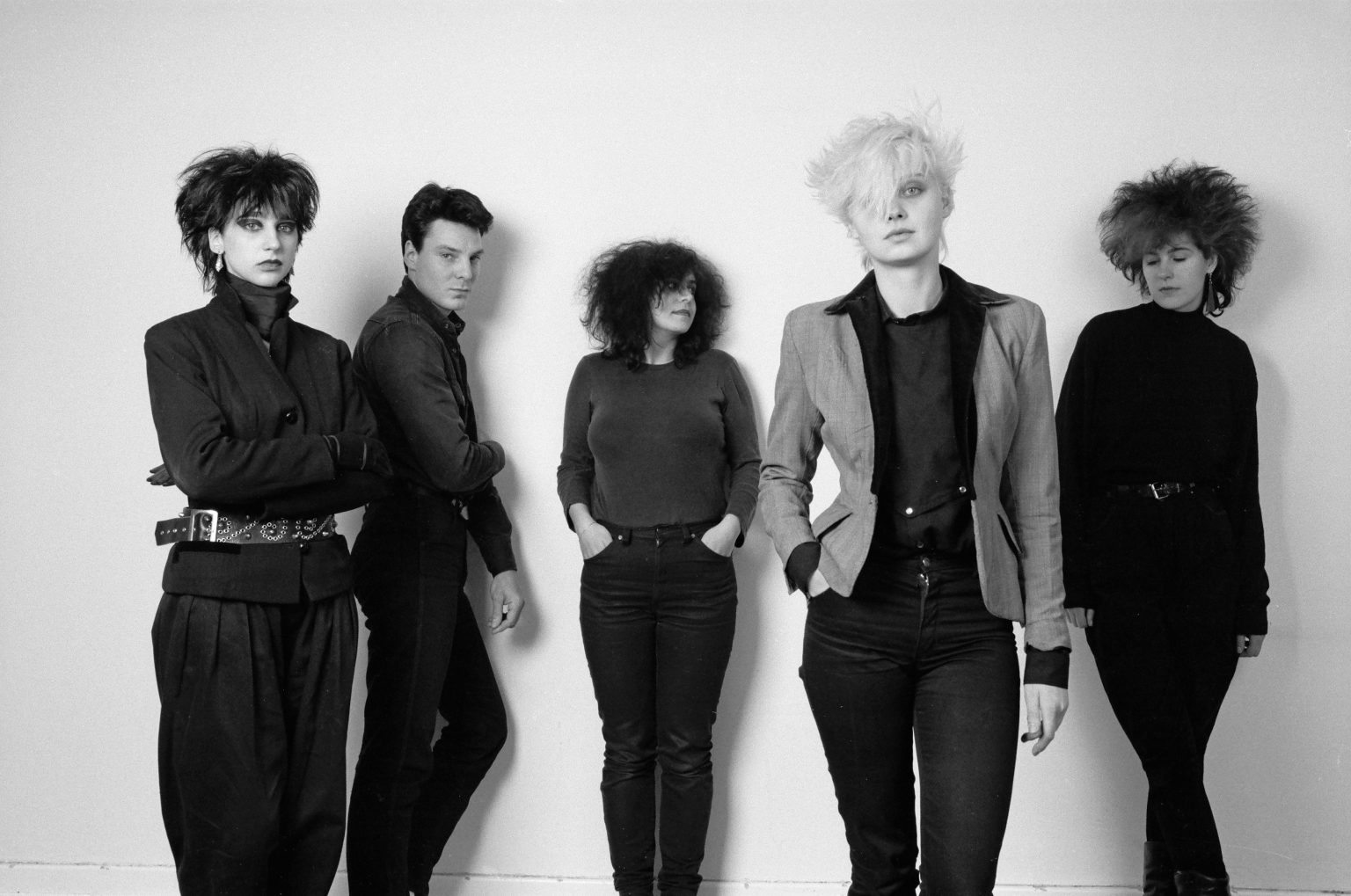 Anja with Xmal Deutschland circa 1982 - Photo by Ilse Ruppert
JB: That would be great! I wanted to ask about Mona as you have mentioned her a couple times. She described your voice as a spear, which I thought was pretty interesting. In regards to your solo album ‘Codes,’ that spear seems to have been tempered with a new kind of atmospheric patience. You talked about that earlier in looking at the relationship with your own voice. How has it changed now that you are more a solo artist with total control rather than a member of a band. Do you recognize like a change in your in your voice and how you sing at all.
AH: Yeah, it’s changed. I mean, how I sing and even the people I work with, Mona (keyboards/electronics), Christian (St. Claire), who’s doing the drums and Andrew (Drew Richards, guitar) is from London, so they really give me the freedom. When we talk about performance, to support me, it’s me and them. It’s not “us,” it’s them, and so that is a difference. It makes it very open for me, and playing live, I have moments sometimes where I just forget things. I think, “Okay, then I have to improvise,” and they know it. I watch someone or I’m in my own thoughts, and so I can improvise, but they can react, which is good. They don’t lose it. In Xmal Deutschland, being backstage it was, “You did it wrong! You lost this part,” or “You made a mistake.” These days I’m totally relaxed on stage. I’m a performer, I can perform. I don’t want to be like, as people sometimes say, “There she is, and she is a star” or something. No, I don’t see myself like that. I’m a performer, I do art dot and that’s what I’m doing, and the support is great. What they do, they make it all happen. It’s very precise and worked out like in a studio and in rehearsals here and there, and they’re good musicians so they can manage to support me. Which is good.
JB: Yes! Did Xmal Deutschland ever do any improvisation in the studio or on stage?
AH: No, there was not much improvisation. It was more like you can also tell on the songs, like verse/chorus/bridge, very structured. But when you start working like that and you go on like that, you always repeat yourself. (James agrees) It’s always the same. I mean, you learn over the years, of course, how songwriting works but, then again, you have to open it at some point, and that was the case with ‘Codes.’ It was completely open. There was no one saying, “Now, we have to do it this way,” because I sat down with Mona and said, “Let’s get into something ghosty or something,” like the track “Exit” for example. I love this track, even playing it live is very spooky and the groove really gets somewhere, and you can really see the words coming in. It is so much fun to write that way.
JB: Have you known Mona a long time?
AH: Yeah, I’ve known Mona since early days. When I started making music we met at pop concerts and we had the same friends. Her boyfriend lived in that place I was talking about (squat), and so she came in and out. We knew each other for a long time, but we lost each other for a while, because she moved to Berlin and I moved to London. Then maybe 10 years ago or even longer, I started visiting her in Berlin and whenever I came up to see her she kept saying “You should really think about singing again.” And I would tell her no (both laugh). “You should think about it, and we can try something” she would say before I would tell her, “No! Never!” (More laughter) Then the idea for ‘Codes’ came up, you know this idea of the diary and because I was bored, I thought, “Yeah, why not?” Mona said, “Yeah! Come over! Jump on the train and head over.” It was completely illegal to travel then but I did it, and then we recorded it. She said, “If you don’t like it, we can throw it away but just give it a try.” And it worked. So that’s when it all started.
JB: Has she released other solo stuff?
AH: Yeah, yeah, she does quite a lot of work. I mean, she does the film music stuff, and she does her own solo works. She released an album (‘Don’t Turn On The News’), recently together with an author/photographer, a very well-known photographer (Miron Zownir), and he writes poems, and she did the music for it.
JB: I would like to hear her stuff. Was it Mona that helped foster the idea of you singing again because you sounded like you were reluctant to the idea!
AH: Yeah, as I said, we worked on this very first song, “Skuggomas” and I wasn’t too sure if it really worked, to work together because we are both strong personalities, you never know, but it worked. We come from different points, really but it sort of fits in a way, and we discuss things very often, but in a good way. It’s always positive and something always comes out which is very important because it doesn’t happen that often. In many ways it just doesn’t end, the back-and-forth. “Does this end somewhere?” And the other will say, “No, it doesn’t make sense.” You know, you don’t listen to me. I don’t listen to you. Stop it! But we’re always having moments where we say, “Okay, now I get what you mean. Go back on it.” Which is always interesting. It’s a good way of working. She always says, “You can’t tell people I made you make music and push it,” but in a way, it was like that because I was not too up for it. I have my art, I’m happy. But I’m happy with making music again. I have to say it was a bit of a trauma, really. When I stopped, I always said, “I will never go back. Never, ever!” You know, like many others did. Now, I’m in a situation where I can manage it, I can do it. I like, music. It’s not traumatic anymore, I can listen to music. And you know, I can get myself into this kind of work. That’s good.
JB: Is there any contemporary music that’s caught your ear?
AH: Not really. I don’t have the time to listen to music in a way. I like to listen to sounds people recommend. They tell me, “Listen to this and that,” but I don’t fully follow any bands. I find it difficult. I think right now, it is starting to happen. There are some bands in Germany who play really tough guitar music, you know, like Killing Joke or something but played by very young and not all the dark wave stuff with synth, following the rules. No, I can’t listen to that. It’s okay, but I know those sounds, thank you. I want to hear new music and energy. That would be great, but where are they?
JB: That always comes up in interviews are new bands rehashing the past. There is some originality with some of the bands, but others, to your point, just regurgitate stuff we’ve already heard before. Why are we listening to it again? Do something new with the genre if that’s the direction you’re going to go.
AH: Yeah, it’s true. Yeah, that is a problem, and that really is a problem when you understand music and know music over many, many years. You know how it works. You know the sounds, where they changes are, when the buildups are coming and blah, blah, blah. It is sad to say that, but it gets a bit boring, and I get a bit bored. And sometimes, you see, people where you think they very unique but rarely people stay unique when seeing what comes out when they go on for another two or three years. Mainly they stop at some point because it’s a tough job, being in a band. I hope to see at some point we see more people who you really think could be it. They get it.
JB: You’ve observed that the myth of Xmal Deutschland grew larger because you simply disappeared, which I think is very true. You’re revisiting some of the Xmal Deutschland stuff live, but you’re changing it up a bit different. Are you at peace with it all now?
AH: I can manage playing these songs, I like some of them and some I don’t like, but I see the point where people want to hear it. Sometimes I find it to be an inspiration to listen to some of these old songs because I didn’t listen to them for decades. I just put them away into my cupboard, and that was it. I find it very fascinating that so many people are catching up on this old sound and these records. We never understood that there was something about the band or these records that many, many people liked, you know. But today, I can tell because I’m in focus, and I do interviews. I get all the resonance which is very interesting. I can cope with that, so I find it very interesting.
JB: Are you in touch with anybody from Xmal Deutschland anymore?
AH: Yeah, I’m in touch with Fiona, (Sangster, keywords). She is doing all the merchandising and taking care of communications. Peter, (Bellendir) the drummer, died (1955 – 2013), but the very the first drummer, Manuela (Zwingmann), she lives in London. She’s a good friend of mine and Manuela Rickers, the guitarist. Well, I worked with her on the album, but that was basically it. So, we are sort of in touch, but then again, I do what I do, they don’t. It’s not that easy for them, I think, to see the success.
Upcoming Tour Dates:
Jun 18: Zduńska Wola, Poland – Miejski Dom Kultury
Jun 19: Wrocław, Poland – Stary Klasztor
Aug 28: Santa Ana, CA – La Santa
Aug 29: Los Angeles, CA – The Paramount
Aug 30: Portland, OR – Star Theater
Aug 31: Seattle, WA – The Crocodile
Sep 1: Denver, CO – HQ
Sep 2: Houston, TX – White Oak Music Hall
Sep 4: New York, NY – A Murder Of Crows 2026
Sep 5: Detroit, MI – Small’s
Sep 30: Berlin, Germany – Silent Green Kulturquartier, Betonhalle
For more information, please visit Anja Huwe | 4AD | Sacred Bones Records | Bandcamp | Instagram