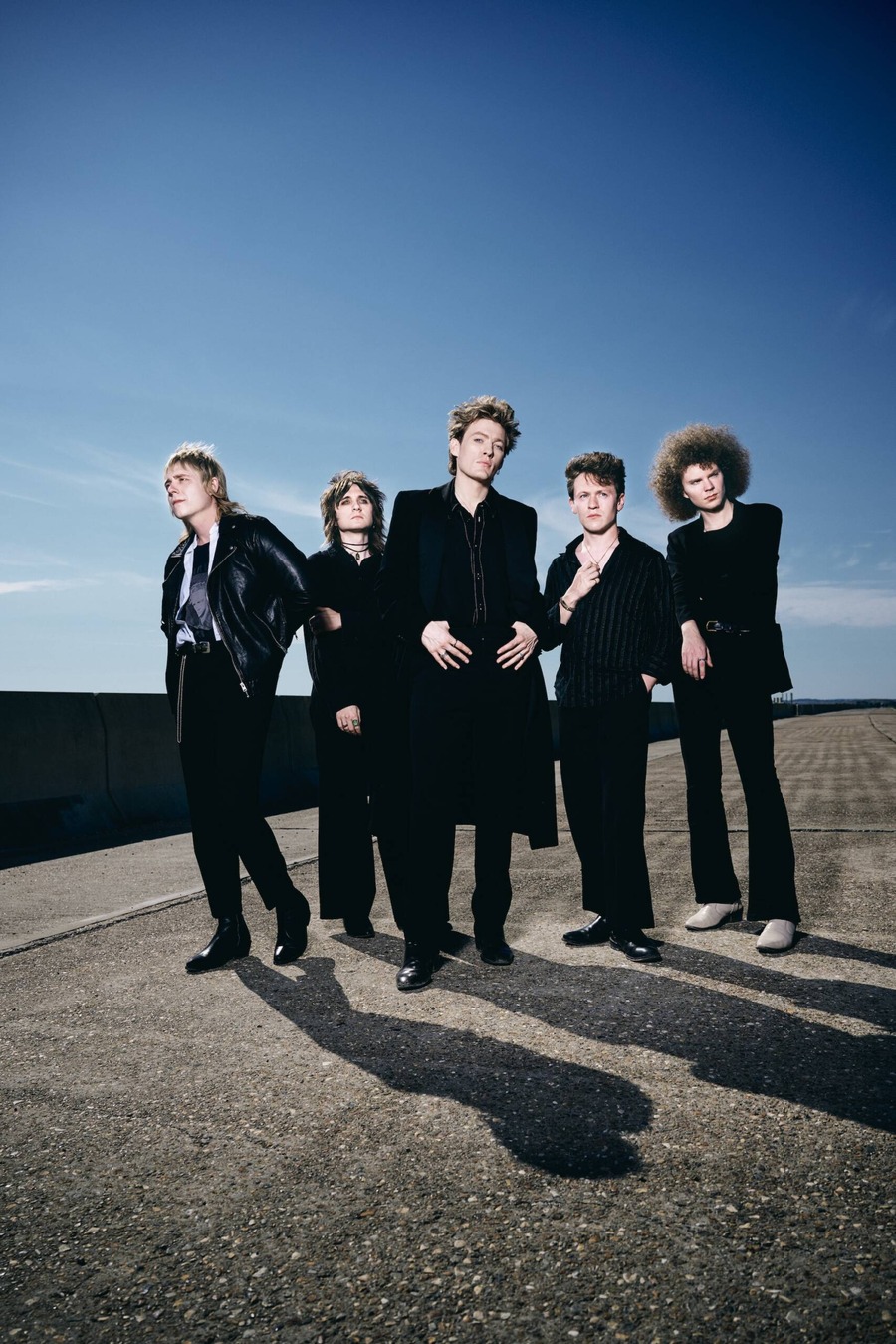
Photo by Scarlet Page
Pushing the album release up a month would have resulted in Brigitte Calls Me Baby’s sophomore album, Irreversible, dropping on Valentine’s Day, a fitting date for the Chicago band’s brand of romantic indie-pop. It’s a missed opportunity for a young, but experienced, group whose songs touch on the pangs of nostalgia, the blur between dreaming and waking, and the reality that love isn’t always mutual.
While on the road in Europe supporting The Vaccines, guitarist Jack Fluegel and bassist Devin Wessels hopped on a call to discuss the buildup to release, the sequence of the 11-track record, the whirlwind of the tour, and the honest lyrics that can sometimes be the hardest to talk about.
How difficult is it to sit on an album and wait on the release date? With all the stuff surrounding a release – doing interviews, playing shows – does the release date sneak up on you or does it feel like you’ve been waiting forever?
DEVIN: Oh, it definitely feels like we’ve been waiting forever. But at the same time, I think the date has arrived quicker than we may have anticipated, which is good. I’m excited.
Now that the album is out, is this where the real work begins?
DEVIN: Honestly, this part is the fun part. People can hear it, we can play it for them. The real work was the preparations leading up to tour. This is the part I think we enjoy the most.
From a preparation perspective, obviously you’ve done a lot of touring before this, does it get easier? Do you do different things as you’re preparing for a tour around an album release, as opposed to being mid-tour, or is it business as usual?
JACK: This one’s a little different. This was the first time getting ready for a tour where we had this whole new album of songs. We’re excited to see what kind of response they’re going to get and looking forward to finding out which songs are going turn out to be fan favorites.
The tour in Europe that you’re on now started before the release of the album. Has there been a standout or a couple of songs from the new stuff that have gotten a reaction that you either did expect or didn’t expect?
DEVIN: I would say right now the biggest one that stood out is “I Can Take the Sun Out of the Sky.” People are hearing it for the first time most times we play it, and there’s something about it that seems to get people engaged, which is really gratifying to see.
If I were to walk into a bookstore and buy Irreversible, would I find it in a fiction or nonfiction section?
JACK: That’s a good question. I think for the most part, at least lyrically, it all comes from a real place, from a personal, introspective place. So I’d say nonfiction if I had to.
There is a song called “I Can’t Have You All to Myself” followed by a song called “I Can Take the Sun Out of the Sky.” Was it intentional to have a “I Can’t” song followed by a “I Can” song?
DEVIN: Well, sometimes coincidences happen for a reason, and that may be one of them.
JACK: “I Can Take the Sun Out of the Sky” was actually a track that was not intended to be on the album, maybe it wasn’t even written yet. We thought the album was done, and then that tune got written, and it kind of felt undeniable. We were able to quickly get it mixed and got it approved to add to the album, so I think we just slotted it in right where another song was meant to be, and got that happy coincidence.
Growing up, I always thought movies were shot the way that we see it – the first thing shot is the opening scene, the last thing shot is the closing scene. I used to think albums were recorded in sequence as well. Of course, now I know better. When deciding on a track order, do you guys each create a sequence and work, then compare or is there somebody in charge of figuring out the album sequence?
DEVIN: It’s a lot of discussion. Similar to what you were saying with film, you’re trying to create a cinematic experience and a narrative and a through-line with the music, so it’s something we all feel pretty passionately about. Luckily, we tend to get to a place of agreement eventually.
JACK: That was basically a 45-minute phone call. We all came in with our dream sequence, took some votes, and hashed it out. I love doing it, though. I love making a good list, making setlists, sequencing albums.
Do you guys spend a lot of time during production listening in different environments? Like, how does it sound through a car stereo, through a phone, through desktop speakers, through a big stereo system? Or do you just trust the mixing and mastering and that it’s going to sound good regardless of where people listen?
DEVIN: I think that happens naturally. We do a lot of writing, and certainly in the mixing phase of this album we were touring constantly, so naturally every time we listened we were somewhere else with some other system at our disposal. It sort of worked out that way, whether it was conscious or not.
Did you end up making any changes because maybe you were listening in the car and it sounded different than through earbuds?
DEVIN: Oh, that’s certainly part of it. I like to think about how people are actually going to listen to this album, where it’s going to meet them. If it doesn’t work there, then it doesn’t really matter if it works on the nicest speakers in the studio you recorded in.
When you’re not on tour and not in a bus or traveling, what is both of your most common way of listening to music?
JACK: If I’m listening to music, I’m probably out for a walk listening on headphones. Not so much sitting down at home.
DEVIN: Similar for me. I’m either out walking, or I like to listen to records at home. I try to give myself intentional music listening time if I can. It’s hard to get these days, but it’s important.
My day job means a daily commute, so most of my listening is in the car. If I’m at home, although I have a record player and about 300 albums, I find myself gravitating to Netflix over sitting at home listening to music. Most of my listening is in the car, or I’ll throw earbuds in at work, definitely different experiences from listening in the car versus listening at home on the weekend.
DEVIN: And if we do our job right, the album should hold up wherever you are.
In terms of songwriting and lyric writing, I’m guessing Wes does most of the lyric writing? And then from a general band perspective, is it a democracy to get the overall sound, or do you each have your own parts you’re responsible for? Is the writing and recording fairly split, or does everybody get together and work on something together?
DEVIN: Yeah, for the most part, Wes handles the lyrics.
JACK: The origins of songs – usually one person, I might write a song, show it to the band, and if they dig it they’ll start contributing to it. It could change a lot or a little, same with Devin. Usually, one person is coming up with the original concept of the idea, and then it can change quite a lot from there once the others get their hands on it.
I’ve been married 28 years and have definitely, in my life, had dreams with women who are not my wife, and I would always feel sort of guilty about telling my wife I had a dream about somebody else. I was wondering, and you probably can’t answer this, but for “I Dance With Another Love in My Dreams,” I was curious if that’s the kind of thing Wes would explain to a partner and be like, “Hey, it was just a dream, it was in my subconscious.” Or is that something, like, you just never tell your wife you dreamt of another woman?
DEVIN: Actually, I can answer that one, because that one started with me. I guess it’s a difficult thing to talk about, and that’s how it ends up in a song. Sometimes it’s easier to put it in a song than to have a conversation.
But then do you have to explain it to your significant other — either this song is about you, or it’s not about you? Or is it just sort of unwritten that you don’t talk about lyrical content with a significant other?
DEVIN: In that particular scenario, I didn’t need to explain anything. I’ll leave it there.
Do you think of album titles as representative of what people are going to come into as an entire package? Does Irreversible represent the general overarching theme of what people should come into, or was it just a good title for the album? How do you decide on titles and how they relate to the songs on the record?
JACK: Looking at the first record, that’s a song title, but it’s also kind of a statement about our viewpoint and the lyrical viewpoint of that album. I’d probably say the same about how we came up with the title of this album.
Does the past inform the future? From all of your experiences up to now, is everything you’ve gone through to get to this record and this tour a buildup of the past since the band started? Or do you wipe the slate clean when a record is made or a tour starts, and say, “This is day one of the next chapter, what we did in the past might inform some of this, but really we’re charting new territory”?
JACK: Each record should be its own package, but you can’t help it being informed by the past experiences you’ve had. We try to bring as much as we can. This is where the sound is going, can’t help but be inspired by audience reactions along the way.
What have you learned from the past when it comes to touring that you’ve course-corrected? Not necessarily mistakes, but what things did you learn that made you say, for this tour, we’re going to give ourselves more time between dates, or stay in different hotels? Has there been stuff you’ve learned along the way that you’ve been able to change?
JACK: Well, we’ve gotten pretty good at driving on the wrong side of the road touring in the UK. On our first tour over here, I swear I couldn’t sleep for a week before it started, I was so nervous about driving on the other side. Part of what we learned is learning to rely on each other, because you can’t do it all yourself and if you try to, you’ll go crazy. We try to have each other’s backs and step up when somebody needs help.
And you’re still driving yourselves, still in some sort of Sprinter van?
JACK: Yeah, exactly. We’re our own guitar techs, backline techs, all of that.
I was talking to a band the other day, and they said that being an opening band offers some challenges because you’re always chasing the tour bus. Does that feel that way to you, that you always have to leave the venue early because you’re doing your own driving as opposed to having somebody else drive?
JACK: Yeah, I totally get what that band probably meant. This run I can’t really say that about, because we’re pretty much just in the UK with the Vaccines. We’ve done some American support tours, and that’s a lot different, the drives are just so much longer, and it can be tough. But you get to get there a little later, you don’t have to show up as early as the headlining band’s crew. It’s not so bad.
Opening for the Vaccines, do you get a 45-minute set, or more, or less time?
DEVIN: We’re doing 30.
Were you playing new songs before the album came out? How split is the setlist between the two albums?
JACK: We’re kind of doing half and half. We’re playing the singles from the new album that are already out. And then trying to filter in every night, maybe play one or two more from the new album, swap them out so we get a chance to try them before our headlining run. We try to represent both albums and not worry too much about whether the songs are released or not, because we’re under the assumption a lot of people are just there to see the Vaccines and might have never heard of Brigitte Calls Me Baby.
Are there any songs you just don’t think will ever work their way into the set? Or would you say everything you’ve written is a candidate for the setlist?
DEVIN: I won’t say never with any song, but there certainly are songs that don’t translate the same live as they do on a record. There are ones that will be rare to appear publicly.
As a non-musician and a music fan, that doesn’t intuitively make sense, why would you record something you can’t play live? But having talked to enough musicians, I understand that sometimes studio stuff uses things you just can’t take out of the studio, or it’s a chance to experiment, to layer different things. The satisfaction is completing the song in the studio as opposed to playing it live. Would you say that for those songs that might be a little more rare? Is it more about “We just wanted to try this thing out and the intent was never really to play it live”?
JACK: I wouldn’t say that. I think it more boils down to tempo and energy. We’ve got a couple of more ballad-y tempo songs on this record, and we love those songs. But with a 30-minute opening set, I think it’s just kind of understood we want to pack as much energy and excitement into it as we possibly can and maybe steer clear of the ballads. One day they’ll all get played at some point.
And obviously the difference between a 30-minute set and a headlining set allows you to expand that more and maybe play some of those songs. Like “These Acts of Which Were Designed.” I really like that song. It seems a little dreamier, a slower song, maybe brings the energy down a little bit, but I do think it would fit nicely into a set.
JACK: Yeah, I think we’re going to play that one. We’re excited to give it a go. We haven’t pulled it out yet, but we were rehearsing it and it was kind of becoming a favorite. Looking forward in the headline sets to giving that one a go.
Many years ago I had the chance to interview Gary Lightbody from Snow Patrol, and I asked him: if you’re not on tour and it’s just a Friday night or a Saturday afternoon, and I were to run into you somewhere, where would that be? His answer was that he’s a huge movie fan and if I ran into him at a bar and said “Hey, have you seen this movie?,” he said he would probably talk to me for 2 hours about movies. Is there a topic, something you’d like to talk about outside of music, and where would that conversation happen?
JACK: Not to steal his answer, but even before you said it, that’s where my mind went. You’d probably see me at the movie theater, there’s one about 5 minutes from my house and I’m there several nights a week. I could talk movies. I’d way rather talk about movies than talk about music, personally.
You still enjoy the act of going to a theater as opposed to streaming something at home?
JACK: Yeah. If it’s something I’m really excited to see, I try to get out and see it. It just seems to resonate more.
Off the top of your head, is there something you’ve seen recently that you’d recommend?
JACK: Right before I left, I saw the new Sam Raimi movie, Send Help. The Evil Dead movies are some of my all-time favorites, and I love Sam Raimi. I thought it had some of those great callbacks to his older films. I thought it was really good.
Devin, what about you? What would be something you could talk about outside the scope of being in a band?
DEVIN: Oh well, Jack and I end up talking about movies most Friday nights. You might find us at the bar talking about movies.
JACK: Or we might be talking about a podcast that talks about movies.
DEVIN: Even better.
If you could relive one day or night of your life where you can’t change anything about it, is there a day that really sticks out that you would just want to relive?
DEVIN: As it pertains to the band, I would say our first time in Paris. We played at the club Supersonic. We were just talking about it the other night, that show had to be one of my favorites we’ve ever done, and that whole night, there was just something in the air. I’d go back and relive that, for sure.
What made that show more memorable than others?
DEVIN: It was one of our first times playing in a non-English-speaking country. To be out there and have your lyrics sung back to you by an enthusiastic crowd, there’s something special about that experience the first time.
Jack, anything spring to mind ?
JACK: A good one was definitely when we played Lollapalooza. That was a hell of a day. I think our album came out the day before. We actually played two sets at Lollapalooza. We played on one of the big stages early in the day, and then later that day we hauled all our gear on golf carts over to a different stage and played there. Then I went and saw the Killers close out Lollapalooza, and then I left there and went and saw our friends The Last Dinner Party play an after show, all in one day. Pretty damn good day.
Playing Lollapalooza, was that like a hometown show for you, or did it feel more like a tour stop?
JACK: I literally drove my Ford Focus to the gig, so it kind of felt like a local show.