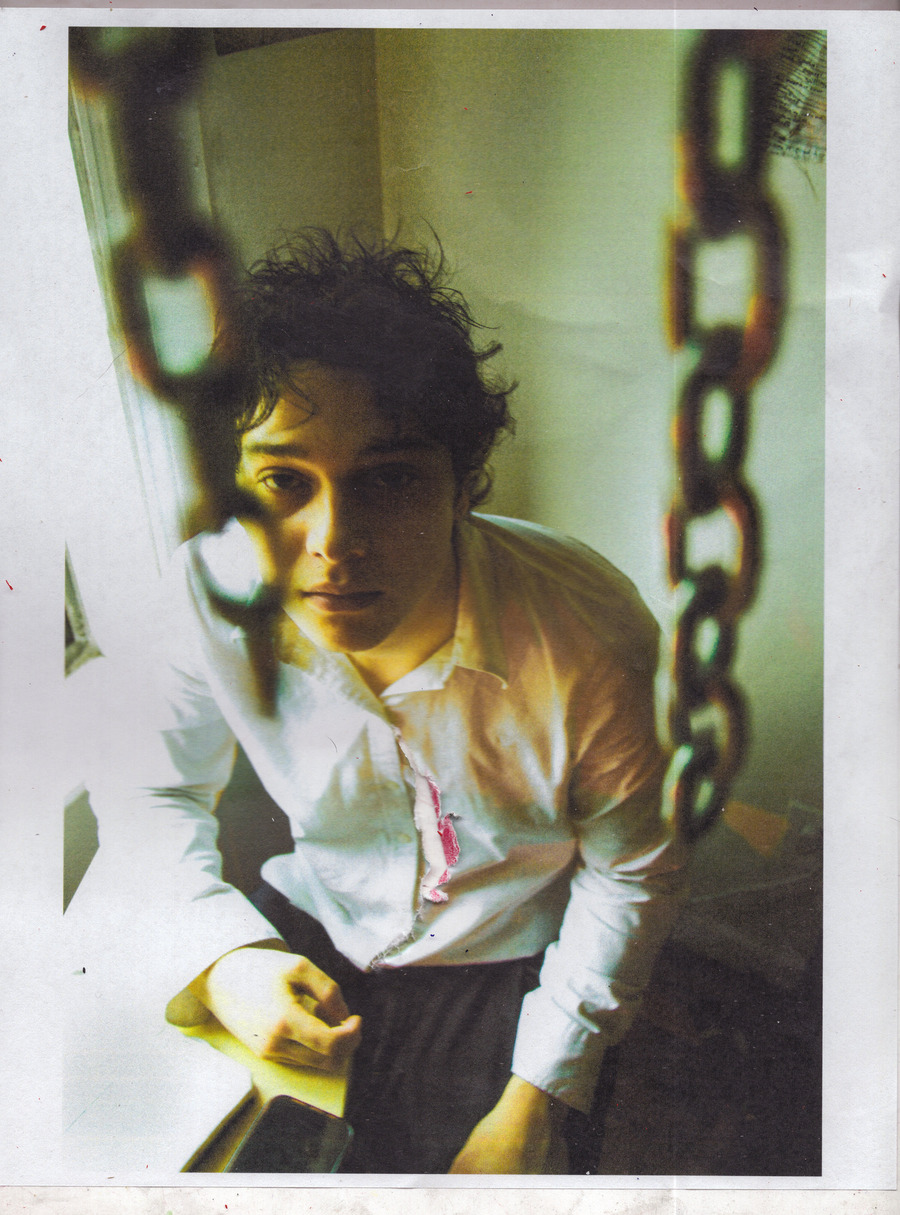
Photo by Leila Simpson
For some, finding their voice comes quickly. For others, it takes time, experimentation, and a willingness to explore. Liam Creamer knew early on that he wanted to pursue a career in music and was fortunate to come from a supportive family that encouraged him to follow that path. After moving cross country, Creamer began crafting what would eventually become his debut EP.
There isn’t a strict linear path across the half dozen songs on the record, but Creamer’s musical voice is the through line. He’s a musician and producer who grew up during the boom of streaming music having the entire history of recorded sound available in the palm of his hand. That access shows up in the music. His influences span everything from the reverb soaked textures of shoegaze to the intimacy of indie singer songwriters, from the heaviness of metal to production techniques that can completely reinvent a sound.
While Creamer is still early in his career, he’s already made an impression on people in the music business – much like his family did years earlier – who believe in his talent enough to invest time and resources into his growth. With management in place and a record deal in hand, he’s laying the foundation for a career that doesn’t feel boxed in.
In a recent conversation, Creamer talked about a growing fascination with the intimacy and storytelling of country music. While that’s not a genre he’s explored much in recorded form so far, it speaks to a songwriter still tuning his instincts and staying open to wherever the next idea leads. Betting on musicians is always a gamble, but at this stage of Creamer’s career, the upside is easy to hear. The songs on this EP feel less like a destination and more like the beginning of something still taking shape.
Before getting into the interview, it’s worth clearing one thing up: there is no one named Ken Park in this band. Like artists such as Lynyrd Skynyrd, Jethro Tull, or Bob Moses, the name isn’t meant to point to a person, but to a project. Creamer talks about where the name came from and why he chose to leave his own name behind, a signal of how intentionally he approaches both identity and sound.
You’re from San Diego, but you moved to New York for music. What was that like?
LIAM: I do everything for music. The usual thing is people around LA go to LA, people around New York go to New York to do the thing. I was in a haze of wanting to get as far away as possible. I was working at a pizza parlor to save up, and I did it. It was obviously difficult at first, but there’s something wonderful happening in New York right now with music that many places don’t have, and the community’s great. It’s a way to feel like I’m in high school and I’m definitely not.
Was it a culture shock moving from San Diego to New York? As I’ve only visited New York, never lived there, it seems like even the little things like buying groceries is a different experience.
LIAM: The groceries were crazy. There was definitely culture shock in ways I completely overlooked. The culture thing was no stranger to me. I come from a Mexican background, and Bushwick is a very Hispanic place, so that was really cool. But there are just other things. San Diego is easy, and that’s the reason I left; everybody’s so comfortable. In music especially, there’s barely anything happening there, and nobody’s willing to do anything different. Since moving to New York, I’ve stayed relatively the same, in terms of being a comfortable person. I’m not the hustle-bustle person that New York wants me to be, and I’ve figured out a way to block out the noise. Getting out of New York is just as important as living there.
How did you end up choosing the name Ken Park?
LIAM: My last name is Creamer — C-R-E-A-M-E-R. I had crazy nicknames in high school. That was kind of the reason I didn’t go by Liam Creamer. And I never really wanted to go by just my name either way. I really liked the idea of naming a project.
I saw the movie Ken Park when I was about 10 or 11. I’ll add to that, watch the movie if you want to feel empty. It’s a tough one. That’s why the name stuck. I didn’t get halfway through it as a kid, because I was just like, wow, this stuff is crazy. At the same time, it follows skate culture in the Inland Empire, California, which is kind of what I grew up around. So it was a little nostalgic in that way, what they were wearing, the soundtrack, all of it was reminiscent. Larry Clark’s style is just so cool in movies. At the time, it was aesthetically what I wanted my music to sound like: nostalgic, but still with some kind of grit to it.
How did your manager come into the picture? How did you get discovered?
LIAM: It was word of mouth. It had already been something I’d told friends in San Diego, that I was trying to move to New York. Jon was helping get a band started that he would likely represent in New York, and one of those people, my good friend Shannon, was going to play in that band and had told Jon about me. It didn’t end up working out, not for any crazy reason, it just fizzled. But me and Jon stayed in touch, and he’d heard all my demos. It was a slow build of just staying in touch, him watching my songwriting progress. I was always, prior to moving to New York, more into becoming a producer.
I moved to New York 100% because there’s nothing else I want to do. But I’m also aware that it’s a multi-billion dollar industry, and I can find a way. I’ve got some skills other than songwriting. Touring is where the money is right now if you want to make a living, and it is totally possible. I also grew up in a household that was very supportive of just the idea of me being good at something and pursuing it. My mom came into my room once and told me I was really good at music and it would be such a waste if I didn’t try. That really stuck.
I also did orchestra in school, and a teacher told me I was really good but a half-asser. That’s when something clicked. I played a little high school football, and they always talked about just keep pushing. Those thoughts kind of connected. If I put more effort into this, then maybe I can be something like all those bands and people I watched playing shows on MTV when I was growing up. That light bulb lit. I realized I had something.
What was your musical upbringing like? What were you listening to as a kid?
LIAM: Avenged Sevenfold, weirdly enough, when I was about 10. I was a big fan of Nirvana when I was very young, because that’s what I was playing at recitals. Then blink-182, Green Day, Lit. Then Foo Fighters, huge fan as a tiny kid at 7 years old, and then it just progressively got heavier through Avenged Sevenfold. There was a brief point where I was listening to some very heavy metalcore stuff. I still love it. I’ve been thinking about starting a screamo hardcore side project, but I cannot scream.
I was also a percussionist in school, and everybody was into jazz and neo-soul, flexing big chords on the keys. I had my time with that too. My father had a big influence through 60s music, not necessarily that he showed me directly, but music I found on my own. “Spirit in the Sky” by Norman Greenbaum, things like that. My dad went to Woodstock. I had this big romanticizing of another generation, and that was pretty formative.
Then in my late teens I got into more contemporary songwriters. An ex showed me Big Thief and Adrianne Lenker, Phoebe Bridgers, a lot of really great writers. I’m still really good friends with that ex, and she’s an amazing writer herself. On my own time I was also listening to a lot of shoegaze and harder stuff: My Bloody Valentine, Slowdive, Blue Smiley, they were pretty big in the resurgence of shoegaze in the 2010s. I always come back to the Beach Boys Pet Sounds. It was there for both the hard times and the really good times in my life. It’s grown with me.
The EP features songs that sound a little different from each other. Are you still figuring out your sound, or is that range intentional?
LIAM: A lot of these songs were written in very different times. Each one is just kind of giving the listener what I was listening to at that time, or experiencing in my life. I think it’s also the effect of not recording this in a proper studio, it was really just me experimenting. I do like to think I have a sound, or more just a consistent voice. If I were to get into a studio and record an album in a month with these songs already written on guitar, then it would be that cohesive album we tend to think about. But for me, each song started with a production. The initial spark came from production, and that’s something I’ve completely flipped recently. The EP is lyrics coming from the music, instead of the music coming from the writing. I’m really excited to try the new approach.
Did you name the song “Maybe Delete” because you thought you might delete the file and not put the song out?
LIAM: Yeah. That beginning intro part was something I did one day, just an idea, and I was at a time where I was afraid of overflowing my computer storage, so I titled it “Maybe Delete” because I didn’t need it on my computer if I wasn’t going to use it. It would have been called “If I Were You,” but I just stuck with “Maybe Delete.”
Is everything on the EP played by you?
LIAM: All of it is me. All of the instruments are me, and then on “Dragonfly,” Emily Borrowman, who is in a band called Smush, sings on it. I played with them in Akron. Playing those shows is so fun. It was the opportunity in my life to genuinely need to wear hearing protection.
What does your live set look like right now? Are you playing all six songs from the EP?
LIAM: Right now there are about three songs from the EP that I’m playing in an eight or nine song set. I’ll kind of switch out which songs I want to play from the EP that night. Some of them are just ridiculously hard to play live and don’t translate that well.
I’ve never played “Maybe Delete” live. The reason I’m not willing to try it without some kind of tech setup, either a backing track or click, is that there’s not really a lyrical song under it. It was a production exercise, me just making something I wanted loud. I wanted this kind of sound, and that’s what I got from that song.
What comes next after the EP? Is there a full-length in the works?
LIAM: In my heart, the EP is me saying hello, and now I know what I want to do and I’m going to go do it. This was my experiment. I would like to make some records. Whether that’s another EP or an album, I’d rather get to 10 or 11 songs and ask those I trust what to do with them. It all boils down to how I progress as a writer. Right now it’s peaks and troughs. I’ll come up with a bunch of stuff in months, and then drop off for months. That could change.
I’ve been listening to a ton of country lately. Just the songwriting is amazing. I’m excited to actually put my vocal up front and say what I have to say instead of hiding behind any production. Not that that’s exactly what I did on this EP, but I was going for a drawn-out sound. Now I want the song itself to inform the music. I have a lot of songs I wrote in between all the EP tracks, it was very much curated out of a long list, but I’m at a point where I don’t entirely identify with a lot of them, and I want to go back and repurpose some of it.
If you could place one of your songs on a playlist, what two artists would you sandwich yourself between?
LIAM: EP-wise, Smashing Pumpkins. I had a question once about what four records the EP sounds like, and I said Siamese Dream by Smashing Pumpkins, Carrie & Lowell by Sufjan Stevens, Pet Sounds, and For Emma, Forever Ago by Bon Iver. And I think that kind of hits on the all-over-the-place thing.
There’s a lot of music coming out of New York and Geese, in particular, is having a lot of success.
LIAM: Somebody told me they’re beyond New York now, and I kind of agree. I don’t see them as a New York band anymore. But that’s another thing, all of these bands are so different. There’s not a specific scene that’s doing well. I feel like, partly because of social media and Spotify and how easily we’re all influenced, we just pick something, or have endless choice of mediums. I’d like to think I don’t have to choose a specific genre, that it just magically appears based on my personality and identity. There are just so many different people making different music.
You’ve been touring as a member of other bands. Is that just to help pay the bills?
LIAM: It’s also incredibly fun, and it’s with really good friends. Just as long as I’m getting fed well. I played drums for Smush, and my last tour was playing with Jake Minch. Jake is definitely a singer-songwriter, and I was supposed to play drums but ended up playing lap steel and banjo. A real turn of events. The chemistry on the road was just great, everybody and the music. The songwriting was great, and it actually gave me the ability to take action on wanting to write songs on guitar and not for the production.
What does the next six months look like?
LIAM: Definitely lots of shows, and lots of writing. I have a bit of a catalog. If I wanted to, I could put out some singles. Being on a label and having a team, TikTok and social media is unavoidable. My whole thing about TikTok is: don’t get too into it. I’ll only do one take and that’s the take I’m going to post. I’ve done that, and some people have come to shows knowing lyrics to stuff that isn’t out yet, which is everything I could ask for. That might lead me to want to release a single. But nothing is on paper right now except for another EP or an album.
The label putting it out is TODO Records. Austin and New York based, a small label with an incredibly great ethos of helping new artists. Simon and Meesh Halliday and Pooneh Ghana. Simon was head of 4AD. Pooneh is an amazing photographer, and Meesh is just incredibly tapped in on the art and industry.
And yes, it’s coming out on vinyl too, which is awesome.
Any final thoughts on where you are as an artist right now?
LIAM: There’s something in there. The pot just hasn’t boiled over yet. I’m writing all my ideas down and not letting one go. I actually feel like a songwriter now. A very important thing is to always make it feel like a hobby and not a job. Once you start saying you want to do this as a career, it does something in your brain where you start second-guessing everything you put down. Learning that was huge for me.