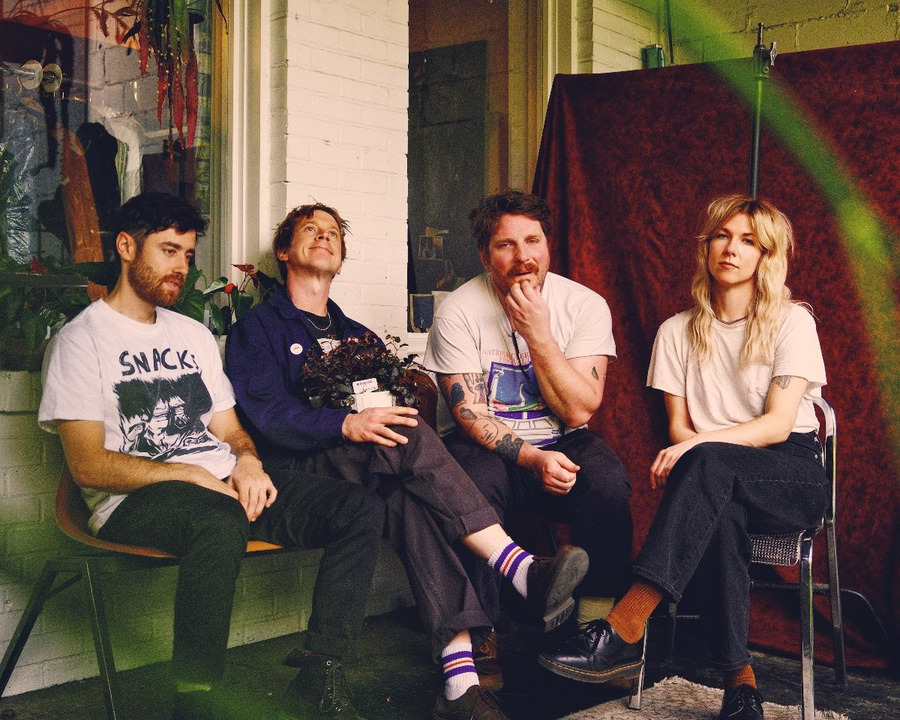
Photo by Kris Sampson
John Robinson is not old. But he’s not not old, either, not in the way rock and roll counts these things; where a decade of playing in bands (Illegal Drugs, Turf War) that barely made a ripple, much less a splash usually buys you a Wikipedia footnote, not a fresh start. And yet here we are: Pleasure’s All Yours, the debut from his new band Ultra Lights, is shaping up to be one of 2026’s most anticipated records, a strange sentence to write about a bunch of guys who, by rock star standards, should be thinking about life after the spotlight, not writing hooks that the kids are going to love as much as their parents do.
Call it a mid-life plot twist. Robinson spent his twenties and thirties chasing sounds that never quite fit, genre-hopping from one project to the next without landing anywhere. Turns out the sound he was after was one he already knew: being eighteen in the early 2000s, MTV still pumping out videos in the background, The Strokes, Pavement and Archers of Loaf teaching a generation how to sound like they didn’t care while secretly caring very much. Ultra Lights doesn’t hide from those influences, it just plays them rougher, messier, less concerned with getting it right.
Maybe that’s the joke, or maybe it’s the whole point: it took Robinson two decades to stop trying to become someone else’s idea of a rock star and just play the kind of music he would have loved as a teenager growing up in Georgia.
Pleasure’s All Yours is out today on Chunklet Records. In the days leading up to the release, Robinson carved out time between shifts at his restaurant job and away from his wife and bandmate, Leela, to talk about what it’s like, after twenty years of near-misses, to finally get noticed.
Hitting you hard right out of the gate. It’s release day and maybe this will be the first thing people read as they listen to the album. What is the most important thing that people should know about Ultra Lights?
JOHN: We’re just trying to play rock and roll music that’ll relate to everybody, versus trying to make it be complicated for people. There’s no gatekeeping with it, you know what I mean? It’s open to everybody. I’m 42, I’ve been playing music for a long time. I’m not trying to do the new, original thing. I know everything is influenced by what has already come before, and I just wanna write music that I enjoy, but also, it’s nice that people do enjoy it.
You’ve gotten some nice pre-release press including being named a “Band to Watch” by Stereogum. As you mentioned, you’ve been playing music a long time. Is it a surprise that people are taking notice or did you know when you were making this record that it was something special?
JOHN: There’s a bit of a surprise. I’m not saying that because I’m 42 that’s the end of anything, but the bands that we, me and you, see get written about the most right now, they’re gonna be probably in their mid-20s, or their early 30s, usually. So the fact that Stereogum latched onto it and wrote about it is a bit surprising, but I spent a lot of time on the music for this band, and put a lot of care into it and cut the fat, as I would say. I didn’t put anything on the record just to fill it up. It’s all songs that I like. People in the band heard the demos I’d already done before we recorded, and they really liked them. I had a lot of support before we finished the record from all the people that already heard the demos, like Henry from Chunklet. So I did feel really good about it beforehand, but now it’s exciting, getting asked to do podcast interviews, and having an interview with Stereogum, it’s super exciting.
What do you think is different about what you’re doing now compared to what you were doing in previous bands? Why is this special and getting attention?
JOHN: It’s different from what the previous bands had done. The first band I was in was when I was 15. And then I was in a band with my brother and all these older guys that was kind of indie rock. And then, At the Drive-In and all that emo stuff was popular at the end of high school, so I was in a screamo band. I went from that to heavy rock. And then, the garage rock thing, like with the Black Lips and all that, became a big deal, and then I was in a garage rock, poppier sort of band that’s the closest to Ultra Lights out of any of the bands I’ve previously been in. Then I was in a heavy band again.
Ultra Light’s the most influenced by what I would have been listening to when I first started playing music, because I was watching 120 Minutes on MTV. I’m old enough to remember when MTV still had music videos, and I have so much of that influence. I’m also old enough to have not had YouTube and all that stuff where I could have found music when I was young, so this band’s very influenced by the alternative and indie rock that MTV would have played for a guy that grew up in Augusta, Georgia. I didn’t grow up in Atlanta or somewhere where they had really great record stores. There was a record store in Augusta, but I never went there, because no one talked about records at my school at that time. It wasn’t a trendy thing, I guess. They had kind of fallen out, and CDs were the thing.
I have kids in their early-to-mid 20s. I find that they are in the same age range as many of the artists I talk to. I don’t know if it’s because they were raised as part of the FaceTime generation, but they seem to be very comfortable talking with someone who is old enough to be their parent.
JOHN: Oh, yeah, a lot more comfortable than me. I work at a restaurant. I work around a lot of kids that are younger, in their 20s, and they are super relatable. They’re a lot more open about their emotions. I’m sure they are just way more inundated with technology than I am.
I do feel my age when I make a reference to a band that I feel like everyone knows, maybe a band that was popular in the late ‘90s or early ‘00s, and I’m met with blank stares.
JOHN: That’s when I feel old too, when I’m talking about, “I was at this show,” or “We played with this band,” or I’m talking about a band from Atlanta from what seems like 5 years ago but was really probably around 12 years ago and none of kids I work with know who I’m talking about.
You create playlists and post them on Spotify. I saw one you created when you were in Turf War called Turf Sturff and it has the song “Somebody to Shove” by Soul Asylum on it. That song contains my favorite lyric of all time, “You’re a dream for insomniacs.” What’s your favorite lyric that you’ve written?
JOHN: Recently, in the song “Good Enough,” there’s a line at the end of the song that I got really excited about. “You got all your knowledge from a house that’s been haunted.” I was trying to explain that to the band. I was all excited, because we’re getting all our knowledge from the internet, from Reddit or whatever, so I thought that was a cool concept, that it’s haunted with other people’s ideas and lies, basically. I thought that was a cool lyric. But I’m sure I’ve written better ones than that that I can’t think of off the top of my head.
Do you have a favorite lyric from another artist?
JOHN: I’m good at taking all the music and basically ingesting it into myself, and obviously making music that sounds familiar to other people, but I can’t recite lyrics to other people’s songs.
The older I get, the less I retain lyrics, even of songs I love.
JOHN: It becomes harder and harder. I had to write down all the lyrics to the album after we had done it, and I had to handwrite them, which was really hard because I don’t handwrite 11 songs worth of pages ever. That was hard on my hand and my brain, and I think I even missed out some lyrics on a track. I had to write them out to send to blogs, and to the guy that’s doing our radio campaign for us, and I had to listen to the songs to remember them. I know how to sing them when I’m singing. It’s like a state-dependent sort of learning situation, where I’m playing guitar and I’m singing at the same time. I have all that down. So when you’re asking me what’s my most interesting lyric, I can’t think of what it would be, but if I was in the moment of the song, I would be like, “That’s the one,” you know?
I can just picture seeing Ultra Lights live some day and I’ll look up at the stage while you’re playing and you’ll look at me as you’re singing in the middle of a song and you’ll say, “I just thought of it. This is the answer to your question about my favorite lyric!”
JOHN: “That’s the one!” Yeah, the “Good Enough” one, that was a new one I remember. I write all our songs. I’ll record demos. I’ll record drums, I’ll record every part, and I’ll sing, and I’ll kind of have lyrics for the songs, but a lot of stuff will just be ad-libbed, and then I’ll have to kinda squish it, and make it make some kind of sense as a song. And when I figured that one out, that one at the end of “Good Enough,” I was just excited about it, because it went along with the melody I did, and I thought it was an interesting concept.
Where do you find the most inspiration for lyrics? Do things just come to you, or do you consciously say, “This thing happened in my life or, I just watched this TV show, and I need to work that into a song?
JOHN: Yeah, it’s definitely off of real-life stuff I’ve seen. A lot of times I’ll do spoken word when I’m writing. I’m basically rapping, you know? When I started off in music, that was actually the first thing I did. I was trying to be like Beck and the Beastie Boys. I did a lot of that ad-libbing, goofy, some sort of sense of humor to it, so now I try to make sure that in every song there’s some sort of levity, or some sort of humor in there somewhere, so it’s not just all, “I feel bad,” and “everything’s bad.” There needs to be a little bit of brightness, or sense of humor, tongue-in-cheek thing in there.
I read and I watch a lot of movies and stuff, but I don’t necessarily get influenced by that stuff when it comes to songwriting. I have a book that’s called something like “How to Use Words in a More Interesting Way” and sometimes I’ll go in there and I’ll come up with concepts, like maybe a chorus. A lot of the time, that’s how I’ll get the idea for the song. I’ll play around on my idea, and then when I finally get a chorus, then it’s, “Alright, now how does the song make sense with that chorus?” I make a story out of that.
That makes sense. I’ve never played music. When I was a kid and taking a music class, we learned how to play acoustic guitars. I remember being handed one and strumming and thinking to myself, “Wait, I don’t sound like Eddie Van Halen.” I thought it would be easy to learn. It wasn’t for me and I didn’t have the patience so I never tried again.
JOHN: I remember getting my first acoustic guitar, and I was like, “This doesn’t sound like Sonic Youth,” “This doesn’t sound like Nirvana.” The Nirvana Unplugged album had come out, but I was like, “This doesn’t sound like that.” For that first year, I didn’t really play guitar, and then I got an electric guitar, and I got lessons, and then I figured out how to make those sounds. You’re like, “Oh, this is how you make a sound that sounds like Sonic Youth, you just have a distortion pedal and stick your guitar up to the amp.” I did a lot of that when I was a tween. I started playing guitar when I was 11. I have an older brother, he’s like six years older than me, so all the music that I got into when I was really young was the cooler music, because I had a brother that was already in high school.
My brother moved away when I was in high school, he moved to Athens, and then it was MTV, or whatever Alternative Press would write about. I would go to Borders and find out about certain bands, and sometimes you would find something cool. There’s this band, Verbena, from Birmingham, Alabama.
I love Verbena.
JOHN: Yeah, that band was one of my favorite bands, but really, it’s just that album, Souls for Sale. The first band I was in, I was trying to do a Verbena thing, but I was too young and didn’t know how to play guitar well enough. But now, this band I’m in, I feel like it doesn’t sound like Verbena, but there’s definitely that influence of that 15-year-old kid that was obsessed with Verbena. My brother got to go see them play, and I wasn’t allowed to go, and I cried. I remember I was so upset, but then I saw them years later, and they weren’t that good. Into the Pink, I really liked, too. But now, going back, I’m more into Souls for Sale. They had an EP before that that’s really indie rock sounding, and I even like that stuff more than Into the Pink. They’re one of those bands that I keep with me. There’s this band Icarus Line that I really like, and I got to see them live and hang out with them on their tour bus when I was like 20, but I don’t know anybody that listens to those bands, but I really love them. And there’s a band called Vietnam that had one really good record. Those records wound up being some of the most important to me, because they felt like they were mine, you know? It felt more personal. Those are the type of records you want to champion and tell people about because they’re not heard enough.
It’s cliche, but I went from being an ‘80s hair metal loving teen to an indie rock loving young adult almost overnight. I saw Bret Michaels from Poison play a show at a half-empty venue that had an 1,800 person capacity and then, just a few nights later, seeing Nirvana early in the Nevermind tour playing a sold-out show at a venue that held 200 people. I felt like Nirvana was mine even though they were already creating a big buzz. It was a new world of music for me.
JOHN: I bet. My friend Jason that I work with, he’s like eight years older than me, he was talking about that, being into them right beforehand. Or my brother-in-law, he’s like 50 years old, I think they went to see Nirvana in Columbia, South Carolina or something, and man, that would have been so awesome to get to see them. I’ve only obviously watched them on video. I used to have that VHS tape that had all their videos, and them playing live, in the 90s. And then 1991: The Year Punk Broke, that was a big thing for me, I used to watch that all the time. I was in middle school when I saw that. Nirvana is the beginning of everything for me, which I’m sure it is for so many people, but Nirvana’s the first, it’s like your first love. They’re the reason why I started playing guitar. And then Sonic Youth sat alongside of that, mainly because 1991: The Year Punk Broke, I watched that so much, so I fell in love with them, and now I’m kind of doing another version of Sonic Youth, where I’m in a band with my wife, but we’re 42 years old starting a band. We’ve already had a life together, without playing music for a long time, and now it’s us starting it with more maturity.
I interviewed someone in his 50s not too long ago and he jokingly said that he wished he hadn’t started playing music until he was in his 40s because those early days, he did so much stupid stuff and had no idea what he was doing. He feels like now, he understands everything so much better.
JOHN: Yeah, you appreciate it way more. The fact that people are interested in this record, I feel so much more appreciation and excitement for than I did when I was in my late 20s, starting my band. Turf War was the band that I was in. We did get press, and we wound up having management, and we got to play some festivals. We almost got to do the band thing, and then we broke up, but there was so much immaturity involved in that band. I’m glad I had those experiences, but more than that, I’m so glad that I wasn’t successful in that band, because it’s really refreshing to be starting this band now, at this age, because I’m not beholden to any past music I wrote. I don’t have to sound any specific way because there’s no back catalog of music that I owe to anybody. This is the band now that I want to be in, and people like it, so I can continue doing this band, and I can do whatever I want with it. I feel like when you get successful in your 20s, and then you turn my age, and you’re still doing the same thing with that band, I bet you just get bored with it, and you’ll probably do something new. I appreciate that I wasn’t successful, and that I did fail, and that the band had the falling out that it did, because I did learn a lot of lessons from that.
It’s funny, the last few minutes we’ve been talking about nostalgia. You’ve got a song called “Nostalgia” on the album but it was released as a single early on and then on an EP. Is that the oldest song in the Ultra Lights catalog?
JOHN: That was the first song we released as a single. I’d already written a record, basically, during the pandemic. I just learned how to record, and learn how to play guitar better, and mess around with my vocals, all kinds of stuff, building up to what this band was gonna become. And then, when I first moved back to Atlanta from Augusta, right after the pandemic was over, “Nostalgia” was basically the first Ultra Lights song I wrote. But, “Nightmares” that’s on the new record is actually a little older than that, but that was just a song I had recorded, and it wound up going on the record. “Nostalgia” was the first one that was like, “This is what Ultra Lights is gonna sound like.” That’s how I got everybody to be in the band. I sent them the original demo I did of that song, and that’s how I convinced them to come play music with me.
Seeing as how “Nostalgia”’s third appearance is on the full length, it must be an important song for you because you keep releasing it.
JOHN: My brother is the reason why I wound up recording it for the record, because he was like, “You should put ‘Nostalgia’ on the album.” So I re-recorded it, and I liked the album version better. The new version, I like a little bit better, it’s more in line with what I initially thought of as the song. It has good lyrics, it has an interesting message, which I’ve talked about a few times, that the idea for that song came from, I was watching Brené Brown’s Atlas of the Heart. It was on HBO, but she was talking about nostalgia, and how people thought of nostalgia as being this really positive thing, but she was saying nostalgia, actually the word means, I can’t remember what it is in Latin, but basically it’s kind of like a bitter memory. There’s something dark to it, and how nostalgia is what wound up leading to the whole MAGA movement and everything like that. And so that’s why I came up with the idea of writing that song, and also because every movie was a reboot at the time, every TV show was taking place in the 80s, no one was coming up with anything new.
The funny thing about that song is that I am talking about nostalgia, that it’s nothing, but at the same time, that song sounds like an older song. It’s a nostalgic-sounding song, and I like that. I like that it has all those layers to it, you know? That’s what I want. I don’t want to be punching down at anybody. I want to be part of the joke, I want to be in on the joke, I want to also be making fun of myself, because I’m also part of this thing that we’re in now, where we’re just being influenced constantly by social media, or media in general.
Is there a song that maybe isn’t gonna be a single on the record that is sort of like your underdog song, the song that’s like, “I really hope people listen to this one, because this is a really good one,” but you don’t want to bring attention to it.
JOHN: I think the last song on the record, one of the last songs we wrote for the record, “Got Damage,” it’s a good-ass song. It’s not a single, but it’s very much, like, if I was a younger John listening to Ultra Lights, that would probably wind up being my favorite song on the record. I guess you could consider that an underdog song, and “Wild on the Outside” is also one, but I put that one up closer to the front end of the record, because I was like, “I think people will like this one.”
“Wild on the Outside” and “Diamond Dreams” are the two I think are the underdogs.
JOHN: Cool. I mean, “Diamond Dreams” is the last song I wrote for the record, and I was super die-hard about that song. It seemed like it was kind of slow, so, with Kris Sampson who we recorded with, we took the recording that we had done on the computer, and dumped it onto tape, and then sped it up just a tiny bit, and then dumped it back into the computer. So it’s just a hair sped up, but yeah, I love that song too.
That’s hilarious. Is it true that you went to see Lifeguard, and that’s what made you come home and be like, “I can do this”?
JOHN: We had already been a band. This was like, a year ago, I think. But that’s when I wrote that song, “Bad Feeling,” the day after I saw Lifeguard, because I saw them, and I was just like, “Man, these guys are like 21, they look perfect, they sound perfect, they’re just so good at what they’re doing already,” and I felt very defeated. Even though I was really, “I’m not those kids’ parents,” but I was proud of them for being so awesome, but I just also felt like, “Why am I even trying to do this anymore?” And then I wrote that song, “Bad Feeling,” and then I was like, “Oh, this is a good song.”
Kai is so talented and so young. I also love his other band, The Sharp Pins.
JOHN: It’s just so good. We played with Sharp Pins, a few months after I saw Lifeguard, because Henry’s friends with them, because he knows one of the kids from Lifeguard’s dad, I guess the guy that was in 90 Day Men and Disappears. Henry, who put out our record, he’s 55, he actually put out Lifeguard’s first single on Chunklet, however many years ago, so he knows those kids. He’s like this kind of crazy uncle figure to them, so that’s why I went and saw Lifeguard with him.
But man, they are so great, and at the same time, it’s like, it makes me feel old, but I do like seeing great bands, and musicians that are better than me, because then it challenges me, and it forces me to try harder. When I was younger and in bands, and I know anybody will agree with this that has been in bands that have toured with other bands, if you tour with a band that you like and you think they’re better than you, then you’re in this really healthy competition, and that’s what you want. You don’t want to just be playing in a band that you think is better than everyone else in the music scene you’re in. You want to be challenged. You want to hear bands that you’re like, “Oh, I wish I wrote that song.” And that’s who I am. I’m always hearing songs, and I’m like, “I wish I wrote that,” but it’s like, somebody else is also listening to my songs, thinking the exact same thing, and that’s cool.
Did you grow up during the CD era?
JOHN: I was around for the tapes, obviously. I had The Addams Family tape, and that first MC Hammer tape. I think I even had Green Day’s Dookie, and Nirvana’s Nevermind. I think the first CD I got was probably Beck’s Mellow Gold, I think that was around when we started getting CDs.
How do you feel now that we’re in this streaming era? Do you still like to physically own things? I buy a lot of vinyl but the reality is I listen to most of my music in my car and rarely throw a record on the turntable.
JOHN: Yeah, that’s where I listen to all my music, driving to work and driving back from work. That’s it. Our record player is actually messed up right now. We need a new belt, and I ordered a bag of belts from Amazon and put one on, and it still wasn’t working. I’m not listening to any of my records right now, because the record player doesn’t work, but I listen to all the new music I hear in my car.
Is touring a realistic thing given you’ve got a 7-year-old at home, or is it more just playing around town?
JOHN: We do the live thing, we go out of town, we just went to Chapel Hill on Saturday and played a festival there. A lot of it isn’t even that me and my wife are in a band and we have a kid, it’s more like, everybody’s older and they have jobs. Our drummer and our bass player, they have jobs that it’s harder for them to take off work. But we’re gonna do a 4-day thing in November, we’re booking right now. We’re planning on touring, it’s just, with this band, a lot of that stuff is baby steps, just because it has to be, “Hey, can you guys get off for this?”
There’s a big difference between touring when you’re 22 and touring when you’re 42.
JOHN: That’s the biggest difference. I used to go out with my old bands. I never went out longer than two and a half weeks, but it would be two and a half weeks, two weeks, even a week. Now, it’s more complicated getting everybody in the band to go out for a week, plus, me and Leela have a child, it’s like, we’re gonna be away from him for a whole week. He’s getting older, he has way more of a personality at seven years old. It’s like, “Oh, you’re cool, you’re interesting, and we’re talking to each other, and we’re bonding in a different way than when you’re five years old” when you’re just helping them out doing stuff. But now I’m playing Mario Kart with him, and talking to him about real concepts. I’m talking to him about some book I’m reading by Denis Johnson that’s called Already Dead, and he’s like, “Why is it called that?” And I’m like, “I don’t really know, it’s a really weird book,” but I’m talking to him about that stuff. Going out of town to play shows, I feel it more in my heart than I did when he was younger. But we still plan on touring, it’s just we’re gonna make it work in whatever way we can make it work.
Do you go see a lot of bands?
JOHN: I was for a while, but now, since the band has become more of a focus, we’ve been busier. I work at night. I work at a restaurant, I’m a server, and then I manage too, so most of my nights are spent working, having band practice, or the nights that I don’t have those things going on, I try to put my son to bed. I haven’t been going to a whole lot of shows recently.
They did a Kindercore Records 25-year thing in Athens a month ago, and I went to that because my brother played that festival. He was in this band called The Agenda that was on Kindercore in, like, 2000. They were a garage rock band, kind of like The Hives. I moved away from home when I was 17, I moved to Athens, so all the bands that were in Athens at that time, that’s who played this festival. It was cool to hang out with all these guys that are just a little bit older than me, but seeing them, it felt like a high school reunion thing. That was cool. We saw Twisted Teens recently, that’s our favorite newer American band.
When you’ve got kids your son’s age, it’s tough. You have to balance things. But, once they become teenagers and get licenses, it’s free game. They are out with their friends, they don’t want to hang out with you at home. That’s when I started going to a lot more shows.
JOHN: I hit 40, and that was a hard year. I was like, “Shit, I’m 40 years old.” And then 41, I was like, “I’m starting to look different, I’m starting to look like I’m 40.” But then, this year, at 42, I’m like, “I’m missing out on a lot of things.” I’m not going out as much, but now I’m like, “It’s okay, my life’s not gonna be over when I’m 50 years old.” Right now, I’m not hanging out with my friends as much, I’m not going out to as many shows, but I am focused on the important things in my life, which is my kid and making the music that I want to make. I’m very focused on my band and my relationship with my wife, and those are the most important things to me. And like you’re saying, he’s gonna become a teenager, he’s not gonna need me in the same way, but then that’s when I’ll hang out with my friends again.
A few years ago, I went to a show that my teenage daughter also went to. I told her I would pretend like I didn’t know her. I wouldn’t embarrass her. But, it was kind of cool to look across the venue and see her with her friend enjoying the same show that I was at.
JOHN: Yeah, that is cool. I saw Bikini Kill when they came and played in Atlanta. The first show I ever played was in a Bikini Kill cover band, it was the week before the first band I was in played a show. I went and saw them when they did their reunion, and it was really cool, because I was 40, but there was all these teenage girls there with their parents, or by themselves, and they all looked like the girl that was the singer for the Bikini Kill cover band that I did when I was 15 years old. I was like, “This is full circle.” I’m too young to have seen Bikini Kill when they were active, but I did listen to them in high school, and they’re influential to me, and now they still are to young girls. I’ve seen a lot of that. When I saw Pavement, there were a lot of people there with their kids, and I was like, “This is cool.”
What’s a song that takes you back to something very specific in your life?
JOHN: It’s that Eminem song “Stan,” the one with Devon Sawa in the music video. That song takes me back to being in the back of this guy, Joey Ellis’ car. The muffler had glass packs on it, so it’d be super loud when he would drop you off at your parents’ house. He would drive away, and it would scream, it was so loud, and you were trying to sneak back into your house. That song always makes me think about being in the back of his car, smoking weed, or whatever we were doing. And that’s not a song I like, but that song triggers that memory. I feel like with those songs, if you didn’t continue to listen to them for the rest of your life, there’s so many other songs that there are probably more important things that happened in my life while I was listening to this one, but I’ve continued to listen to them, like Sonic Youth and stuff like that. I’ve listened to “Teenage Riot” like a million times. That song’s not gonna bring me back to a specific memory, necessarily, because I have so many memories of that song, but that Eminem song, I remember being in my friend’s car.