
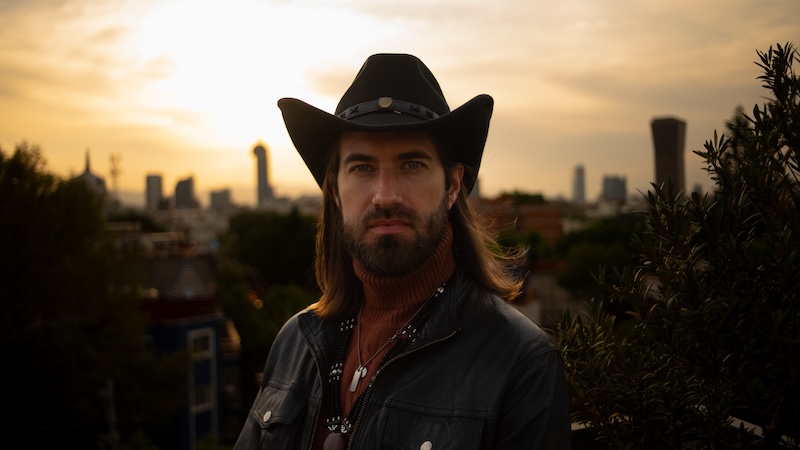
Photo by Santiago Gomez
Johnny Delaware isn’t unconventional, but the way he’s releasing his third album, On God’s Time feels almost radical in 2026, radical and refreshing in a world consumed by devices and instant availability. The co-founder of Susto – with the support and encouragement of his record label, New West – is releasing the album on vinyl and CD (purchase here) with streaming coming later this year, maybe. There’s no hurry, no big algorithmic push, no race to land on playlists, no sense that the album has to get a strong push on Instagram and TikTok in the first 48 hours of release. Instead, Delaware’s been taking the songs directly to the people, playing them live at house shows where he has a chance to talk about them, selling the record face-to-face and letting the connection happen the old-fashioned way. It doesn’t seem like such a radical idea, but it’s not the way most artists do things these days.
This approach fits the album. On God’s Time is a record about patience, intention, morality and what we do with the time we’re given. It asks big questions without getting buried under the weight of them. Why are we chasing what we’re chasing? What does it mean to make something that matters? And if the point isn’t fortune and fame, then maybe the point is simply reaching people while we’re here. No regrets. No missed opportunities.
If there’s someone who can make this approach work, it’s Delaware. Not long into our first conversation a few years ago, I felt like I had known him forever. He didn’t come across like a star on the other end of an interview; he felt more like a friend. When I finally met him in person while he was touring with Susto, it felt less like a first meeting and more like a family reunion. That warmth, that openness, that easy generosity is infectious. Delaware has a way of leaving people better than he found them, which feels like the whole point of taking these songs directly to listeners one room, one conversation, one record at a time.
In our conversation, Delaware talked about releasing music outside the normal streaming cycle, the importance of house shows and real connection, the South Dakota landscapes that shaped the sound of the album, and why boredom, running, and unplugging from your phone might be more important than we want to admit.
You’re releasing the album on vinyl first, and streaming will come later this year. What’s the idea behind this?
JOHNNY: I think it’s just fun to try anything new. I believe that conventional ideas bring conventional results. I have nostalgia for, back in the day, praying for a song to come on the radio to hear it, or having to go to the store to buy it. I see a lot of artists complaining about Spotify and DSPs and the money we’re making – or not making – off of downloads or just memberships from those companies. It’s like, “Let’s all put our thinking caps on and figure something out.” I’m not Taylor Swift or the Foo Fighters, so I have no pull, but I want to act on morality and my own beliefs, and if I can do that with a label, that’s really cool.
I have the vinyl with me and the CDs, and I’m doing this promo tour telling people, “Hey, this won’t be out for a long time yet. We don’t even know when it’s going to come out. The new album of mine is called On God’s Time. I think it’s kind of a clever way of promoting it, because we have a date for it and we’re kind of living up to that ethos, and it’s been going great. People, after playing these songs for the live, buy the record because they’re curious about it, because they know they won’t probably hear it on streaming platforms for a while.
New West is sort of giving you time to work this record, there’s no expectations tomorrow or a month after it comes out — you and the label are considering this like a project, like there’s no time limit to it. Right?
JOHNNY: Yeah, we just don’t know when it’ll come out, because I have four European dates coming up over the next like 14 months. The first one’s going to be in September, and then I have 3 next year that I’m going to hopefully be playing, 2 of them full band, and 1 solo. 3 full band, 2 solo, sorry, it’s confusing. But there are a lot of European dates, let’s put it that way. We’ve been kind of checking it out, and we’re like, “We don’t have any rush, and this is cool that we can maybe try to promote this in a more analog way.” I was all for it. It was kind of their idea, and I went with it, and I’m grateful for them for pitching that, because there is no rush, and it goes great with the album title.
There are other artists taking this approach. Futurebirds and Aaron Lee Tasjan have both put out physical stuff before streaming. You’re putting the work into it, not hoping that an algorithm will help get you in front of people. I appreciate that you’re doing things the old school way and playing music in front of people and then selling them the music so they can continue to enjoy it and feel a real ownership.
JOHNNY: I like to say it’s what a real artist does. I don’t think it’s realistic, and I believe in quantum leaps, and I’m not opposed to a small percentage actually happening in your life, but I’m not in my 20s, and I’m not a pop product, so the chances of me actually taking off on a TikTok single are very low, and I realize that. It comes down to my intention and why I do this in the first place — just like you, Chip, what’s your intention for doing this interview? There’s always an intention behind everything we do. I’m going to die someday. A lot of this record is about death, and I want to have connection. I know I have to make a living at music, but what’s the intention of doing all this other than going and playing songs? I have a great time playing music, but it’s about connection. That’s why I love these private events, because I’m hanging out with people, having a great time in the process. There’s no green room, so we’re all just drinking beer, hanging out together. The whole green room is the party in the house, all of us hanging out. I think it’s great that people get to have that relationship with artists that they like to listen to.
I remember talking with David Ramirez. He was on tour months before his album came out. I asked if that was odd for him and he said he is, first and foremost, a live performer. Having albums to sell is great, but he doesn’t need a new album to go out on the road.
JOHNNY: I’ve kind of been going through that with this tour, because the songs aren’t out, obviously. It’s kind of cool, because the response has been great, people love to hear the songs live just on acoustic guitar, so they’re like, “Now I have to get the record.” I can’t speak for everyone, maybe some people would be bored with that. People don’t have attention spans anymore for an acoustic guitar and a singer, but I’ve been really working hard to make it as entertaining as possible, and it’s been going awesome.
Johnny, you’re aware that I lost my daughter at the age of 17. For months, I couldn’t listen to music. When I finally did, I eased into it by listening to an artist I didn’t know, didn’t have any connection with, Israel Nash. And I had the chance to talk to him and tell him about my tragedy and how his music meant a lot to me because it was the first thing I really listened to as I worked my way through the fog. He said that’s why he does what he does. It feels to me like you’re saying the same thing. It’s not about fortune and fame; it’s about reaching listeners and making an impression on them.
JOHNNY: Why do people want fame and fortune? It’s a good question to ask yourself. I reflect on that all the time. What am I chasing? What am I going for? Because I don’t want to be famous. I think that’d be horrible. To get back to what you’re saying, if it’s not about being famous, then it has to be about connection, and just getting your songs out to people, because they mean something to you when you make them, right? There’s this instinct where you’re like, “I think it might mean this much to someone else then too.”
And that sounds like the theme of the record. There’s an end date to everyone’s life. We can’t avoid that. So, take advantage of what you’ve got knowing that you might not get a tomorrow.
JOHNNY: I think there’s a common thread that runs through the songs. Some songs don’t carry the weight of existentialism like the other ones, some are just fun songs, but the majority of them are asking questions. What is the purpose to this, and if I am going to die someday, which I know I’m inevitably going to have to do, what do I have to do to not regret anything while I’m dying? In Hinduistic tradition, the whole thing is to not have attachment, and while you’re dying, just to kind of chant “Ram Ram Ram,” which means God, and to not have an attachment while you’re dying, so you don’t have to reincarnate again. I like to kind of cherry-pick my favorite things from all the religions and incorporate them into my own life. So that’s one of them, where I’m like, I really feel that’s true. I don’t wanna die thinking, “Oh shit, I didn’t get to do this,” or having any form of wanting to come back — which if I do reincarnate, great, I love being here. And I don’t think time is linear. Like if I did reincarnate, maybe I’d come back in the 1200s, it doesn’t have to be into the future. But yeah, they’re existential songs.
Did these songs exist somewhere, like a drawer in your head, or drafts on a hard drive, or voice notes on your phone, or did you write them specifically for this album cycle?
JOHNNY: It started with the sound. It always starts with the colors and the sound of what I want the record to feel like. And this record, particularly, I’ve had in my back pocket this feeling and this sound for probably 12 years. I love all those old T-Bone Burnett style produced records, and the Crazy Heart soundtrack stuff. Even some of the Jakob Dylan stuff he did with T-Bone Burnett was really cool back in the day. I like that smoky kind of desert southwest sound, but I wanted to incorporate South Dakota into it somehow as well, because I come from the section lines of cornfields and dirt roads of South Dakota. I was like, “How can I bring this form of my past into a production style that I really enjoy?” That was the goal, and what I really wanted to do for this record.
You nailed it. That was the picture I had in my head as I listened to the album. This doesn’t happen with everything I listen to, but there are some songs or albums that I can picture an entire scene/narrative in my head. On God’s Time is one of those albums. Listening to “Entertaining Prophecy,” I daydreamed a scene out of a ‘70s movie like Smokey and the Bandit. The song doesn’t necessarily make me think of the movie, but it makes me think of the ‘70s and truck drivers and roadside bars where there’s a band on stage providing background music rather than being a dedicated concert.
JOHNNY: That’s kind of how I saw it too. I wrote that one kind of subliminally for my father, because after his retirement he just kind of gave up, it felt like, and I think people, when they lose their jobs, they kind of lose their identities. I don’t think people realize how big of a weight it holds, like holding a job for 40 years. It was my idea to have him retire, and then when he retired, things fell apart, and I felt kind of bad pushing him to retire. I felt like I owed him something, but obviously I’m not his babysitter either. He should still have an identity beyond a job. I wrote that one for him, because I saw him kind of give up. That was the one where I was just like, “This is what I wanted to see him do. This is what I wanted him to be.”
I work a corporate day job and have known people who have retired. They all seem to be anxious to get to that retirement date, but when you ask them what they’re looking forward to, they don’t really have plans, and some have seemed even scared about the unknown of a post-job life.
JOHNNY: It’s very important to still carry on and have things to do. You can’t just sip on margaritas all day. I know people like that, in the small Mexican town that I live in, with my wife on the coast of Mexico. I am surrounded by retired people who are just drinking all day, and I look at them and I study them, and I’m like, “Man, you are miserable,” because you need to always have a passion, you need something to keep interested in.
I didn’t realize you had released “Regret Town” as a single. I always listen to albums and try to pick out the songs that I love but that aren’t going to be singles. I think of those as the “hidden in plain sight” songs that people may miss if they are only listening to the songs that have been released as single, and “Regret Town” was one of those songs for me. Are there any songs like that for you, songs that people might not “get” on the first listen but that are songs you really hope people invest time in?
JOHNNY: I think “Sue Lee of Big Sky” is a different song. A lot of songwriters are singing a poetic book that has a lot of lyrics, but it’s a different kind of style for me. It’s really fun, it’s quick, sharp cadences. That was the one where I was like, “I really care about this song, it’s different. It might not be the smartest thing to put up front, but I don’t care, because this is more about the feeling of the record anyway.” So I put that one first.
It definitely sets the tone for the rest of the album.
JOHNNY: I hope all the songs tie together. I had to cut a few that I didn’t think made sense with the feeling we were going for. But then “Heaven’s Town,” I think, was cool too, because a lot of my friends really liked that one the most, and that’s second. And then “Less Fear, More Soul” is third, and a lot of people are gravitating towards that, but that’s going to be the next single. And then “Big Pants” is going to come out. Actually, I think “New Orleans” might be the sleeper, to be honest. A lot of people are talking about that, and that isn’t going to be a single. It’s just tough, I like all of them.
I love that you’re so proud of all the songs. I remember in the ‘90s where artists wanted to fill up the entirety of a CD so there would be 74 minutes worth of music. That led to a few throwaway songs.
JOHNNY: I don’t ever want to put a song out that might be a throwaway. I think back in the 90s, that made sense. Even that great Alanis Morissette record had, like, 8 hits or something on it, it was so good, but there’s some throwaway on it for sure.
I don’t think you sound anything like Jimmy Buffett, but I think about what it is that people like about him, and I think about sort of a breezy, light-hearted spirit, where people all congregate to forget about their worries and take part in a communal ceremony. Your music has that power. You’re everyone’s friend and treat your listeners that way. You’re not making music for kids who are into playlists. You’re making music for more mature listeners, people looking to reclaim that youth but not ashamed of their age. I can imagine you being this generation’s Jimmy Buffett, maybe without the cheeseburgers. If you were to answer the question, “I feel like this generation’s – insert name of artist,” do any musicians come to mind?
JOHNNY: Yeah, yeah, yeah. I feel like a Neil Diamond/Bob Seger kind of mixture. That’s kind of a good baby to have. I just love old songwriters, and I value good songwriting. I think the best songwriters were in that era. I’m not knocking modern-day songwriters, there are great songwriters now but there was just a feeling in that production, and the things that they sang, and the care that they put into the poetry. I try to hold my standard up to that kind of those songs, at least combined.
You talked about this earlier. Are the songs you asking yourself questions, questions to the universe, or do you want listeners to take away some sort of message that you’re delivering?
JOHNNY: It’s always gonna be up to people. The revelations and the things and all the answers and the keys that we hold, they’re all inside of us. These songs are a handbook to survival or something, maybe, possibly, just to help you find those keys. The songs don’t have the power. Everyone has to do that themselves, and it’s very hard in this era of technocracy because we’re all so distracted.
It’s hard to make people do those things even more so today. I was kind of thinking to myself, “I like to go running,” I just got done running, I was without the phone for an hour, and I was just thinking, “These people are probably trying to get ahold of me. And it feels so good to not be on the phone,” but yet we’re so tied to these things. But, to get back on topic, I think it was me trying to figure some things out, but also through books, through the best writers, like Rilke, everyone’s trying to figure it out when they’re writing down something, and then that translates to the readers and the listeners.
Are you telling me that when you run, you don’t even have earbuds in and listen to music or podcasts?
JOHNNY: Right. Nothing. I’ve always run. I was a state champion runner. I just never wanted to have anything, because running competitively, you don’t get to run with earbuds. So I would never train with earbuds, because I knew mentally the music would help me. I knew that strength to power through had to come from within myself, because I couldn’t run around the track at the state meet with earbuds in.
I usually listen to podcasts when I run. I usually pick 30 – 60-minute episodes and then try to run until the episode is over. I don’t like running so it distracts me and let’s me focus on something else.
JOHNNY: Podcasts are a great idea. I think anything to just get you out there running and taking care of yourself is great. And honestly, it’s not a vanity project why I run, I do it for my mind. I’m just such a happier person when I exercise, and I treat people better. When I am on the road and I haven’t exercised for 2 weeks, I’m a monster, dude, I just need to move my blood. But also, in society right now, it’s so hard to just stare at the wall anymore. Have you noticed that? I’m just trying to get back to this place where I can stare at the wall without feeling bad.
I think boredom is so important. I was reading the other day how a lot of us lack maybe 20 or 30% less empathy for other people, just because we don’t have that freedom to think about other people, because we’re always distracted, getting stuff shoved in front of our face. So, yeah, I’m trying to be bored lately. Let’s put it that way.
I’m the worst. Always scrolling on my phone. In the elevator? Scrolling. Walking to my car? Scrolling. I’m addicted. I don’t know how to put my phone in my pocket and unplug.
JOHNNY: We all are addicted. I’m not trying to ride my high horse here, Chip, I’m addicted too. It’s such a part of society, but it is interesting to go without it and evaluate your thoughts. While you don’t have it, you’re like, “I’m feeling a little uneasy about something over here.” Your brain acts really strange, and it’s interesting to observe. But, by the way, I gotta get on my phone in the elevator too, it’s so awkward, everyone just kind of looking at each other. I sometimes get on my phone, I don’t even have it on, sometimes I’m just looking at it so I don’t have to look at everyone in the elevator.
I imagine playing house shows, you’re not playing to audiences who are on their phones for your whole performance. I’m betting you have their full attention.
JOHNNY: Big time. Everyone’s listening, everyone’s laughing, everyone’s cracking jokes, it’s just fun. I’m not your typical songwriter. I like to converse a lot in between songs and have a good time, and everyone else feels open to crack a joke with me, and then everyone’s talking, and then I get to the next song, and everyone gets quiet again. It’s just a cool hangout. I don’t know how it goes for other artists, but for my house shows, they fucking rock.
You mentioned the dates in Europe. Any other touring plans?
JOHNNY: Yes, I have some stuff kind of building right now in November, but September is going to be in Scandinavia, full band. I’m basically taking all of Susto out except Justin, because he’s having a baby. Luckily, I’ve got those guys to back me up, which is going to be awesome, because we have chemistry already. That makes it easy on me too, because I’ve had nightmares where I book a tour and go out and play with people I’ve never played with, it can be something, let me tell you that much. But then in November, I think I’m going to probably be doing some Susto dates, probably opening a couple shows.
Before we wrap up, wondering what’s going on with Starboro, the band you’re in with Daniel Womack of Futurebirds. You’ve put out a few songs, will there be dates?
JOHNNY: We’re going to be touring a few more dates in August, and while we have a week off in between gigs, we’re going to record one or two more songs. We were thinking that we’d release something in September, but the full-length Futurebirds record comes out on streaming platforms in September, so there’s a conflict. We’re probably going to do late fall for Starboro, maybe October. Then maybe my record comes out on streaming in November or December.
I love all the connections you have with the Futurebirds.
JOHNNY: Those guys were champions of my old band, The Artisanals. They took us out on the road on our first tour. The Futurebirds were good to me from the beginning, and then they took out Susto on our first tour too. The Futurebirds have always been very generous to any band I’ve been a part of. They’re great guys, and I love the new stuff they’re putting out, I think it’s awesome, and I’m happy for them. They seem to just keep growing as a band, which is awesome. After 20 years of being a band, sometimes it goes the opposite direction, so I’m proud of them.
Are you always writing? Have you thought about what’s next?
JOHNNY: My next record is going to be called Heartlander, which is a concept record about South Dakota and my upbringing. They’re all kind of the same style as On God’s Time, but more rock and roll, John Cougar Mellencamp kind of shit. I sometimes wonder about that — I think I go into the future a little bit, and I’m like, man, what if I start to suck someday? I never want to suck. So I guess I just gotta seldomly keep deep diving into the shrooms so I don’t get lazy. Or whatever.
************
For all things Johnny Delaware (tour dates, purchasing On God’s Time, etc), visit johnnydelaware.com.