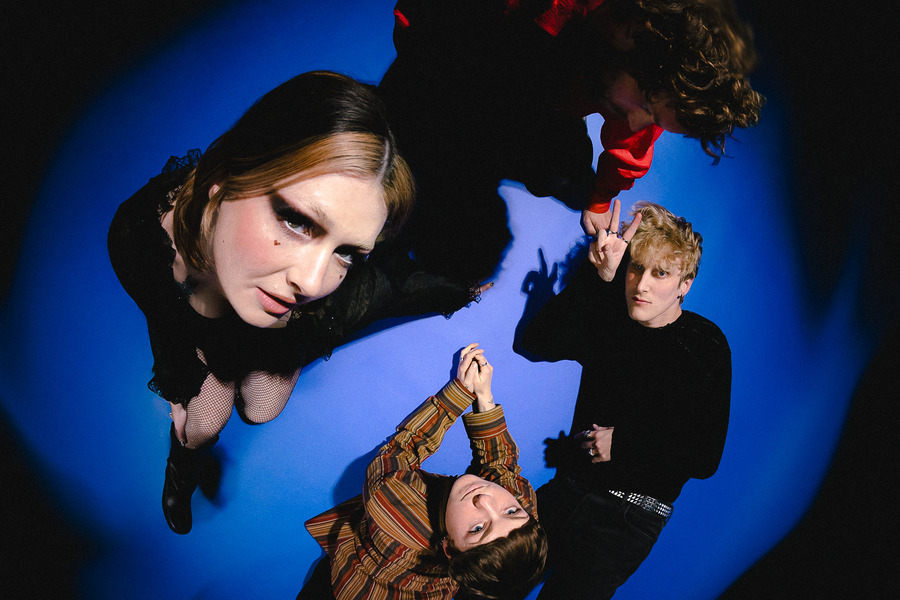
Photo by Mikayla Hubert
Yumi Zouma’s sound has evolved over the past decade, incorporating fresh and exciting influences along the way. While their early work leaned toward the poppier side of indie synth pop, attentive listeners might have sensed a guitar-rock band simmering just beneath the surface. In 2017, the band contributed to Turntable Kitchen’s Sound Delicious vinyl subscription series with their take on Oasis’s (What’s the Story) Morning Glory?, showcasing their knack for blending keys, synths, and electronic drums while hinting at their love for ’90s Brit rock.
That instinct comes fully into focus beginning with 2023’s EP IV, which pushed Josh Burgess and Charlie Ryder’s guitars to the forefront. Their interlocking parts now sit in dynamic conversation with Christie Simpson’s luminous vocals, while Olivia Campion’s shift from tightly programmed rhythms to a more organic, human-feeling drum performance subtly reshapes the band’s foundation. The momentum carries through to their new release, No Love Lost to Kindness, where Burgess and Ryder carve out tones that feel expansive without losing clarity. From the shimmering opening of “Cross My Heart and Hope to Die” to the hauntingly sparse closer “Waiting for the Cards to Fall,” this new direction is worth exploring for longtime fans and newcomers alike, especially those looking to add to playlists featuring Wolf Alice, NewDad, and Nation of Language.
Formed in New Zealand but now operating across time zones, Yumi Zouma has become a truly global band: Simpson is based in Melbourne, Ryder in London, Burgess in New York, and Campion in Wellington. Ryder and Burgess joined me from their respective adopted home cities to discuss the new record, the band’s evolution, and what comes next. Ryder signed on first, already in the thick of pre-tour preparations, and began by detailing the behind-the-scenes work that goes into bringing this show to stages around the world.
CHARLIE: We’re in the middle of designing and ordering the backdrop for our tour. As part of our album artwork, on the inside and the back, we’ve got these designs of roses with all the petals falling off them, so we’re going to get a massive rose printed on a backdrop. It then lights up in different colors according to the single artworks and things like that. It’s a big operation, but hopefully it’ll get done in time for the start of the tour in a few weeks.
Is that the first time you’ve done a backdrop?
CHARLIE: No, we’ve done a few in the past. Usually it’s just Yumi Zouma in lights or something like that, but this one’s going to be more of a curtain than a light, so it should be good.
JOSH: Sometimes you reverse-engineer something like that. For the European tour it was very much looking at all the venue specs, running all the stage specs. You can kind of get carried away with what your wildest dreams might be, but there are so many practical limitations. It is one of the things that keeps touring interesting: on top of showcasing the music, you try to create a vibe. We’ve done it a few times over the years, with different lights, like a big lit-up neon light.
You’ve been touring since 2014, is dealing with venue logistics something you learned along the way, or did you somehow arrive prepared?
JOSH: Growing up in New Zealand, there was a great thing called A Low Hum, which would bring local bands all around New Zealand, a 12-to-15 day tour. In a small place like New Zealand, that’s actually quite a feat. They would come to my town of 70,000 people, and these were all underground New Zealand acts. The bands that created a vibe, whether through theatrical elements or intentional parts of the performance, really stuck with me. A band that both me and Charlie really connected with when we were first seeing bands was a band called So So Modern. They dressed in a certain way and did things with intentional parts of the performance. I think we always carried a bit of that.
Our first shows were with Shit Faker, who is an Australian artist, and I think our second show was around 6,000 people. We got thrown into the deep end. We’ve played everything from arenas with Lorde to a Kansas City dive bar. There’s only so much you can control in the infrastructure, but the intentionality is important. Even if there are nights where the backdrop can’t be hung or there are different light considerations, just having some intentionality gives you a push in the direction of creating a performance. We always make sure we’re running playlists we’ve made, even DJing before some shows, just to make sure that when someone comes in, it’s Yumi Zouma World for four hours.
CHARLIE: It’s a combination of trial and error. We’ve gone through a lot of different backdrops and things that were too heavy. We’d carried our own lights for a while, but eventually you couldn’t fly with those things anymore, so we’ve had to chop and change. You also get inspired by the other bands you tour with and see, you can try and steal their ideas.
Have you had any Spinal Tap moments: a mis-sized backdrop, something going wrong at the last minute?
JOSH: I had a big LED light curtain for a while, and it required a computer modem. Our modem broke before a London show, and when you’re younger these things are so much more dramatic and feel so life or death. I remember pleading with a venue manager to please let me use the venue’s Wi-Fi router, thus cutting off everyone else. Luckily, they found a second one. Nothing quite as visceral as a miniature Stonehenge, but who knows, maybe this backdrop, maybe we haven’t specified feet versus inches anywhere.
If you had to write a mission statement for the band, could you?
CHARLIE: I don’t think we’ve ever designed one, but maybe we need to do a team day away, Josh, a company retreat to determine our values.
JOSH: I think being New Zealanders, despite us being expats who live abroad, we still have that New Zealand-ness of sometimes not thinking about certain things and letting them run their course. This can manifest in good ways and also in bad, avoidant ways. In some ways, avoiding directly asking “what is the mission statement?” has allowed us to be flexible. We’ve done things that, if you sat down and looked at a plan, would not be recommended: only touring when we want to, on our terms, for instance. The last EP we made in Japan. We just went to Japan, rented a studio, and wanted to have that experience. Had we had a strict mission statement, we’d have been reminded to stay focused on building the US touring, but we did this instead. So the mission statement is: no mission statement.
Looking at the arc of the band, and this record in particular feels like a transformation, how much have you changed, where you almost don’t recognize yourselves from a few years ago?
JOSH: In some ways Yumi Zouma moves slowly because of our remote setup. Change either happens really quickly or really incrementally. There was definitely a period where we were focused on being a kind of Balearic electronic/indie guitar band, representative of a lot of the music we were listening to and a lot of the places we were traveling. I can see eras of the band, and even appearance-wise our press shots are often 18 months apart, so if you’ve grown your hair, it’s a stark contrast. But nothing too dramatic, like “that was the industrial phase, now we’re in the 70s psych phase.”
CHARLIE: There has been a slow build from the very beginning toward becoming more of a rock band. When Josh was describing the beginning, we were very much an electronic project: synth-pop, bedroom pop. Then as we started touring, and getting a live drummer for the first time in 2017 or 2018, and adding distortion on the guitars, we slowly started becoming more of a normal rock band. The last EP had some songs that were a little noisier, but this is probably the first album where, if you’d only listened to our first album and then this one with none of the singles and EPs in between, you might think it was a crazy change. But if you listen to every release in chronological order, it makes much more sense.
Josh, you mentioned recording in Japan just because you wanted to have that experience. Is that the same reason you recorded in Mexico City?
JOSH: Definitely this idea of taking ourselves somewhere that’s not our normal place of residence, and doing that with four people, is always a fun, creative thing. When we were in Mexico City, we went to see wrestling, went to some really great restaurants, walked around, and doing that as a group, where the only objectives are to go into the studio and mess around and try to get some fodder, has become something where at least one of those trips in the cycle of a record really helps the creative process.
CHARLIE: There are also logistical things. For Mexico City, that came in between a North American tour. We’d just played in Mexico City, and there was time off between legs to get in the studio and get the album working. It seemed like a very good excuse to spend time in a city we hadn’t spent much time in as a band. It was our first show in Mexico City, so it was a very special experience. This album will always have that relationship to that city, which I think is very cool.
JOSH: People also have fewer distractions. You don’t have your other social obligations. And in a pragmatic sense, New York and London are expensive places. Me and Charlie work mostly out of home, so when we want to do stuff together, we have to rent a studio. Sometimes the economics work in a more favorable way in other parts of the world.
Is there such a thing as downtime in the band? Can you go weeks or months without being in touch with each other?
JOSH: Honestly, I don’t think there’s even that much downtime. This is our fifth record, we’ve done four EPs, there’s always a project happening. There’ll always be a text thread of things that are Yumi Zouma-related. I can’t picture a time where the band was switched off, out of office for six months with literally nothing going on.
CHARLIE: There was even a time when we were working on one record while having nearly finished the next one. We’ve always been a band that likes to keep very busy and release as much as we can. Maybe because we’ve never had the benefit of a moment of huge success or virality, we’ve always gotten out of the band what we’ve put in. Every release meant a few more monthly listeners on Spotify, or the opportunity to expand the team, or work with a new record label, or get a new booking agent. The incentive was always there to be as active as we can.
You released six singles before the album. Is that a band decision, a management decision, a label decision? What’s the thinking?
CHARLIE: It’s a bit of both. Being all spread out, it’s a little difficult for us to do things that normal bands would do: always being active on social media, touring all the time, posting a lot. Spreading out our releases throughout the year means there are no big periods of dead air when nothing’s happening. Previously we’d been on labels that were more like, let’s release three or four singles max for an album. But with streaming, there are considerations that make releasing more of it more worthwhile. There are also platforms that only let you release more than half the songs as singles anyway, so you’re partly restricted by that.
JOSH: We’re hoping people will discover us and then come listen to our catalog, as opposed to just the one song they came across. If you have six different points where you’re saying “here are some songs from this body of work,” you might get someone thinking, “I connect with that song,” and then clicking on the profile where there’s a whole life’s work. There might just be different entry points for different people. Even within the singles we’ve done, something like “Blister” sounds very different to “95.” If you liked “95,” you could go through our recent catalogue and find things that sit on similar touchpoints. It’s more of a label-led thing, and we’ve been really lucky with streaming in our career, a combination of good timing and engaging with the platforms as they first launched. Our job is to make the music and make the world around it, and sometimes relinquishing some control where a label says “if we do six singles, more people are going to hear these songs” is a nice feeling.
A lot of records lately feel like glorified EPs: 9 songs, 32 minutes. This record is 12 songs, 44 minutes. Was there a deliberate intention to make something fuller?
CHARLIE: The album length is sort of dictated to us by the songs. The tendency now is that streaming platforms incentivize you to split up your releases to meet the minimum album requirement, seven songs, as much and as often as possible. But we got into the studio, wrote a whole bunch, and started whittling down to the songs we thought were album-worthy. That number just ended up being 12, a cohesive group of songs we all thought were strong. We could have added more or reduced it, but these songs presented themselves in a cohesive way where nothing was really asking to be cut or added. The B-sides we’ve used for things like Japanese special edition records were very clearly a different group of songs, so it was an easy demarcation.
JOSH: A lot of this record has been an exercise in letting go a bit instead of agonizing over whether it should be 12 songs or 10, we naturally came to 12. Because we produce all our records ourselves, to get something ready for mix takes a real commitment. You have to say, “this thing is done, this is how it all sounds, now we can give it to our mix engineer.” It just felt natural. All 12 hit the finish line within six weeks, despite the whole record taking maybe 12 months to write, record, and produce.
I read that the guitar sound on this record draws from a lot of 90s and early 2000s influences. Are those bands you’ve been listening to your whole life, or are you still discovering new inspiration?
CHARLIE: For this album, we probably came back to a lot of bands we’d listened to in our childhood and then moved away from for many years. When we first started Yumi Zouma, we had a much more refined palette, a very crystalline, shiny set of influences that were all drawing from that dreamier world Josh was talking about earlier. But naturally, as the years have gone by, we’ve become more of a rock band. The beauty of Yumi Zouma is that, with the lack of a mission statement, it’s allowed us to move in different ways. I never really feel like we’re constricted by a certain genre. When we were all in the studio together, we were all feeling the same vibes, intrigued to explore a sound that was a little bit heavier. It still sounds like us, but there’s a little more distortion on the guitars.
Does it ever surprise you that a band from New Zealand can reach someone like me in Ohio? Or did you grow up in a world where that geographic distance just didn’t matter?
JOSH: We started coming up as teenagers in the late 2000s, so that dream was really starting to be implemented. MySpace was the earliest iteration I can remember, being able to hear music from around the world with a lower barrier to entry. I appreciate how that was a factor. But it took a few years for New Zealand to catch up. The big bands that would come to New Zealand would be the Foo Fighters or something. Indie bands weren’t coming to New Zealand in the same capacity that Yumi Zouma turns up in Ohio, if that makes sense.
When I listen, specific references really pull me in: “Chicago 2AM,” driving down the 95, dropping Travis Kelce’s name. Are those drawn from real situations, or are they literary devices to give the listener something to hold onto?
JOSH: “Chicago 2AM,” that comes from Chicago 2AM. We were there. We have experienced Chicago 2AM. The 95 in particular, I live in New York, it’s quite an infamous stretch of highway, that feels more like a lyrical device, more metaphorical. But it really is a combination. We try not to write in just one style of voice. It’s song by song; things sort of manifest themselves.
CHARLIE: The Travis Kelce reference was because we were literally talking to Josh’s partner, Phoebe, about watching the Super Bowl at the time we were writing. That’s why we dropped it in there. And “Chicago 2AM” is literally about singer Christie meeting her current partner in Chicago at 2AM. We’ve also done it in the past where we’ve dropped names of friends just to add character-building, world-building connections, like our friend Abbey Vares in a song called “Persephone” in 2017. It’s definitely something we’ve done both ways.
I always end with this one: is there a song, album, or artist that, when you hear it, closes your eyes and transports you back to a specific moment in your life?
JOSH: I was DJing recently and played this song really late at a club, maybe 3 AM, quite slowed down. It’s a song that always takes me back to 2008, Germany, on tour with mine and Charlie’s first band that well predates Yumi Zouma. It’s “A Little Bit” by Lykke Li, she was a Swedish artist, and that record was produced by the Peter, Bjorn and John folks, who were very hot off that Swedish sound at the time. That song always transports me back to that period of my life. It’s got such an iconic intro.
CHARLIE: There were so many ideas going through my head. One was listening to the songs my parents would play when I was really young. Around dinner time in the living room, they’d put on the soundtracks to Phantom of the Opera, Evita, Les Misérables. Those are indelibly switched into my mind. There’s also stuff like when my dad used to listen to Meat Loaf or Bruce Springsteen.
Then similarly to what Josh was talking about, when I was 16 or 17, the songs I was discovering on blogs and listening to on my second-generation iPhone are important to me, things like “Let’s Make Love and Listen to Death From Above” by CSS, or the album Meteora by Linkin Park on my MiniDisc player when I was 13 or 14.
We also had this thing back in New Zealand, our MTV equivalent called C4. They had a show called Intellectual Property where they’d play all the up-and-coming new releases happening in Europe and the States. The first time I ever heard “Last Nite” by The Strokes was on that, and also “Can’t Stand Me Now” by The Libertines. I can very vividly remember watching those and thinking, “this is very cool.” I also think it was a VMAs where they got both The Vines and The Hives to play back-to-back in one segment. Craig Nicholls from The Vines smashed his guitar halfway through the set, and I thought that was very rock and roll.
****************************
U.K. AND EU TOUR DATES 2026
March 4 – Trabendo – Paris, France
March 6 – Yuca Club – Cologne, Germany
March 9 – Vega – Musikkens Hus, Little Vega – Copenhagen, Denmark
March 10 – John Dee – Oslo, Norway
March 11 – Debaser Hornstulls Strand – Stockholm, Sweden
March 13 – Headcrash – Hamburg, Germany
March 14 – Badehaus Berlin – Berlin, Germany
March 15 – Klub Hydrozagadka – Warsaw, Poland
March 17 – Flucc Wanne – Vienna, Austria
March 22 – Yes – Manchester, U.K.
March 23 – G2, The Garage – Glasgow, U.K.
March 25 – Isilington Assembly Hall – London, U.K.
March 27 – The Workmans Club – Dublin, Ireland
NORTH AMERICAN DATES 2026
Apr 30 – Black Cat – Washington, DC
May 1 – First Unitarian – Philadelphia, PA
May 2 – Warsaw – NYC, NY
May 4 – Sinclair – Boston, MA
May 6 – Lee’s Palace – Toronto, ON
May 8 – Outset – Chicago, IL
May 12 – The Pearl – Vancouver, BC
May 13 – Neumos – Seattle, WA
May 14 – Aladdin –– Portland, OR
May 16 – The Independent – San Francisco, CA
May 19 – Pacific Electric – Los Angeles, CA
May 20 – Belly Up – San Diego, CA