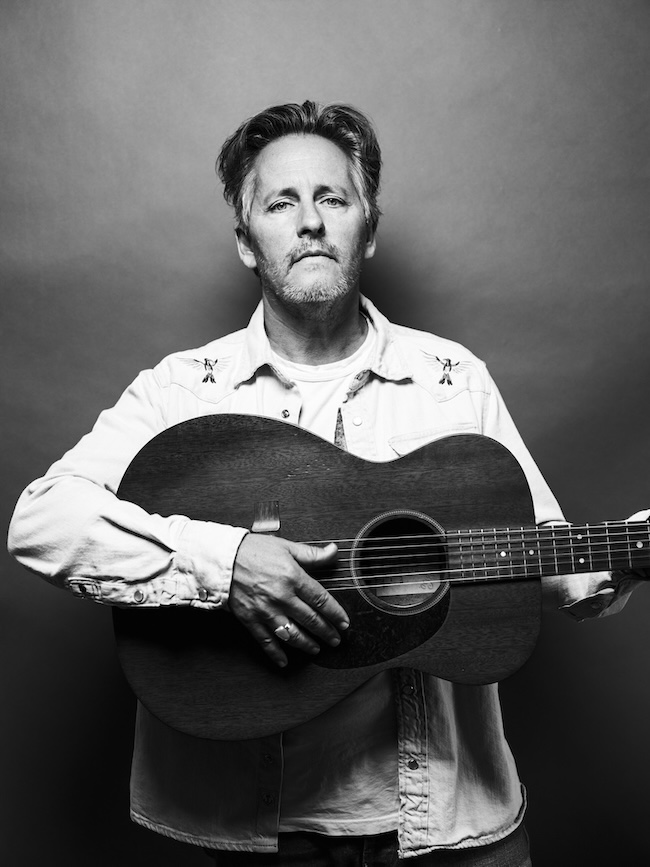
Photo by Joshua Black Wilkins
There’s an effortless lightness to Josh Rouse’s songwriting. Steeped in the folk-pop of ’70s AM gold, his songs feel untethered from any particular moment, more interested in a good melody than in whatever’s on the radio this month. That foundation has guided his career for nearly three decades, starting with 1998’s Dressed Up Like Nebraska, though there have been detours along the way. After moving to Spain, Rouse dabbled in bossa nova, jazz, and Latin rhythms on 2010’s El Turista, and he made a convincing turn toward ’80s synth-pop on 2018’s Love in the Modern Age.
On Museums and Women, named for a John Updike story collection, Rouse returns to familiar ground: songs populated by characters, small observations, and the passing strangers who drift in and out of our lives.
By Rouse’s telling, the album came together without a master plan. He and producer Brad Jones began recording songs in loose, live-in-the-studio sessions, and only after a body of work had piled up did it start to feel like a record, at which point the project took on more focus.
Fourteen albums in, by his label’s count, Rouse’s approach to songwriting hasn’t changed much but the business around it has. Today’s musicians are also expected to be content creators. Case in point: Rouse recently posted an Instagram video where he unboxed Museums and Women, pulling the record out and seeing it for the first time on camera. We started our conversation there.
I saw on Instagram—and I know some of this is social media content you’re probably obliged to deliver—the unboxing of the new album and it made me wonder: back in the Rykodisc days, did they send you a box of CDs to unbox?
JOSH: No. I definitely would sign stuff, but there just wasn’t any social media. I would get advance copies. I’d see the CD before it came out, for sure. None of those Rykodisc records were on vinyl back when they were released. Ten years ago, I think, they did 1972 and Nashville. They’ve done Dressed Up Like Nebraska, and then they’re going to do the other records starting next year.
Did you ever have any sort of release-day rituals? Did you go out to the stores and see it and pick it up and be like, “Hey, this is my new CD”?
JOSH: Oh, yeah, for sure. Especially with my first couple of records, or just running into it somewhere. When you first come out, you end up doing a lot of in-store performances, which a lot more people attended back in the day.
I was definitely going to record stores. I was talking with a friend about it: I would buy records based on the cover. I don’t know about you, but I’d buy them without ever hearing the music. Before listening stations started happening—early to mid ’90s, I guess—if a cover looked cool, I would buy it. Or I’d like the band name. There was some kind of taste thing going on, my high school taste or whatever, and I would buy it. Or I’d learn about music from reading magazines.
But when my records would come out, it was always fun to go to the store. When Dressed Up Like Nebraska came out, I went to Tower Records and saw it there. Then, I think it was my second record—I don’t know if Tower had closed by then—it was 2000, I think, about the time I met you. I think there were still some Towers around, but I remember Grimey’s, which is a big indie record store now in Nashville, it was a small little house then. He had just opened up, so he had my stuff on CD. That was our hang.
We’re about the same age. We didn’t have the history of recorded music in the palm of our hands. Often, I’d buy an album, like you said, based solely on the cover. If I was lucky, maybe I had seen a video on MTV and that was enough for me to buy the CD. It was a risk. What if there was only one good song on the album. I would always just hope that the CD was good since I spent money on it.
JOSH: Back then you were forced to listen to all the songs. Not forced, but… A lot of times, those songs that weren’t that immediate ended up being your favorites. The deeper cuts ended up being the favorite cuts.
I don’t think you and I grew up listening to the same stuff. I loved ’80s hair metal.
JOSH: Oh, I like that. I grew up in a small town. My high school years, I spent in Clarksville, Tennessee, just outside of Nashville. Talk about a metal place. All my friends who played guitar were into that. Glam metal was coming out of LA, like Bang Tango, Faster Pussycat, and all those. I love those. Those records are good. I go back and listen to them sometimes.
What I discovered about those albums, going back and listening to them 35 years later, is that they often filled all 74 minutes of a CD. Back in the day, I was thinking it was cool to get 12, 13, 14 song albums, but this many years later, it’s often obvious to pick out the filler songs that were added just to fill out the CD.
JOSH: Maybe that was a time when the more songs you put on there, the more money you could make. So you just keep putting as much time and as many songs as you can on there, because you’ll get a bigger royalty.
Your albums tend to fall in the 30-to-40-minute range. Have you ever felt pressured to fill out an album with 60 minutes’ worth of music?
JOSH: No. I’ve always liked 10-song records, even eight-song records. I am a big fan of some people, and I could listen to them more, but when it comes to listening to one person or one band—the exception would be the Beatles, because they had three different singers—listening to the same voice, I think 30 minutes for me can kind of do it.
One of my favorite things about your albums is that you have the spirit of ‘70s soft-rock, singer-songwriter stuff. As a music listener, do you have a particular affinity for that style of music? Or any particular genre, or decade, or era? Is there something you gravitate to as that comfort zone, if you need to listen to something?
JOSH: It ranges. There’s not one particular band. I suppose it’s just a mood. Miles Davis’s Kind of Blue is always a record I put on for background music, or to listen to when I go to sleep. It’s a great record; there’s always something different in it. Nick Drake’s Pink Moon. Any of those Nick Drake records are always comforting for me.
As far as the soft rock thing, I think that’s just the way it worked out. I always have major seventh chords and minor seventh chords, and those happen in that kind of music sometimes. Bread, or even a lot of ’70s Neil Young songs, have those chordings that I like, and that gives me comfort, I guess. Carole King’s Tapestry was one of the first records I owned, and I had that on eight-track. I had an eight-track player in my room when I was a kid. That’s still part of my DNA as a songwriter.
I interviewed you in 2000 and you talked about staying up-to-date on listening to new music. You talked about Lambchop and seeing Cake. I’m curious about your music habits in 2026. Are you falling back on artists like Miles Davis and Carole King or are you trying to discover new music?
JOSH: Definitely discovering new music. Instagram is one way. I know that sounds weird. Apple Music or Spotify is another. It’s a great discovery tool. Or a friend will say, “Have you heard this, or have you heard that?” I’m definitely still discovering new music. I’m not just stuck with my records and that’s it.
It’s scary how well Instagram’s algorithm knows what I like. I’m constantly being served up music by artists I’ve never heard of that sound like all the music I like and listen to.
JOSH: They’ve definitely got our taste down, being directly marketed to. I’m a big film person too, so all the stuff that I like… I’m kind of like you. It’s hard to keep up with it. I’m writing it down and putting it in notes. I need to keep it all in the same place so I can find it.
I read that you were working with Brad Jones. You had a couple of songs, he wanted to hear a couple of songs, and you were trading songs back and forth. When did it go from trading songs to thinking, “Wait, maybe this is the start of a new album”? And, have you ever worked that way before on an album – starts and stops – or have you followed a standard album release cycle where you define when an album starts, when it gets recorded, all to meet a release date?
JOSH: Well, probably since about 2013, I’ve been putting out records about every three years, I guess. So yeah, kind of an album cycle. When the album comes out, I’ll start touring around and getting ideas for other songs, and then compile those throughout a few years. That was the case with this, although I wasn’t really set on making a record, because I didn’t have a record deal. To answer your question, about halfway through, we had about half a dozen songs, and I said, “Hey, Brad, maybe we should just keep going. I’ll just make something and put it out myself.”
I’ve kind of done that, but I’ve always worked with a record label since the beginning, with someone putting the money into it and marketing. He wasn’t charging me very much to record, so I was like, “I’m gonna keep coming over here, I’m gonna drive you crazy.” And he’s like, “Why don’t we put a deadline on this and say, ‘Christmas 2025, let’s try to get these last four songs done’?” We just did two-song sessions, or three-song sessions. It went really quickly. For the first six months, it was pretty casual, and then that’s when I decided, “Well, let’s put this all together.”
As an artist, it’s tough because of the way people are consuming music now. It’s expensive to make a record. I have a pretty large international following, so I’m going to have to put out vinyl in Europe, the UK, over here. I really have to get some credit cards out and do that whole thing. So it’s like, “Maybe you should just do a digital EP.” But then I said, “Well, I need to forget about the physical thing for right now, and just see what happens.”
I have done records like that before. I did a Christmas album that was definitely intentional. I had three songs, and I said, “You know what, I’m gonna focus until October and get this done and write them.” But I’ve never been one to just sit down and give myself an “I need to get a record done and I’m going to do it now” deadline. I don’t have a work ethic like that as far as writing goes. I wish I did. I’m envious of those that do.
It got a little bit better when I had children, because I didn’t have any free time. I’d get an idea, and I’d record it and stash it away, and about six months later, I’d be able to work on it. So I had to establish some kind of work routine, at least three days a week, to get songs finished, especially when my kids were younger. Now it’s no big deal, and I’m not doing that anymore. I should. I have quite a few songs. Quantity has never been a big thing for me. It’s always quality, and I’m still a firm believer that the songs kind of find you.
I could write a song every day, and I’d probably get more good songs that way. Talking about songwriting is weird. I get inspiration from a lot of things. Songs sneak up on you all the time, when you’re not expecting it. I’ve heard a lot of people say that. Sometimes I think, “I’m never gonna write a good song again, or I’m never gonna write anything again.” And then, all of a sudden, in a few days, I’ll come up with a handful of great ideas or great songs. It comes in waves for me.
There are six strings on a guitar. You’d think that there’s only so many songs you can make out of those six strings and yet we will never run out of new music, people will always be creative and do something that hasn’t been done before. That’s so cool.
JOSH: It’s kind of a meditative thing. I could write every day if I were to do it, but I feel like the good ones, in my process and my own little journey, I’m just waiting on them. I don’t know if I’m conscious enough—this sounds weird to say—of being influenced or being inspired. I could be not inspired. I could be in a hotel room and bored and pick up the guitar and start playing, and something comes out because I was not looking for it. Sometimes when you go chasing them too hard, they just don’t come. That’s when you get, I guess you would say, writer’s block.
For the print version of Big Takeover, I do my best writing when pressed with a deadline. I often will write late into the night and when I know I’m running out of time. I’ll hit send and then forget everything I’ve just written. I’ll pick up the magazine a few months later and barely remember writing any of the reviews that I turned in.
JOSH: That’s the way the good ones come, exactly. Or I’ll forget about things and go back and listen, and maybe at the time I thought, “Well, this wasn’t a good idea,” and I’ll go back and think, “This is good. I’m going to work on this.” So definitely my mind is on a different wavelength at that moment. There are probably some old ideas sitting around in my voice memos that I haven’t worked on that are pretty good. But most of the time, luckily, I’ll find the ones that I thought were good and work on those. Sometimes you can get the whole thing done; sometimes it’s just a seed of an idea that needs work. There are some stubborn songs, for sure. There are a couple on this record.
When you talk about the seed of an idea, is that the music you’re going to play, or the lyrics, or the combination of both?
JOSH: Well, it’s the title of the album, which I took from a used book called Museums and Women. I had that sitting around, and I was going to write a song called “Museums.” I just thought it was a great title. It conjured up a lot of ideas in my head. I didn’t have a song for that, but when I said, “Hey, we’ve got six songs down, this is kind of sounding like a record, should we keep going?” Brad was like, “Well, this folder says ‘Josh Rouse 2025.’ Do you want to call this something?” I said, “Well, I’ve always liked Museums and Women for a title,” and he started laughing.
It sat there for another six months and became the title of the album. Then I thought, “Well, maybe I should do a song called ‘Museums and Women.’” That’s when I did actually go in and find a nice idea. I had a chord progression and made up the words, and I think I was humming the melody in the first idea, but it seemed to work.
I really like the lyrics to “January Sky”. Are lyrics, especially first lines, something that are important to you?
JOSH: Oh, yeah. I had that written down. At first it was “broken bones, fish and rice,” and then I changed it to “broken bones, shepherd’s pie.” But I had that for a while. I always liked the poetry of that song. I almost never do this, but those lyrics were not completely finished—pretty much the idea of it, “January Sky,” and the first verse. I had a demo on a different set of chords, and it sounded different. I was like, “I’ve always liked these words,” and I put it on a different chord progression, and it worked.
I’m fascinated by the idea of taking parts of different songs and putting them together for something new. It sounds like that’s what you did with “January Sky”.
JOSH: Exactly. And that doesn’t happen that often. I do collaborate every once in a while with other writers, and we’ll do that. I’ll play an idea, and someone will say, “I’ve got something kind of like that, check this out.” Well, let’s put them together. I just worked with this guy named Peter Morén, this was a few years back. We have a song called “Missed Opportunities,” and that song was like that: his idea that he had sitting around, and my idea, and we mixed them together, and it turned out great. A nice little power pop song.
A couple of songs on the album I want to talk about. The first one is “Parnell Street.” I grew up in the ‘70s and in the verses of “Parnell Street,” I found myself singing Joe Jackson’s “Is She Really Going Out with Him?” Do you hear that?
JOSH: I was a guest on a podcast last week, and they pointed out the same thing. I didn’t hear it until just the week before that. We were playing it live, and I said, “This is kind of like a Joe Jackson tune.” I did meet Joe Jackson; he was on Rykodisc for a while. I’m not a huge fan, but I like his songs, I like his phrasing. So you’re definitely right on with that. He always delivered a tough vocal—not Springsteen tough, but a different kind of tough, I guess you’d say.
As we’re having this conversation, leaves are starting to change color and will be falling before we know it. While your song is called “Spring,” it reminds me of Fall. It reminds me of wearing flannel pullover hoodies, walking down the street and shuffling through leaves. Can you tell me about inspiration or the feelings you had when writing that song?
JOSH: Thanks. I wrote that one really quickly. Here’s what happened: I came up with a chord progression and the melody, and I liked it. I sent it to Nick Lowe, who’s a friend of mine, because we were talking about working on a song together. He said, “Oh yeah, Josh, this is nice. Give me some time, I’ll get to it.” And he never did. I gave him some time, but I wasn’t going to push him too hard on it. So I finished it.
Not at the beginning, but after I had it done, it reminded me of a Teenage Fanclub song or something. It’s funny: I’ve listened to Elliott Smith for a long time, and I think Elliott Smith was a big Teenage Fanclub fan. His chord progressions and his melodies are very similar to theirs. So that’s what it reminded me of, and I was a little worried that it would come off too much like that. But you, as someone who’s listened to a lot of me, did you pick that up at all?
No.
JOSH: Okay, well, there you go. Every time I still play it, I still feel like I’m imitating Teenage Fanclub.
Interesting. I’m going to have to go back and listen. I find it funny, a lot of younger artists are citing Elliott Smith and Jeff Buckley as influences, which I think is really great. Twenty-four-year-old kids who weren’t even alive when either of those guys were making music.
JOSH: I know. It’s weird to be our age and the ’90s are coming back, and some of it you love, and some of it you’re like, “Okay, well, this is… all right.” My son’s 15, he plays in a band, and he’s definitely in that. Everybody he plays with is into that ’90s-type stuff.
I really love the peppiness of “Things Are Looking Up.” It was a great idea to release it as a single before the album came out.
JOSH: I came up with just the title of that song, and probably just the timing and the phrasing of it, and then I wrote some music for it. It started taking shape of, “I don’t want my set to be too sad Dad.” Some song with a bit of an “up with people” spirit to it would be great, and that’s that song. It’s fun to start the set off with it, or put it in there when—not that my stuff is really gloomy—but if it gets too melancholy, it’s good to have it. And because I have so many records, that’s where I’m at a bit: what can I write and put on an album that I haven’t been doing a lot?
With your extensive discography, it’s got to be really difficult to put together a setlist. How do you pick and choose?
JOSH: It gives me anxiety. I know there’s a handful of songs that I can play. I have some friends like this, and I’m envious of them as well: they’ll go play a show and just do the most obscure songs that they have. I’ve never had any hit songs, but I always want to do a handful that I think people will know, and they’re going to feel like, “I plopped down some good money to come see the show, and I want to have a good time.”
That’s where I’m at, I guess. A bit less now, but for the past 15 years, the audience that comes to see one of my shows, if they’re around my age, it’s a lot of work. It has to be planned. It’s not like, “Oh, I’m not doing anything, I’ll go see a show,” like you did in your 20s. They’re probably not that social, so they’re going to have to get a sitter. A lot of planning goes into it. I don’t want to play a whole set where they’re like, “Wow, I only knew one song, and I have a bunch of his records.”
Is it difficult for you to write a 10-song album of new stuff and then only put one or two songs into a set?
JOSH: Right now, I’m probably going to do half of the record. Usually, when a record comes out, I do about half of it. Then I do some things that people will know, and the other ones change nightly. I always ask other people who have as many records as I do, “How do you make a set list now? What do you do when you put out a new record?” It’s good to start with a new one, put a couple in the middle, and then one toward the end.
Once we get going on tour, I get a bit more comfortable with it. From my last album that came out in 2022, I still do two songs, I guess, and maybe one or two from the one from 2018. I’m curious to see what’s going to happen with this, if there’ll be at least two that stick around. Usually they’re the songs that people seem to know.
One thing about putting out an album now is who the songs are going to speak to, and if it’ll be enough people to really call my attention and go, “I keep getting a lot of requests for this.”
I have lost track. You were in Spain, but you’re not in Spain anymore?
JOSH: No, we moved to Nashville in 2017.
And you’d been in Spain for a decade?
JOSH: Yeah.
Was it a little bit of a culture shock to move back? I went to high school with someone who moved overseas for close to two decades. When he returned to the States, we got together and he had trouble coming up with some words in English.
JOSH: Yeah, that happens to me. I think it’s happened during this interview. There was a word I was trying to think of in English, and I could only think of the Spanish word. I tour quite a bit, so I was always coming here or to England or somewhere with the same language. But when I moved my family here, being around them and helping them integrate, I definitely had a sense of feeling for them, because it’s a new place. Although they had visited a lot, living here and the cultural things that we do differently, especially driving, for my wife, it was like, “Whoa.”
So you moved back in 2017, and then three years later, all of a sudden you’re stuck inside. Was that weird? The situation itself was weird for everybody, but with COVID, was it tough, or better because you had a chance to spend that time with them?
JOSH: Well, here’s what happened. We were here until January of 2020, and my mother-in-law became ill. I was still working here; my wife and the kids went back to Spain. A month later, I was producing a record over here, and in the middle of it, my wife called and said, “You’d better get over here now, because they’re closing the airports.” And I was like, “No.” Our house over here was empty, so we ended up staying over there another year and a half. Our dog stayed with someone. It was difficult over there because we were in an apartment, and you just couldn’t do anything. Here we have a backyard and all that stuff, so it was hard.
I’m not trying to ask you to brag or anything, but you’ve met a ton of musicians, maybe heroes of yours. You talked about Nick Lowe, and I read that Robert Plant said he might cover one of your songs. Have you had encounters where you pinched yourself and been like, “I can’t believe I know this guy”?
JOSH: Yeah, definitely. I’ve never met Prince, but he came into one of my shows. Things like that are always, like I said, bragging points, or stuff I tell my kids, and now my kids joke and go, “Oh, do you know him too? I can’t remember, was he at one of your shows?” I think they quit believing me a while back. I was like, “No, I really do know that person. We hung out one evening or something like that,” because when you tour around enough, you do end up crossing paths. There was an Americana Awards thing on the radio the other day. I didn’t go to the awards, but I listened to it, and I knew probably 80 percent of the people on there personally. It’s like, “Wow, it’s cool.”
You get numb to it a bit. I think it hit me more when I was first starting, and then I got a bit more used to it. It’s good to go back and think about how much being able to make music, make a living at music, make a record, get out and tour, and meet other people that are doing it, or people you’ve looked up to—it still feels great. It still feels gratifying to know that you’ve made something that got out there enough that one day this guy is going to be listening to my music. It’s overwhelming sometimes. I’d really have to meditate on that, and I have before, going, “Wow, I don’t want to get too used to it.” To answer your question: I don’t want to get too used to Robert Plant recording one of my songs, or going, “Oh yeah, they know me.”
A long time ago, I met Edie Brickell, and I made a joke with her: “You should have me over to the Simons’ for dinner one night.” I gave her my phone number, and she called me and invited me over. Of course, I was on tour, so I couldn’t go. I was in the van—this was before smartphones, probably 2002—and it was an unknown phone number. I couldn’t dial it back. I was like, “Edie just called me and invited me to dinner with Paul Simon and her son. Oh my God.” I was living in Nashville, but I did a show with her in New York. It was a benefit, and we met. I kind of invited myself to dinner, and she’s like, “Oh, no, come, come on, give me your number.” Never happened.
You’re doing some opening dates coming up. And then what? Do you have plans?
JOSH: Oh, yeah. I’m doing some headlining dates. The band and I are going to do half a dozen dates on the East Coast, and kind of the same thing on the West Coast, until Christmas. Then I go to the UK and some European shows next year, and then I’ll just keep touring. I really still enjoy doing it.
What’s a song, artist, album, or whatever that, when you hear it, it’s like hopping in a time machine and going back to something specific?
JOSH: “Lay Lady Lay” by Bob Dylan. My grandparents had this huge Buick—or it was a Pontiac, I don’t know. It was one of those huge cars, powder blue, a nice color blue, with big white bucket seats where you could fit like 12 people in the back seat. No one wore seat belts back then. I was probably around five or six, bouncing around, and there were a bunch of people cruising around. I’m sure it was an AM radio they had in there. That song came on, and I remember everyone getting really quiet. The lyrics to that song felt X-rated to me, and I think I remember my grandma going, “Hey, I don’t know if I like these lyrics.” They were kind of risqué. I’ve had to play that song a couple of times—I didn’t have to, I chose it—for a tribute night or something for a concert, and I’ve done it. That song always takes me back to my grandparents. It was the first time hearing Bob Dylan, and the first time being embarrassed. I almost wanted them to turn the song off, because I felt like I shouldn’t be listening to those lyrics, probably because of them.
That’s what I love about music: you can tie memories and time to it.
JOSH: Tied to memory, for sure. Even my own material—I know it’s weird to say—there’ll be nights when I’m playing it, and it’ll take me back to either when I was touring it 20 years ago, or when I wrote it. That’s one of the beautiful things about music.
Somebody, someday—maybe today, maybe tomorrow, maybe 10 years from now—is going to answer the same question with “There is a Josh Rouse song that reminds me of …
JOSH: I think a lot of people that are still coming to the shows are, you know, still living out their 20s—not living out, but they come to the show and it takes them back to that time when maybe they had less responsibility or something.