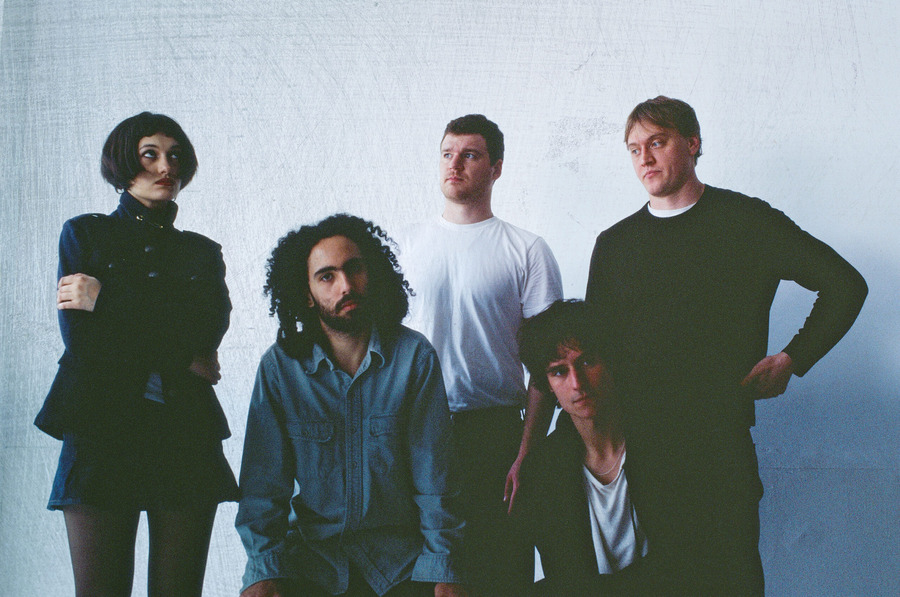
Photo by Jimmy Quinn
On their debut full-length, dollhouse, NYC band Slow Fiction move effortlessly from euphoric indie sprawl to reverb-washed noise-pop, wrapping shimmering melodies in a dreamy haze of fuzz before settling into hushed, late-night warmth.
That sonic diversity is dollhouse’s greatest strength, resulting in a collection this is nearly impossible to pigeonhole yet never feels disjointed. As the band shifts effortlessly between widescreen anthems (“junior year”), urgent post-punk bursts (“ninetynine”) and intimate, atmospheric detours (“idle hours”), there is a lived-in confidence to their songwriting that makes every unpredictable turn feel familiar.
I was joined by Julia Vassallo (vocals) and Paul Knepple (guitars) for a conversation about the band’s evolution, how lyrics serve as just one piece of the puzzle, and the slow-burn album cuts they hope listeners spend time uncovering.
Slow Fiction formed in 2022. Has the four years you’ve been together gone by in a blink of an eye or does it feel like you’ve been together forever?
JULIA: We technically did start towards the middle-end of 2021, and then we got our full five members that we are right now in 2022. It does feel like it’s gone quickly in some ways, but I think because of the amount of stuff that we’ve learned together, and also done together, it kind of does make the time feel well spent and also appreciated. You look back and you’re like, “We’ve actually done so much shit together.” It’s hard to be like, “That went by in the blink of an eye,” when you can categorically be like, “Our entire history together has existed in this space of time.”
If you could go back to the point where you were a solid five members and give 2022 Slow Fiction some advice, what would you tell yourselves?
PAUL: I was just talking to my friend’s brother, who’s starting a band. We were talking, and he asked that question. I think I said I would just say to be patient. When you start a band, you feel like you have to do what you think bands are supposed to do immediately: record music, play shows, whatever. But we’ve grown to learn the most important thing is just writing together and playing together, and you don’t really need to rush into doing too much other stuff.
When you graduate high school, you’re a different person than you were when you started as a freshman. Do you consider yourself a different musician than you were when the band started or has it felt more like an evolution?
JULIA: I’ve been playing, singing, or playing piano, or learning chords on guitar, amongst other things. I love learning that stuff and I have my whole life. But from what I knew going into being in this band to now, and what I’ve learned musically—and with production, or recording, or any of those building blocks—I never really thought about too much before in a practical way.
Advice to give to your younger self four years ago is kind of like that thing of: “You’re not gonna know how to record into a vocal mic the way you think you do, and that’s okay.” There’s so much to learn in recorded music versus live music, versus just writing music for yourself, versus writing it with other people and collaborating.
Can you remember when you collectively thought, “We’ve really got something here. This is where we’re supposed to be and now it’s time to conquer the world.”?
PAUL: A super specific point, I don’t know, but I think we definitely had a moment, after maybe two years of being a band, where we were playing shows all the time and wanting to get out there in New York City, playing as much as possible. I think we had a moment where we were like, “Okay, maybe now we shift our focus to trying to find what we want to sound like as a band.” I think that was an important moment for us, because, especially forming right out of COVID, people were just excited to play shows, so we were totally in on that. But once we kind of took a step back and were like, “Let’s just focus on writing for a while and figure out how we want to record and what we want to sound like,” I think once we did that, we totally shifted as a band.
From a lyrical perspective, are you an “every word counts” kind of writer or a “I hope you get the message, but not every word is important” writer?
JULIA: I would never want to ask somebody to listen to a song a specific way. The way we relate to music is the way our body interacts with the world, our senses all latch onto different things for a reason. If somebody is listening and they resonate with the lyrics, that’s fantastic. Other people don’t experience songs the same way. They’ll be like, “I listened to this song, and to me, this drum was like the lyrics,” or “This part spoke to me in a lyrical way, and that guitar line made me feel emotional.”
Everything I’m writing has an intention and a lot of care handled with it, but leaving the listener to have their own experience with that, whatever that may be, is super important too.
The older I get, the less I retain lyrics. But, while I can’t sing along with every song, it’s the overall feeling that makes me feel something, the mix of instruments and vocals.
JULIA: That’s why we’re all doing it together. We’re trying to capture a feeling. If something sonically interesting is happening in the room while we’re writing that gives me a feeling, I try to ask, “What is that feeling we’re hearing and experiencing right now?” and then give a little bit of extra life to it, something to latch onto. It’s all supposed to be in that same space and create that harmony, you know?
“heavy metal” is the shortest song on the album and has the fewest words. It’s immediately followed by “turning down flowers” which is the longest song and has the most words. Was that a conscious decision to go from something short to something long?
JULIA: We were sequencing and it was a combination of following a pattern thematically, as well as the sonic sequencing that we were choosing to do. We were thinking about how it would be on the vinyl, how would those songs sound? But those two songs coming back-to-back is funny in a way because it makes sense to me. I’m curious if it makes sense to other people.
You released several singles before the full album. Are those songs that you chose to feature or did your label or management pick them?
PAUL: It’s a joint decision on which songs will be released as singles. We recorded 11 songs, finished mixing, and sat with them for so long, and then it’s time to pick the singles. It’s nice to have input from somebody else, usually it’s the label and the rest of the team. It’s interesting because we could have a couple songs that we’re like, “This obviously would make sense as a single,” and then you get a decent amount of other people’s input, and it’s totally different which is good because you’re releasing to a wider audience, and everybody has different tastes. So, I feel like it’s kind of give and take, you try to find the best middle ground and the songs that best represent the album.
When you play live, the singles likely get the best response, because those are the songs you were pushing. When I go to see bands live, there are always songs that weren’t singles that I hope find their way into a setlist. For me, those songs on this album are “mouthpiece”, “what the night told me”, and maybe even “idle hands.” What are those songs for you, the ones that you’re looking forward to performing live that people might not be as familiar with?
JULIA: We were smiling because when you said that, I was like, “what the night told me”. That’s definitely our band-who-made-the-record’s favorite song. We’ve watched documentaries and read things where bands will say, “Our favorite song wasn’t the single” and that is just so true. It’s stereotypical to read or hear about because I think it happens more often than not.
But “what the night told me” and “idle hours”, I think we talk about those two songs a lot because of their significance to all of us and our recording process, “what the night told me” especially. (Bassist) Ryan (Duffin) mentioned the other day in another interview that that was the first time that, when we were in the studio, we all heard what we had laid down for that song and were like, “This is going to be a song on the record.”
Kicking off the album with an energetic song like “junior year” is a great idea. That song is going to pull people into the album right away.
PAUL: Totally. That was pretty much our thinking. We had been starting our live set with that song, and it felt really good. Not that we let the live show inform the record too much, but there’s something about the intro of the song. We had the conversation about starting with just the bass and drum intro as the start of the whole record and it felt really cool to us. We were going back and forth with sequencing for a while but that one as the opener was one of the few things that we didn’t really debate that much.
There are all sorts of side jobs that come with being in a band, things like posting to social media, making videos, doing interviews. What are the side jobs you love and the ones you wish you didn’t have to do?
JULIA: I feel like managing all the socials is one of those things. Some people are so naturally acclimated to them. When that type of communication starts feeling like you have to schedule everything, I would pass that off to someone else. But it’s also great getting to chat with people after they see you play live and they send you a really nice message afterwards. It’s give and take. You have to be appreciative of all the side things that you are doing.
If a record store clerk is recommending your album based on what a customer is already bringing to the counter, what artists or records do you hope they’re pairing you with?
PAUL: I feel like with our past releases, just because they’re smaller bodies of work, it might be a little easier to pin down. With this record, there’s so many different styles of songs.
I agree. I’m having a hard time describing your music to people. It doesn’t sound like any one or two bands to me, it’s original and yet familiar, if that makes sense.
PAUL: It is cool to hear that maybe it’s harder to describe. I always imagine somebody else listening to it and being like, “Well, obviously, it sounds like …”
There were a couple more classic indie bands that we were inspired by in general this time around. Broken Social Scene was one that we talked about, because not that we sound like them, but they also do a good job of having a particular sound but then having so many songs that sound different. Obviously, Yo La Tengo is the blueprint of that style of music.
And then also, I feel like with the songs that you mentioned as well, with the more shoegaze-leaning songs, there was some inspo from that melodic, poppier side of shoegaze, bands like Ride and Jesus and Mary Chain for one portion of the record.
The bands you’re talking about, they have been around probably as long as you’ve been alive. How does a band like Yo La Tengo enter your world? They aren’t exactly getting millions of streams on Spotify or on covers of magazines.
PAUL: Family and friends growing up, for sure. At the same time, when you’re talking about influences, it’s easier to list older bands. We’re also influenced by bands that started when we started, that are more modern, and I think it’s harder to specifically pin those bands down as influences.
JULIA: You and your peers who are making music around you, you all have similar influences of what you grew up with, and those are all overlapping.
When we see a cool band come out with a record that we like and think, “That’s so interesting,” it’s funny, because we are all simultaneously in this generation of artists pulling from the generation prior to us.
Bruce Springsteen has such a huge catalog and is known for his blue-collar anthems. The song “I’m on Fire” was a bit of a different sounding song in his catalog but it might be my favorite song of his. It was cool to hear you cover it. How did you come across that song and why did you decide, of all the Springsteen songs, to cover that one?
JULIA: We do love doing a little cover here and there whenever we have the time, and kind of in between things. And that one was so much fun to do. We did that one on the Tascam.
PAUL: Yeah, that was on a 4-track. It was really fun to do. We did it at the end of the year, December, and we were getting ready to go visit families for the holidays, so we had downtime, and we were just like let’s do something that’s fun. I forget how that song came up.
JULIA: The lyrics in the bridge of that song are probably some of my favorite lyrics, point blank. He’s being so honest, but then also using imagery in a really beautiful way, and I think that people do think about Bruce when they think about a working class hero along with the E Street Band. I grew up in Jersey, as did Paul, as did (guitarist) Joe (Skimmons), so I was hearing E Street Radio in the car quite a lot growing up, trust me. I think the first time I heard that song being like, “Wow, this is a really different flavor of songwriter that he’s showcasing. It’s very sensitive, and just a little bit of a different appeal.” I think that’s why I remember hearing “I’m On Fire”, and being like, “I think I like this guy.”
So does that mean that somewhere, either recorded or not recorded yet, you have a Bon Jovi cover?
PAUL: Oh, we haven’t gotten around to Bon Jovi yet, but …
JULIA: “Livin’ on a Prayer” coming soon.
Is there an artist that you would love to do an entire covers album of?
JULIA: We were talking the other day about how we wanted to do Elliott Smith covers, because we’re just all very big fans. I would like to do, just front to back, a whole Elliott Smith record and it would be impossible to do it justice, so I’d make it completely different. That or maybe Sparklehorse. That would be fun.
Do you have a favorite Sparklehorse record?
JULIA: Vivadixiesubmarinetransmissionplot. That or Good Morning Spider. I go back to Good Morning Spider for sentimental value. I think both of those demonstrate that as long as you have great choruses in songs, you could play both Elliott Smith and Sparklehorse on guitar or you could make electronic versions and they still would sound so sick.
Who would you like to hear make a Slow Fiction cover album?
PAUL: You know what I was just thinking? I would love a really somber, like, Phoebe Bridgers version of some of the songs. I feel like it would be so good, some of the more up-tempo ones, but then in her more acoustic style.
JULIA: Totally.
PAUL: And I feel like I thought of that because I was thinking Dinosaur Jr. would be a really cool band to do a raucous version of our album and then I remembered J. Mascis has covered Phoebe’s “Motion Sickness”, I saw it on YouTube. And then I was like, “Phoebe Bridgers doing a ‘junior year’ version, but really slow.” I think that’d be sick.
JULIA: I want to hear him do “dollhouse”. I love that song, “See You at the Movies”, by J. Mascis. It’s literally one of my favorite songs. I listen to it, I feel happy, and I feel sad, and it’s just the best. When we were writing the song “dollhouse”, I just kept thinking about J. Mascis singing that song, even though it doesn’t really sound that similar, the two songs. I would get so much glee from hearing him do it.
Do you guys have jobs outside of music?
PAUL: Yeah, I work at the Mercury Lounge and the Bowery Ballroom, two venues in New York. I bartend and work the door and stuff like that, but I’m just venue staff when we’re home.
JULIA: I have sold merch at Mercury Lounge a few times, but I teach kids online. It’s very fun. I like teaching books to kids too, it makes me reread them, which is really fun. And then it makes me realize that we’ve got to get some levity into the curriculum. I can’t give you 1984 and Fahrenheit 451 back-to-back. The world is hard already.
I didn’t realize that you toured with Sprints a few years ago on their U.S. tour.
PAUL: Totally. They’re homies.
JULIA: We love them. Shout out.
I interviewed Jack and Sam a few years ago, love that record but I think the latest record is even better. I might have interviewed them shortly before you toured with them.
JULIA: We tour with them in September of 2024. We still look back on that tour as just one of the best times ever. They are such a joy to hang with. We were on the road with them for like a month. I have a funny memory of Jack and Sam, as we were driving away from them at the end of the tour, and it just made me laugh when you said you interviewed them.
You’ve got dates coming up soon opening for Swervedriver. Have you toured with older bands in the past?
PAUL: No, this’ll be the first one from that era that we’ve looked up to for a long time. We’ve played with bands that are slightly older than us, that are still heroes of ours, but from a slightly more recent era.
So you haven’t gotten touring advice from bands who have been doing this forever.
JULIA: I feel like, jokes aside, touring with Sprints was a huge learning experience. They are truly a joy to be around. They had the best energy and were extremely welcoming, extremely supportive. After the tour ended, they were still extremely supportive. They taught me the proper way to support other artists, especially artists that they’re bringing on tour. It was great.
Do you have a go-to concert shirt that you wear?
PAUL: My favorite one is one my dad got me; I think when I was in high school. My dad got me the Dinosaur Jr. shirt with the little kid smoking a cigarette on it. My favorite merch shirt that I have, for sure. So yeah, that’s the first one that immediately comes to mind for me.
JULIA: I feel like the one that always comes to mind for me is one I got at a record store pop-up in one of the Brooklyn flea markets, back in 2021. It’s the Cramps, “What’s Inside a Girl” shirt. I cut it years ago and it just hangs off in an awesome way, and it’s worn in, and I feel like it just kind of fits the vibe. You can just wear it to whatever, and it kind of makes sense at a venue, because everyone knows who that is, and it’s also funny that it says “What’s Inside a Girl” on it.
Is there a song that, when you hear it, instantly takes you back to something specific from your past?
PAUL: When I hear “Under Cover of Darkness” by The Strokes, I think of one specific corner in the town that I grew up in, driving with my dad in his Jeep, because he had the Angles CD. I guess that must have been high school.
JULIA: When you were saying dad’s car, for some reason that struck me. Me and my older brother, Dylan, we used to drive around with my dad sometimes, on Sundays after church, and listen to music, and he would always put on “The Circle Game” by Joni Mitchell. I didn’t know who that was. When you’re young and you just hear a beautiful voice, you’re like, “What is this?” And I remember that, because I just remember the lines, like, “In the seasons, they go round and round.” My dad was like, “This song is about the passage of time,” and when you’re young, you don’t really know what that means, nor do you really care. You’re like, “I’m 8!” And then, as an adult, I cannot listen to that song now without immediately crying. I heard it not too long ago, and I was like, “Turn that off, please.”