
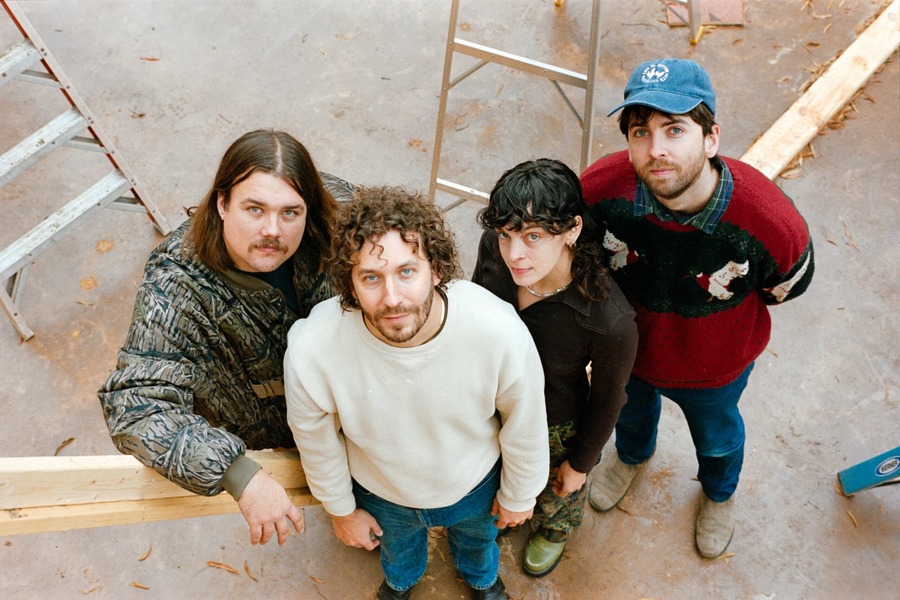
Photo by Charlie Boss
Few albums this year feel as honest, or as rooted in the rhythms of daily life, as Companion, the third album from Sluice and their first for Mtn Laurel Recording Co. On the opening track, “Beadie,” frontman and guitarist Justin Morris sings, “I used to move every Spring, now I don’t” and “My parents met in high school when they were just 17,” lines that read like they’ve been lifted straight from a journal.
The Durham, North Carolina four-piece – Morris alongside Oliver Child-Lanning (bass), Avery Sullivan (drums), and Libby Rodenbough (fiddle) – offers vivid snapshots of Southern living: its ease and looseness, its quiet struggles, and the sense of community that underpins it all. Thematically, Companion brushes up against Americana, though Sluice won’t be mistaken for Wilco, Jason Isbell, or The Avett Brothers. Instead, the band drifts through a slower, occasionally experimental terrain, building songs from ambient keyboard textures (“Gator”), field recordings (“Ratchet Strap”), and layered harmonies (“WTF?).
There’s a subtle distinction between Sluice and fellow North Carolina band Fust, but plenty of overlap. Members of Sluice have contributed to Aaron Dowdy’s records and have also served as Fust’s touring band, including a current run with Merce Lemon. Returning the favor, Dowdy adds background vocals to Companion.
With the Fust/Merce Lemon tour underway, Morris called in from an off-day in Colorado to discuss Sluice’s origins, his approach to lyric writing, and the role North Carolina continues to play in shaping the band’s music.
I first heard of Sluice when interviewing Aaron in 2023. I don’t know much about you, can you give me the highlights?
JUSTIN: I’m from Winston-Salem, North Carolina, in the middle of the state. I kind of got my start playing music in Asheville, because I went to UNC Asheville. That’s where I met so many people that I still play music with or encounter. It’s kind of crazy thinking back on it, but a huge scene came out of that Asheville crew. Wednesday and MJ Lenderman and all that. I met Aaron and Frank and Avery, who play in Fust and also play with Sluice. I met Alli Rogers, who’s recorded and helped produce a bunch of our music. Alli and I were both auditioning for the music program the summer after our senior year of high school, and I would love to be a fly on the wall for that conversation of us talking about Bright Eyes and Modest Mouse. I kind of figured out how to play in bands and met a ton of people at that time in my life.
When I finished college, it was a small town, and just through friends of friends, I got a job selling merch on the Angel Olsen tour. That was when her awesome album, My Woman, came out. I was a huge Angel fan, still am. That tour started right after I graduated UNCA, so I did a few years of traveling with them. It was a really amazing, eye-opening experience. After that tour let off, I was feeling a little rootless and ungrounded, classic early 20s, “what do I do with my life?” situation. I followed some friends up to New York, where I got really close with Avery Sullivan. He needed a roommate, I was looking for a spot, so the two of us got an apartment together that ended up being where we recorded the first Sluice release. He was really monumental in helping coax out some of those early songs.
I had a pretty tough time in New York, met a lot of really beautiful people, and I’m very grateful for the experience, but I kind of ran home with my tail between my legs back to North Carolina. I think it really made me appreciate the state that I’m from. When I came back, I’d lived in the mountains and in the central part of the state where I’d grown up, but I hadn’t spent any time in the Triangle. I’d grown up reading about Superchunk and Carrboro and Chapel Hill and thought it might be a fun place to live. I saw a Craigslist post for a sublet over the summer in Hillsborough, North Carolina, just outside of Durham, for really cheap, and there was a studio in the backyard. It just sounded perfect. That house ended up being Oliver Child-Lanning and his wife Oriana Messer’s house, who are now great friends and musical collaborators. I’ve sort of accidentally started falling into a music community there.
Since then, Avery moved back to the Triangle from New York. Aaron, who also moved from Asheville to New York, got a placement doing his PhD at Duke, and so he was in town. Fust kind of began to become a larger band, and at the same time, my friend Alli had been working at Betty’s, which was a studio run by Sylvan Esso in Orange County outside of Chapel Hill. She was super encouraging of bringing in friends to do work there. This little scene kind of grew out of that. We’ve been really lucky about having places to record and being able to play, and people being interested in the shows. It feels like we have a very healthy little scene now, which is a treat.
In the early-to-mid ‘90s, there were definitely a lot of indie rock scenes. Maybe I haven’t been paying attention but it feels like scenes haven’t been as prominent as they were 30 years ago. But, that being said, there’s a lot of great stuff coming out of Asheville and Chicago in the last few years, which feels like the scenes of old.
JUSTIN: Yeah, I remember reading about Superchunk and thinking there was a scene here. The town I grew up in, Winston-Salem, there was some music there: Ben Folds is from there, the dBs and Let’s Active and all the stuff that Mitch Easter was doing. I just remember being a younger person and feeling worried that maybe that was something I would miss out on, or that was history. But it’s cool to feel like it’s not even just a happening spot or time, but just that people are being creative with each other and supporting each other’s output. That’s really cool.
It seems like you’ve, maybe accidentally, run into people who are now part of the family, part of the band, part of the scene. It doesn’t sound like you’ve gone through 15 iterations of the band to get to where you are today.
JUSTIN: Exactly, and it makes me really grateful. It feels like the opposite of a hired gun, like, “I’m a songwriter and I want the biggest shredder and the best bass player.” We all really love each other. It’s cool.
What was your music-listening upbringing? What ignited the idea that you wanted to play music, or learn to play guitar? At some point you cross that boundary from just turning on the radio to, “this is the thing.” What was that for you when you were growing up?
JUSTIN: There was a lot of music in my house growing up. My dad, in particular, is a big music fan, loved Bruce Springsteen. The first concert I went to was the Rising Tour. Music existed in my household, and especially my dad’s car, as something that was exciting and special and fun. My parents aren’t particularly musical people, but they’re definitely appreciators and excited people about art, which was a great environment to grow up in. They were really supportive as I started getting excited about music and wanted to take guitar lessons.
I had an awesome guitar teacher who I’m still in touch with, named JP Mullen. He was an amazing player, but he would also just hang out with me. He was probably a college or grad student when he was teaching me, but he would just be like, “have you heard of Radiohead? Do you want to watch a music video?” So I feel like I was never a big explorer or a Napster hound, but I got really lucky with people that wanted to hold my hand and show me stuff. I had some friends growing up that had older brothers with CD binders, and just kind of by the luck of the draw, I got really into A Ghost is Born, the Wilco album with the egg on it. That was just in David Sugg’s CD binder, and I was like, “I really like that song ‘Handshake Drugs,’” having no context to any of that other stuff.
I also had an amazing, really impactful chorus teacher in high school, Terry Hicks. He was a really emotionally open teacher, unlike most other teachers, and it wasn’t uncommon for people to weep in that class when they were seniors. He really instilled a deep respect for the impact of a crescendo and things like that. I had some great instructors and guides along the way that I think matched my enthusiasm and further ignited it.
So you came about it honestly. You learned how to play, you learned how to sing, and then you graduated high school and you’re like, “I know how to do this, and maybe I should?”
JUSTIN: Definitely. It was always something that I was really excited about. It’s funny, my core group of friends in high school were all film nerds, and I kind of ambiently absorbed some of that, and almost all of them ended up going to film school. Up until the end of high school, I was really thinking I was going to do that too. I was applying to public liberal arts schools, trying to find something where I could do a little bit of music, a little bit of film, maybe also get an English degree so I could be an English teacher when those creative projects don’t work out. But I ended up going more for the music route, and I’m glad that I did. I think that was more my aptitude.
Do you have a backup plan, like, if this doesn’t work out?
JUSTIN: I’m always cycling through backup plans. The touring stuff is hard, not to complain about getting to do something that’s a dream, but it’s a little bit of a hustle trying to figure out paying your bills. I’ve done a lot of carpentry and construction work since the pandemic. Kind of accidentally fell into that. Until I’ve been taking music more seriously the last few years, I felt like I was kind of pushing the inevitable, like, I need to go to grad school, or I need to figure out something else, or get my teaching license. I come from a family of educators, and I’m dating an educator. That’s always felt like the straight job I could get.
The pandemic hit, and through a friend of a friend, I ended up getting an apprenticeship on a construction crew, knowing how to do none of that. It’s been productive and meaningful work that’s also been fairly flexible, to be able to take jobs here and there and come back to it. We’re currently building a studio in our drummer Avery Sullivan’s backyard, doing a full-on framing project right now, which is a ton of fun. Every tour, I’m always kind of being like, “okay, I’m back, who needs something fixed?”
Will that studio be for the band, or would you want to record other people? Do you have a background in producing?
JUSTIN: I went to UNC Asheville and got a degree, it was called Music Technology, there. It actually has a really cool history, because Bob Moog helped start the program. I had an amazing professor, Jude Weinberg, who is also someone I should totally mention as a real champion of encouraging me to do good work musically. That’s what I went to college for, is studio production. I really enjoy working on other people’s records, and I’ve put a lot of my own sweat into the Sluice records on the production side. When we make that studio, the thought is it’ll be a big upgrade as a practice space, which is currently the shed in my backyard, 11’ by 11’, and also that we can make records there, and have our friends, and then maybe friends of friends, or the general public at some point, do work there.
I don’t know what it is about you North Carolina guys, but both you and Aaron work a lot of names into your lyrics. When I talked to Aaron, he told me that most of the names he uses in songs aren’t real people and that he uses names to humanize feelings and emotions. You use a lot of names and locations too. Is there a certain shared inspiration between the two of you or is it just coincidence?
JUSTIN: I definitely take a lot of inspiration from Aaron. I really admire the way that he writes fiction and music. It’s something that I deeply wish I was better at, because my stuff is very, very confessional, maybe kind of auto-fiction-y, but very true to my own lived experience. That’s how I sort of stumbled into writing songs. It was interesting for me to kind of get a grip around Aaron’s songwriting, and to not take things literally. Like, he’s got a really happy marriage to his wonderful wife and these songs about divorce and not being able to feed his kids, this is a fictional project, which is very cool.
Aaron told me that he sometimes writes from the perspective of an unreliable narrator, somebody who is writing about Aaron’s life but doesn’t have all the facts and only writes about what he sees, or thinks he sees, even if it’s not the full picture. Your lyrics seem a little more matter of fact and pulled from your true lived experiences.
JUSTIN: Totally, they’re much more true to my experience. And probably playing in Fust has had an effect on that too, there’s at least one song on this record that is very much intentionally trying to write with metaphor and image, and not be as on the nose. But my typical way is very stream of consciousness, kind of diaristic lyric writing.
Do you watch or read a lot of abstract, stream of conscious type things? Or are you watching clear narrative, point A to point B, TV shows or movies? Does any of that influence the way you write lyrics?
JUSTIN: I’m sure that it does. I haven’t read the whole series, but I really enjoyed the few Knausgård My Struggle books. It was really cool to see someone playing with their own story, and also kind of a danger-ahead warning of seeing how that can hug up your life if you let it. But I’ve kind of always written like that, it’s always felt most natural to me, and I think a lot of it’s a coping mechanism for dealing with difficult emotions, or sadness, or deep joy too.
As far as consuming more abstract media, I feel like I’ve been consuming less and less abstract media as I’ve been getting older. I love straight-ahead narrative. I love a good story.
I noticed the nod to Pavement’s “Cut Your Hair” in the lyrics on ‘Gator’. Are there other references on the album?
JUSTIN: Yep, for sure. Nice catch. There are some references to “The River,” the Bruce Springsteen song. There’s a reference to “Camera,” the Wilco song, in “Vegas.” I’m sure there are some other pieces too. I love to be as open about those as I can, people whose work has inspired me.
”Gator” seems very stream of consciousness, like you sing about listening to a Desert Storm Podcast. Do you think your songs tell stories, or are they more phrases and ideas that work together? Is there a narrative throughout the album and throughout the songs?
JUSTIN: I think it leans towards the latter. I probably have some that are a little bit more abstract, or just sort of, this is an emotion I’m talking about, but usually I can pinpoint each one to: okay, this was an intense experience I had about this, and then I journaled about it, and then I turned it into a song. They feel more like stories, to me at least, but I assume it’s more convoluted to the listener who has not lived the experience I have lived. There’s a lot of detail that probably wouldn’t necessarily connect, but I kind of like that. I like finding that in other people’s music.
Are you the chief songwriter, or does everybody contribute?
JUSTIN: It’s become much more of a collaborative band, which I’ve really enjoyed as we’ve been touring more and playing more together. But it would be fair to say that I’m the principal songwriter. I’ll come with a sense of what a song should be, and maybe have some amount of arranging, but the songs definitely take shape with the band. There’s a lot of input back and forth, people bringing in different references or having opinions about how things should be structured and mixed, which is great for me, because I’m just a sensitive person, and it can be tough for me to get a song over the finish line sometimes. It’s great to bring it to people I trust who can hold me accountable by becoming invested in it themselves, and seeing it to completion.
Is it weird being in your own band, where you’re the principal songwriter, and then playing in Fust where you follow Aaron’s direction?
JUSTIN: It’s honestly a huge breath of fresh air, because I really get a lot out of leading Sluice and having people respond to the music, and feeling like I maybe have a little bit more of a direct connection to an audience through that. But for my personality type, I love to be a sideman that sings harmony for someone’s songs that I really love, and can kind of fall into the back a little bit more. It can be a little tricky with scheduling and touring and being away all the time with multiple active projects, but it’s been really great for me creatively to have that balance, to dip a toe into being a frontman, and to dip a toe into falling into the wings. I really enjoy both of those.
The way people stream music these days, they usually start with the first song and work their way through the album. So, naturally, the first few songs will be the most streamed, most well known. I’m wondering if there is a song deeper in the album that you’re just like, “I hope people make it to this song”?
JUSTIN: I’m glad that you brought up “Gator,” because that’s kind of that one for me. That might be what I’m most proud of on the album as far as songwriting, and the final composition. I’m really happy with it, and would love to go more in that direction. That was one I was talking with our team about: “Can we make that a single? This crazy long stream of consciousness one?” Probably a bad idea. But I hope people find it on the record and like it.
On “Unknowing,” you’re using a vocoder. What inspired you to use that?
JUSTIN: That song is the first time I’ve ever used fully outside text for lyrics. Over the years I’ve gotten really interested in religion and spirituality, and have read a good bit of Thomas Merton and really enjoyed his writings. I ended up doing a solo tour where I was close to the monastery where he lived and did a lot of his work and writing, and ended up going there and having a really meaningful time. I had an instrumental, and I had this deep love of this writer, and thought it would be interesting to try to merge these things.
A lot of time passed before the record was finalized and mastered and put out into the world, and one of the things I felt a little self-conscious about was that song. The vocoder was not on it in the initial recording. I really, really love the text of that poem or prayer, but I didn’t want it to come off as preachy or saccharine. I was working with Alli in her home studio, finalizing mixes, and kind of mentioned that insecurity. She was like, “Well, let’s fuck it up, let’s see what it sounds like. We don’t have to keep anything.” She had an old analog vocoder that Nick had lent her. We ran the original vocal track through that, she gave me a keyboard, I hooked the output of the keyboard into the vocoder and was kind of playing chords along to the vocal delivery, and it turned out to be this really bizarre thing that I think adds to the song in the end.
That’s out of the norm for Sluice. Do you think that somewhere in you you have a punk rock record or a heavy metal record or an ambient record, something that is very far removed from the music people know you by?
JUSTIN: I remember when I first started dating my girlfriend, Sara, she was really surprised how much I liked Charli XCX and British dance music – hyperpop stuff. I love the PC Music label: AG Cook, Hannah Diamond, all those people. I don’t know at all how to use Ableton or make any of those sounds, but there have definitely been times when I’ve had a little too much coffee where I’m like, I should make a hyperpop EP. I haven’t made that record, but maybe I’ll make that record.
Likewise, I’d love to make more ambient drone music. That’s probably more likely a direction I would go in as I get older. I think a lot of New Age and meditation music is a really beautiful, helpful thing in a lot of people’s lives, so I could see going in that direction. I would also really love to make a children’s record. Me and Alli Rogers have talked a lot about collaborating on that, maybe that can be an early project when we finish the studio. I grew up listening to Really Rosie, the Carole King record. She did a cartoon with Maurice Sendak, maybe in the 70s, where she wrote all the songs and plays the lead character, Rosie, this precocious little 9-year-old putting on shows with her friends. It’s this awesome kind of psychedelic animation with really high-quality songs. And I would love to do soundtrack work. That would really marry a lot of my early loves. I’ve done a tiny bit of that for friends, student films and things like that, but would love to do more.
You’ve played shows with Superchunk, toured with Indigo De Souza. What other tours have you done that I might have missed?
JUSTIN: We’ve gotten really lucky with some really cool opening tours. We played a three-show run with Angel Olsen, which was a cool full-circle thing of having been on the crew there and getting to play. I did a solo tour with Dean Johnson, which was really lovely, he’s an amazing songwriter. I did another solo tour opening for A. Savage from Parquet Courts, which was awesome as well. The smaller-scale headlining stuff we’ve done has been really meaningful too. We’ve gotten to see a lot of the country.
You’re wrapping up this tour and then basically getting back in the van pretty quickly, right?
JUSTIN: Pretty quickly. We’ll have about 2 weeks at home, which will be really nice. This has been on the schedule for a while, and we were all talking and were like, yeah, that’s gonna suck a little bit, but that’s the time we need to do it, and we gotta get out there. We’re looking forward to the shows, but it’s a bit of a slog having them right next to each other.
Hiding Places is opening?
JUSTIN: Yeah. I’m stoked to get to see them. I haven’t seen them play before. We’re good friends in the circle of folks. I knew Audrey from Asheville times and have really enjoyed keeping tabs on that project and that circle of people as well. They’re working with Andrew Stalker, who books for us, so it was suggested and it was like, oh yeah, definitely, let’s do that.
There’s a quote-unquote scene in Asheville that I dream of. I feel like I could go spend two weeks there and see a hundred good bands. There’s something romantic to me about a scene that’s not in a city. Is Asheville everything I’m imagining?
JUSTIN: It’s a wonderful town, and I’m really glad that I’ve gotten to spend so much time there. A scene that’s not in a city. One of the hardest parts for me about living in New York was figuring out how to get gear to a practice space. If you’re in a place that’s maybe a little bit more affordable, where there’s a little bit more space, maybe there’s a shed in the backyard where you can put your stuff, in my experience, it’s way easier to be creative.
Asheville’s a beautiful town, well worth some time spent there. It’s changed a lot since I’ve been there, but I’m glad to still be able to keep tabs on it by going to play, or going to record, or going to see friends. And likewise, I’ve really enjoyed feeling more rooted in the Triangle. That feels kind of like a little sister community to the mountain zone.
The last question I ask everybody: Is there a song, album, or artist that, when you hear it, takes you right back to something specific?
JUSTIN: My freshman year of college, I got caught smoking weed in my dorm. At the time I was very early into record collecting, and me and my roommate had a little turntable. We were playing “Bridge Over Troubled Water,” hitting a vape, passing it to each other, and the student resource officers came in. My heart completely sank, elevated pulse, I’m gonna get kicked out of school, what are my parents gonna say. It was a few years until I could listen to that song again without feeling like all hell was gonna break loose. Pretty stark difference in tone of the song to the situation I was experiencing.
When you hear it, do you feel like you can smell weed?
JUSTIN: I probably did the first few times. But I’ve made it through. I can handle it now.