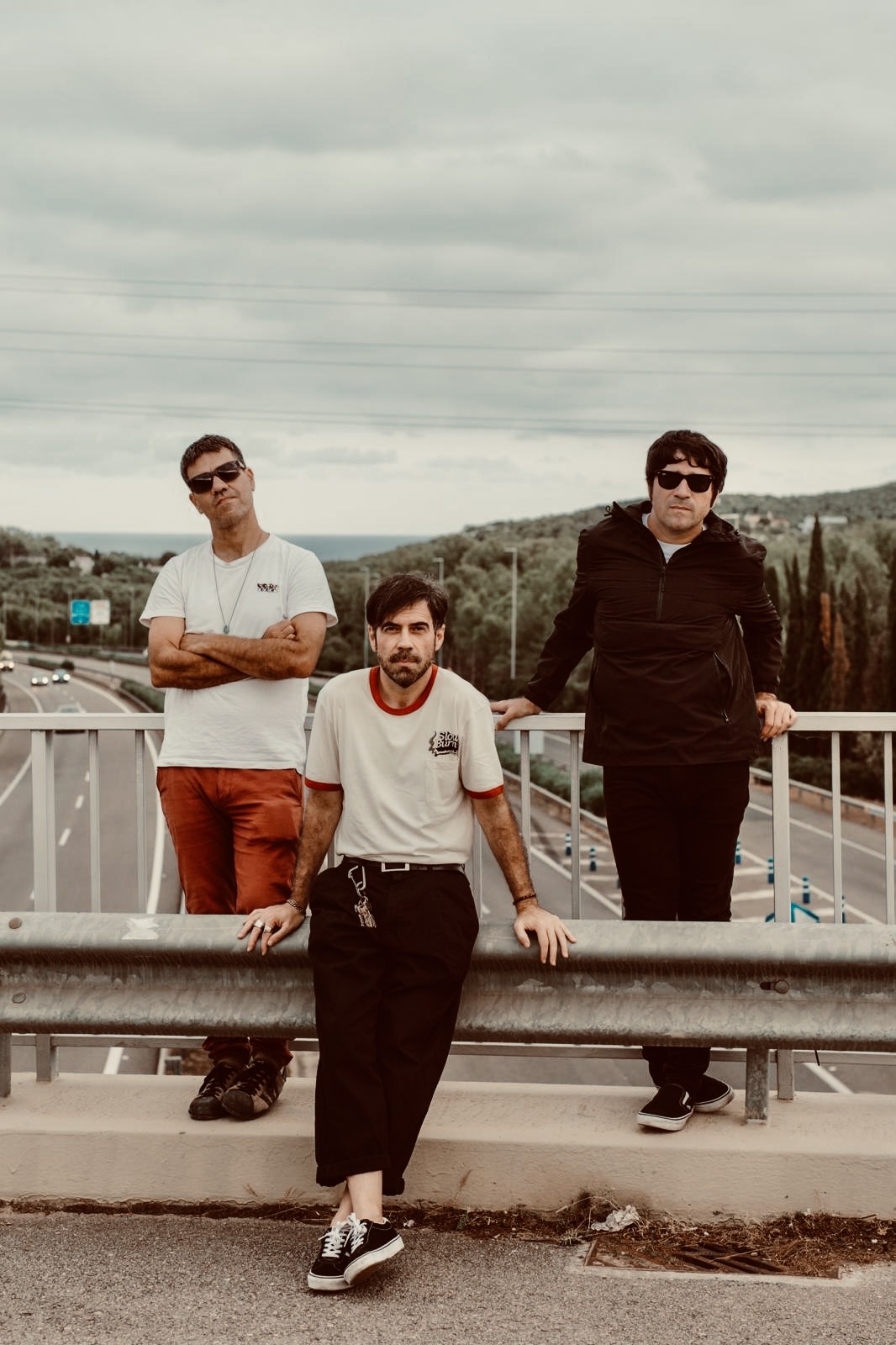
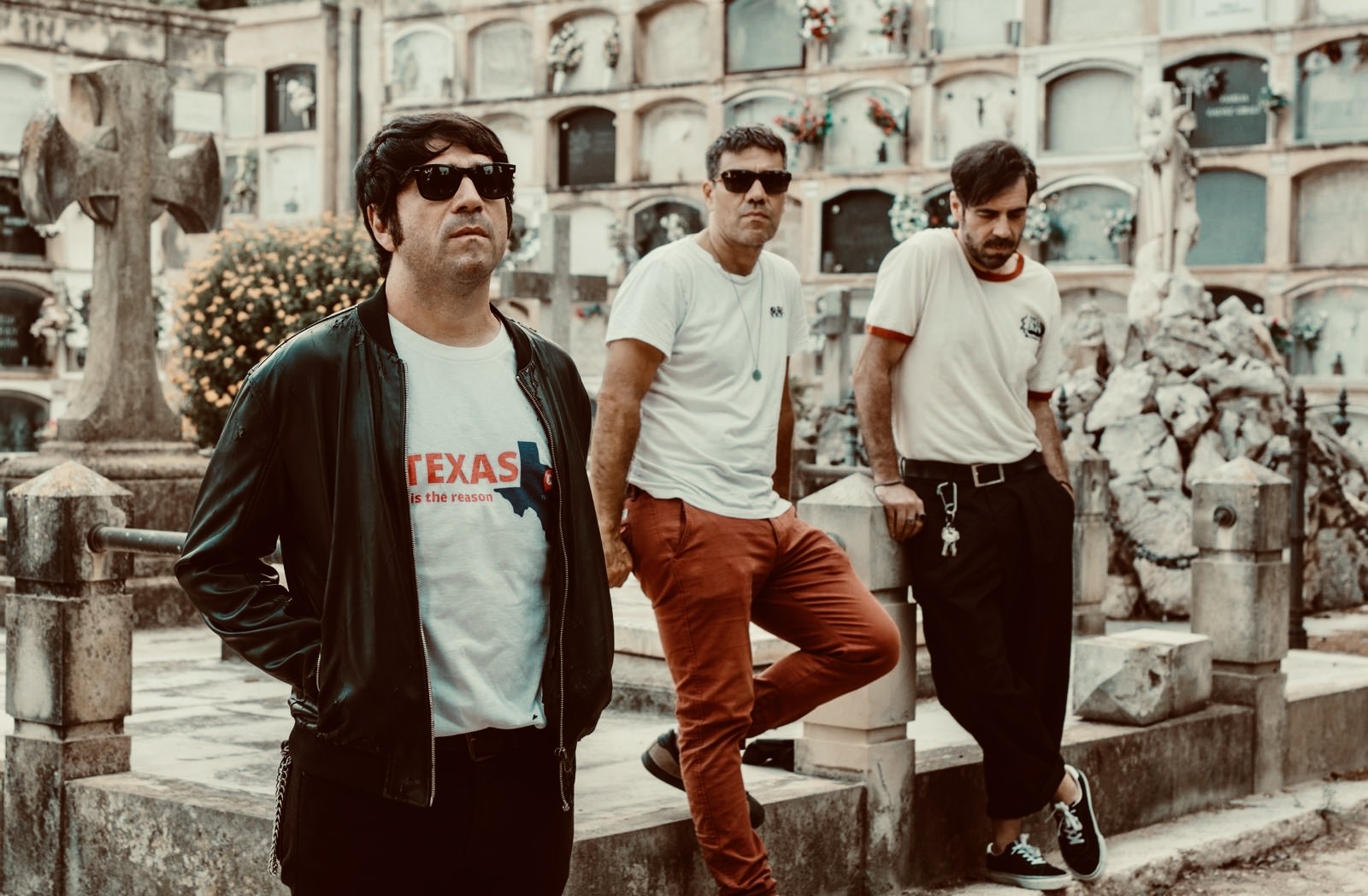
All photos by Lala Garcia
Before the current explosion of reverb-drenched guitars became a global mainstay, there was a band in Spain crafting storms of sound in a relative vacuum. Formed in 2008, The Lions Constellation didn’t just play shoegaze; they championed a visceral, wall-of-sound philosophy at a time when the genre was far from the cultural forefront. Led by the multi-instrumental depth of RJ Sinclair on vocals, guitars, and keys, anchored by the foundational pulse of Graham Lions on bass, and driven by the percussive textures and backing vocals of P. Arthur, the trio has a sonic identity that was is as haunting as it is heavy.
Their 2009 debut album, ‘Flashing Light’ (BCore Disc), cemented them as pioneers, creating an immersive intensity that resonated loudly across borders even as they moved like ghosts through their own local scene. After a decade of silence that only served to sharpen their sonic edge, the band released the EP ‘Under The Skin’ (Beauty Fool Records) in 2021, a release that proved their hiatus was less a disappearance and more an incubation of even greater emotional depth. That same year, a collaborative split with Dive Collate reaffirmed their status as international benchmarks within the global psychedelic noise movement.
Having shared stages with titans like Interpol and Wire, and delivered crushing performances at Primavera Sound, they have consistently balanced tectonic power with fragile beauty. As we approach the late 2025 release of their latest evolution, ‘New Moon Rising’ (Shelflife Records / Too Good To Be True / Make Me Happy), the band stands as a vital antithesis to the wave of uninspired clones currently flooding the genre. They remain the architects of a singular, hypnotic atmosphere that feels both timeless and urgently modern.
Many thanks to Ed Mazzucco at Shelflife for the coordination and to RJ for being so generous with his time.
James Broscheid: After more than a decade of evolution, absence, and reemergence, ‘New Moon Rising’ arrives not merely as a continuation but as a statement of intent. In returning to the long-form album after the intensity of ‘Under The Skin,’ what inner shift, whether it be personal, artistic, or philosophical, made this the right moment to expand your sound into something that feels both more cosmic and more deliberate than before?
RJ Sinclair: The band has always had a pretty fluctuating life: periods of a lot of activity and others where things slowed down. A lot of that simply comes from our personal lives. There have been times when we were able to line up and times when we weren’t … adult life, basically. There have also been several lineup changes. Our EP came out during the COVID pandemic, and in a way, that prevented the band from having the continuity it needed. Over time we went through more lineup changes until we arrived at the current formation as a trio. Sonically, it’s also important to remember that it’s been almost 20 years since we first started the band. Even though the core influences are still the same, we’ve always been ‘90s indie kids so the sound has definitely evolved a bit.
Maybe we’re a little more refined now. I wouldn’t’t necessarily say we’re better musicians, because the band still has that very punk DIY influence and, in that sense, we’re pretty limited, but we do try to do things now that we couldn’t really translate into sound 20 years ago. When you’re young you just love distortion. I’m not saying we don’t still like it, but now we try to give it a purpose. I already started writing songs with that mindset around the time of the EP, and I think with this album we’ve taken another step toward what we want to do in terms of the kind of songs and the sound we’re aiming for.
JB: When you released ‘Flashing Light,’ you were operating in a Spanish underground that had not yet embraced shoegaze’s resurgence. Now that the genre is saturated with revivalist acts, how do you consciously avoid nostalgia becoming a trap, and how do you define the difference between honoring your origins and resisting self-imitation?
RJ: Honestly, we never set out to make a specific style of music. We just had certain bands that we loved and had grown up with, and that naturally led us to write our first songs. Like I mentioned before, we’re basically ’90s indie kids, and we were lucky enough to see many of our favorite bands live back then. We grew up with that music, so in a way everything felt very natural. Back in the mid-2000s, this kind of music wasn’t really being rediscovered or celebrated worldwide, and definitely not in Spain. And as I said earlier, our main influences are still pretty much the same. I guess that gives us a bit of an advantage when it comes to writing songs, because we’re actually pretty disconnected from the current shoegaze explosion.
Before many of those bands came back or started being rediscovered, we already existed as a band. I’m not saying that as a criticism, it’s totally natural. New generations who didn’t get the chance to see those bands when they were active tend to look at the groups that have come back and take them as their main references. For example, we were never huge fans of Slowdive back in the day; they weren’t really one of our main references in the late ’80s or early ’90s. But nowadays they’re probably the main reference point for a lot of newer bands. Sometimes that also means the current shoegaze sound becomes a bit narrower, because a lot of the bands and labels that were around back then and were really important at the time, don’t get as much attention, even though some of them were arguably more influential than Slowdive. To give a more local example, in Spain a lot of the newer bands with this sound tend to build their identity around having tons of pedals and a female vocalist. And again, that’s completely respectable, but our path is a bit different. When we started the band, we already felt somewhat on our own, and honestly even now I don’t really feel like we’re part of a specific scene.
JB: Being somewhat disconnected from the current shoegaze revival, the genre is now arguably more visible than it’s been since the early ’90s. From your vantage point, does this resurgence feel like a genuine expansion of the language of the genre, or more like a museum culture forming around a handful of familiar sounds?
RJ: Like I mentioned before, I’m not really that up to date with newer bands, so I probably can’t give a very specific answer. What I do notice, though, is that these days the -gaze suffix gets added to almost anything, from rapgaze to blackgaze. Sometimes it feels like, rather than a real evolution of the genre, it’s more a way of labeling different sounds so they fit into the same current. I also understand that, in the times we’re living in, it might feel natural for newer bands, because shoegaze is very present again. But maybe it’s not so much about reclaiming something as it is about feeling part of a broader movement.
JB: You have often been described as receiving more recognition abroad than at home. As artists rooted in Spain but shaped by international stages like Primavera Sound, how has this sense of geographic displacement influenced the emotional architecture of ‘New Moon Rising’? Does feeling like outcasts in your own country sharpen your creative identity or complicate it?
RJ: Well, I think from the very beginning, we’ve been a band playing a kind of music that wasn’t really being made where we’re from. On top of that, we were singing in a language that isn’t Spanish. Whether you like it or not, those things tend to close some doors in your own country, and we’ve almost always found a warmer reception outside our borders. Because of musical affinity, we’ve also often ended up sharing the stage with European or American bands that we had a lot in common with. Many of them were actually surprised that we were from Barcelona, and they encouraged us to take our music outside of Spain, saying there would probably be a more receptive audience for it abroad.
As an anecdote, I remember that when we played some shows with The Horrors, they tried to convince us to join them for some dates across Europe. And when we played with Interpol, their singer (Paul Banks – JB), asked for one of our vinyl records and even invited us to visit New York. On the other hand, when it comes to reviews and press, our music has almost always been received better by international media. You also have to understand that Spain has historically had a certain linguistic barrier, and a lot of people prefer to listen to bands that sing in Spanish, especially if the band is from here. The question always comes up: “Why do you sing in English? If you did it in Spanish people would understand you better.” Since the 2000s, many bands that originally started singing in English have eventually switched to Spanish just to survive. We even tried talking to a few Spanish labels about releasing the record, but none of them showed any interest. The Spanish music industry is still very focused on bands that sing in Spanish.
JB: In retrospect, do you see that linguistic choice as a principled artistic decision, or was it originally just instinct that later turned into a kind of quiet rebellion against the expectations of your own music industry?
RJ: I think it all comes from our background: we grew up listening to music in English. We don’t have anything against music sung in Spanish, but we were never really devoted listeners, so it never influenced us. Writing in English has always felt natural, both with this band and with other bands I’ve played in. On top of that, I’ve always had more acceptance for my music outside of Spain; I’ve toured more in Europe and the U.S. than here.
I completely understand why local labels and the national industry focus on bands that sing in Spanish. At the end of the day, it’s all about the numbers: ticket and record sales. If people are demanding music in a certain language, in this case Spanish, our music just doesn’t fit. After that, it’s up to each band to decide.
I can tell you that in the 2000s, with the music industry crisis caused by new technologies, everything shifted toward bands singing in Spanish because they could reach more people, and a lot of bands that started in English switched languages to survive. I was never interested in playing that game.
JB: Opening for bands as stylistically distinct as Wire, The Wedding Present, Moon Duo and, as you mentioned, Interpol & The Horrors must have exposed you to radically different philosophies of sound and stagecraft. In what ways did those encounters subtly infiltrate the compositional or production decisions on this new LP, particularly in how you balance abrasion and clarity?
RJ: We’re a band that listens to a lot of different musical styles; in fact, we love learning from all of them. Meeting people from other countries, with different cultures and ways of thinking, is something that really enriches you, both personally and musically. On top of that, we’ve always been lucky to make some really good friendships. I remember one year at SXSW running into the singer of Moon Duo (Ripley Johnson), he recognized me, and we ended up spending an afternoon just chatting. And David (Gedge) from The Wedding Present even asked if he could record our show to share it with his friends.
JB: Wow! Quite the compliment! Shoegaze often thrives on obscured vocals and emotional ambiguity, yet ‘New Moon Rising’ seems to suggest a more intentional interplay between fragility and force. How do you approach the tension between burying the human voice within the storm and allowing it to emerge as a vulnerable anchor point? Has your relationship with lyrical transparency evolved since your earlier releases?
RJ: I think that’s always been a key part of our sound; we love both noise and pop. We’re really into pop bands from the ’60s through the ’90s, but also punk, noise, and hardcore bands. So maybe our sound is a mix of all that: powerful, heavy guitars with really poppy melodies. As you said, we’ve always aimed for the intensity of the guitars combined with vocal melodies. That’s been a common thread in all our songs. Maybe in the past the sound used to take priority over the melodies, but on this record, I’ve felt confident enough to really express my feelings and wrap them up in the fuzz sound.
JB: After the hiatus, the EP felt like a sharpening of edges rather than a soft return. Did that record function as a necessary purge before embarking on the expansiveness of this latest album? In hindsight, do you see it as a bridge, a reckoning, or a controlled experiment that unlocked something essential for this new chapter?
RJ: Well, you could say that EP was kind of a new starting point, and you could definitely start to hear a shift in our sound. Like I mentioned before, we began dialing back the distortion and giving our songs a new dimension. That EP also pushed a lot of the songs that ended up on the new album. Keep in mind that almost 15 years have passed between the EP and this record, so the difference is really noticeable. You could even say that ‘New Moon Rising’ wouldn’t exist without that EP.
JB: You return to the idea of purposeful distortion, that noise now serves the song rather than overwhelming it. Was there a specific moment, record, or realization that made you question the old “more fuzz equals more emotion” philosophy that many bands still rely on?
RJ: I think now we try to give the songs a sense of evolution. I’m not against using distortion, we still use it, but on this record, we wanted to control it and give it presence only in the parts of the song where we really felt it made sense, not just use it for the sake of using it. It’s more about using distortion in service of the song, so that it actually means something.
JB: Your split release with Dive Collate underscored your place within a global network of shoegaze artists. How does engaging with scenes outside Europe reshape your understanding of the genre’s future? Do you feel responsible for steering the sound forward, especially when so many newer acts risk repeating established tropes?
RJ: The split with Dive Collate was totally unexpected, we had no idea our music had reached that far. In that sense, it’s really rewarding to know that, even though we’re almost unknown in Spain, there are a lot of people out there listening to us and following us in different parts of the world. It also allowed us to release our new album in the US, Europe, and Asia, rather than in Spain.
On the other hand, we don’t feel any responsibility over the genre. From the very beginning, we’ve followed our own path, making the music we like, without worrying about whether we’ll reach more people or not. If there are a lot of bands doing shoegaze now, great, that doesn’t concern us, whether it’s a trend or not. We’ll keep doing our thing as long as there are people who want to listen.
JB: The title ‘New Moon Rising’ evokes cycles, darkness preceding illumination, and gravitational forces unseen but deeply felt. How consciously did you weave lunar or cyclical symbolism into the sonic textures of the album? Were there conceptual frameworks guiding the sequencing, or did the narrative reveal itself retrospectively?
RJ: I think the album’s title evokes a new beginning, especially considering that it’s been 20 years since the band’s first steps. It also brings a renewed energy and much clearer ideas, thanks to the maturity we’ve gained, doing things without rushing and knowing exactly what we wanted. We feel a bit like the phoenix, rising from our ashes. And even though the album reflects a certain darkness, I think it also carries that new life, that new light.
JB: When a band survives that much fragmentation, it often develops a mythology around endurance. Do you see this record as a resurrection of the band you once were, or as the quiet admission that the original version of The Lions Constellation had to die for this one to exist?
RJ: Well, what I mean is that even though time passes and the lineup changes, somehow, we always end up coming back with new music. And I feel like each time the songs are stronger. I guess everything that’s happened along the way, the pauses, the changes, the doubts, has given us a kind of experience and perspective we didn’t have before. Now we look at the band, and at the music itself, in a different way, maybe with a bit more calm and clarity.
JB: Your wall-of-sound approach has always flirted with chaos while remaining meticulously controlled. When recording at Atlantida Studios, how did you technically and emotionally calibrate the threshold between overwhelming density and melodic breathing space? Were there moments where restraint felt more radical than excess?
RJ: We brought the songs to the studio practically finished. A month before going in, we only had three tracks, because the idea was to release an EP and take things slowly. But everything got rushed, and I ended up writing 12 songs. We recorded the album in five days. We already knew that the fuzz would be much more contained; we wanted the songs to have their own life, to create a collection of singles that together would tell a complete album.
We made a lot of changes within the songs themselves. Even though I didn’t have much time to write them, I guess the experience gave me the ability to create tracks much richer in changes and arrangements than on our first album or the previous EP. We’re still in love with the wall of sound, but we also wanted to give the songs light and shadow.
JB: Recording twelve songs in just five days sounds almost reckless for music built on dense textures and careful layering. Did that constraint force you to accept imperfections that a longer session might have smoothed away? And if so, do you think those rough edges actually preserved something essential about the band?
RJ: Well, we didn’t really have more time or budget. We’re not professional musicians, and we weren’t chasing perfection. I think, given our limitations, we accomplished a lot more than we expected. A lot of the songs were recorded in a first take, without overthinking them, mainly because of the time constraints. Sure, with more time and a bigger budget we could have done other things, no doubt, but in the end, I also think those first takes give the songs a certain freshness. If you overthink them, there comes a point where you keep going in circles and always find something wrong
JB: Given that shoegaze is experiencing another global wave of popularity, often amplified by digital culture and short-form media, how do you reconcile the slow-burn immersion your music demands with the accelerated listening habits of contemporary audiences? Does ‘New Moon Rising’ challenge that culture intentionally, or are you finding new ways to inhabit it without compromise?
RJ: Like I mentioned before, I think if we were constantly paying attention to everything happening around us, we wouldn’t be making music. We’re a bit of a rare bird: we have our own pace, and we make the music we feel like making. Maybe it’s connected to what I was saying about growing up in the ’90s, our idea of making music, or even listening to it, has more to do with that era than with today. We still listen to albums from start to finish, without worrying about follower counts or streams.
We’re not trying to make our music popular or have it change our lives; we’re happy with who we are and what we do. I think the sense of immediacy is more of a thing with the new generations, and that can be really stressful and frustrating if you want to have a band and be constantly monitoring all that stuff.
JB: You speak fondly about the ’90s idea of listening to albums, yet ‘New Moon Rising’ is entering a landscape dominated by playlists and fragments. When you think about someone encountering your music through a 30-second algorithmic snippet, does that feel like a distortion of the experience you intended, or simply the modern equivalent of discovering a band on a mixtape?
RJ: These things kind of escape me a bit. I mean, I understand how the new generations listen to music today, even though I still listen to it the old way, and I wrote this record to be heard in full, song by song. What people do with it afterward is something you can’t control, and since I make songs I’d like to listen to myself, I’m not a slave to those 30 seconds and I don’t write with that in mind. That’s the only thing I can tell you.
JB: After nearly two decades of championing a sound that was once unfashionable, what does artistic longevity mean to you now? Is ‘New Moon Rising’ a culmination of everything you have learned about distortion and dream logic, or does it mark the beginning of dismantling the very sonic identity that first defined The Lions Constellation?
RJ: It’s kind of dizzying to think we started almost two decades ago, but at the same time you feel proud of the path we’ve taken. Obviously, we’ve learned a lot, not just musically, but personally too. I hope this isn’t the culmination of a sound, but more like a “to be continued.” We’re already writing new songs, and it would be great to record them soon, continuing the journey from ‘New Moon Rising’.
JB: Does “to be continued” mean the next step is refining that formula even further, or are you tempted to dismantle it entirely and risk alienating the audience that has followed you this far?
RJ: Well, I meant it in the sense that I don’t want so much time to pass between releases. I already have some songs written that I’d love to record and bring to the live shows. I’d say they’re a bit faster, though still in the vein of the last record, with very poppy melodies but sounds closer to ’80s hardcore, like Hüsker Dü, for example. I’m not sure if that’s very shoegaze (laughs).
To learn more or to purchase, please visit Bandcamp | Shelflife Records for the Americas and Too Good To Be True or Make Me Happy for Europe.