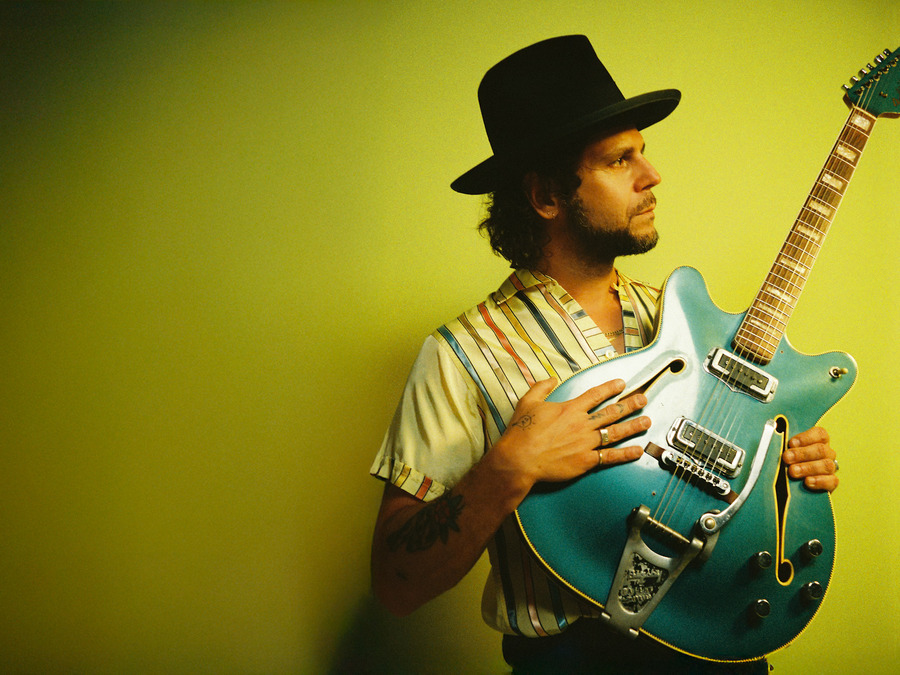
Photo by Kate LaMendola
For most of his career, Langhorne Slim has been the quintessential folk-rock troubadour, crisscrossing the globe to share stories as both a headliner and a coveted opener for acts like The Avett Brothers, Drive-By Truckers, and The Lumineers.
On his latest project, The Dreamin’ Kind, Slim teams up with members of Greta Van Fleet, a partnership born after he opened a few dates on their 2021 arena tour. While the album retains Slim’s signature folk DNA, collaborating with the band allowed him to finally indulge a lifelong rock-and-roll itch.
In this conversation, Slim explores the fluidity of genre, the ease of finding a new creative shorthand with outside collaborators, and his conviction that music remains the ultimate bridge for a divided country.
When you write your bio, what will the title for the 2025 chapter be?
LANGHORNE SLIM: I wouldn’t write the bio, I would have somebody else do it. Let’s see, what would it be? “No Feeling is Final, Keep Going.”
Love it. You’re primarily known as a folk/Americana artist. What sort of rock music inspires you as a human, a songwriter, a performer?
LANGHORNE SLIM: I like all kinds of music. I think most of us do. You write about music; I doubt that you’re just into one type of music. I’m into anything that moves me, that awakens my spirit. I’ve done a few interviews and I’ve used these as examples: I could listen to Lead Belly, I could listen to Wu-Tang Clan, I could listen to Minor Threat, and I can get a very similar feeling, even though the sounds and the melodies might be drastically different. It’s music that feels raw and real, that has that essence, that sort of divine grace that is what I fell in love with music for.
When I first fell in love with music, I was being introduced to anything from the Beatles and the Kinks to Broadway musicals. Eventually, I leaned more into one side over the other, but I loved all of it. I loved live performances. This record, for sure, if you only know me from my last record or even my whole catalog, maybe it seems like a major jump. But for me internally, and for what I’m into as far as music and art, it feels very natural and like a logical step. I’ve been wanting to get things louder for a while.
This tour will be with my normal band that I’ve been with for many years. This record was not with all of them; a couple of guys played on it. I romanticized having the same band and playing with the same people, this gang of misfits, and I love that. But something happened over the pandemic. You had to work with what you had at your fingertips. You couldn’t really get on a plane and fly. My band lives all scattered around the country. Something just broke within me; my creativity got very horny for collaboration with new people and to see what that might bring out in myself that’s in there and wants to come out, but maybe needs to dance with some different partners.
I can’t remember exactly if it was during the pandemic or when things were starting to open up again, but I did this little outdoor show and Sam (Kiszka) and Daniel (Wagner) from Greta Van Fleet had shown up. It felt very cosmic in that way. It wasn’t nobody going out of their way trying to make something happen. It was meeting some dudes and hitting it off and just getting together to play music with new friends. I was nervous to do it, because I usually just play with the same people. I was a little scared, and then we just had a blast. Those guys, from their own accounts, were fans of my previous work and felt where I was coming from, and were also interested in seeing where else we could go. It was a beautiful marriage of just guys getting together and being creative.
You said something that really triggered a memory. You were talking about growing up and listening to a lot of different stuff. I remember I had Star Wars figures, and I would set them up like a rock band. I had a Sugarhill Gang album, the Grease soundtrack, Rush’s Moving Pictures, and the first Asia record. I pretended my Star Wars figures were a band that performed whatever album I was playing on the turntable. It was natural to go from rap to rock to soundtrack music. At that age, I didn’t discriminate. I was consuming everything.
LANGHORNE SLIM: When I first started playing shows, before I was making any money or anybody knew who I was, you’d just play any show that you could with friends in whatever beaten-up venue or basement. There’d be a punk band, a poet, a hip-hop guy. It’s just people being creative, and I love that energy. People were supportive. People dug what each other were doing because we were striving and being creative. Why would a punk band be on? In fact, I did a lot of shows in the early days with rock bands and punk bands just as a solo dude, screaming and playing guitar. As far as I remember, it always went over well because the kids there were just wanting to see people expressing themselves.
Now, as I’ve gotten older and I’ve got a career that’s 20 years or something like that, I’m super interested in seeing what else is there and getting back to that kid thing that you’re talking about with the Star Wars figures. It’s not necessarily a bad thing, but I do think that a creative person can keep trying the same stuff or maybe even become stagnant when it becomes a career, because without even consciously knowing it, you’re trying to keep going with the thing that you’ve been doing. That can be like a tunnel. There’s some light, but I want to get out of the tunnel and see more. I feel like this is an example of that, but only a small example. There’s so many different kinds of things I’d like to do that I don’t even know what direction that is at the moment. I’m hungry for music. I love creating and I love the feeling of being inspired. I need to keep chasing that, or else I start to feel like, what am I doing this for? I don’t try to stay hungry, I just was born hungry.
When I was in high school, it felt like lines were drawn. You were either a metalhead, a Deadhead, a pop radio kid, etc. It wasn’t until I went to college that I felt like I could listen to multiple genres. And, I discovered a lot of music that I previously didn’t know anything about.
LANGHORNE SLIM: I think we’re human, and part of the human-animal experience is to find our tribes. I don’t think that that’s inherently negative. I get concerned about that when people that are older stay constricted, either in politics, in social life, or in music, because it feels so horribly limiting to me. In terms of art and music, you have a career in music, I have a career in music, we have a passion for it, why in the fuck would we limit ourselves when we know that Sugarhill Gang and Asia both make us feel something?
For me, when I was a kid, I loved Michael Jackson, and of course I’m of the age when Nirvana hit. That’s how I played guitar; my cousin taught me “Polly” and that was the end of that. But I remember these big moments of hearing Otis Redding sing on the radio for the first time. I used to watch Don’t Look Back, this Bob Dylan documentary, over and over again. A friend of mine let me borrow Minor Threat: Live at the 9:30 Club and I would watch that over and over. Both of them I had to eventually tell myself to stop watching, because it went from inspiring me to informing too much about me where I was trying to mimic it. I’m not gonna beat Bob Dylan, and Minor Threat has already done their thing.
Even at an early age, I knew that I was open to a lot of different sounds. Early blues and soul and all that stuff just hits me. It’s all punk rock and all folk music. To me, they’re the same. They just have different levels of volume. It’s rebel music, it’s people seeking something higher, it’s people seeking connection out of loss or deemed societal wrongs and harm. If I believe it when somebody’s singing it, that’s what I look for, and that’s what I hope for when I’m performing. Whether you like the song or not, you know I ain’t faking it.
To jump into the new record, I was looking at your catalog and this is the only album, outside of your self-titled, that doesn’t have a title track.
LANGHORNE SLIM: Oh, wow, I didn’t know that. That’s cool.
Did you have a song called “Dreamin’ Kind” that didn’t make it onto the record?
LANGHORNE SLIM: It’s definitely a play off of a song. Track two is called “Dream Come True,” The line in the song is, “You and me, baby, we are the dreaming kind.” So it takes from that line, but I didn’t name the song that.
The album seems to have what I would traditionally expect to hear from you, and then the rock side. Was that a conscious way to present yourself, or was there a reason why it’s not all just garage rock songs?
LANGHORNE SLIM: The initial thought was that the whole record would be something very different, leaning way more into a rock and roll, garage rock sound. What wound up happening was we did core sessions, three weeks in a studio. The first session was with Sam and Daniel from Greta Van Fleet, our friend Cam, Casey McAllister, who plays keys in my band, and Matt, who goes by Twain, who is a dear friend and plays in my band some of the time and does his own stuff. That was supposed to be more of the rock stuff. Then my traditional band came in for the other two weeks.
What started as “let’s have this record be something very out of left field” turned into “let’s have this record be a little bit more with the songs that people might expect.” What you think might be the record going in always changes. You’re just putting the songs that you feel dance the best together. There is still a bunch of songs that we’re going to get to for the next record, but the thought to have it be more extreme the whole way through turned into just what feels like the best record to put out: what’s done and what feels good together.
Greta Van Fleet can be polarizing. There are those who don’t like them because they sound like Led Zeppelin and then there are those who love the band, maybe even for that same reason. Personally, I love them. I don’t know if you want to tell me how you feel about their music, but I am wondering if you were familiar with their stuff before meeting Sam and Daniel?
LANGHORNE SLIM: I was, yes. We did two or three shows together. I don’t need to dance around it at all. I had heard of them because they’re well-known, but I didn’t know if I had heard the music. What I had heard led me to a preconceived notion. By the time we opened for them, I had already met two of the guys. I noticed immediately that the fans they bring out are music fans—young people, middle-aged people, older people. Sometimes you open for a much bigger band and you don’t get the time of day; people have their backs turned. But these people were rocking out to the opening bands. That’s always a good sign.
Then I watched them and I was like, “I believe it.” Maybe if I would have heard one of the songs off their first records and it sounded like Led Zeppelin, I would have shared the criticism, but that wasn’t my introduction. I got to know them as people first and became very close friends with Sam and Daniel. I would fight for these dudes because they are so genuine, talented, and wide open. They just want to create stuff they believe in. Meeting them was like meeting these young musical angels. I don’t know how I would have been if my stuff took off in my early 20s; I would have been very destructive. They’re not. They’re the sweetest guys.
I remember watching them in a basketball arena and just thinking, “This shit slays.” It’s heavy, it’s theatrical, and they’re putting on a show. I love how they choose to dress and the androgyny vibe. We forget that this has been going on for a long time, yet people still have a hard time with it. I’m a fan of the music and I’m a fan of bringing all the freaks to the dance floor and making everybody feel welcome.
What was it like writing with Sam and Daniel? Did you each bring ideas that you were comfortable with from what you do individually or was this a chance to wipe your slates clean and just write without tapping into what you’re known for?
LANGHORNE SLIM: I suspect it’s very different from how they write with Greta. For me, by morning I would have my acoustic guitar and write my more folky songs. By afternoon or early evening, I would pick up the electric guitar or this other instrument called a Violette and put my hands in places I’m not used to, coming up with riffs I’d never explored. Or I would have a melody in my head while driving over to Sam’s and we’d go off of that.
The most fun part was when Sam got excited and said we should call Daniel. Daniel came over, set up his drums, and we would just take the idea and go. For the most part, I have written my songs almost entirely on my own, or brought it to someone to add a bridge. This was a lot more collaborative. It was definitely a different process for me.
I’ve bucketed this into three mini-albums in my head: the traditional folk-based stuff, the “Netflix period piece” material like “Rickety Old Bridge” and “Engine 99,” and the rock stuff. My favorite is “Haunted Man.” It feels like a Tom Petty and Neil Young mashup.
LANGHORNE SLIM: Yes, it’s definitely very Neil. Instead of trying to mask that, I decided to lean into it. I’m a huge Neil Young fan, so I don’t mind if it comes across as an ode to him.
Your stuff has been played in commercials and movies. Has there been a time where you heard it in a scene and thought, “They nailed it”?
LANGHORNE SLIM: For years, when songs got picked up, I wasn’t watching TV, so people would just tell me about it. I will say there was an SEC commercial for college football that used “The Way We Move,” and that was pretty cool. I don’t write with that in mind, but anytime a movie or a TV show uses a song, I’m glad.
The commercial stuff, coming up when I did, was certainly not part of the dream; it was anti-the-dream. We had an offer two years ago and I initially said no thank you. Then I told my partner, and she reminded me we had a baby on the way. I reconsidered. Part of the dream was and remains to get the music out there and have people come to the shows. It is interesting how things have changed in the 20 years I’ve been a professional musician. I’ve heard from some people “Get that money!” and others saying “You’re selling out.” No, I’m using that money to fund a record. It actually helped me be even more of an independent person.
I heard your Rolling Stone interview and you talked about how you typically make an album in about 10 days, but this one took quite a bit longer due to Greta Van Fleet being on tour and various other factors. In the future, is that slower pace okay, or do you want to get back to that 10-day window?
LANGHORNE SLIM: It just depends. I just want the album to be great and the music to be great. I would love to make a record in 10 days and be super happy with it, and have it come out not nearly as long as it takes these days to get records out. But I was also really happy within my own personal life and spiritual life. I very much am the kind of person that wants what I want when I want it. I want the gratification; I want it to be done before we even get started sometimes. That can be a real hindrance on enjoying the process. This experience was a lot of things that were really beautiful and positive, but it was also opening up to other people and trusting other people in collaboration. It was going on a timeline that I couldn’t control all on my own. I really like how it all came out and how it feels. Do I pine for the days where we would get a studio in somebody’s house and grind it out in 10 days? Yeah, that’s badass. I love that. But I also enjoy learning about flowing and trusting the process.
The type of music you play, it works as both a solo thing, with just you and an acoustic guitar, and a band thing where the music is filled out by additional musicians. With band members living all over the country, I imagine the logistics of a solo tour are easier than trying to coordinate everything for a full band tour.
LANGHORNE SLIM: It’s easier. It’s not necessarily better, but it’s easier on a lot of different levels. There’s just me and a friend or a tour manager. The logistics are a lot easier. Soundcheck is the biggest thing for me; I get to plug in my guitar, sing a song or two, and soundcheck is done. Then I get to walk around the town. With a band, everything takes a little bit longer. But this record is made to be played with a band. After the pandemic, for a myriad of reasons, I’ve noticed even people that are way more band-oriented are doing solo stuff. When things came back, I did some stuff with the band, but the record I made over the pandemic was a lot more of a solo vibe. This one, it’s just time to get back at it, so I’m super psyched. But there are definitely work and considerations to be made when there’s five or more of us.
With a deep catalog, how do you figure out a setlist that makes everyone happy? Is that possible?
LANGHORNE SLIM: I think it’s a case of be careful what you wish for when you’re in my shoes. I’ve never had a big radio hit, so I don’t have that pressure, though I know I have hits within the LANGHORNEe Slim community. Thankfully, those songs I enjoy playing still. But I don’t feel like I need to play the same songs every night regardless. On this tour, I definitely am going to lean way more into the new record and play some older songs that we love—maybe reimagine one or two of them. On Monday, my longtime friends in the band are coming to Nashville to rehearse the new record for the first time. We haven’t even touched this music altogether as they weren’t the guys on the record. I think that will inform the approach we take. I haven’t written any setlists at the moment.
Are you still looking for a live guitar player?
LANGHORNE SLIM: I found one. I’m going to meet him on Monday. He’s flying in from New York. It’s a guy named Marlon Sexton who comes highly recommended, and I’m looking forward to rocking with him.
I imagine you get pitched some interesting things for appearances or guest spots. Has there been an occasion where you took a chance on something and it turned out awesome? You’ve done some things with Jordan Klepper that seem unique and different.
LANGHORNE SLIM: Jordan’s become a great friend and I love that man. Being that he is from The Daily Show, when he reached out to do those shows, it was an immediate yes from me. But the thought had crossed my mind: is this going to be something where I’m going to get a bunch of bullshit because of the politics? I don’t know if I did get that or if I lost fans on that side. To me, in seeing Jordan’s show so many times, it isn’t a punching down sort of thing. Personally, I feel politically like this shit is pretty terrible. I’m not a fan of the other side being in control either. I think we are spiritual beings living in a material world with material leaders, and we got our priorities jacked. There’s a lot of negativity and hurt people, and I don’t personally feel like the people in charge are really looking out for the people.
I know that’s how I feel in my heart. I don’t have hatred toward anybody. Given an opportunity to play on this stage or that stage, I would play on a stage full of Trump fans or Republicans and sing my songs the same. They might even like them; they might hate them. But where I’m coming from as a human being is that we could most likely be doing a better job. I think music is divine medicine and is much more of a connector than it is a separator. I want to bring people together. I am a dreamer, and I believe that we could live in a kinder world where we are bringing people together more than we are separating.
There’s a line in “Rock N Roll” that is something like “mama doesn’t approve” or “mama’s not proud.” Was that a lyric that just fit the song, or was that inspired by your actual life?
LANGHORNE SLIM: The line is, “We might not make our mothers proud, we might not know our fathers well.” It goes with the song in that it’s just examples of the ups and downs we all face. Nobody gets out unscathed. Some people inherently have it worse than others, though my grandfather told me many years ago that all pain hurts the same for the person that’s feeling it. Everybody has their issues from childhood to adolescence. How do we dance with all of that? In my personal case, my mother is very proud of me and the man I’ve become, but my mom raised my brother and I, and I put that woman through a lot over the years. Thankfully, as far as me being a music man, she was always supportive and proud.
I’ve been closing all my interviews asking artists if there is a song that takes them back to a specific time in their life. Can you think of one?
LANGHORNE SLIM: Man, probably too many. “Sitting on the Dock of the Bay” is one where I feel like I remember hearing it for the first time. Otis Redding is still my favorite singer.
My parents split when I was a kid, and my dad would pick us up from Jersey most Sundays. He loved classic rock, so he’d bounce back and forth between the Philly stations. I remember sitting in the back of his car, feeling whatever he was feeling, and the music just took over and transported me.
Also, anything off David Bowie’s Ziggy Stardust. We would go to Florida to visit my grandparents every Christmas or Hanukkah, and I would time it so that right when the plane would take off, the song would start and crescendo as we went up. That’s one of my favorite records of all time. Even though my new record doesn’t necessarily sound like it, I love albums that have different flavors and styles rather than being just a “genre piece.” Jethro Tull’s Aqualung is another one. I could go on.
It’s amazing how we form those core memories. About 90% of people I ask say their memory starts with being in the back of a car.
LANGHORNE SLIM: It’s so powerful, and it can go either way. There’s a record called Tropicalia put out by Soul Jazz, a compilation of Brazilian psychedelic music, and it’s one of my favorites. But I was listening to it during a breakup, and for a couple of years afterward, I couldn’t listen to it at all. It would just bring up too much; I could feel it in my body. I’m fascinated by the science of music memory and scent memory. You hear it or smell it, and you’re just transported back. It’s intense stuff.