
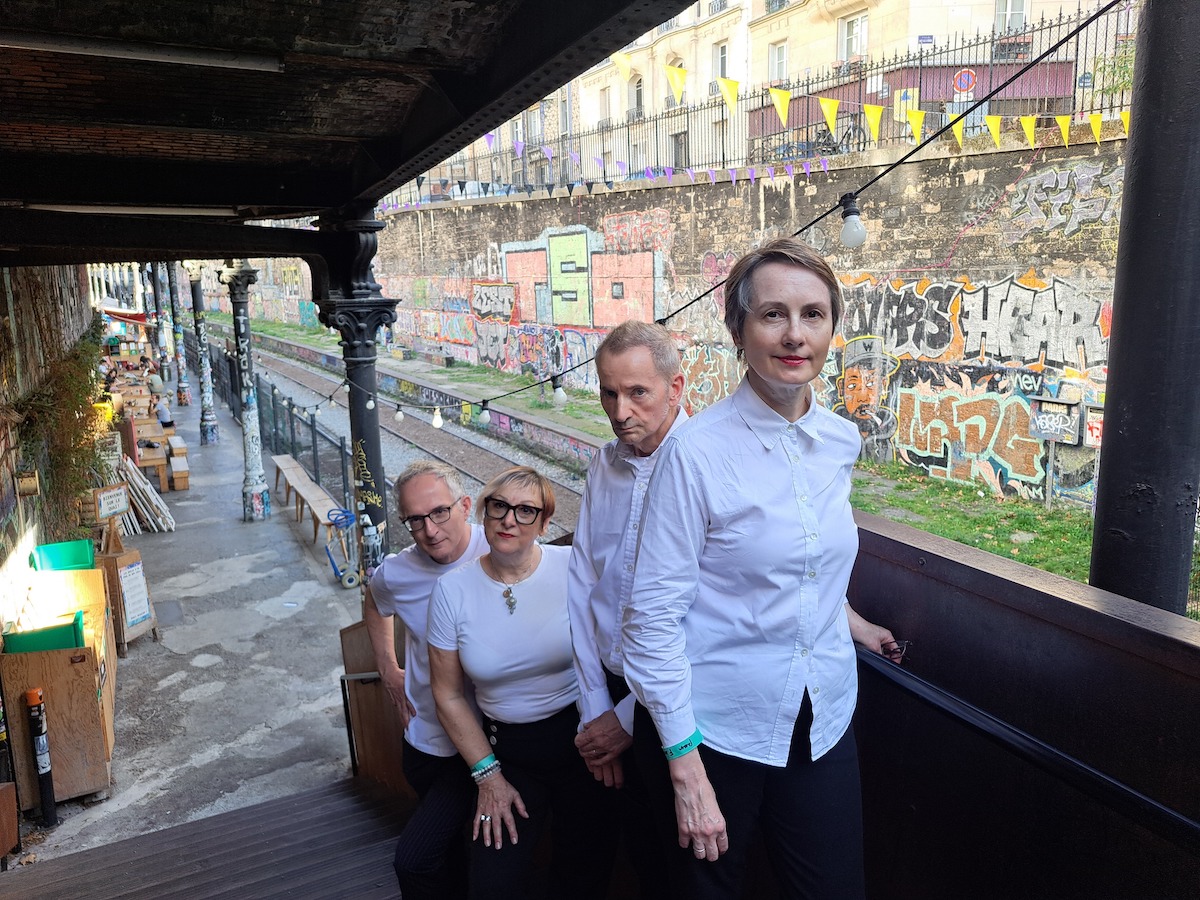
Photo by Ian Greensmith
The arrival of ‘Tears Before Bedtime’ (Skep Wax) the newest LP by the The Would-Be-Goods, feels less like a routine album release and more like the opening of a carefully curated cabinet of curiosities. For nearly four decades the group, guided by songwriter and vocalist Jessica Griffin, has occupied a singular corner of independent pop: literate yet playful, delicate yet slyly subversive. Since their 1988 debut single “The Camera Loves Me” (_ él Records_) first announced Griffin’s distinctive voice, the project has moved through the indie landscape with an elegant independence, cultivating its own aesthetic rather than chasing the fashions of the moment.
Griffin’s work has long drawn comparisons to the rarefied pop sensibilities of the él Records era and the romantic sophistication of mid-century French chanson, yet it ultimately exists in a world of its own. Her songs behave like miniature novels: compact narratives populated with curious characters, doomed romances, and flashes of wit that arrive with arched-eyebrow precision. Across the years, The Would-Be-Goods have built a reputation for turning pop songs into small, exquisitely drawn vignettes; stories that unfold with melodic grace and literary flair.
With ‘Tears Before Bedtime,’ Griffin returns with what may be the band’s most expansive and sumptuous statement yet. Joined by longtime collaborators Peter Momtchiloff (guitar/percussion), Andy Warren (bass), and Debbie Greensmith (drums), she has assembled a record that feels both cosmopolitan and intimate. Crisp guitar lines, buoyant rhythms, and arrangements that nod to baroque pop, surf shimmer, and even Bollywood-tinged horns create a luminous musical setting for Griffin’s lyrical imagination. The songs themselves move fluidly through time and geography, wandering from Belle Époque Paris to mythic antiquity to the quiet drama of teenage bedrooms. Each track reveals itself like a carefully framed portrait, balancing luminous melodies with lyrics that explore the subtle shift from innocence to experience.
Beneath the album’s polished charm lies a current of irony, melancholy, and quiet absurdity, giving the music a depth that rewards attentive listening. In a period of accelerated trends and disposable novelty, The Would-Be-Goods continue to embody something quietly radical: sophistication without pretension, wit without cynicism, and pop craftsmanship that refuses to hurry itself. ‘Tears Before Bedtime’ welcomes one into Griffin’s distinctive universe; one where stories, melodies, and ghosts from other eras mingle under soft light. It’s the perfect moment, then, to sit down with Jessica Griffin and explore the imagination behind one of indie pop’s most enduring and singular voices.
Much appreciation to Rob and Amelia at Skep Wax for the connection and to Jessica for her candor.
James Broscheid: You have mentioned that ‘Tears Before Bedtime’ was the band’s first full-band album in some time that started before the pandemic in 2019. How did the long gestation of this record, across such an unpredictable period of time, shape the themes and emotional arc of the album?
Jessica Griffin: Although I usually write about personal things, of course these are influenced by whatever is happening in the wider world, and I think the mood of my songs often reflects the mood of the times. In the UK, the pandemic isolated us inside our homes for months on end, maybe for the first time in history. For me, this wasn’t altogether a bad thing, as it made me start my ‘song a day’ project. I ended up with 173 new songs, so I had lots to choose from to complete the album. (We’d recorded backing tracks for six songs the year before). I was worried that the pre- and post-pandemic songs might not work well together but now I think it’s hard to tell which were written pre-Covid and which were written later.
JB: You chose a title that echoes the recurring image of “tears,” yet you’ve said the album isn’t necessarily gloomy. Can you unpack that tension between melancholy and joy? How you balance those opposing moods in both lyrics and music? (For example, does laughter ever feel closer to tears than joy?)
JG: Laughter can feel close to tears, but I don’t think that’s what’s going on in my songs. If there’s joy, it tends to be in the music rather than the lyrics. I often combine joyful or upbeat tunes with melancholy lyrics. There’s one song on the new album, “The Back of Your Bike,” with lyrics that are both joyful and sad, but the joy belongs to the past – it only exists in the girl’s memories. Music can be happy and sad at the same time, and I think some of my melodies are both.
JB: “The Gallopers,” the first single, has been described in the press as a “cautionary tale about the glamour and danger of the fairground.” What about that metaphor drew you to open the record with that story?
JG: I’ve always been interested in the interaction between innocence and experience. Some of the characters in my songs are naïve, others are disillusioned, or even corrupted, by experience. A mother’s warning to her daughter seemed like a good place to start.
JB: With guest instruments like trumpet, flute, and cello on this album, it feels richer and more orchestrated than some earlier records. What was it like writing arrangements for these instruments for the first time in your career? Was it liberating, intimidating, or both?
JG: I didn’t intend to write the arrangements for the guest instruments, but it turns out that classically trained musicians usually prefer to be given a part to play, rather than improvising as people in bands tend to do. I enjoyed writing them and found they came to me as easily as my vocal melodies. The biggest challenge was writing them out on manuscript paper. (This was for flute and cello – I sang the trumpet parts to Allison Thomson in the studio as we had a tight deadline, and I didn’t have time to write them out.)
JB: Recording vocals alone at home sounds both intimate and controlled. Do you feel more vulnerable that way, or more protected?
JG: I feel more relaxed recording at home than I do in the studio, where I’m hyper-aware of my surroundings, of time pressure and of the people listening in the control room. At home, on my own, I can lose myself. I feel freer to experiment with my voice, to put a bit more emotion into my singing.
JB: Do you think that solitude brings you closer to honesty or does it allow a different kind of performance to emerge?
JG: A vocal is a performance, it’s not necessarily an expression of real emotion, although it might involve drawing on memories of real emotions. It can be impossible to sing when you’re feeling very emotional, as I found when I was recording the vocals for “The Wind Will Change” (on ‘The Night Life’).
JB: When you finally bring those privately recorded vocals into the band context, does the song feel like it’s being shared… or surrendered?
JG: I wasn’t worried about sharing those vocals with the rest of the band. In fact, Andy and Debbie only got to hear the vocals after the album was mastered. My only concern when I brought the home-recorded vocals into the studio was that they worked with the backing tracks, which they did.
JB: Many of your songs have vivid, cinematic characters and settings. On this album, do you find yourself stepping into these worlds as a storyteller, or observing them with a more detached gaze and has that perspective shifted for you over the years?
JG: The characters and their worlds take me over while I’m writing the song. They are absolutely real to me – I don’t feel as if I’m inventing them. I have sympathy for my characters if the story is being told from their point of view. I don’t judge them. But if I’m telling the story as an external observer, I can be more critical or sardonic. The song that comes to mind is “Mystery Jones” from the album ‘Brief Lives’ (Matinée Recordings / Fortuna Pop!, 2002), about a travelling magician with a sinister penchant for making ladies disappear.
JB: Has writing from inside certain characters ever challenged or unsettled your own moral instincts?
JG: The character in “Goodbye To All That” on ‘The Night Life’ (self-released, 2023), has done some things which I certainly wouldn’t endorse, but it’s a satirical song so I didn’t feel any qualms. On the new album, there’s a song about the Victorian artist Richard Dadd, who became delusional, killed his father and was committed to a lunatic asylum then moved to Broadmoor (where he was very humanely treated and allowed to continue making art). He did something terrible, but I’ve tried to enter into his inner world, using his own writings and his extraordinary paintings. The most famous is “The Fairy Feller’s Master-Stroke” (begun in 1855 and worked on until 1864), which inspired a Queen song (of the same title from ‘Queen II’ on EMI / _Elektra, 1974 – JB). (There’s an exhibition of Dadd’s paintings coming up at the Royal Academy in London later this year, by the way).
JB: An earlier project (which resulted in the self-released album ‘The Night Life’ from 2023), came from a daily songwriting challenge you set for yourself. Did that intense, disciplined creation process inform the way you approached writing for ‘Tears Before Bedtime’? If so, can you point to a specific song where you see that influence most clearly?
JG: About half the songs on ‘Tears Before Bedtime’ came from the song-a-day project. (One of them, “Madame X,” is also on ‘The Night Life,’ but not as a full-band arrangement.) I’m sure that at some point I’ll go back to that writing formula. The key to its success – I wrote 173 new songs – was restriction. I had a daily title as a starting point, which Peter usually gave me (but which I occasionally adapted or chose myself), plus a time limit (24 hours to come up with a demo of the finished song). I found these restrictions extremely helpful as I had a word or phrase to trigger the creative process, and there was no time for self-criticism. I just had to get on with it. I don’t know if this resulted in the songs being noticeably different from my earlier work, but I do know that I found myself writing a lot of songs I’d previously have shelved as “not very Would-Be-Goods.” I might record those as a separate project.
JB: Are there unspoken rules you still notice yourself obeying and occasionally resisting?
JG: I can’t think of any.
JB: The songs you once might have dismissed as “not very Would-Be-Goods” now interest you. Has your definition of what the band is quietly shifted over time?
JG: I’ve never tried to define the Would-Be-Goods as we’ve changed so much from our early days as a studio project (me and a backing band), to a ‘real’ band from the early 2000s, with a detour into a solo project in 2020/21. The Would-Be-Goods may take different forms in the future but I love being in a real band so I hope that will continue.
JB: In your songwriting, characters often feel as alive and specific as real people. Do you ever find that characters return to your work, as if unresolved, and how do you know when a character’s story is truly finished?
JG: I don’t think a specific character has ever come back to me, but types of characters recur, especially the ingénues. I’ve been thinking about writing a concept album based on the characters in “Ouija Board Romance” (one of the songs on ‘The Night Life’), set in a fictional English village in the 1920s or 1930s. Possibly a murder mystery! As for whether a character’s story is truly finished, in some songs I’m painting a little vignette of a life that continues after the song is over, while in others a whole life is compressed into two or three minutes.
JB: The ingénue figure recurs in your work. Do you see her as a cautionary figure, a romantic one, or something closer to a survivor whose story hasn’t yet caught up with her experience?
JG: Not a romantic figure, sometimes a cautionary one, but mostly just someone whose understanding hasn’t caught up with her experience. And the figure isn’t always female.
JB: Your influences span from French chanson (love it!) to garage pop to narrative lyricism. With this record, did you become more conscious of genre blending, or did you still follow ideas wherever they naturally led?
JG: I never set out deliberately to write in a particular genre – I don’t do pastiche. I don’t wake up thinking, “Today I’m going to write a song in the style of Georges Brassens.” But it’s usually clear from very early on (my songwriting process almost always starts with a phrase or line of words and music that arrive together), what the overall sound of the song is going to be, and what sort of arrangement it needs.
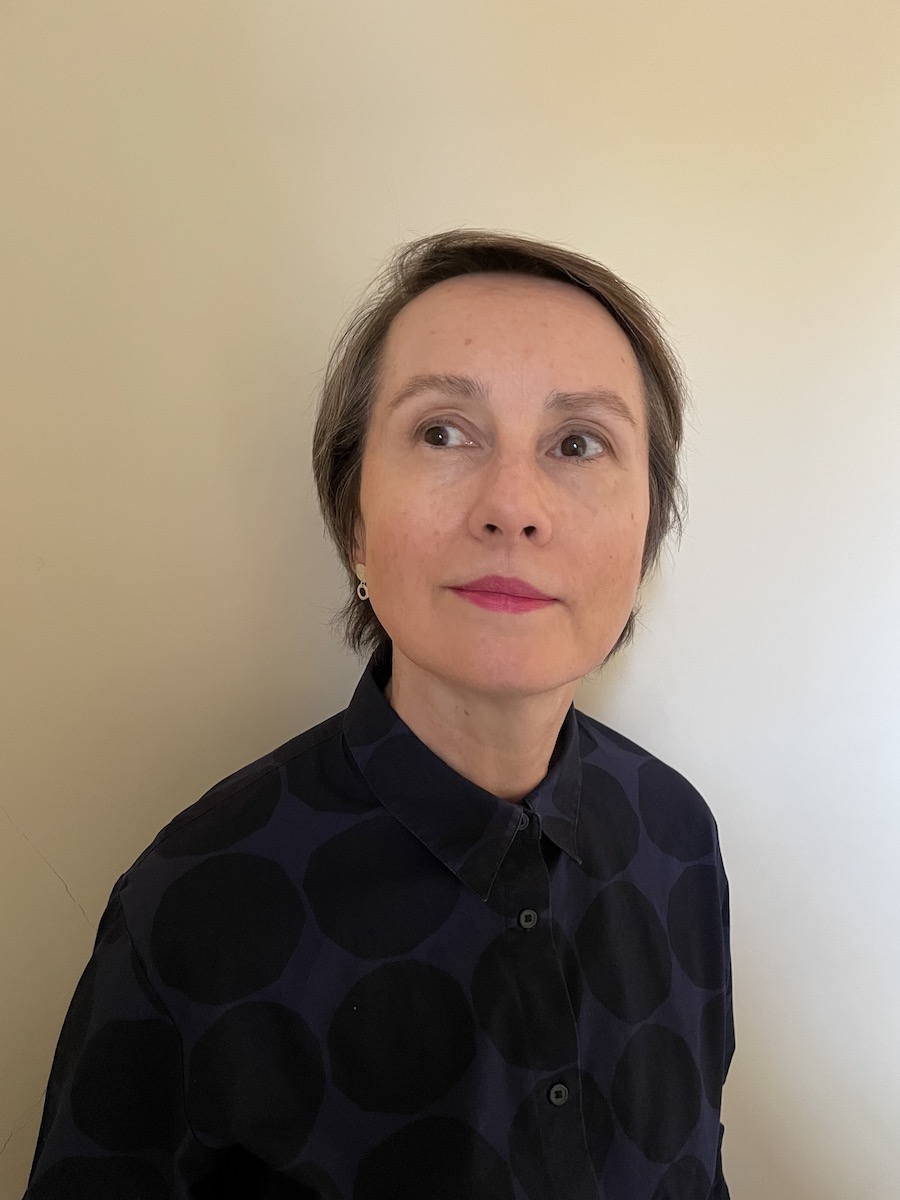 Photo by Peter Momtchiloff
JB: You don’t consciously write in genres, yet you sometimes subvert them. Do you think listeners need to recognize the original genre for the subversion to work or is that pleasure mostly yours?
JG: The original genre is just a starting point. I hope the song will work even if the listener isn’t familiar with the genre it’s subverting. An example would be “Miss La-di-dah” from our album ‘The Morning After.’ It was inspired by those 60s songs in which a man flames a former girlfriend for getting too big for her boots. I wanted to tell the story from the woman’s perspective.
JB: Are there any songs on the album that changed meaning for you from the moment you wrote them to the moment you recorded them with the band? If so, what caused that shift?
JG: Sometimes a song will reveal a deeper meaning to me, but it will be some time after we’ve recorded it, perhaps years later. I think the part of me that writes songs is wiser and more knowledgeable than my everyday self.
JB: When a song only reveals its deeper meaning to you years later, does that ever change how you feel about having released it when you did? Or do you trust the song to arrive in listeners’ lives at the “right” moment regardless?
JG: A song will either resonate with the listener or it won’t, and it will probably have different meanings for different people. So, there is never a “right” moment. I’m not trying to send any messages. My business is just to write the song and put it out there.
JB: You’ve previously described yourself as a lifelong reader and someone who enjoys entering other minds in your writing. How does reading, particularly fiction, influence the way you inhabit personas in your songs, and is there a book you read during this album’s creation that shaped its tone?
JG: I don’t know if I’ve developed my imagination through reading a lot from a young age, or if I’d have had a vivid imagination even if I’d never become a reader. I was going to say that creating your own persona or character is different from entering imaginatively into a novelist’s world but it doesn’t feel as if I’m creating my characters, they are just there. Once or twice I’ve written a song based on a novel I’ve read. An example is ‘Innocent Abroad’ (from ‘The Morning After’) which is about the character Portia from Elizabeth Bowen’s novel “The Death Of The Heart” (Victor Gollancz Ltd, 1938). I don’t think I was influenced by a particular book while I was writing the songs for the new album. When the pandemic started, I was probably chain-reading pre-1960s mystery or detective fiction, as I always do when I’m very anxious or under stress.
JB: Looking back, do the characters you created during the lockdown feel different in their emotional time compared to the ones you wrote in 2019, even if the music sounds cohesive now?
JG: In most of the songs, pre- and post-pandemic, the characters are trapped or frozen in time. For some, time is cyclical. The mother in “The Gallopers” foresees her daughter making the mistakes she made herself. The victims of “Dr Love” keep going back for more of his dubious “medicine.” In “The Moon Doesn’t Mind,” the moon sees human beings performing the same foolish antics again and again over millions of years.
In other songs, the characters are in the thrall of the past. Memory brings lost happiness back to life in “The Back of Your Bike” and in “The Rose Tattoo” a symbol keeps obsessive love ever-present. “Madame X” is about being preserved or frozen in time as a work of art – a theme I’ve explored before, (e.g. in “Cecil Beaton’s Scrapbook”). “Tears for Leda” (probably the oldest of the songs on the album – I wrote it in 2012 or earlier), reflects the Ancient Greek belief that everything that happens is predestined. We can’t escape our fate.
JB: Many artists speak of performance differently than songwriting. Do you find that touring, especially in the first live performances, reveals nuances you didn’t notice in the studio?
JG: If that happens, it’s because the song has an effect on the audience that I didn’t anticipate. An example is “Too Old” from the album ‘The Morning After’ (Matinée Recordings / Fortuna Pop!, 2004), which I thought of as wryly humorous. People have said they find it very sad as well as funny. The audience always falls completely silent when I’m performing it.
JB: You have said that melancholy and lightness coexist. Do you see humor as a defense against sadness, or as something that actually deepens it?
JG: I certainly noticed humor being used in that way in my family when I was growing up. Even the darkest situations can contain funny moments. I don’t know if it deepens sadness … I’ll have to think about that.
JB: After decades of making music with The Would-Be-Goods, are there creative risks you still feel hesitant to take or risks you would like to explore on the next record?
JG: I’ve always written whatever I wanted to write. I think if you always write for yourself rather than producing what you think will be popular, you can’t go too far wrong. But I haven’t always shared what I’ve written, just because some songs don’t seem like Would-Be-Goods songs. I might try some of those songs out with the band and see what happens.
JB: You’ve also worked with very different kinds of labels over the years. What does “a good label” mean to you now in a way it didn’t earlier in your career?
JG: Now that I’m at a stage in my life where I can make music my main focus, it matters more to me that our music is widely available for people to discover. I’d say that a “good label” is one that really likes what we’re doing and does its best to get it out into the world. There’s also a great element of luck involved, especially when it comes to timing. I don’t know why, but it feels as if this is a good time for us to be releasing a new album.
JB: Do you think there’s something distinctive about this current generation of indie labels run by musicians, compared to the indie world of the late ’80s and ’90s?
JG: I don’t have a lot of experience with the music industry, and él Records, my first label, was completely unique, so it’s hard to make comparisons. But it seems that record labels now have to do much more via social media and internet-based media than in the old days when a record’s success depended on the whims of a relatively small number of music papers and magazines and radio stations.
JB: You’ve said before that playing live in America is something the band would love to do, but logistical hurdles make it difficult. If you could design the perfect American tour (concept, cities, even venues), what would it look like? I would love to see you make it over here!
JG: It’s hard to say, given my very limited experience of playing in the U.S. and even visiting the country, (I’ve only been to NYC, Washington DC and San Francisco). My perfect tour would definitely include those cities, but I would love to play in some smaller places too. As for venues, when we went to San Francisco in the early 2000s, I was completely bowled over by the Tonga Room at the Fairmont Hotel. Assuming it’s still there and hasn’t changed, that would be an amazing place to play.
JB: Looking back to ‘The Camera Loves’ Me from 1988 and forward to ‘Tears Before Bedtime’ in 2026, how do you feel your relationship with songwriting has evolved, not just technically, but emotionally?
JG: With my song-a-day project I came back full circle to when I first started writing songs and it felt like a challenge or a game. I can’t say if and how my songwriting has developed technically as the songs I’ve written are so varied. When it comes to emotional development, I can see that in my earlier songs I tended to use wit and humor as a defense against emotion or as a disguise, but I feel a bit more freedom to write about (and express) emotion now, maybe because of the confidence that’s come with age.
JB: If a listener came to your catalog backwards, starting with ‘Tears Before Bedtime’ what do you hope they’d recognize as constant?
JG: It’s very hard to see one’s own work from the outside. A good critic can say far more interesting and perceptive things about my songs than I can myself, I think. Maybe the (sometimes uncomfortable) mixture of melancholy and humor and an attempt to make something beautiful.
JB: In songs like “The Back of Your Bike,” joy exists primarily as memory. Do you find that writing about remembered happiness requires a different emotional distance than writing about present pain?
JG: The emotional distance between me and my subject isn’t something I choose. It’s not that I find it hard to write about (or in the grip of) emotion, whether it’s joy or pain, past or present, but I’ve rejected songs before (or at least, have not released them) because I felt too exposed emotionally. Using a persona or character does give some degree of protection. As I said earlier, that seems to be changing.
JB: You often place joy in the music and sadness in the lyrics. Do you think listeners tend to feel the music first and only later realize what the words are doing to them?
JG: I don’t know. I don’t seek deliberately to lure the listener in with a catchy tune, but it helps. Judging by the comments people make after our live shows, they do listen closely to lyrics, even if it’s the first time they’ve heard us. This makes me happy, as for me the words are as important as the music.
JB: When a song’s sound announces itself with the very first line, do you feel more like you’re discovering the song, or receiving instructions from it?
JG: It usually feels more as if the song has discovered me. It’s never dictatorial although sometimes it can be annoyingly insistent if I don’t pay attention.
Learn more by visiting Skep Wax | Bandcamp and follow the band on their socials here: Bluesky | Instagram | Facebook