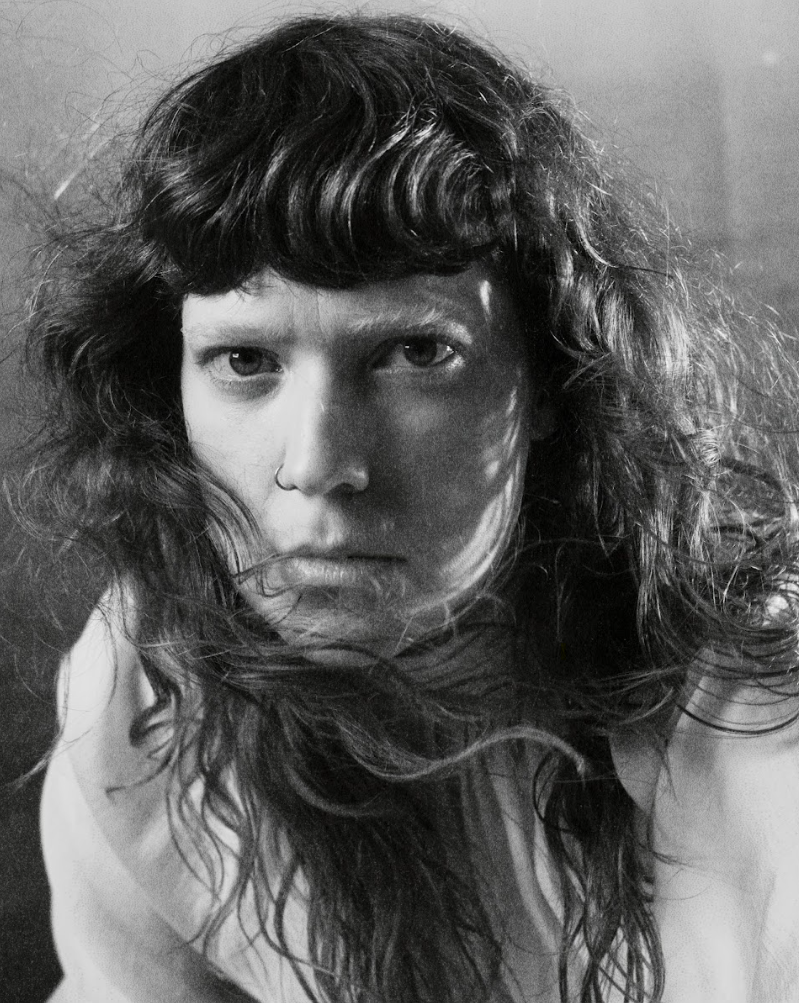
Early in 2026, Lucy Kruger & The Lost Boys released one of the most stunning albums you’ll hear this year. Since moving from South Africa to Berlin in 2018, Kruger has allowed the city’s industrial skeleton to seep into her haunting, noir-pop soundscapes.
Musically, the new record, Pale Bloom, shares a sonic DNA with the expansive, avant-garde arrangements of Circuit Des Yeux, anchored by a gravitas reminiscent of Nick Cave’s most atmospheric work. Kruger’s quiet, entrancing vocals act as a delicate foil to the thick, fuzzed-out guitars and pulsating synth bass evoking the raw, rhythmic tension of PJ Harvey. By weaving remembered nursery rhymes and folk motifs into a landscape of mechanical percussion and industrial grit, Kruger has crafted a soundtrack to a psychological thriller that doesn’t yet exist.
While the music of Lucy Kruger & The Lost Boys inhabits a haunting space, the woman behind it is remarkably grounded. Over a recent Zoom call, I found Kruger to be a warm, pleasant presence, measured in her language and deeply thoughtful in her responses.
When you write a book about your life, what will the chapter title be for 2025?
LUCY: Two things popped into my mind. Something about falling from grace, and something about a sort of elective moment when you realize that your parents don’t know everything, some kind of global version of that, relating to humans. I would say “A Fall from Grace” still sounds too graceful, so maybe a “Stumbling from Grace”.
Paul Simon said in a podcast that the music you listen to and love between the ages of 12 and 16 is the music that will stick with you for the rest of your life. It helps shape and influence who you are as an adult. What were those albums from your teenage years that even today you go back and just love?
LUCY: I understand that statement from a perspective of the music being quite formative, so they leave a very strong impression, but I don’t know how much I returned to it. I have been thinking about this lately, about struggling to return to music that used to mean a lot to me, even in recent years, as if being nostalgic is not so healthy at the moment for me.
Those years, I think I discovered Joni Mitchell’s Blue when I was 16. I think that record will never get old, but I am quite careful to treat it respectfully. I feel like you can wear records down, and I really choose key moments to revisit it when it’s really in a moment of listening. I don’t want it on in the background; I don’t want to corrode it further. The less you listen to something, the more strongly it’s tied to a particular memory; you don’t generalize the music.
Some of the music that I was exploring for myself personally, that wasn’t necessarily familial music, I’m not sure how much I returned to that stuff. I don’t think my taste was great at that time. Maybe it also depends on what’s popular in the time between 12 and 16, and if it’s not necessarily the best music.
Part of Simon’s broader answer was talking about the Everly Brothers and having an opportunity to be in a room with them and saying, “You’ve been in my life my entire time that I’ve listened to music.”
LUCY: Simon & Garfunkel would actually be somebody like that for me because it was around so much in my house. When I do hear it, it is quite grounding, somehow.
There are movies or books that take you time to get into, 10, 20, 30 minutes in, then it hits you. Your album is one where right from the first note, I’m hooked. I don’t need to guess what’s going on or wait for the band to warm me up. Was it intentional to open with “Bloom”?
LUCY: I think you do want to sort of grab people because people’s attention spans are different if you are a very well-established artist who people are willing to give time to. I didn’t necessarily think “Bloom” was that track, but conceptually, it just couldn’t be another song. It’s quite a long opener; the verse is quite drawn out. Many times I thought, “Do I need to cut a verse from this?” and then I thought, “No, it is the song, it needs to be there,” and I just hope that people are patient enough to listen.
At some point, you also think you can only make the album for the listener up to a point. You sort of have to give them the benefit of the doubt. My friend who was helping me with the album said, “Probably if they can’t make it through ‘Bloom,’ this album isn’t for them anyway.” That’s a really good point. You can’t try to fool people into thinking your music is something that it’s not. If somebody is going to listen, they would need to make it past “Bloom,” and if they did, they would be well set up to receive the record.
That is an absolutely fantastic point. When you mention that it’s long, thinking back to the song, I don’t think it’s long, but then again, it probably is. I recently got a link to an album by a pop-punk band; it’s 9 songs and 14 minutes long.
LUCY: It’s an interesting thing that genres do; they work with time completely differently. It depends on how you’re using time. It’s very subjective.
The first word that comes to mind as I’m listening to the album is “haunting.” I usually assign that to scary movies, but I googled it and it says: “beautiful but sad, difficult to ignore and forget.” Is “haunting” a word that you use to describe your music, or that you think about when you’re writing?
LUCY: That makes sense to me. I think it’s where I make the feeling from which I make music, feelings that are strange and lingering, but not so easy to express. It’s more feeling-based and atmospheric. A mood is being expressed more than a concept.
You opened the album with a nursery rhyme lyric, “Mary Mary, how contrary”. I also caught “Catch a Falling Star” in “Animal/Symbol”. In “Ambient Heat,” is the “I know, I know, I know” a reference to Bill Withers “Ain’t No Sunshine”?
LUCY: There are a few moments like this in this album where it is supposed to be, in some way, like a memory trigger. You’re moving through time, so you sing something and it brings up something else. It was a bit of a stream of consciousness. It’s not such a direct reference, but I’m not sure if I even thought of that.
When you’re writing, are you referencing other things you’ve heard as you’re singing?
LUCY: Not consciously. It’s all subconscious theft. A composition, at least in the way I do it, and I think mostly, unless it’s done very cerebrally, is some form of improvisation. It’s coming from whatever comes out of you, and often what comes out of you must be formed from something you’ve heard.
Especially in some of the newer songs where I write over a loop rather than with the guitar, it has the capacity to be more a stream of consciousness. When I write with a guitar, you need to be able to repeat constantly in order to revisit what you’ve written. But if you are just holding a microphone in your hands and recording everything you’re doing, it just can come out of you once, and then you can listen back and feel like that feels like something. It has more memory triggers or impulses leading to other things that are somehow in your body.
When you are improvising, how much of what you do on the spot ends up on the final record? Are those rough drafts that you come back to, or have you written songs where lyrics just come out on the first try and it’s there?
LUCY: There’s been a few songs. Ambient Heat” is one of those examples, and an old song of mine, “Howl,” where I feel like I was not really in control. It was very much a physical experience of singing and singing and singing, and then coming back and seeing what could be repeated or what I could put together to form a song. I think you can hear it in the composition; it’s quite streamy.
When I write on guitar, it’s more structured in the sense of verse, chorus, verse. I usually have some part of it that comes out quite naturally, and then I have to try much harder to get the rest to work around that original impulse. But I prefer it when it all comes out sort of like a catharsis. It’s not very controlled. I have a lot of respect for writers who are very controlled in that sense, but if I’m too in control, it ends up pretty bad.
Do you ever go back and listen to things you’ve recorded and say to yourself, “I don’t remember singing that. Where did that come from?”
LUCY: Totally, very much. Especially these later things where my writing approach is very different. I think, “Wow, who wrote that?” Not because it was necessarily good, just because it wasn’t labored over. It comes from something a bit more subconscious, for lack of a better word.
During COVID, the Beatles documentary really let me see songwriting in process. Seeing how some artists will take a verse from one song, a chorus from another, and an intro from another and put it all together. Honestly, that blew my mind. Do you do that stuff?
LUCY: I feel like those guys are such masters. I love that documentary; I thought it was amazing. I just had an operation and had to rest, and then I watched all of those. It was the perfect time to get an insight into that process. There you have people who are just extremely comfortable with their craft and with each other, and so loose and not restrained. Skillful, but very playful. It’s so funny to see them; they almost look kind of jaded, flippantly throwing around these brilliant ideas while they’re in their 20s.
I don’t do that as much. I used to have a duo called Medicine Boy, and we were both writers. Andre used to do that more. There was a specific song where he heard me writing a song in the second room of the house and came and was like, “Oh, do you think I could take this chorus?” He was a bit more capable of doing that. I get a bit more stuck in the sense of, “This belongs in the short hold.”
But it’s liberating watching that, also realizing, because I think I get stuck in this idea of, “Oh, I have this feeling and it has to be true to this feeling,” but actually it’s all play. What ends up translating might be something where you weren’t feeling something particularly strong at that point, but something is in it that makes it translate. There’s really no rules around what ends up feeling honest. It’s a very serious, but completely non-serious process.
On the song “Woolf,” you sing “Here it comes” and then the song changes tempo and the synth is introduced. Was that your way of letting the listener know the song was about to shift?
LUCY: For sure. I think that was a case of, not so much that you do it consciously, but definitely conceptually, it’s like, “Oh, here’s this old patriarchal story,” and then it drops into this. But the whole song is supposed to be a kind of taunting experience of trying to coax out your muse, but also your old demons.
I talk to a lot of artists now who say that not only are they artists, but now they are their own promoter, marketer, and social media person. Do you feel that pressure of having to do more than just write and record the songs?
LUCY: Definitely. I do work with some people, obviously on a very small level. I just think it’s a very competitive place, people trying to get their music out, ideally trying to make money from it in an economy that’s struggling. In a space where many people can make music, which is wonderful, more than ever no one’s really being paid for it. All those things combined, it’s a bit disastrous and a bit absurd to do it, but obviously many people really want to do it, so we keep trying. It’s a fool’s game, really.
Do you enjoy the social media aspect?
LUCY: No, absolutely not. I think it’s terrifying. It’s dreadful. It feels so spiritually corrupting, genuinely. It’s so hard to navigate your ego in that space. It actually makes me feel a bit ill. Not the act of sharing, but just the act of promoting. To corrupt the idea of sharing with promotion is just a bit sad. There’s something not right in it. But I don’t really know how else one does it. In general, art and capitalism are very confusing things to put together. It does make a mess in the mind.
I don’t understand how an artist can sell out a 2,000-seat venue because of a 30-second music clip that went viral. It sort of takes away the art of it; it’s about who can do the best job of making the right kind of content.
LUCY: It’s interesting. I guess all art is shaped by what the container is. David Byrne writes about this in his book, How Music Works about how the spaces where you’re performing music influence the music, and that’s just always been the case. This just happens to now be the structure. The space is a TikTok video that is however many seconds long. At one point in time, those spaces lent themselves to more meaningful work. The more you shrink time, the more worrying that seems to me. It just feels overwhelming to me, actually. Overstimulating and overwhelming.
If you weren’t constrained by how much music fits on a record, would this album have been longer?
LUCY: You see, that’s the thing. I don’t mind some of those constraints. We learn to sit through an album and we understand that time. For me, that’s okay. I guess it’s just also what I grew up with, but that feels like a good amount of time to enter a world. Even the act of making a single feels like way too much pressure to try and explore a world or translate something. In a single song, it’s quite intense. If you have ten songs, they speak to one another and there are complex layers of meaning that can form that I just don’t know how you would do in a single song. I do want to press to vinyl, and vinyl has 22 minutes a side. That particular restraint kind of suits me.
I’ve talked to a lot of artists who have said that by the time an album comes out, six singles have been released. At first, my thought is that you’ve basically given the whole thing away, but artists often say that you have to keep it fresh in people’s minds. If you drop ten songs at once, they might not make it all the way through, but if you drop one here and there, they might give the whole thing a listen.
LUCY: I will have released five singles before the album comes out, and I do think it’s kind of crazy, but it is again just working within the constraints. For me, it is compromising a little bit with regards to how the world is working at the moment, but still being able to keep that thing that you want to do. There are certain artists where I know they’re releasing an album and I don’t really rush to listen to the singles; I kind of wait for the album before I listen properly. That choice is then yours.
I don’t make playlists; I really do like the act of starting and finishing something because that’s the way that I think you want me to hear your music.
LUCY: Yeah, and I guess that isn’t the case always anymore, but for certain records, definitely. When they started releasing records at some point, they were also like, “Oh, we need three singles and the rest can be album fillers.” So it really depends.
What gives you the most satisfaction? Do you prefer the creation, the recording, or playing live to get the reaction of the audience?
LUCY: I think the writing humanizes me, and the performing brings me to life. The recording is hellish. The recording and mixing process is so tedious to me; it’s so existentially confronting and hard. I know some people love being in the studio, but I always find it pretty hard. The writing can also be hard, but I definitely feel more human after I’ve done it.
Then I just love to play live. There’s a possibility to explore intensity and strangeness that just doesn’t exist for me outside of that space. It feels very invigorating and connecting.
If I understand correctly, your U.S. live experiences have mostly been South by Southwest. Have you ever done a full tour of the States?
LUCY: No, we only played once. It was just me and my guitarist, and we did the New Colossus Festival in New York and South by Southwest in Austin.
Since you haven’t played in the U.S. much, what does touring look like for you? Where do you travel?
LUCY: We travel mostly in Europe. We did the UK last year and will do it again this year, and then we do play in South Africa, where I have some Lost Boys as well. There are five of us in the band. Because of that, we don’t take an engineer, and a lot of the sound is controlled from the stage. We play quite differing setups in terms of the kinds of venues and who we’re playing to.
I don’t know that I would want to see you open for somebody. I think I would need the whole thing.
LUCY: I do prefer to play longer sets. Some bands don’t like to play more than half an hour, but I would like to play for a very long time because I think it takes that time to explore a range of feeling. When we play shorter sets, we end up just really going for it, which is cool, but it’s not necessarily exactly what the band is. I would love to almost play two sets in a night.
Are you playing traditional rock clubs at this point, or are you doing anything more theatrical?
LUCY: I would love to do something more theatrical or deliberate, but it’s just not so feasible at this point. Flexibility is an important part of being able to play. We try to find moments within the club space to elevate it a bit. There is something pleasurable to me in the structure of the rock show that can break boundaries; as an audience member, you can stay or leave, you’re not bound the way you are in theater. That makes it more exciting. It’s a strange space between elevation and reality. You are talking to the audience as yourself, but then in the next moment, you can take it to something quite heightened, and that’s acceptable.
Is it fair to say the U.S. is not a priority for you?
LUCY: It’s so expensive and difficult to get there. With things being what they are, it just doesn’t make sense. Outside of the political situation, which is obviously very complex in many places, it’s just a hard place. For American artists, there is a lot about touring there that is complex in terms of funding structures and getting around. There are so many brilliant bands there, and we’re still trying to figure it out here. It just doesn’t make too much sense, which is sad. I would love to, but it’s not simple.
I love the record; it’s definitely a full album listen. Do you know how easily available the vinyl is going to be in the U.S.?
LUCY: I have them on Bandcamp and I ship to the U.S., so it’s easy enough in that sense. It’s probably not so easy to get in a record store there, but through Bandcamp, yeah.
I always close interviews with this question. For me, there are songs that, when I hear them, take me back to something so specific. Is there any song like that for you?
LUCY: The one that comes to mind now, this is terrible, but when I was about 12, “Teenage Dirtbag” (Wheatus) came out. I bought the single on a CD. I grew up in Johannesburg, and we used to have a little house by the dam about an hour and a half drive away. I went with a couple of friends for the weekend, and my boyfriend at the time was with me, which was very exciting at that age. One night, we took the mattresses down to the dam and were just lying there, looking at the stars with our group of friends. I remember that song was playing, we played that song all weekend.