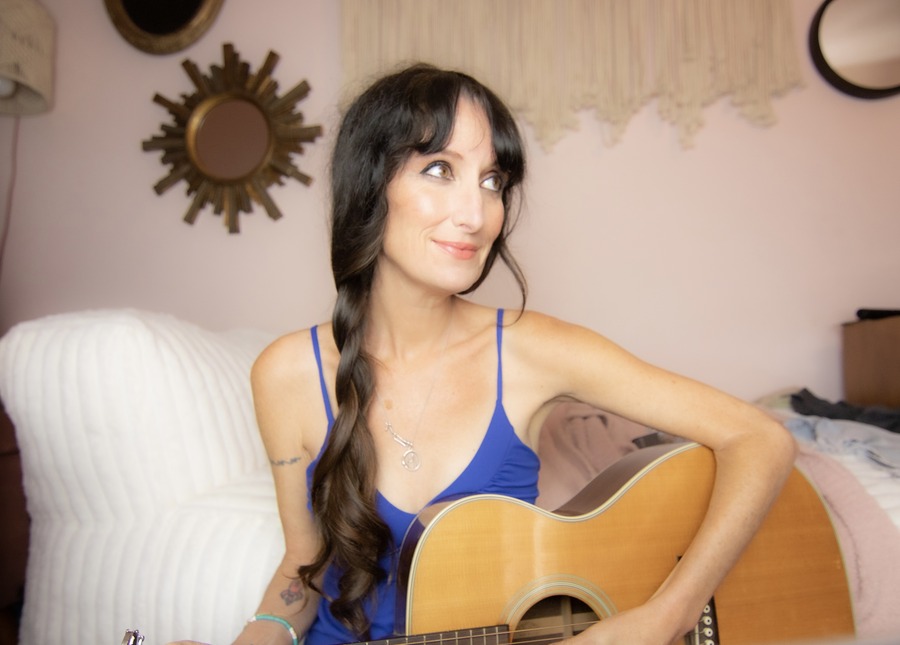
The number of albums Maria Taylor has appeared on throughout her career is genuinely impressive. Two with her first band, Little Red Rocket. Six with Azure Ray. Countless appearances alongside Bright Eyes. And now eight solo albums, the latest of which, Story’s End, arrives after perhaps the longest gap in her recording life since 1997.
Seven years passed between solo records, but Taylor was hardly idle. She toured as Bright Eyes’ drummer, ended a marriage, raised two sons, and lived through a pandemic like the rest of us. Many of the songs that became Story’s End were started in 2020, and she would have liked to release them sooner, but she had the self-awareness to let them breathe. They came out when they were ready, not when a marketing plan said they should.
Now 50, and on the other side of some significant life changes, Taylor’s songwriting has settled into something mature and unhurried. The songs are lush and layered, the lyrics reflective, the vocals tender. It would be easy, at this stage of a career this long, to play it safe and give people what they expect. Instead, Story’s End stands among the best work she’s ever done.
I’ve been following Taylor since I first heard Little Red Rocket in the late ’90s, so that felt like the right place to begin.
I don’t know if a publicist sent me the Little Red Rocket CD or if I bought it, but I was a big Veruca Salt fan and gravitated towards female-fronted bands in the mid-to-late ‘90s. I really liked the Little Red Rocket CD at the time, and listened to it a lot. It’s probably been 25 years since I last listened to it but when I threw it on this week, it took me right back to 1997. It reminded me of driving to work and always having a stack of CDs in the car to listen to.
MARIA: I love that about music. When I listen to some of those first Elliott Smith records, I just go right back to that car, that Toyota Corolla I was driving, and the smell of it. It’s like, better than a picture, really.
I usually save this for the last question but since you brought that up, can you tell me more about how listening to an Elliott Smith song takes you back in time to something specific?
MARIA: It’s more that Elliott Smith record as a whole. I don’t know why, it’s weird, but Either/Or is one that brings me back to Athens and to the Dunkin’ Donuts right next to my house. I can smell it. I remember when I first got this big cell phone, and I could plug it in in my car, and I just remember… everything about listening to that record incessantly, around that time. That was Athens, Georgia. I don’t even know what year, I think I was 23, so, forever ago.
And the album before that, too. That takes me back to Birmingham, Alabama, my first apartment with my boyfriend. I can smell that weird musty smell in there, and I just remember loving the production and realizing, because this was right after we signed to Geffen, being like, “I like this four-track bedroom sound. This is what I should be doing.” It really opened my eyes to a style that I related to.
Little Red Rocket started in Birmingham, Alabama. I heard you say on the See Jurassic Right with Steven Ray Morris podcast that you were dating Remy Zero’s drummer, Louis Schefano. Were you dating him before Remy Zero, while he was in Remy Zero, or after?
MARIA: Louis was with Remy Zero right when we started dating, but then he left Remy Zero and started playing with Verbena. So the first year or two of us dating, he was pretty much the drummer for Verbena, and then he stopped, and then he started playing in Little Red Rocket. Verbena eventually got less active, but we were all just part of this incestuous little Birmingham music scene, just kind of making music together.
The Remy Zero boys definitely had their foot in the door, and they also opened our eyes. Like, oh wow, you can actually get a record deal, you can go on tour. We were just playing music because it was fun, but they really put it in our minds: get a record label, go on tour. I don’t know that we would have had the same trajectory if we hadn’t met them. We just followed their lead.
I don’t know that there are still scenes like there were in the ‘90s. I remember labels sending A&R people to Columbus, Ohio in the mid-90s and scouting bands.
MARIA: I think that because of the internet, there aren’t scenes anymore in the same way. Although, I do feel like there’s this promoter who just opened the Sid the Cat venue in Los Angeles, where I’m playing on Friday, and he’s sort of making a scene, because he’s just this guy who loves music and is bringing people together. It feels more like a scene than Los Angeles has had in a long time.
Birmingham had a little bit of a scene, Remy Zero and Verbena and Little Red Rocket, but when I started visiting Athens, Georgia, and there was the whole Elephant 6 scene, that’s when I really saw what a scene could be. Birmingham had what I always called ‘small-town-itis,’ where if someone like Remy Zero got a record deal, it was like, “fuck Remy Zero, you sold out.” But when I went to Athens, everyone was building each other up. There were publications writing about all of them, they were playing shows together, people were flying out to see them. It was a beautiful difference, and we just immediately moved there.
Then the same thing happened in Omaha, Nebraska. We met Bright Eyes, and there was this other awesome, supportive scene, and we just moved there. We were kind of scene hoppers, but it was so fun. We got to be a part of several scenes in different cities. It was intoxicating in the best way. Any press or any success for one band only helped the whole scene, and it was great.
You must have so many stories. You’re like Forrest Gump. You’ve been in all these different scenes as they were kind of exploding. Do you consider yourself a Birmingham person in LA, or are you fully LA now? When you tell people where you’re from, are you still a Birmingham person?
MARIA: I am very proud of being a Southerner, and my family’s all in Birmingham. But South Pasadena, this little town inside of LA where I live, it’s like Mayberry. I’ve definitely found my home here. I love that I’m raising my kids here. I feel like I’m a South Pasadenan, for sure.
I love Southern people, and it drives me nuts when someone born and raised in LA suddenly has an accent and is writing country songs because they live in Nashville now. I’m proud to be a Southerner.
But I love living here. A lot of my friends moved here around the same time, and that’s important to me. And I love being so close to the ocean and the desert and the mountains, all the possibilities. There’s still some kind of magic in big cities like LA and New York, and I like being near it.
I tried moving back to Birmingham. I got a house right by my mom, walking distance, and it was great to be near my family. Everything was so familiar. But it was weird, I just wasn’t happy. That’s when I realized it does matter, the place. California is just really where I feel happy and inspired. Now when I visit my family, those visits are so special, and when they come here, it’s so special. I feel like I’ve found my home in California.
I know there are reasons for the length of time between the last album and this one. You’d been on a pretty consistent solo release schedule up until around 2016 or 2017 or so, and then raising kids, life stuff, the pandemic. Is that why it took seven years for a new record to come out?
MARIA: All of the above. And then I think it would have come out sooner if Conor hadn’t asked me to play drums, because I was so nervous about that. I really spent about seven months just practicing drums all day before we did those tours. And then he asked me to do another tour, and I just got into drum mode.
I’m so thankful for it, because I really did get to take that space and come back to these songs and make changes that I wouldn’t have otherwise. I feel like the record is so much stronger because of that. But also, I’m just not good at forcing things. These songs had to be finished until they were finished. I realized there was a lot of stress and unhappiness, just a lot of shit going on, and I think the music just wasn’t ready to fully come out yet. It was bottled up inside. But playing the drums felt great, because I was getting it all out in another way.
That feels like good self-awareness, knowing these songs maybe aren’t ready. A lot of people probably rush stuff out for a million different reasons.
MARIA: Definitely. There are songs I look back on and think, why didn’t I spend more time with this? There’s a whole album of mine where I’m like, that was not ready. I just felt like every two years I should put out a record, because that’s just what we always did. And trying to make a living as an artist is just so hard now. I’d think, well, if I keep putting stuff out, maybe I’ll get a license, or whatever. But everything changed after the pandemic, and I just stopped. Not that I stopped seeing it as a job, but I think I knew these songs were something special, something different, and I was going to wait until they were done.
Has your thinking changed at all? In the early days, whether it be Little Red Rocket or Azure Ray or anything else, were you making music for a label, for fans, for other people? Does it feel different now? Did you make this record for yourself, for your fans, or both?
MARIA: Definitely for me. I wasn’t thinking about hooks or singles or anything. I was just trying to make something beautiful, and take my time with it.
How do you know when it’s done? Because you probably could have spent another five years on this.
MARIA: I just knew. Everything I talked about in that podcast, getting divorced, all of it, kind of came to a head, and then I knew the songs were done. But I also knew I needed to start making the record, take it out of demo form and put my energy into something, because I was feeling really depressed and lost and scared. So I knew it was time to dive in.
I started with Mike Mogis, and we intended to do the whole record together, but then he got really busy, Bright Eyes went on tour, and it was going to be another five or six months before he could get back to it. I was in no position to just sit and wait. I needed to work on the songs.
So my friend Ben Brodin, who had just moved here from Nebraska, I worked on a few things at his house, and I could just tell we were really in sync. I loved everything that was coming out of the studio, and so I asked him if he’d produce it. He lives about eight minutes away, so I could just pop in. And I love that I really got to work with all my favorites: Mogis, Nate Walcott, my brother, Brad Armstrong, all the classic people plus someone new to finish it off and mix it.
What was the timeline? Have some of these songs been around for a while in various forms, or did they all come together within a certain period?
MARIA: Almost all of them started in 2020. Some might be 2021, but a lot were started in 2020.
As a mother who has carried children, does this feel like the longest pregnancy ever to finally get these songs out?
MARIA: Oh, yeah. And once it was finally made, I was trying to raise money to put it out myself, and then Conor decided he wanted to put it out, but then the label wasn’t going to be ready until this year. So once it was done, I had to just wait for so long, and I’m impatient as it is. It felt like the longest pregnancy, and then just staring at this newborn baby that you can’t touch for eight months.
That’s why I sent it to so many people. A lot of fans would say they couldn’t wait to hear it, and I was like, “I’ll send it to you.” I just couldn’t wait anymore.
Do you have other songs ready for a follow-up, or are you going to raise this child for a while?
MARIA: I’m going to raise this child for a while. I do have some. It had been so long that there were actually 13 or 14 songs, and I narrowed it down to 10. But usually that means the others weren’t quite worthy, so I might not go back to them.
For now, I just want to ride this one out. I’d love to play some shows, but with my kids, they’ve gone through a huge transition this year, sleeping on people’s couches like the old days just doesn’t make sense in my life anymore. If it was a big tour where I’d be in front of a lot of people and it could really help this record get heard, I would do it. Otherwise, I’m just trying to figure out what makes sense. I know you’re supposed to get on TikTok and do all that stuff. I’m trying. It’s just… ugh.
Let’s talk about your kids for a second. I interviewed Robert Francis recently. He said he has a studio in his backyard and his kids will come down and see him there but they don’t really know that he’s a musician. He said, “They know what I do, but they also don’t know what I do, especially as a performer. I suppose I’d want them to know that I had this whole life that existed before them.” Do your kids know you had a whole life before them? Do they ever listen to your music?
MARIA: I took them on tour until they were about five, then I didn’t want to take them out of school. But my mom would be the nanny, and so we went to Europe several times, and they went on full US tours.
Now, my youngest, he’s a little more daring, will hop up on stage and sing with me sometimes. They know my songs, they learn my songs. My oldest loves to learn my songs on guitar. They’re very aware. There are things I’ve done that they’ll discover. I’ve sung on some Phoebe Bridgers songs that come up trending on TikTok and they’ll be like, “That’s you!” Some of their friends are starting to know who Bright Eyes is, and they’ll say, “My mom’s in Bright Eyes.” I have to say, “Well, not exactly, but I’ve played with them, yeah.” They think I’m cool still. I don’t know when that’s going to stop, but right now I’m happy about it.
There are definitely orchestral elements on this album, “Sorry I Was Yours,” “Powerlines,” “Nathaniel,” that I love. Not quite cinematic, but I just love how you’ve included those elements. Was that planned from the start, or something that came later?
MARIA: I had it in my mind from the beginning. On my demos, I had some cheesy string patches, but I knew if Nate Walcott agreed to do it, I felt like these songs deserved that kind of strength.
I think it’s the ballet dancer in me. From age three to twenty I was a ballet dancer, and I danced to orchestral music every single day. So I hear a lot of strings and classical elements when I’m writing songs. On records where I didn’t have much of a budget, I’d try to arrange them myself, but with this one I was like, “This is a special record, I need Nate.” Those were the songs I wanted him to do, and he just knocked it out of the park.
He sent it back and I was just like, oh my god. There’s really nothing like being in the studio when string players are recording your song. Every time I cry. It adds this whole other element, I don’t even know what to call it. I guess cinematic, but it’s something else. A timelessness. I love the strings so much on those songs.
When I first listened to “Be Careful What You Wish For,” it made me want to hear you do a jazz album.
MARIA: I’ve thought about it! And actually, I wrote that one before the pandemic, I think it was 2019, and I was kind of thinking about that. Like, this would be fun, a little speakeasy jazz thing. I always have ideas like that. I once wrote this kind of bluegrass thing and thought, maybe I’ll do this. But I have ADHD, so…
I don’t really know much about jazz. I know that when I pull up Spotify and put on a jazz playlist, I’m like, “I like this,” but I don’t know what kind of jazz, I don’t know which artists I should listen to. I just know there are certain moments where it’s the most perfect music in the world.
MARIA: But it hits the spot when you need it. There’s just nothing else.
Right. And when I heard that song, I was like, “I could listen to a whole album of this.”
MARIA: Okay, well, I’m going to drop that in my notebook. Maybe I’ll get on that.
You and I both grew up through records to cassettes to CDs to iTunes to Napster to Spotify, and probably back to records. When you’re listening to other people’s music, do you follow whatever format is easiest, or are you a purist about it?
MARIA: I wish I could say I only buy records. But now it’s just so easy. I’m on Apple Music, I pay the subscription, and I don’t feel great about it. Living through it, watching what was a pretty decent living for me just slowly become free… music is basically free now. I need to be better about that. I want to be better about that.
I usually go on walks. That’s kind of my music time. With the kids, I put on playlists while we’re getting ready and stuff, but yeah, usually it’s just my phone on a walk. I used to walk around with a Discman in 2012.
So did I. Do your kids listen to things that are completely different from what you’re into? Have you influenced them?
MARIA: A little bit both ways. Right now they’re into Travis Scott, and honestly, they like whatever’s trending on TikTok, so sometimes our tastes align. But there was a while where they were into this DJ named Alan Walker and Marshmello, artists with, like, two billion views that I had somehow never heard of. They definitely open my eyes to different things. But they also like the music I listen to.
Have you taken them to concerts you might not have gone to on your own? Have you gone to see Marshmello or anything like that?
MARIA: No, I should bring them to something. I’ve basically just forced them to go see my friends’ bands. They do like Bright Eyes and know the songs, and if my brother is in the band, or if I’m playing, it’s fun for them. And they love Phoebe Bridgers, so there have been a couple of shows where we were at soundcheck and they were just running around singing along to her songs. But no, I’ve never taken them to something I wouldn’t have gone to myself.
Your work with Phoebe, did that happen through Conor, or did you know her through LA? She’s from there too, right?
MARIA: Yeah, I actually knew her before Conor knew her, but just through email. My cousin, Scott Register, he’s a music DJ in Birmingham, Alabama, he met her before she blew up, and he emailed us together, like, “you guys need to know each other, I think you’ll like each other.” So I asked if she wanted to open my show. She said yes, but then she was going to play a show with Conor a couple weeks later, and it felt like a conflict, so she was like, “actually, I don’t know if…” and I said, “that’s cool.” That’s when they met. So we did know of each other, but we ended up getting to know each other better through him.
So you’re in a suburb of LA?
MARIA: Yeah, I’m about six miles from downtown. But it’s literally like Mayberry. You can walk everywhere. I can walk to the dentist, both schools, the grocery store. I never have to drive.
That is not what you think of when you think of LA.
MARIA: That’s the thing. I hated LA when I first visited in my twenties. Because no, I don’t like driving, I hate traffic. But I found this great little neighborhood, this little city called South Pasadena, and it’s just great.
Is it a creative community? Do you have neighbors who are musicians and things like that?
MARIA: My record cover is glass art made by my neighbor, he does fused glass, which is different from your typical stained glass. Not many people in the world do it, and he’s really talented. And my across-the-street neighbor is a musician. He’ll be walking down the street with a ukulele. The east side of LA in general has a lot of artists.
But I’ve also met a lot of people through being a mom at school. Now a couple of my really good friends are doctors. Before, I only had musician friends. It’s been fun getting to know people who are completely different. It’s enhanced who I am. You don’t want to be in a bubble.
You’ve got a couple of shows coming up: LA and New York, and a couple more?
MARIA: Yes. My son has a life-threatening food allergy, and he wanted to go on this school trip to the Pacific Northwest, but he wanted me to come along in case of an emergency. So I figured, if I could book a couple of shows, I could afford it. I’m going to play Seattle and Portland. And then New York on the 15th, and then this Friday in LA.
Are these shows with a band, or just you?
MARIA: Seattle and Portland will just be me. LA is going to be a full band, we’ll have the string players there, and a lot of my friends I’ve played with forever. New York will be a band too, I just need to finalize it. I might play half solo, half with a band. But LA’s going to be great.
You worked with a lot of great people on this album, like Nik Freitas. Is it strange being surrounded by all this talent, people who, like yourself, just need their voices heard but aren’t as well known as they should be? I feel like there’s no answer for how you break out and become a household name.
MARIA: No clue. Nik Freitas is one of my absolute favorite songwriters, and I don’t understand why he’s not playing to thousands of people every night. I’ve been doing this forever, and I still don’t know how to get people to hear it. With this record, a lot of people are saying it’s my best yet. But how do I reach people beyond my existing fan base? I don’t know. I mean, I’m 50, I don’t think anybody wants me in my underwear on Instagram.
Unless your kids figure out TikTok for you. I’ve heard of so many artists who blow up because of it, and I’m like, I just don’t understand how to make something go viral.
MARIA: My kids post things and get 5,000 views, and I post something and it’s like 20. They’re like, “just use these hashtags” and I’m singing my heart out to crickets.
What would a successful 2026 look like for you?
MARIA: I would love to get some songs in TV shows and movies, because that’s a great way for people to find you. My biggest songs, the most widely heard ones, got there through being on a show. And I would love for some bigger bands with fan bases that would connect with my music to bring me out for some short runs. I don’t want to be away from my kids for too long, but little two-week runs where I’m playing in front of a lot of people and selling records after the show, that would be great. I think those two things would make me a very happy camper for 2026.
*****************************************
Upcoming Tour Dates
April 10 – Sid the Cat – Los Angeles
April 15 – Night Club 101 – New York City
April 28 – Undertow Show – Seattle
April 30 – Undertow Show – Portland
For more information, including links to purchase Story’s End, visit mariataylormusic.com.