
Photos courtesy of Skep Wax
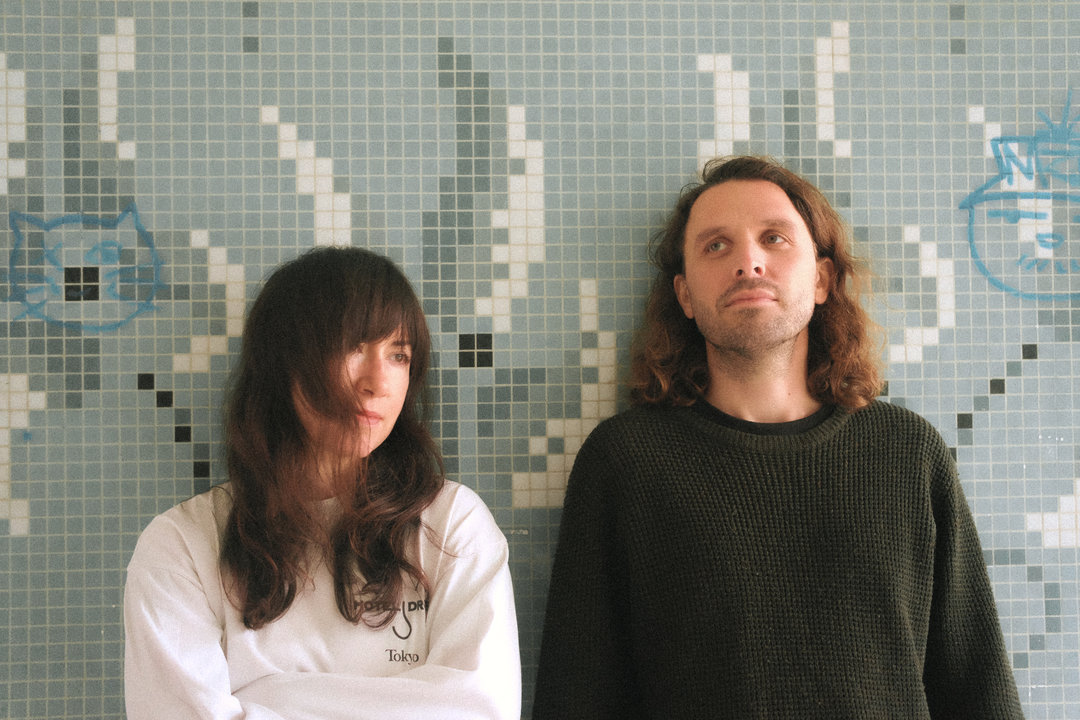
In the heart of Paris, where the echoes of artistic history often lean toward the grandiose, Special Friend operates with a refreshing and deliberate minimalism. This Franco-American duo, comprised of Erica Ashleson and Guillaume Siracusa, has spent the last several years refining a sound that feels as intimate as a shared secret yet as expansive as a hazy afternoon. Their collaboration began almost by accident in 2018 when Erica first picked up the drumsticks and Guillaume picked up his guitar to accompany her practice. What emerged was not a series of covers, but a spontaneous and immediate songwriting partnership that quickly coalesced into their distinctive brand of indie noise-pop.
Their music occupies a unique space between the quiet, contemplative tension of slowcore and the fuzzy, melodic warmth of nineties-inspired lo-fi. Over the course of several releases, from their self-titled EP to the critically acclaimed albums ‘Ennemi Commun’ (Howlin’ Banana / Hidden Bay Records, 2021), and ‘Wait Until the Flames Come Rushing In’ (Howlin’ Banana / Hidden Bay Records / Skep Wax, 2023), they have demonstrated a rare ability to find depth in simplicity. Their work is characterized by interlocking vocal harmonies that switch seamlessly between English and French, underscored by clattering rhythms and languid, effects-heavy guitar lines. It is an aesthetic that values the space between the notes as much as the notes themselves, drawing listeners into a world that is both nostalgic and strikingly modern.
With their latest evolution ‘Clipping,’ Special Friend has moved beyond their initial DIY recordings to explore richer, more immersive textures. By taking their process to secluded countryside studios and collaborating with international mixers, they have expanded their sonic palette to include strings and synthesizers without losing the raw, vulnerable essence that defined them from the start. This growth reflects a band that is not content to simply repeat a successful formula but is instead constantly interrogating the boundaries of their own creativity. As they sit down to discuss their journey and the philosophy behind their craft, it becomes clear that Special Friend is more than just a musical project; it is an ongoing conversation between two artists who have found a perfect, resonant sync in the middle of a noisy world.
Many thanks to Skep Wax for the coordination and to Erica and Guillaume for the conversation.
James Broscheid: ‘Clipping’ carries a metaphor of pruning growth (removing what’s harmful to help something thrive). How do you see this idea manifesting emotionally and sonically across the album? Were there any moments where you felt something had to be removed to let the core of a song really breathe?
Erica Ashleson: The idea of ‘Clipping’ came after we had already composed the song (and later decided to brand the album with the same title). I was thinking of ideas for what the song could be about, and the lyrics came quite spontaneously, as usual, in a free writing sort of way. Existential dread and the passing of time are common themes of most of my lyrics. But there is something very metaphorically beautiful in the art of clipping or pruning. If you want something to grow stronger, you need to remove what’s weighing it down. It wasn’t intentionally a part of the musical song composition side, but I guess you could find a parallel in the way we compose together, with just guitar, drums and vocals, a bit of keyboards, but keeping things simple yet emotional.
Guillaume Siracusa: To me, this metaphor is more meant for life in general. But I guess by that all the choices we make when composing, writing, arranging, and recording songs, are in a way similar to the act of pruning. A lot of ideas are abandoned in the process because we feel they don’t help the song.
JB: What’s the hardest kind of idea to let go of: one that’s technically interesting, or one that feels emotionally right but doesn’t quite fit?
GS: Definitely something that feels right emotionally, it’s all about the emotion in the end. Getting rid of ideas that are emotionally interesting is difficult, but it needs to be done sometimes.
JB: You both describe pruning as a necessary act, but also as something guided by instinct rather than rules. When you disagree about what needs to be cut, how do you usually resolve that?
EA: I’d say we generally agree on most things, the pruning part related to song writing sometimes comes towards the end when we’re selecting songs for the album, deciding which ones to keep and which ones we could revisit later, or completely scratch out.
GS: I don’t think we ever had to argue too much. We often agree and we also easily accept when the other person is not fond of an idea or a song, we’re just two so it’s not too difficult to find ideas that we both like.
JB: Previous interviews showed you embracing lo-fi minimalism and organic methods on ‘Ennemi Commun’ and ‘Wait Until the Flames Come Rushing In’. ‘Clipping’ ventures into richer arrangements and broader textures. How did that tension between simplicity and complexity shape your creative decision-making?
EA: The way we create has always stayed the same: we compose together in our practice studio, composing the music, finding vocal parts, then later writing the lyrics to go along with the song. What changes later in the studio has always depended on the conditions we had access to at the time. We recorded our 1st EP ‘DIY’ in our practice studio. Our first album ‘Ennemi Commun’ was recorded by a sound engineer friend of ours in a different friend’s house on tape, which was a huge level up for us at the time. Our second album ‘Wait Until the Flames Come Rushing In’ was recorded in a DIY music studio by 2 other sound engineer friends of ours. This time around, for our 3rd album, we finally had enough money saved (from touring, merch, record sales, etc.) to be able to record in a studio located just outside Versailles in the countryside, having access to vintage gear and different synthesizers to play around with, while allowing for some production tips from Alexis Fugain (who was pushing the buttons with help from Margaux Bouchaudon).
GS: We were happy to have the opportunity to spend more time with arrangements; it was mostly a lot of fun. From the beginning, we knew that it was important for us to preserve the minimalist approach of our music, so we were careful not to add too many layers of instruments to the songs. Alexis helped us a lot during that part, he already experiments a lot with sounds and arrangements in his own bands, he always had good ideas & insight and helped us make the right decisions.
JB: Speaking of your previous work, you have had a balance between melancholy and momentum. In ‘Clipping,’ songs range from krautrock to folk to slowcore. How did you maintain a unified emotional thread while exploring such diverse sounds?
GS: We don’t worry too much about cohesion in style between our songs. Somehow it just works naturally, probably because the core of our music is just us candidly making songs with a guitar, some drums and our voices. We’ve always had fun experimenting with different styles of music. I think you can already hear that in our previous records, but it is more obvious in this one because we became better musicians and felt more confident pushing things a bit further.
EA: Melancholy is the emotion, but it can be expressed in different tempos, generally mid-tempo to slowcore, but can still somehow be there with a krautbeat or folk song. I think we naturally lean towards this sort of vibe, maybe we’re both just depressed inside (laughs), so we have to intentionally fight against it by composing a few upbeat pop or noisier songs to balance everything out.
JB: Do you see that fight as part of the album’s pruning metaphor? Choosing when to let melancholy stay and when to trim it back?
EA: I wouldn’t say so, at least not directly. The pruning as a metaphor leans more to the lyrics I’d say, since it’s coming directly from my brain. But when it comes to the music composition, it’s really a spontaneous thing that results from both of us playing, and I’d say it’s pretty random whether a song takes on a melancholic state, I’d say it’s more of the tree trunk, and instead of pruning, we do the oppositive of having to hang ornaments on the branches to make it more joyful.
JB: If pruning is about removing what weighs something down, what do you feel this album allowed you to finally keep (musically or emotionally), that your earlier work couldn’t fully hold?
EA: I would rather see it as the result of pruning, what happens after. The idea is to have something that’s stronger, more improved, and I think we’ve evolved as better musicians on this record.
GS: I think on this album we just did a better job at crafting songs to the best version that we could.
JB: Confidence comes up a lot in relation to ‘Clipping’; better musicianship, more studio control, clearer decisions. Do you think confidence has changed what you write about, or just how you allow yourselves to explore it?
EA: I’d say the latter, how we explore rather than the subject itself.
GS: I agree.
JB: As you mentioned earlier, this album was recorded with significantly more studio time and collaborator input (including mixing with Syd Kemp). In what ways did expanding the recording environment challenge or expand your established creative methods?
EA: Spending more time in the studio and working on the mix with Syd Kemp really expanded the record’s soundscapes. The challenge, and what ultimately paid off, was being more rigorous and patient with each take, and not settling out of laziness. That was made possible in part through the guidance of Alexis and Margaux, who would sometimes coach us. It’s challenging, but incredibly valuable to have an outside perspective in a recording situation. Between the 2 of us we’re just 2 brains, but adding 3 more brains really helps bounce around more ideas in terms of production or arrangements.
GS: We were very lucky to be working with very talented people that really understood our music and where we were going with this record. It always felt easy and even reassuring to work with them. To me the challenge was when I was alone between sessions suddenly having doubts about everything.
JB: How do those moments of uncertainty shape the next phase of collaboration? Do they lead to sharper decisions, or more openness?
GS: It depends, oftentimes I just worry too much, and things are already good and don’t need to be changed. Other times, my doubts are a good signal that something needs to be improved.
JB: In the past, you described your recording processes as spontaneous and sometimes constrained by lo-fi limitations. With ‘Clipping,’ was there ever a moment where having more tools or time forced you to reconsider the purity of your initial ideas?
EA: I don’t think so. Even though we had more studio time and access to different gear, the way the album was recorded still really reflects the music we play. That’s part of why we wanted to record at Studio Claudio, we know that Alexis and Margaux understood our universe and we trust their style and taste, same for Syd Kemp.
GS: The songs were all composed before entering the recording studio. So, the spontaneous / lo-fi / embracing limitations spirit was there. Even if we knew we wanted more arrangements for this record, for most of the songs we already had demos that we liked the vibe/mood of, so we had a sort of reference to know if an arrangement idea was helping the song or not. For just a few songs we knew we needed to rely mliked,n the recording and production to get to something we liked and it usually worked with simple ideas like doubling the main guitar with an acoustic guitar in “Nothing.”
JB: Remote mixing sessions with Syd involved intense back-and-forth. Did the distance and digital communication influence the emotional layers in the songs? Can you recall a specific idea that changed radically because of that process?
EA: Same, I don’t remember the recording sessions as being particularly emotional, more like long Google Meets. But I think it helped us feel more connected to the mixing and decision-making process, instead of having someone mix everything and sending it over for us to decipher all at once. This approach actually made things feel simpler and helped both Syd and us move in the same direction, which worked really well. Less phone tag.
GS: It almost felt like we were in the same room with him. We were used to distant mixing but with the mixer sending us a new version of the mix and us giving them feedback so this new way of working actually involved much less back-and-forth since we could interact with him during the process. The mix was done in 2 weeks, which is way shorter than what we’re used to. Certainly, because Syd is really good and always makes smart and efficient moves when mixing. But also, because a lot was done during the recording with Alexis and Margaux, most of the important production decisions were taken before mixing. This is part of their philosophy as a recording studio, trying to get as close as possible to a definitive sound with each take. I really enjoyed doing things that way.
JB: Your lyrics have moved between abstraction and specific references, from Paris protests to ADHD and cinematic touchstones like ‘Buffalo ’66’ (Lionsgate Films 1998), ‘Midsommar’ (Alamo Drafthouse Cinema, 2019). When does a personal experience become “universal” enough for you to put in a song?
EA: Freewriting. I rarely overthink what I write. The only thing that matters to me is what’s in my mind at the moment I sit down to write lyrics for a specific song. The process is almost always the same: I listen to a dictaphone demo of the track and start with a phrase or a word that might have been sung, then build an idea around it. One idea naturally leads to another. For example, “Breakfast” started from this image of my cat staring at me like he wants to eat me for breakfast (he always watches me eat), which then made me think about my apartment and the life I live in it: sometimes doing everything else other than what I am supposed to be doing (ADHD) like rearranging the plants on the shelf, forgetting my keys, things like that. With “Paints a Picture,” my mind was really preoccupied with political events at the time, literally buses burning in the streets of Paris, so I decided to write about that. Sometimes, if I’m not feeling particularly inspired, I’ll invent a whole story inspired by a film. That was the case for “Sanctuary,” which I tried to link abstractly to ‘Midsommar,’ probably because I’d watched it a few days before I had to write lyrics for the song. I mostly avoid very direct personal anecdotes because I prefer things to stay a bit abstract, which makes them feel more universal. But occasionally I’ll allow myself to write about something personal in a more discreet way (“Mold,” which also makes a small reference to an Elliott Smith song), hoping people will still connect to it, because we’re all linked by shared emotions and collective unconscious experiences.
JB: Do you consciously map characters or scenes onto your own emotional life, or does that connection emerge subconsciously later?
EA: Everything is subconscious I’d say.
GS: Erica writes all the lyrics, I have minimal contribution, just a few words very occasionally. I really love her writing. Being a non-native speaker in English I probably miss some nuances but I often get the feeling that I resonate with them and I like singing them.
JB: Erica, Have you ever surprised yourself by not cutting something that felt too revealing at first and later realizing that vulnerability was essential to the song?
EA: It’s not really a question of censorship, because knowing myself, I naturally write in a way that is self-controlled when it comes to song lyrics, knowing it’s public and not a diary entry. So usually, whatever surfaces, I keep or find a different way to reword it, so it works better with the song.
JB: Reading past interviews, you mentioned your rapid creative connection at the project’s start and a mutual spontaneity in composing. Now, after a couple records and tours, how has your dialogue as collaborators evolved?
EA: I think it has stayed pretty much the same, but we keep getting better at what we do.
GS: What might have changed is that we only dedicate specific periods of time for composing now. It’s mostly due to the fact that I moved away from Paris and we have to be more organized. We used to gather every week, and we would either rehearse or jam or compose, depending on our mood. Now we have more intense sessions with more specific goals, separated by weeks, sometimes months, without playing together. I think it helps the creative process. When we start to compose again after a long time, we feel excited and fresh.
JB: You’ve cited influences like Yo La Tengo and slowcore aesthetics in past work. With ‘Clipping’ incorporating folk, krautrock and indie pop, how do you reconcile your indie roots with this more adventurous palette? Do you see these genres as extensions of what you began with, or a purposeful departure?
EA: I think they’re all closely related and not that dangerously experimental, intertwining between indie pop, kraut, slowcore… all very 90s. It’s very unlikely that we’ll make a hardcore or death metal song because it’s not really what we’re listening to.
GS: Experimentation, mixing with other genres is not uncommon in indie music (Yo la Tengo being a great example), which is already a really broad genre. I suppose we’re still going to try new things, to evolve as musicians but it will probably still sound indie. We’ll see.
JB: The album artwork carries symbolic elements (butterflies, orange tree, dice, cat). If ‘Clipping’ were a philosophical thesis rather than an album, what would its central argument be? How do the symbols extend that idea?
EA: Life is evolutionary and always changing. Nothing in the realm of thoughts or ideas is absolute. Like a roll of the dice, you don’t always know what will happen next, but caterpillars become butterflies, trees outlive humans & transcend time, and cats are and will always be sacred.
JB: Did working visually on the album ever clarify lyrical ideas for you or even retroactively change how you understand certain songs?
EA: The lyrics always come first, and the artwork comes later. They both happen spontaneously but always relate because they are both a manifestation of my thoughts and subconsciously linked. I find the connections later after comparing them.
GS: I like the fact that it portrays all these symbolic ideas but at the same time it’s just beautiful candid drawings from Erica.
JB: Throughout your career you’ve balanced the DIY ethos with increasingly ambitious production. Do you see this as a philosophical stance as much as an aesthetic one? Maybe a statement about what indie music can be in 2026?
EA: Ambitious production is relative, because we are far from the big studio production type places that I don’t think we will ever see, we will keep recording with our friends but in good conditions that correspond with our tastes, but who knows how that might evolve.
GS: We’re not making any statement, we still love some DIY dirty lo-fi recordings but we also love some lush modern broad sounding productions. We just do what feels right and what is available for us in the moment.
JB: How does being a Franco-American duo inform your perspective on sound and language? Has the act of singing in both English and French ever made you rethink an idea or emotion in a song because of how it felt in a different linguistic context?
EA: I naturally write lyrics in English but speak in French 95% the rest of the time living here. I think having access to double vocabulary and different ways of saying something can sometimes create some creative song writing. Inertie and Bête from the second album are very abstract, Guillaume, who is a native French speaker, thought what I wrote was strange but took on a poetic form in some ways.
JB: Is that weight something you’re interested in confronting more directly in the future, or does it feel like a different emotional instrument entirely?
EA: I really would love to write more in French, but it’s not as natural for me. Whenever I have more time, I’d like to write more songs in French, but sometimes when we’re in a rush, it’s easier to write in English.
GS: It’s funny because a lot of bands in France sing in English, I guess small mistakes (or sometimes big ones!) make their lyrics sound odd to a native speaker. We rarely see it in the other way. When Erica writes in French it sounds odd to me but interesting. I hope we’ll do it more often in the future but it’s not easy because singing in French really has a big impact on how the whole song feels and its aesthetics. It seems to be harder to make it work for some reason, at least in the context of our band.
JB: Your earlier work was influenced by the pandemic, travel disruptions, and playing live in new territories. Now that ‘Clipping’ is coming out in a post-pandemic touring circuit, does touring life inform the urgency or pace of these new songs? Any chance you’ll make it over to the states for some live dates?
EA: The brain forgets so fast… What is COVID? Right now, we’re both really excited about being able to tour the UK soon, and we’re currently organizing shows in France for the spring and summer. Touring and traveling are very expensive though, and as a relatively small indie band, it would probably only be possible for us to tour the U.S. if we were opening for a more established band with an existing audience or playing a festival that could help cover flights and gear rental. We actually played our first, and so far only, two shows in NYC and Brooklyn in 2020, literally a week before travel shut down because of COVID.
GS: I hope we can make it someday but it’s complex.
JB: Your live performance interaction has shaped past records (with loops, layering, adaptability), did ‘Clipping’ push you toward writing for performance as much as for listening? How do you envision these songs evolving on stage?
EA: We always write for performance (guitar, loops, drums, vocals), but recording in the studio allowed us to spend time on creating intricate soundscapes for the record and finding synth parts, which can later be played live with a 3rd musician if and when possible (Special Friend trio).
GS: I would say we mostly write for performance. But it’s not a golden rule. Most of the time the songs work well without the additional instruments added in studio, with a looper pedal that helps us layer guitars. Our only golden rule (so far) is that we don’t use pre-recorded loops, I always record the loops live. There are just a couple of songs on all of our records that we won’t play without a 3rd musician.
JB: (To Guillaume) Since you’re often responsible for live looping and structure, did the richer arrangements on Clipping change how you think about negative space and restraint during performance?
GS: We don’t bother too much with arrangements when we play live. The songs were often written with looped guitar lines, and they work well like that. We’ve also started to include a third musician playing keyboards on stage, we can switch between those 2 different lineups, the songs are just played differently. Negative space is something important in our approach, it’s always taken into account right from the beginning when we compose a song.
JB: In 2021 you spoke about the joy and challenge of working with someone who understood your music in the studio. Now that you’ve had more experience with outside collaborators, how do you define creative empathy? Has that definition changed since your debut?
EA: I’d never heard of that concept before, but I feel really grateful for the hard work, kind-human-ness, and empathy that Alexis, Margaux, and Syd brought to the process while we were making this record. It never felt cold or transactional, like someone was just doing a job. I like to think they enjoy the record as much as we do (laughs).
GS: For me it’s crucial to work with people who get your music and with whom you shared an idea of where it should be going. Relationships are also important, it can be really intense sometimes, and being with kind people helps. And it’s even better when they are your friends. We had all that plus a lot of talent for this record, we are very grateful.
JB: Between Erica’s early musical background and Guillaume’s experience in other bands having shaped your dynamic, do you ever find yourselves writing against your instincts? Maybe intentionally trying to disturb your comfort zones? If so, how did that play out creatively on Clipping?
EA: Since I’m coming from nothing and have evolved over the years (have played bass, keyboards, and even a bit of guitar in other bands) I still have no idea what I am doing, but thankfully it seems to be working out!
GS: Occasionally (not too often, I’m lazy!), as a musician I like to challenge myself to learn new tricks or techniques on the guitar or to play a new instrument. But in the context of the band, I think we are quite easy-going. Like, let’s just spend time creating together and we’ll see what happens, just having fun! We can be adventurous but always in a naive, playful way so it doesn’t feel like getting out of our comfort zone. We become more demanding when it’s time to decide which idea should be kept for a song, it has to feel right for both of us.
JB: Guillaume, you’ve played in other bands, but Special Friend seems rooted in a very specific intimacy. Has distance (geographic or emotional), changed how you listen to Erica’s lyrics when you’re singing them?
GS: I don’t think it’s changed, when I switch to “Special Friend mode” it feels like nothing has changed and we’re just taking things where we left them.
JB: Do you think that mindset protects the music from over-intellectualizing or does it ever limit how far you’re willing to push an idea?
GS: Probably a bit of both but it’s a very natural way for us to function, so far we’ve been more productive doing things that way.
JB: Looking ahead, do you imagine a point where the act of “clipping” becomes less about restraint and more about regeneration, letting new forms grow that might surprise even you?
EA: It’s never been about restraint, rather not getting stuck on what’s unnecessary and finding the essence of it, not doing too much but also trying to go a bit further in making something beautiful.
GS: Yes, and focusing on what really matters, letting it shine.
For more information, please visit Skep Wax | Bandcamp | Instagram | Facebook | Spotify.