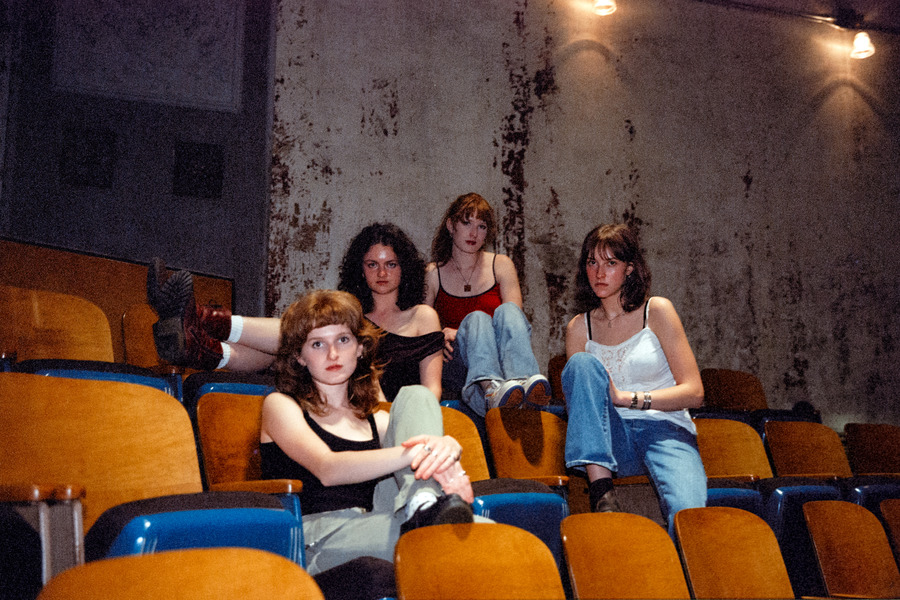
Photo by Miles Kalchik
There’s something remarkable about a band that has been together for nearly a decade, particularly when its members are still young enough to have most of their musical lives ahead of them. For Neptune’s Core, though, the time playing together has given them something many bands spend years trying to develop: an almost instinctive familiarity with one another. Comprised of two sets of sisters – Hannah Richter (bass) and Sofie Richter (vocals), along with Jackie Cywinski (guitars) and Kaitlin Cywinski (drums) – the Chicago quartet has grown up together musically, developing a tightness that comes through in their guitar-driven sound, vocal harmonies and natural chemistry. There’s a hint of ’90s guitar rock in the mix, but Sofie’s theatrical background adds another dimension, giving the songs a sense of character and drama without sacrificing their immediacy.
Pivot, officially Neptune’s Core’s third album, is being treated as something closer to a debut. The band pulled its first two records from streaming platforms, viewing them as valuable steps in the process of figuring out who they were and what they wanted to sound like. Those early albums served their purpose at the time, giving people something to hear while the band found its footing. Pivot represents something different: not a fresh start so much as a pivot toward a version of Neptune’s Core that feels more fully realized, comfortable and proud of where they are today. The album’s release through Shuga Records, home to artists including Post Animal, The Slaps and Uniflora, also puts the band in front of an audience far beyond the Chicago scene where they have steadily built their reputation.
That local experience is substantial. Neptune’s Core has become a familiar presence at Chicago’s street festivals and has played many of the city’s established venues, accumulating the kind of live experience that comes only with showing up and doing it again and again. At the same time, the members are balancing the band with school and their own educational and creative pursuits. There’s no sense of urgency about what comes next. Touring will happen when the time is right and when their schedules allow it. Neptune’s Core has already learned something that many young bands are still figuring out: there’s value in letting things develop at their own pace.
Our conversation reflected that same maturity. There was no need to dwell on how young Neptune’s Core’s members are; their experience, perspective and obvious comfort with one another spoke for itself. What emerged instead was a conversation about growth, identity, community, and creative ambition.
Has this album been a long time in the making? What’s the history of the songs and the recording?
KAITLIN: I would say this album has been a very long time in the making. We started writing the songs for it without knowing when, or if, we’d release them; we were just writing them to write and play them. So some of the songs are a couple of years old, three or four years old even, and others were written right at the recording session. They were recorded across three sessions over roughly the last two years. In the past couple of months, we’ve just been finalizing mixes, masters, and digitals.
When I first heard about you, I assumed you were a new band, but I know you’re not. That said, do the older songs feel like a lifetime ago, or do they still feel fresh and relevant to where you are today?
SOFIE: I’d say they’re still fresh and relevant. I’m trying to think of one of the oldest ones, I think it’s “Tethered”. That’s probably one of the oldest songs there, maybe three, four, five years old. But one thing about our songs is that as we develop as musicians, that development lends itself to the song, it kind of feels ever-changing. Not that we drastically change it, but it’s a flexible kind of song, so we always approach it with fresh energy every time we play it. A lot of people will say, “that time was the best time you’ve ever played it,” and we keep getting better and more confident. So I don’t think the songs ever get old. We still love playing them live.
Because you were so young when you made this album, I’d love to hear you re-record it in 25 years to see if it sounds the same or if, with all that experience, it would sound different.
JACKIE: It’s funny you bring it up, because while putting this album together we were debating adding some songs we wrote six or seven years ago. We decided not to, but it was a big conversation. I think at some point it would be really fun to revisit old songs and do that.
KAITLIN: Kind of related to what you were saying earlier, I think one of the reasons the songs still feel so relevant is that a lot of them hadn’t really been captured in a recording yet, there’s no defined “time capsule” version of how a certain song is supposed to sound, even if it was written four or five years ago. But recording it definitely puts a different perspective on it and gives a lot of people a sense of its true essence, because that’s how most people are interacting with the song. When we play it live, though, it really is a live, ever-growing, ever-changing thing, so it’ll be interesting to see how we feel playing the songs a year after the album is released.
SOFIE: I love that you bring up the 25-year gap from being 22. Some of the songs we wrote when we were 12 or 13, even though that’s a smaller time gap, feel almost as effective, because you’re changing so rapidly when you’re young. One of our first songs was called “Someone Else”. It was catchy, simple, an earworm, and we joke about redoing it. I don’t know if we really mean it, but the thought has crossed our minds, and I think that would be a great time to do it.
When all of you started playing instruments, was it through a music class, a parent, or because you were just super interested in it? Did you go into it with the dream of someday being a rock star?
JACKIE: For me, it was basically what you just said at the end. I grew up going to a lot of concerts, Kaitlin and I are sisters, and I was always fascinated by the guitar players. When I was three, I really wanted to play guitar, but it was way too big for me, so I started with piano. I started with classical piano, and then all the drilling in music theory started being a little too much for me, I was more passionate about the songwriting side, so I flipped over to focusing on guitar and writing music on guitar. For me it was always something I was very passionate about.
SOFIE: I’ve always loved singing, so taking lessons and being classically trained to explore my voice, I loved it, but it was also kind of hard to have to practice and show up to each lesson. I definitely could have practiced more, but I loved the lessons. I also learned a bit of piano and then started guitar, and it was fun to play with people too. I feel like a lot of our first learning years were spent together in this band, we’ve been in it for a long time, so we’ve kind of learned alongside each other, and it’s been really fun to hang out, play music, and improve and learn together.
I was talking to some band where one of the members didn’t learn to play an instrument until they had the time during COVID. I’m so jealous of that. I have no patience for it, so I’m just really impressed that people can dedicate the time, learn to do it that quickly, and put out a record to show for it. It blows my mind.
JACKIE: Sofie didn’t play guitar when we first started the band, but then she started playing. The process at the beginning was really abnormal.
KAITLIN: Hannah and I didn’t start until much later either. Jackie’s my younger sister, but she’s the one who inspired me to get into the music world. I grew up with an intense love for music and going to shows, but I never played an instrument. Then one day it just seemed like, “Okay, I don’t want to be doing sports anymore, I just need to play music.” I took one guitar lesson and it was the worst thing ever. It was physically painful to press down the strings. Then I tried drums and thought, “I think I’m built for this.” That just happened, and I got really into drumming over COVID, playing around with it.
HANNAH: I play violin and piano, but I didn’t really resonate with either. So I started playing bass, largely because Kaitlin and Jackie inspired me, and it just stuck.
How do you get to the point where you go from playing amongst the four of you in a basement or garage to saying, “Now we should actually go have other people hear it and play a show”? Where do you get the confidence to do that?
SOFIE: I think it has a lot to do with our parents and the way we were raised. They’ve been so supportive, so it was almost a given that we’d play a talent show, a middle school fundraiser, or some gig in the back of a Mexican restaurant.
Was that always the mission from the start? When you sat down and said, “We should start a band together,” was it more like, “let’s get together after school and see what we can do,” and it turned into “we’re going to do something with this someday”?
KAITLIN: I don’t even know if that was the initial intent. I think all of us have had pretty intense stage-fright moments, each of us can be overwhelmed by being on stage or in front of a crowd. But when I talk to other people, specifically about Sofie and Jackie’s songwriting, and the way Sofie in particular presents on stage, I almost feel like it was a given that they were meant to share their art with other people. It’s not that we wanted to play in front of a bunch of people, it’s more about creating a community with the audience, and people being able to feel what Sofie’s lyrics mean, and sharing that experience with others.
JACKIE: I think the confidence had to be built over time. Honestly, it wasn’t like we were ready to play and excited the whole time, sometimes I’d be up there thinking, “Why am I up here? This is horrifying.” But we took smaller steps. We started at open mics, which have really supportive communities, and worked our way up to bigger shows from there. I think people are so supportive of bands at every level, and there are a lot of great support systems and communities we were able to find that really built our confidence too.
SOFIE: Old Town School of Folk Music was really helpful, the open mics especially.
I’ve had the chance to speak at some work conferences. I always find that before it starts, I’m nervous and have sweating palms. Then, I present and all that fear goes away and all of a sudden I’m done and I think, “Did I really just do that? I don’t remember any of it.” Is it like that for you?
JACKIE: Yeah, absolutely, you totally get it.
KAITLIN: It’s like you have no idea what happened on stage, but you all have this buzz or energy afterward, so you figure something good probably happened.
SOFIE: I don’t think I’ve ever disliked being on stage. I’m not consciously thinking “oh boy, this is a lot,” I’m just kind of like, “Whoa, I’m playing music right now,” and that’s it. We’re just going forth in this wave. It’s as if playing music is the constant, no matter who’s in front of you or where you are, we’re still just playing music, and that keeps me grounded.
Are you the same people on stage as you are off, or do you put on a kind of superhero persona, like going from Clark Kent to Superman? Is it a different persona on stage, or is everything people see up there really you?
HANNAH: I feel like it’s a different persona, for sure. Personally, I’m pretty shy. I like to pack up the gear; I don’t love going to talk to people at shows and I feel like I have more confidence on stage than I do in a regular conversation.
KAITLIN: As a drummer, I get my shield, and I really like that. People have told me, “You look so focused, where are you when you’re on stage?” On other songs I’m just singing along and can’t stop smiling, I don’t even know where I am.
SOFIE: I definitely channel a different person up there, but as I’ve grown older and performed more, it’s become kind of fun to try to just be myself, have stage banter where I’m not trying to be nonchalant or cool, just literally be me. I think that’s nice. But there’s a couple of songs, “Tethered” especially, where I enter a kind of trance and genuinely black out for it, because I’m rolling on the ground, and I can’t really justify doing that as my typical self.
KAITLIN: It’s a different person, but it’s definitely still part of you.
JACKIE: Honestly, if she was rolling on the floor earlier, that’s not crazy, she literally came over this morning, barely said a word, and just did downward dog and stretches.
So as experienced concertgoers, is that how you learned about stage banter? I’ve seen so many bands that don’t have good stage banter, where you can just tell they’re nervous to be up there. Is it from watching other bands that you picked up how to interact with an audience, or are you still learning that as you go?
JACKIE: I think for me it’s more learning from our own experiences. It’s hard to replicate what anyone else does. Some bands don’t talk at all, and that works well for them and is super cool; other bands are amazing storytellers who talk for minutes between songs about why they wrote something. For us it lies somewhere in the middle, and it depends on the show. Sometimes Sofie will say something, and I’ll make a joke back and we’ll have fun banter; sometimes we’ll tell a story about how a song was written; sometimes we won’t talk at all. It really depends on our energy, it’s more of a natural conversation flow, reading the audience.
SOFIE: I take a lot of inspiration from that. Twin Peaks was great to open for because they’re just comfortable, and the crowd loves them, there’s such good energy. It’s great to be in that zone, feel comfortable on stage, feel the love from the people around you, and then you can say anything. I love Hinds too, they have great energy, and Dehd, always great. I think there are a lot of people who are just happy up there and aren’t afraid to show it and let the audience feel that happiness too. I appreciate that kind of simple, good energy that a lot of musicians bring to their banter.
With the release coming soon, does this feel like the calm before the storm or are you spending every minute promoting, doing interviews, playing shows?
SOFIE: I’d say it’s up and down. Today and tomorrow are pretty busy. I’d say it’s not quite the calm before the storm, but more like some drizzling. We’re getting a taste of that weather.
KAITLIN: After August 7th, the album release, we have a couple other things lined up for the winter. We’re all still full-time students, so we try to do things in spurts. I think we’re also preparing for going into a break for a minute, figuring out what that means for promoting while we’re in school, and then coming back hard in the winter.
I know you’ve released music before, but is this sort of the official first full-length?
KAITLIN: Sort of. We’ve had two other full-lengths, but they’re not currently available on streaming services so we’re calling this our debut record. I think we’re at the point in the band where we’ve established that we want to take things seriously, that we love being in a band, and that we have our sound and the vision we want to create more under control, a certain persona, I guess. We just know who we are a little more now, so we feel like this album is the first accurate representation of what Neptune’s Core is and the kind of music we make.
SOFIE: It’s called Pivot because it’s a clean slate, a new direction, this is how we want to define ourselves. We’re starting fresh and taking down some of the older music, especially since we wrote a lot of it when we were quite young, and so much has changed since then. That’s why we’re calling this our debut record, it’s what it feels like for us.
Does it feel different leading up to the release of this album than the other two records: more excitement, more nervousness?
HANNAH: There’s definitely a lot of excitement and also nervousness. There’s just more riding on this release than the other ones. The others we could justify as being young kids trying out making music, but this is how we want to brand ourselves now.
You have background in being in studios and recording. When you were recording this album, across the multiple sessions, were there things that made you think, “I had no idea this happened in a studio” or “I had no idea you could do this to a song” or did you already feel like you knew pretty much how it would go?
HANNAH: Good question. It’s constantly a learning experience, especially since there are so many instruments you can overdub onto a song that we don’t even technically play; synth, for instance. This album isn’t super synth-heavy, but that’s always fascinated me, even though none of us own synths or play them regularly. Recording these three sessions, I feel like we were all constantly learning something.
JACKIE: What feels very natural to us is just constantly writing in the studio, which is one of my favorite things. We go in, record all of our parts live, and usually keep some of the drums and bass. That part always feels really good and natural, just writing and playing together.
I mention this a lot, but watching the Beatles documentary really opened my eyes to the writing and recording process. I’d never considered that bands take parts of different songs and pull them together to make something brand new. Have you have done that?
SOFIE: A couple of stories come to mind. First was our song “Easel,” which we released as the second single from the record. The ending of that song is a part we’d been sitting on for a long time, it was originally the chorus to a different song I’d brought in a while back. But “Easel” as a full song is pretty recent, one of the last songs we wrote for the album. I remember sitting there writing it, moving along, liking the chorus, but feeling like it was missing something at the end. What’s the grand finale going to be, because we love a good grand finale. So that ending is something we’d been singing on for a while, it became this three-part ending. Similarly, for “Lemon Car”, another single from the album, I was writing it and feeling like maybe it was too out there. Then Jackie started playing something on her guitar, and I thought, “That’s amazing, that sounds great, like this is the missing part.”
JACKIE: I’d just written it, and she asked if I had any other parts, and I said “No, that’s literally all I have.” She said, “Funny enough, I have a song in the exact same key that’s just missing one part” and it was like a perfect puzzle piece.
KAITLIN: That’s also kind of what happened with “Box”, a song we released previously as a double-sided single. They wrote separate lyrics that ended up having very corresponding meanings, and the vocals are interspersed rather than sung together. Since we’ve been playing music together for so long, everything feels so entwined, you can put a part Jackie was playing into something Sofie was making, and it sounds like it was a unit originally.
SOFIE: We blindly wrote these parts, not knowing what the other was writing, and it just happened to work rhythmically and melodically.
That’s amazing. You mentioned “Lemon Car” and “Easel” as the singles. How do singles get picked? Is it you sitting down and deciding, or is it with management, with labels, with a bunch of people?
JACKIE: It was mainly a decision we made ourselves. We wanted a song that was catchy and stood out as a first impression of the record but also carried a message that was prominent throughout. We got second opinions from our management and PR team since when you’ve recorded songs, you know them so well that it’s hard to hear them as a listener, so we like to get outside perspective from friends, family, and our team.
“Easel” is toward the end of the record, and typically singles are second, third, fourth, or fifth, they’re in the top half. How difficult was sequencing the album? Is “Easel” where you wanted it, or did it just end up toward the end?
SOFIE: I’d say “Easel” is exactly where we want it to be, it’s the penultimate song, and it has that meaningful ending I mentioned, since we’d been sitting on that part for a while. Then it ends with “Skeleton”, a song Jackie wrote, which is very down-to-earth, a real acoustic song with two voices, and that felt like the right way to end it. As for sequencing, I don’t think it was too hard; it kind of organically made sense. We had it sequenced before we added three other songs, so there was a lot of rearranging, but once we had the final batch, it felt pretty natural.
I’m always curious: is there a song or two on the album that will probably never be released as a single, the one you love but you’re hoping listeners take the time to find and appreciate, because it’s not right in front of their face? You’ve mentioned “Tethered” a few times, and that’s the one I’ve gravitated to, along with “Cavalry King”. I don’t know if those are going to be singles, but those are the two I keep coming back to as the “hidden” ones.
JACKIE: Honestly, I love the two you named, those were my two picks too, so that means a lot. I think “Cavalry King” is my favorite one to play live, it’s really catchy, really fun, easy to dance to. The guitar part feels like it’s swinging around; it’s just a good vibe. I think it brings energy to the album and is more simplistic than the rest of it. The whole record is very emotional songs, and that one is a story, which isn’t usually something we write about, so I love that. And “Tethered”, I think especially the live performance stands out, though the song is a little different in the recording, very eerie, with crazy harmonies.
SOFIE: I’d add “Cut My Garden Bare”. That was actually the original title track, so its message ties into the message we’ve explained with Pivot. There’s a part where the band first really kicks in, and that’s a very cathartic moment.
That was actually my third pick. I only wanted to talk about two, but that was the one I was going to mention too.
KAITLIN: Sofie’s lyrics and chorus on that one are so powerful. It’s something I feel like a lot of listeners can relate to, but it’s framed in such an empowering-sounding song, which I think is a really cool contrast. I’d also add “Skeleton” as another one, it’s not really hidden, since it’s at the end of the album, which a lot of people do listen through to, but it is very different. It’s special. I think it really brings out Jackie and Sofie’s voices and shows another side of the band and the songwriting, which I think is important.
Tell me about your relationship with Friko and the Chicago scene more broadly. Do you feel fully embedded in the Chicago music scene, or still a bit outside looking in? Is it just from playing a lot of shows and meeting people that your circle grows?
JACKIE: I think we and Friko started playing around the same time. We’re very different ages, but our bands were formed around the same age. We started together and even played smaller shows in Chicago together early on, so we always knew Niko and loved his songwriting. We started recording at the same place as him, which brought us closer to Friko and that whole world, and we ended up playing their release show largely because of Scott, who recorded our album at Trigger Studios.
KAITLIN: As for the Chicago music scene, I feel like everyone kind of knows each other, or at least knows who everyone is. People are going to shows constantly, multiple every weekend. It almost feels stressful in the summer, because it’ll be a Friday night and you have four shows you could go to, with a friend playing each of them. But I think that’s what makes the Chicago scene special, and there are a lot of people we look up to here.
SOFIE: There are fantastic musicians here. It’s amazing that you can drive or take the train 15 minutes and have your life changed at a place like Schuba’s some night. There’s so much talent, and it’s of a genuine nature. There’s a lot of vulnerability that we get to witness. It’s great to be inspired by most of the bands we see; we walk away thinking, “wow”.
I don’t think the Chicago scene ever really went away, but back in the mid-90s when I started writing, Smashing Pumpkins kind of opened the door and Veruca Salt was huge too. A lot of bands you probably don’t know got signed to labels, a band called Fig Dish, for one.
HANNAH: Isn’t your neighbor Blake from Fig Dish?
JACKIE: He is. I babysat Blake’s kids. I ran into Blake two days ago, and I hadn’t seen him in over a year. That’s a really funny coincidence.
That’s funny, because no one ever really knows who Fig Dish is. They didn’t sell many records, but I was a huge fan, and on the Columbus-to-Chicago circuit I saw them play a lot. I got into Friko because I loved the Free Range record and I got a press release saying Bailey from Free Range was in a band called Friko. I expected it to sound very similar, but the first time I heard Friko, it was completely different, and I loved it. And Smut, I really like that record. I think I read somewhere that you guys talked about Liam Kazar.
SOFIE: When I was talking about vulnerability and how amazing it is, I was thinking of Liam Kazar. He’s a fantastic songwriter and lyricist, just a really good storyteller. His melodies, his voice.
The Sharp Pins and Lifeguard too, amazing stuff. I also just interviewed Andrew Sa.
SOFIE: Oh, I love him. Andrew Sa is incredible, he’s got a great voice.
He’s different from Friko, different from you, different from Free Range, but there’s just so much good stuff, and it feels like you all sort of know each other, which is a great sense of community.
KAITLIN: We get compared to the 90s a lot. I think, as far as the sound of our band goes, there’s something about it that for some reason a lot of middle-aged people are drawn to. They’ll say, “You guys remind me of the 90s in Chicago, going to see the Smashing Pumpkins or Veruca Salt. That’s the essence I get from your band. You play rock and roll on stage.” I think that’s really cool, and also something people don’t necessarily expect from us when they see us walk on stage, that we’ll play actual hard rock sometimes. I think it’s cool, especially live, that it can feel pretty intense and bring about that feeling.
Were your parents all fans of those bands? Did you all grow up as 90s alternative kids? Are there bands your parents love that you’re just not into, or bands you love that surprised you were your parents’ taste?
HANNAH: There’s definitely some. I’m thinking of, not even the 90s Chicago stuff, but they played a lot of the Lumineers when I was little, they went through that phase.
JACKIE: I loved Veruca Salt when I was little. Some of their songs were among the first I learned on guitar. There’s a video of me on the couch right in front of us, playing guitar and singing Veruca Salt, and Blake actually sent it to Nina from Veruca Salt. That was pretty surreal. Our parents introduced us to a lot of good music and that’s what inspired me to want to pursue music.
KAITLIN: One thing I took for granted for a while when I was little was constantly hearing Wilco around the house. Our dad is a huge Wilco head. Now I know every song off every album, and Glenn Kotche has been one of the biggest inspirations to me and my drumming, though I didn’t really realize that until sophomore year of high school, once I’d been drumming for a couple of years and started getting more serious about it. His feel, his textural impact, the way he crafts his own part on the drums within the band, it’s really amazing. So Wilco, in that sense, has almost been an inspiration, even though we don’t sound like them at all.
I think that makes sense, and it’s good that you have influences that aren’t obvious. You don’t want to sound just like another band, but you can take styles or influence from the way someone plays without sounding anything like them. I always find that interesting. When I first started doing this, I’d always ask where the band name came from and who your influences were, and I sort of hate asking those questions now. I don’t know if you’ve been asked them a billion times, but I don’t ask them anymore. I do think it’s interesting, though, when an influence turns out to be something I wouldn’t expect.
JACKIE: One of my favorite things is that every time we play live, someone from the crowd tells us we remind them of someone different. We’ve gotten Led Zeppelin before, and I think, where do we even sound like Led Zeppelin? I’m glad they heard that and felt it, and I think it’s nice that people can interpret the message of our music for whatever resonates with you, and hear so many different artists in our sound. I like that it doesn’t just sound like we’re copying music from the 90s or copying a genre, it’s pulled through so much inspiration. Even Kaitlin played a lot of jazz drumming, and a lot of people hear jazz in our stuff. We’re all classically trained too, and I think you can hear that in the harmonies and sometimes in the way we sing. I like that all of that comes through in our songwriting.
I don’t think you sound like this, but if I were a promoter, I’d totally try to book you as the opener for Last Dinner Party. I feel like that would be an awesome bill.
SOFIE: A lot of people say that. Maybe not that exact sentence, but something like it.
As a vocalist, you have that confidence and energy that Abigail from Last Dinner Party portrays. I haven’t seen you live, but I’ve seen Last Dinner Party a couple times, and they exude this “we deserve to be here” quality. “We’re good enough, we’re young, but we can hold our own with people who’ve been doing this for 20 or 30 years.” I always think, “You’re too young to be up there, but you have this confidence that I’m buying into,” and the whole audience buys into it too. I haven’t seen you live, but musically I feel like you exude that same “you deserve to be here, you deserve to be heard” quality. You sound well-seasoned, and I think that’s going to surprise a lot of people when they find out this isn’t your first thing ever recorded. People are probably going to say this brand-new band sounds like they’ve been around forever, and I think that’s a good example of where you are with your experience.
KAITLIN: Thank you. I think also, with Sofie and Jackie having such a strong vocal presence between the two of them, that might be part of that Last Dinner Party vibe too. We get compared to Wet Leg sometimes too, though sometimes that comparison feels more like, “is this just a girl playing rock?” Wet Leg isn’t really our sound, even though we love them and can draw a lot of confidence from their music.
Veruca Salt was one of the first female-fronted bands I really got into, and it’s been spiraling since then. I love women playing rock music. It may or may not have to do with gender specifically, but I listen to a lot of female-fronted bands where I think, “I can’t imagine men doing this, the vocals just wouldn’t sound right coming from guys.”
SOFIE: I really appreciate female voices that go really low and hit that kind of timbre, a low alto is traditionally seen as masculine, but I love it when a woman sings low, like Nina Simone. Or Amy Winehouse, though she’s not quite as low. There are just so many places a female vocalist can go, and I respect so many of them for it.
Give me a Chicago band I don’t know yet that I should check out as soon as we’re done. And then tell me what you’re currently obsessed with.
HANNAH: Sleeper’s Bell. They’re a folk-rock duo who’ll sometimes play with two other members, and they’re really, really good. We saw them the other day at Square Roots Fest, and live they sounded literally perfect. And do you know Feller? Feller is probably my favorite Chicago band at the moment. I think I speak for all of us.
KAITLIN: Our manager Ruby manages Feller as well, and Ruby’s own band, Uniflora, is also really great.
SOFIA: Finom is one of our biggest inspirations when it comes to vocals and melody, they’re so out there, but in such a ridiculously good way. What they’re doing is experimental, risky, and it totally works. They’re unique, doing their own thing, and I love that.
What about your current obsession? What’s on the phone, what’s on the playlist right now?
KAITLIN: Well, this is a bit of recency bias, because we were just at Square Roots Fest and saw them, but I’ve been listening to a lot of Deeper. They played a lot of newer songs, and I think they’re releasing a new album, so I’ve been digging back through their older stuff to get ready. I’ve also been listening to a lot of Chicago rock this summer to keep me amped: Dehd and Twin Peaks, some good classics.
HANNAH: I’ve been listening to a lot of @ with their new album coming. I love their new single, I’ve streamed it basically every day since it came out.
JACKIE: I love Wet Leg too, I think they’re so good live, their frontwoman Rhian is incredible, and even her vision for the whole band is amazing. I love their album cover, just a really good look for the whole band, and the sound is so fun, good to blast in the car, walk around to, go to the gym to.
SOFIE: And I’ve been listening to Bob Marley, really appreciating his voice, his melodies, the overall vibe of the music, it just makes me feel good. I listened to him at the beach recently and it made me smile. I think he’s one of the best musicians I’ve ever heard.
If we get on a call in December and everything’s gone according to plan, what will you tell me has happened between the release date and then?
KAITLIN: We’re opening for someone awesome on tour for the whole summer. That’s it, ideally. That’s all I care about.
Do you have plans to play anywhere outside of Chicago? Have you gone down that path yet, or is it more wait-and-see?
JACKIE: We’re playing a few shows outside Chicago. The day the album comes out, we’re doing kind of a fun DIY thing. We’re doing a Rough Trade exclusive with the album release, so we’ll be playing at Rough Trade in New York on October 9. We’re also playing a show in Indiana, kind of one-off things. And we’re going to have our big album release show on December 29th at Lincoln Hall, which we’re really excited for. That’s a while off, but we’ll have vinyl and maybe some other stuff.
And, to close out this conversation. What song takes you back to something very specific in your life when you hear it?
JACKIE: I think “Habit” by Snail Mail makes me feel like I’m discovering music for the first time. I feel like around that time is when I started discovering new musicians myself instead of just having my dad hand me the best new thing he’d found. That’s around when I started building my own music taste. A funny one is Beach Bunny. If I hear a Beach Bunny song now, I feel like I’m back in COVID going on a run, and it makes me so anxious. It’s like a rush of anxiety, forcing myself to go on a run during a pandemic, terrifying.
SOFIE: I have that with the running thing too. “Little Death” by The Beths. That song really takes me back to a run.
KAITLIN: When it speeds up at the end, we’d just look at each other, so scared.
SOFIE: I’d say “God Only Knows” by the Beach Boys takes me back to before we were doing music so much, when I was acting in plays. That was my everything then, the same way Neptune’s Core is my everything now. The director had so much great music in those shows, and “God Only Knows” was one of them, and I think that will always remind me of that time.
HANNAH: Mine’s probably “Unfamiliar Son” by Twin Peaks. That’s been my favorite song for about seven years since it came out. I remember very specifically when I was 15, there’s a line in the song about “picking it up since the day I turned 15,” and I bawled my eyes out because I could finally fully relate to it. Then I bawled my eyes out again the day I turned 16, because I could no longer relate to it.
KAITLIN: I have this whole stage of life where I started really discovering music and getting into drumming, wearing Doc Martens and flannels, and shaved half my head. I only listened to Green Day and the Pixies, so that’s definitely it for me. Especially “Longview” by Green Day, really anything off Dookie, it takes me right back, and I wonder if my hair’s still all there. The Pixies I think I’ve really healed my relationship with, and they remain one of my favorite bands of all time. Green Day I have a crazy appreciation for, even if I wouldn’t say I listen to them regularly anymore but those are definitely my two.