Photo by Eleanor Petry
There are albums that hit your inbox, when you’re a music journalist, that sound special from the very first note. youbet’s third full-length release (Hardly Art/SubPop) is one of those albums.
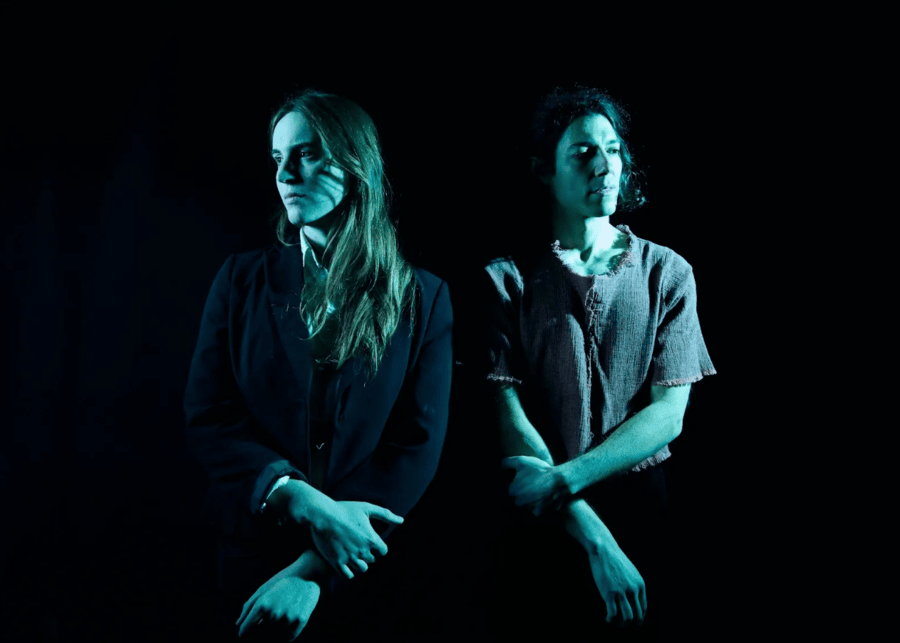
For Nick Llobet (he/they) and Micah Prussack (she/her), every note is open to interpretation. What’s committed to a recording may take on new life in a live setting. It’s all about experimenting, keeping things fresh, new, and exciting, because after playing songs over and over during the recording process and then, if things go well, night after night on stage, the last thing you want is to grow complacent.
The album’s third track, “Undefined,” opens with lyrics that could serve as a mission statement for youbet. “I’m a little undefined,” Llobet sings and that’s the understatement of the year. Avoiding being pigeonholed, describing youbet’s music is a welcomed challenge. In the early ’90s, when genre lines were more clearly drawn, you could’ve called this “indie/alternative”, and listeners would’ve had a relatively clear picture of what to expect. In 2026, with the indie genre splintered in countless directions, that label still fits but it leaves plenty open to interpretation.
Llobet’s falsetto vocals are airy, drifting through songs like “Ground Kiss,” “Nadia,” and “Worship.” In contrast, there are moments of brutish, fuzzy guitars and spitfire vocals on “See Thru” and “Receive.” While the shoegaze revival is in full steam, youbet often operates on the outer rings, never fully committing to the wall of sound or reverb-drenched guitars but flirting with the style just enough. There are jangly, summer park strolls (“Worship”), twisted carousel atmospherics (“Embryonic”), spurts of studio noise (“Bad Moon”), and a quietly graceful landing to close things out (“Bad Choice”).
This album has all the qualifications for serious end-of-year “best of” consideration: it’s charming, anxious, beautiful, chaotic and it keeps listeners guessing while never losing their attention.
Nick and Micah joined me from the parking lot of an oil change shop in Austin, Texas, while on tour with Remember Sports to talk about being on the road ahead of the album’s release, what success and growth look like for the band, how they push themselves to keep things exciting, and the importance of finding the right landing spot for each song in the track list.
I got an advance copy of the album in November. I’ve been listening to it for almost 5 months. You’ve been out touring with Remember Sports for a few weeks now. How tough is it to be touring for an album that you finished a while ago but that people haven’t heard?
NICK: There’s just so much going on that you get distracted by the day-to-day. When you’re on tour and you’re playing the same songs over and over, you kind of reinvent them. You start to experiment. By the end of the tour, you kind of recreated the songs so that you’re still entertained by them. I don’t know if this answers your question, but that’s kind of what’s going through my mind, because when you make an album, it’s like a year until it comes out. So you have to continue to make it fun for yourself, because it’s so easy to get burnt out.
MICAH: In the process of preparing for the tour, we had to figure out how we were gonna play these songs live to begin with. For a few of them, we had never played them live. For a few of them, we had been playing them live for a long time, for the past 2 years, even. So finding a balance between that and the setlist has been really fun. It doesn’t feel like we’ve been introducing a ton of new songs. Really, the new ones are “Undefined” and “Ground Kiss.” Everything else that’s in our rotation, we’ve been playing for a while now, at least a year, sometimes two years.
People who are unfamiliar with the process might ask questions like, “Why does it take so long?” For us, we need the time. We need to make music videos, we need to rehearse. We need to figure out who’s gonna be in the touring band, we need to create promotional material, and it’s a ton of work. Especially because this is a support tour, people, for the most part, other than a couple of diehards, are unfamiliar with our music regardless. So it’s actually been really nice to impress a crowd that is unfamiliar with our music. Our label sent physical copies of the record ahead of time that we’ve been able to sell, and we’ve been selling a ton of them. That’s a very validating feeling, and I hope the people who take it home enjoy it.
Are you having people, before you had the records, come up to you and be like, “Can I buy what you just played?” and you didn’t have anything to sell them?
MICAH: We’ve been specifically shouting it out, like, “Hey, we have our new record.” People have come up and bought our old one, because they didn’t know any better. Every show, there’ll be, like, 2 or 3 people who are like, “I just drove 3 hours to see this show for you guys,” and it’s extremely touching, because we’re not quite at that level that we can headline in some of these markets. But to have that encouragement from people driving far specifically for us, and especially now being able to offer them the new thing, it feels really good.
Do you feel like this record is gonna give you that opportunity to headline your own tours in markets that you haven’t played? Or are you still looking forward to this year as more of an opening-type thing?
NICK: This industry is so unpredictable. We’re so lucky to be able to do what we’re doing now. We’re really just having a great time, breaking even, you know? I hope so. But our expectations are very healthy. I think we just found a way to make it sustainable, breaking even, and just having a good time. We have a lot of friends that we’re making around, and yeah, it would be really nice to step up the ladder, to take one step higher on the ladder of this wonderful industry. But we’ll take whatever we can get at this point. We’re just lucky to be doing this and have our hands work.
MICAH: Nick and I had discussed that if we’re able to continue doing what we’re doing now, that’s still a level of success for us, because we’re happy, we’re enjoying ourselves. Obviously, we could be existing in a greater state of comfort in various capacities, or making a little more money at the end of the day, but this album, putting that expectation aside, does feel like a level up. It’s just impossible to anticipate how that will manifest. There’s so many ways to level up, and there’s so many different levels that you can level up to. I think our goal right now is to one day be able to headline. We’re just gonna keep working, because we have so many songs that we can write, and so many shows that we wanna play, and so many people that we wanna keep connecting with. This is the best part of tours, you get to meet people, you get to stay with interesting people, it’s like a little adventure. In this case, it’s a big adventure, because we’re doing the whole damn country. Nick and I just can’t affix strong expectations to what we’re doing. We’re doing it for the love of doing it at the end of the day, and as long as we can keep doing it, that’s success for us.
Was it just you, Nick, on the other records?
NICK: It was me and some other players. This is the first album where Micah has been incorporated: her vision and her collaboration, her friendship, all intertwined into one birthday cake of music.
Does that make you feel like it makes you a better songwriter?
NICK: I like to think that I’m always getting a little bit better, whatever that means. It’s hard to gauge how to get better at songwriting, but for me, I just have to stay interested, because I like a lot of different styles, a lot of different rhythms, a lot of guitar styles. So I like to think of it as, like, I create a blueprint, and then with that blueprint, everybody can play with it. So it’s malleable. The music evolves throughout the tour. Maybe I try a different chord voicing for fun, or whatever. I’m always trying to keep it so that it’s modular in some way, but the blueprint stays the same. With that kind of philosophy, there’s always a chance to stay entertained, and that’s kind of how I look at it with getting better. Can I continually be entertained by this music without feeling bored by it?
MICAH: Every time we do this, we learn lessons, we learn about what works and doesn’t work. So I think that we’re always getting better. We’re getting better at touring, we’re getting better as collaborators, we’re getting better as songwriters, we’re getting better as musicians. And as long as we’re open to being wrong, which we definitely are, then it’s just a relentless, one-direction climb.
I like how you say it’s not necessarily getting better, because I’ve been interviewing bands for 35 years, and I can’t tell you how many times I talk to a band and they say, “This is the best thing we’ve ever done.” And I’m like, “Yeah, but the last album was pretty good.” I think you made that point a little bit. It’s not getting better, it’s just doing whatever’s entertaining you and whatever is giving you satisfaction.
NICK: Yeah, totally. I listen to the older albums and play those blueprints on tour, and I’m still fascinated by all the things I can still do with them. It’s just different eras of your life. Nothing’s linear, really. It’s like quantum creativity or something, everything can exist in all these different ways at any time, and you just have to be connected in that moment to the right thing at that time. Can you be loose enough to tap in when it’s time to the thing that works in that moment? I think the artists who are open to that state of being are the ones who have the longevity and the sustainability to continue being satisfied. Because at the end of the day, you just have to stay satisfied doing what you’re doing, because it doesn’t pay.
MICAH: The only way that we would really be led astray is to start to become closed off and not learn from our lessons or decide this is the way that this song always has to be. In rehearsal, we’ll decide, oh, we’re gonna end on this chord instead, and it’s in a totally different key, just for fun. Or, oh, let’s extend the outro. We’re always making changes. That’s the beauty of live music, that element of dynamism that you get from doing everything live, that’s so exciting to us.
Would it be fair to say that you consider yourself, first and foremost, a live band?
MICAH: Well, not to write off the work we’ve done as recording artists, but the amount of time we spend on tour completely dwarfs the amount of time that we spend in the studio at the end of the day. I wish we could spend more time in the studio, but that’s more limited by budget than anything else.
NICK: Budget and space. In New York City, it’s hard to find a place where you can record drums.
MICAH: If we had more money and we didn’t have to work day jobs or whatever, then we’d be able to be in the studio more when we’re not on tour. I think we would love doing that. But it’s fine to work within those limitations.
When you stop getting satisfied with something you’ve done in your past, as the live artist, you can just choose not to play it. Like, you can take it out of the setlist, and you can always keep it exciting for yourself, right?
NICK: Yeah, totally. The idea for me is just to have so many songs that we can create a new set whenever we want. It’s just like Pokémon or something. We just have all these little creatures at our disposal, we can just choose whatever we’re feeling. I like to think of songs that way. I think Jimi Hendrix used to think of all his songs as different monsters. I read an interview once where he thought of them that way. I just kind of like to categorize them like that: what are you feeling, what kind of secret power do you want to share right now? So yeah, I love the idea of just having so many songs in your arsenal that you can creatively decide the setlist whenever you want.
MICAH: Maybe this is just us, but I’m sure this is a lot of other people too, but when we listen back to our old stuff, there’s always things in my head that we can do better. I think Nick and I really share that kind of gradual improvement mindset, trusting the iterative process. We could have worked on one album for a decade and maybe put out something that we thought had no flaws, but that’s not how we work. We work on a record, we want it done by a certain day, and then if there’s stuff that maybe we would learn from and do differently next time, then we’ll do it differently next time. It’s about maintaining that velocity and workflow. Some of the songs that we recorded, it’s like, that’s how we played it at that time. It didn’t always used to be that way, and it’s always gonna change in the future, too. So I guess we are live artists in that way.
On “Undefined,” the first lyric is, “I’m a little undefined.” To me, like, when I heard that, I’m like, that describes the record. Like, it isn’t defined. If you can make a mission statement for the record, that is it.
NICK: Hell yeah. I agree. I can never create, like, a solid concept for an album or something, or some theme. For me, it’s just every song is a different moment that I’m trying to capture, and I just throw them all together as they come. I’d love to write in this way, maybe that’s my next endeavor.
MICAH: What, a concept album?
NICK: Not a concept album. Writing with a theme or something.
MICAH: Well, I think maybe you’re talking more about, like, stylistically, how it’s kind of a chameleon, each track introduces something different. Like, “See Thru” is, like, hard rock, and then “Undefined” is, like, kind of art pop indie or something. There’s so many different genres and styles that we’re jumping between.
I think you’re both right. I think it’s, like, the whole package — the music, the band, everything about it. I told my friend I was interviewing you today, and he was like, “What do they sound like?” And I was said, “The sound like an indie rock band”? I didn’t know what else to say. I don’t know how to describe it.
MICAH: Yeah. It’s not as snappy, you know? There are some great bands out there where I think part of the reason why they catch on, aside from the fact that they’re great, is they’re really easy to understand. They sound like Sonic Youth. They sound like whatever cool ’90s band. And that totally is legible to people. I like those bands. But for us, it’s more like, “Well, why don’t you sit down for a sec? You’re just gonna have to experience it a little to try to understand, because it’s hard to describe.”
NICK: We just listen to a bunch of different things, and I personally, when I’m writing, I really just try to stay open and grab whatever interesting melody or rhythm is coming to me, and I just try to mold that into something. It’s almost always something fresh, which is really exciting for me, and that’s why I’m entertained and I keep going. I like the idea of every song being disparate and then coming together for a full collection.
It feels like each half of the album is it’s own record. The first half is what I would describe as a little bit more noisy, indie. The second half took me in some different directions. Was it intentional to make it like side A, side B, and kind of a different feel on each side?
MICAH: I actually thought of the track order, personally, so maybe I can speak to that. There were some prevailing voices in the room that were basically, put all of the snappier songs on side A for streaming purposes, and then put the subdued or more dense tracks on side B for people who want to stick around for that. We kind of adhered to that for the most part. But when I was listening through, I really wanted to make sure it flowed well. We were really struggling with, like, “Where do we put ‘See Thru’?” That one kind of sticks out. We thought having it second, to kind of rock people’s expectations a little of what they’re embarking on, was a good idea.
And then after that, we needed to change it up. It’s almost like writing a setlist for a live show. If we put two songs that have similar tempo next to each other, they’re gonna blend together. We have to change it up. Even if energy-wise that’s jarring, we’d rather jar people than bore them. That’s much more interesting for us.
There’s a really cool musical moment towards the middle of “Worship.” I don’t know what the instrument is that you’re playing.
NICK: I think it’s a sample of a trombone, a really low-pitched trombone on top of a baritone guitar. It’s like a lot of effects. It might be a synth paired with a low trombone, and then also there’s a baritone guitar there, too.
MICAH: And then also the bass. Just the layers. We wanted that part to be heavy.
Micah, I think you nailed it when talking about the track order. The first half to me are the bangers, right? The second half is where it gets really interesting to me, where there’s, like, acoustic-ish stuff, there’s guitar loops. “Embryonic” sounds to me like if I turned on a public access channel, that would be the theme song for some show.
And then you kind of get this mid-tempo closer. Like I said, the second half to me is the interesting part. I love the first half, but the second half is when I get interested. You’re the third artist I’ve talked to this year that had two songs maybe back-to-back with the same word in the title, or within the first 2 or 3 songs. Was that just a luck of the draw the way they landed?
NICK: I think it was luck, yeah. And then also, it was kind of like, cool, they’re next to each other, that’s kind of cool.
MICAH: I felt strongly that the album should end with “Bad Choice,” and then our producers wanted “Bad Moon” to be, like, track 1. So that would be an idea, but we decided that “Ground Kiss” should be the opener, so then “Bad Moon” got moved to the end.
You’ve toured with some of my favorite bands of the last few years. I saw you did some dates with Friko in 2024.
MICAH: Yeah, it was like 3 and a half weeks or something.
Have you heard their new record?
MICAH: You know, they sent it to me. I texted them specifically for it, and then it got lost in the sauce. I still need to listen to it. I’m sure it’s great, they’re great.
NICK: They’re an amazing band, and they’re amazing people.
MICAH: I love hanging out with them, they’re wonderful.
The other band that I don’t know if you toured with or played a show with, that is another one of my absolute favorites, is Hello Mary.
NICK: Oh, yes. We played a show with them. We played with them at Nightclub 101.
MICAH: They’re amazing. We loved them.
I’m excited about whatever they’re gonna do next.
MICAH: They’re so sick. Stella is an amazing singer. The fact that she was playing drums in that band was crazy, and singing at the same time. But now she’s playing guitar in the new band, Nine Perfect Lives.
Tell me a couple bands that I should listen to, that you’re also into. Anything you’re listening to in the van that is worth listening to?
NICK: I saw this band a few weeks ago called Cohort B. That’s incredible. They just blew my mind. They’re a New York band.
MICAH: They opened for the Jesus Lizard, I think. It was maybe their biggest show, but they’re kind of still at the DIY level. They’re like a punk hardcore band, but they have some elements of, like, Model/Actriz and Swans in there. It’s extremely good. We were blown away, we were both at the show.
To close out, is there a song that as soon as you hear it takes you back to something super specific?
MICAH: For me, it’s “Dear Prudence” by the Beatles. When I was first kind of learning bass, maybe at 2 years in or so, I just got really into learning Beatles bass lines. So whenever I hear “Dear Prudence,” I think of being in seventh grade at Hebrew school, being mad that I was forced to study for my bar mitzvah instead of practicing.
NICK: When I was a kid, I watched a lot of movies, but one movie that really stuck out to me was Hook, the Steven Spielberg movie with Robin Williams. The soundtrack, the John Williams score for that, I’m always listening to it. It’s a little goofy at times, but it takes me right back to eating a peanut butter and jelly with Doritos. I just remember being, like, 4 years old. I still listen to it today, and that soundtrack is so beautiful. That movie also is just one of my favorite movies of all time.
MICAH: Actually, I need to revise my answer. Every time I hear the Shire theme from the Lord of the Rings movie, I uncontrollably cry. I don’t know if that’s better or worse than the Beatles, but that’s my truth.