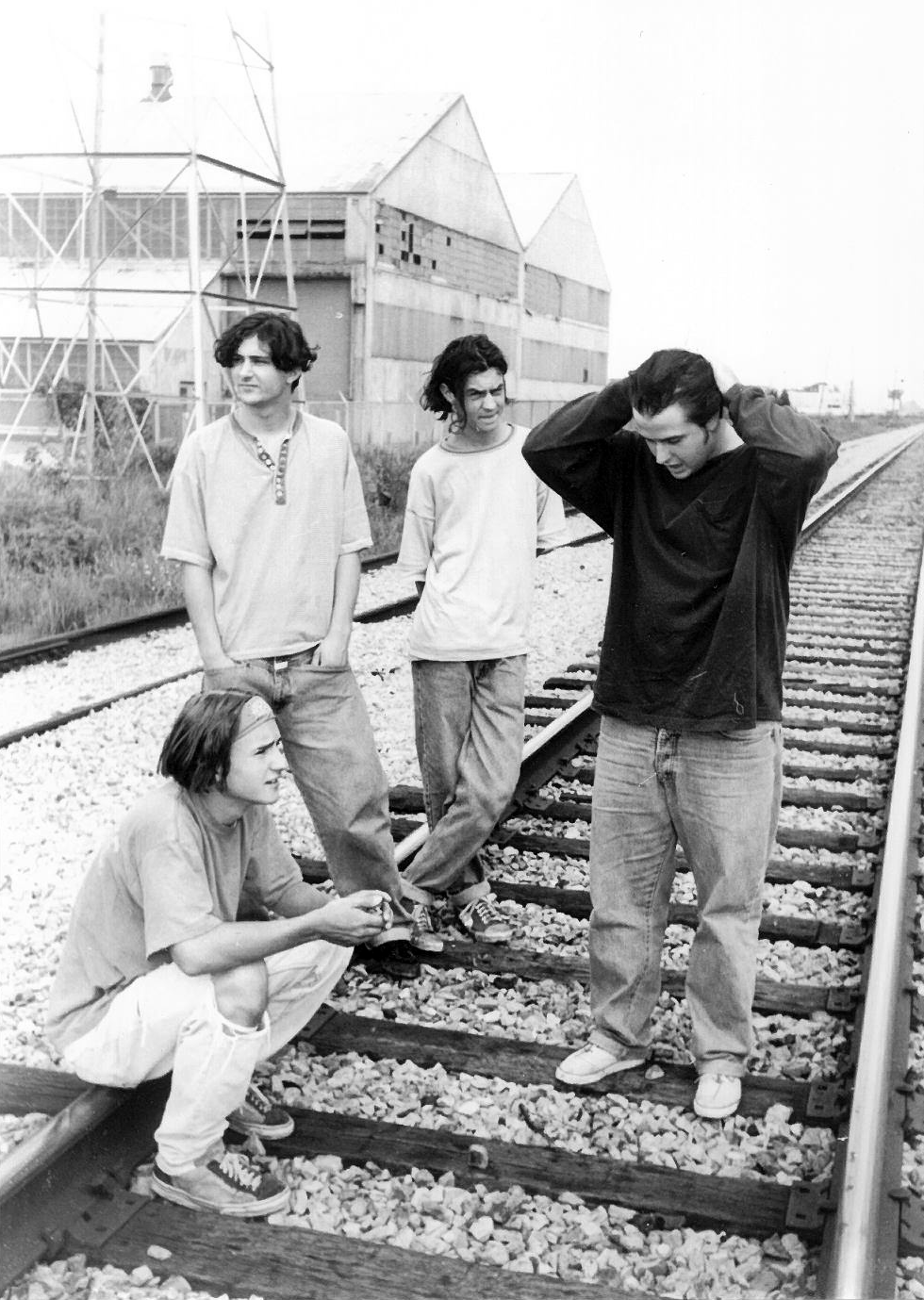
All photos courtesy of Painted Air
Long before nostalgia circuits began canonizing regional scenes, Detroit’s early–mid 1990s underground was already alive with a kind of restless, luminous ambition. Amid the city’s industrial afterglow and musical lineage, Spectacle emerged not as followers of a movement but as one of its gravitational centers. Formed while its members were still in their teens, the band carried an uncommon sense of scale and intention, fusing the hazy textures of shoegaze with a structural boldness that hinted at something larger than the genre’s typical inward gaze. By the time they were sharing stages with their contemporaries and quietly reshaping the expectations of local audiences, Spectacle had already begun to outgrow the scene that first embraced them.
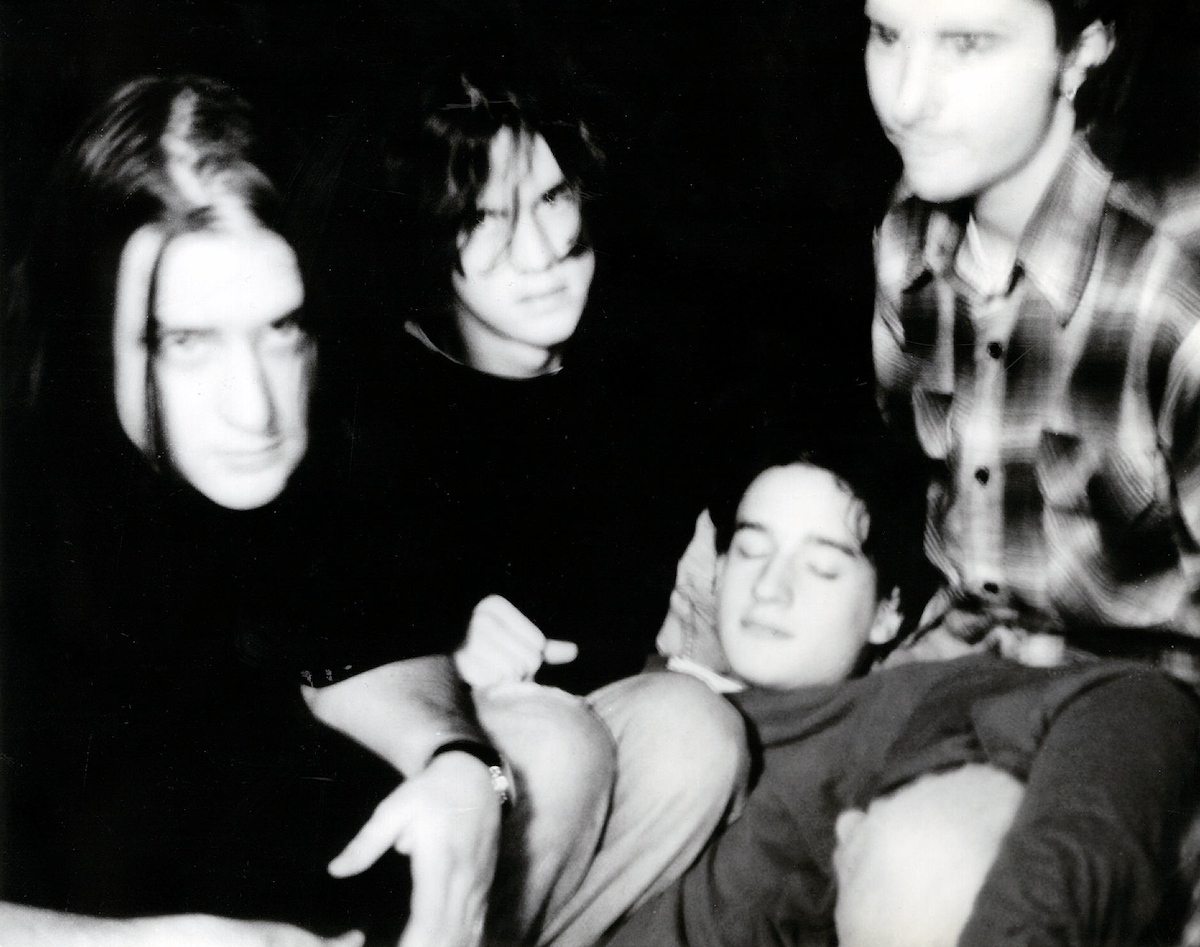
At the core of the band’s identity was a tension between atmosphere and force. Travis Hawthorne’s voice and guitar work threaded melody through dense tonal architecture, while Loren Jackson’s guitar expanded that architecture into something immersive and nearly cinematic. Beneath it, Eric Campbell’s drumming provided both propulsion and fracture, alternating between precision and overwhelming impact, and Nick Sheren’s bass grounded the entire structure with a calm, deliberate presence. Together, they created music that felt less like a collection of songs and more like an environment; something to move through rather than simply listen to.
Their early momentum culminated in ‘Developing In A World Without Sound,’ a release that captured the band’s emerging voice while leaving clear that their ambitions were still unfolding. That promise led to a major-label signing and the recording of ‘Melborn’ in 1993, a record that would come to define Spectacle’s mythology as much as its sound. Working with producers attuned to both experimental nuance and expansive sonics, the band crafted an album that stretched from shimmering, almost fragile passages into towering waves of psych-infused intensity. It was a document of a band in transition, pushing past genre conventions toward something more fluid and emotionally resonant.
Yet ‘Melborn’ never arrived in its time. The abrupt dissolution of their label support left the album shelved, its release deferred indefinitely just as the band stood on the threshold of wider recognition. What followed was not a dramatic collapse but a quiet dispersal. The members moved on to new projects and directions, their creative instincts continuing to ripple outward in different forms, even as Spectacle itself became a kind of unfinished sentence in Detroit’s musical history.
Now, decades later, ‘Melborn’ reemerges not simply as a recovered artifact but as a reminder of how much was already present in those early recordings. The album reveals a band operating with a clarity and daring that feels strikingly contemporary, even as it remains rooted in a specific time and place. In revisiting Spectacle’s story, there is less a sense of reclaiming something lost than of finally hearing something that was always waiting, an echo from a moment when possibility felt boundless, and four young musicians were determined to meet it head-on.
Many thanks to Michael Vitrano at Painted AIr and to Eric and Travis for the great conversation.
James Broscheid: I was born and raised in Cleveland, so I spent a lot of time driving up to Detroit to see bands that didn’t come through Cleveland. Places like Magic Stick, Majestic Theatre, The Shelter, and of course, Saint Andrews Hall.
Travis Hawthorne: We were just in Saint Andrews the other night.
JB: Detroit always got a bad rap from people who never went there. I always enjoyed going to Detroit for shows.
TH: I saw The Verve at Saint Andrews, twice.
JB: That’s funny you mention them because I was trying to get tickets when they played at Saint Andrews when ‘Urban Hymns’ was first released. It sold out right away, so I had to settle on Avalon right outside of Fenway in Boston. I saw them once without Nick McCabe and it was horrible. They were playing arenas by then and they were a totally different band without him.
TH: They were so good. I remember hearing “Rolling People” at Saint Andrews before it was out and they said, “Yeah, we just wrote this.” If people never got to see barefoot Richard Ashcroft on stage, you missed out. The Verve in their 20s, running around stage with no shoes and socks on. Those shows were amazing. The Chicago Metro show was transcendent.
JB: I spent some time in Chicago back then too. Still my favorite show ever was at The Metro when Catherine Wheel did a handful of pre-‘Adam and Eve’ dates over here in ‘97. It was mind-blowingly good being center stage up in the balcony.
TH: For sure. Do you remember the band Revolver?
JB: Yeah.
TH: They played at a local record store in Dearborn, Michigan, just a little shop. I ended up driving the drummer (Nick Dewey) around for the weekend. He wanted me to take him to the mall because he’d never seen a mall. He wanted to know what they were like because he had heard all this hype.
JB: (Both laughing) That’s so funny.
TH: I’ve got the drummer from Revolver in my ‘86 Ford Escort hatchback going to the mall (more laughter)!
JB: By the mid-90s, I thought I had a pretty good pulse on shoegaze because I was so into it, and I had never heard of Spectacle. I was into the Bedazzled Records and Burnt Hair Records stuff. With Painted Air now pressing these albums, the three that they put out so far, I’ve never heard of! I love it though, because there’s so much stuff out there that I’m constantly discovering and Spectacle is one of them. So, I wanted to start by asking you both about Spectacle’s background. Where did you meet and how did the band start?
Eric Campbell: Go ahead, Travis.
TH: The way we got together, I graduated from high school a year before Eric and Loren (Jackson). And Nick (Sheren) was behind them a year.
EC: Actually, Loren and Nick were the same year, and they were a year behind me.
TH: Yeah, there you go. I was out of high school already and I didn’t know what I wanted to do, I didn’t really want to go to college. I had gotten a new guitar for Christmas and knew Loren from high school. During the Christmas break from school, Loren came over and showed me some stuff on guitar, and we just caught up about school and everything. That was that and we kind of went our separate ways. When I finally decided I didn’t want to go to college yet, I ended up calling Loren and wanted to know if he wanted to get together and do a music project, and he said, yes. Then, a friend of mine went to the same high school that Eric and Nick went to, and he knew about Eric and his drumming. He kept telling me about this guy who was super awesome on drums and that I had to meet him. He kept trying to hook us up and one day we just planned for Loren and I to go over to Eric’s house. Somehow, it was planned, there was another guy that was going to play bass.
I just remember getting over to Eric’s house; he was sitting in on drums for what was Nick’s old band. Nick was singing and playing guitar, and they were just wrapping up, and Loren and I were waiting to meet Eric. They wrapped up playing, and this other guy who was supposed to play bass, he wasn’t there yet, but I didn’t know that, and I don’t think Loren knew that, and we didn’t know who anyone was. So, Nick was sitting down there still doing his thing and we thought he was the guy and said, “Pick that thing up and let’s get cooking on the bass!” We didn’t realize he was the singer and guitar player for the other band, but Nick being Nick just picked up the bass. The other guy wasn’t even there yet. If I remember right, by the time the other bass player finally arrived, (who was supposed to be the bass player), we were good, we didn’t need him (laughs). We just started jamming, and then he showed up and we were like, “Who’s going to tell him he’s not needed anymore?”
EC: I don’t remember this nearly as well as you do.
TH: His name was Brian, and he was a football player.
EC: Brian McCarroll
TH: Yeah!
EC: He had a Fu Manchu mustache … kind of a burnout-looking guy (laughs).
TH: The most un-Spectacle bass player (more laughter). He literally was a football lineman.
EC: He was a linebacker. I remember this because I, like an idiot, played football for one year and I hated it, but I grew up kind of playing it because my dad and my brother got into it, and my dad coached different teams. I was never a sports person. I remember he transferred from another school to the team, and I was like this guy’s scary. He’s hyper (all laugh). We were doing those stretch practices for a few weeks before school starts and he’s like, “Yeah! I can’t wait until we start hitting!”
TH: He was intense (laughs).
EC: Of all of the things he turned me on to, which I still love to this day is Metallica, ‘Master of Puppets’ (Elektra, 1986) and ‘Ride the Lightning’ (Megaforce Records, 1984). He would always have this Walkman with his headphones. He would get all pumped up and metaled out before practice. I thought, “This guy is going to run out there and smash me. I’m staying away from him.”
JB: It’s not really the direction we’re going for (laughter).
TH: Right. So luckily, Nick accidentally became our bass player, because he’s phenomenal.
JB: That is so funny and typical Midwestern dynamics. I was thrown into football because everybody was into it. I hated it so much. I dropped all sports by the eighth grade. I just couldn’t do it.
TH: Oh, you made it farther than I did. I was in fourth grade and I was done. I played center for the Dearborn Thunderbirds for two weeks.
EC: The Dearborn Thunderbirds, yeah.
JB: Trying to please my dad.
TH: Oh, me too, I mean, of course!
JB: Forget it.
TH: Yeah, I wasn’t that interested either. So, that was the initial meeting.
EC: I think Nick just ditched his other band.
TH: That’s the other part of the story. Nick, obviously was spoken for, so he just up and left his band and they were done. So, yeah, it was a really cool, happy accident.
JB: You were all in your late teens when Spectacle started?
TH: Yeah, Eric was just graduating that year, I was one year out of high school, and Loren and Nick were still in high school.
EC: Yeah, they were juniors.
TH: They would have been in 11th grade. And so, we started writing songs and almost immediately, like within a couple weeks, Nick signed us up for the Dearborn High School talent show that was held in the auditorium there. That was the first time we ever played anywhere doing anything. It’s funny, because my girlfriend Katy has a good friend who went to Dearborn High, named Rebecca. So recently, Rebecca texted Katy a picture of the flyer she found in her closet to that Dearborn talent show.
EC: Cool!
TH: And it has our name on the back. She goes, “Look at what I found in the bottom of my closet,” and Katy asked me, “Hey, do you remember this?” I’m like, “Remember? It was our first show!”
JB: What was the reception like at the talent show? How did you guys do?
TH: It was great until we wouldn’t stop playing. Every pedal was on, between Loren, me and Nick, there must have been 30 pedals going. Loren was wrapped up in the curtain on the side of the stage, feedbacking like crazy. (James laughs) Someone in the back for almost three to four minutes was telling us to stop, “Cut it off. Stop! Cut it.” We wouldn’t stop. I remember Nick kicked over a chair. I don’t know why.
TH: During the midst of the feedback, Eric’s just continuing to play, Nick kicked over a chair, Loren disappeared. And eventually the sound just cut out. They pulled the plug (all laugh).
JB: I would have loved to have been in that auditorium for that.
TH: They didn’t appreciate the 10-minute shoegaze jam!
EC: I’d love to see a video of that. I doubt one exists.
TH: You know what? The thing is, I think one does exist, which is the only reason I remember Nick kicking over the chair so clearly. It’s probably in the trash now somewhere, but there was a copy at one point.
EC: So, he did it out of rock and roll because it was intentional?
TH: Yeah, yeah, of course. He was in 11th grade (all laugh)!
JB: I would do that now!
TH: Of course! For 11th grade that seemed like an awesome idea in front of Mrs. Johnson from the library (more laughter)!
JB: Pretty revolutionary. Sounds like the four of knew right away that the chemistry was there?
TH: I think so.
EC: Yeah.
TH: I mean, we immediately started writing.
EC: There weren’t really any other steps to it. I think we just started meeting at my house regularly.
JB: Mutual tastes in music too?
TH: I think so. We all came from slightly different angles, but I think there was a common love of, especially at the time, Smashing Pumpkins, The Cure, (Eric agrees). You know that stuff was huge back then. That wasn’t very underground, but then we all had a love for that kind of stuff too. When I listen to Spectacle now, I really hear the Pumpkins, The Cure, Verve… it’s like big soup of My Bloody Valentine and even like the Pixies in our rhythmic stuff sometimes.
EC: I’m not sure if we were all that familiar with shoegaze when we started, but pretty quickly, I picked it up. In my years preceding that, I was into The Smiths and New Order and The Cure … that kind of music. I was always a big Pixies fan and influenced probably by Led Zeppelin also. Sometimes I hear some things I picked up from (John) Bonham. Different things you hear that you picked up from places, and you recognize it later, “Oh, I think that was an influence there.”
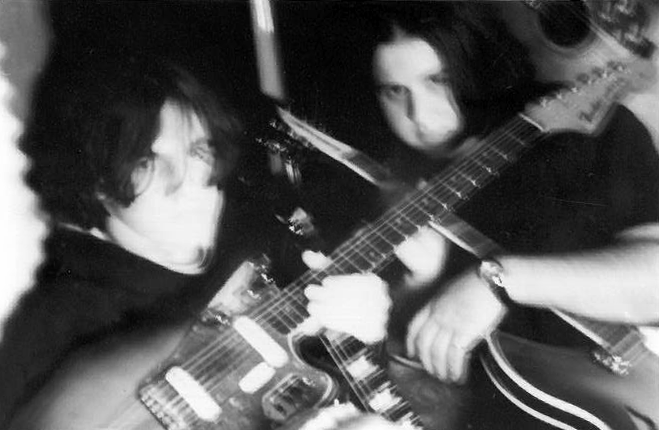 Travis Hawthorne & Loren Jackson
JB: It’s taking me back to the Midwest, just listening to you both because we were raised on classic rock radio in Cleveland, and as a kid I thought that was all there was. Led Zeppelin, Pink Floyd, The Rolling Stones and “Maggot Brain” (Funkadelic) at midnight on Saturdays. It’s still stuff I listen to today, but I came into The Smiths and shoegaze later obviously. Just a Midwest thing of cover bands everywhere, classic rock everywhere and having no idea about the underground and College radio. I finally caught on by the early to mid ’90s.
EC: I think Jane’s Addiction, was around that time.
TH: Yeah, that was another big one
JB: “Alternative radio” of the nineties.
EC: Yeah, there was some shared interest in alternative stuff. I think we all had more of a mellow bent to our taste also. So, instead of going grunge, I think Nick’s other band was a bit more grunge, hanging out with the Pearl Jam and Soundgarden gang, which was alright too. I guess I kind of leaned more toward the mellow stuff and clearly Travis, you’ve already tuned into that stuff at that time, and Loren probably also.
TH: Definitely. We started writing songs immediately, just coming up with a bunch of stuff. I don’t know where we got it, but someone quickly procured a four-track or an 8-track recorder, and we put together a cassette with a handful of songs. Some of that early artwork made it onto the insert sleeve of the ‘Melborn’ record. A bunch of that stuff is pulled from various points in our existence. There is some early cassette artwork and all that stuff in there. We spent a lot of time in Eric’s basement, and that’s why the new album is called ‘Melborn’ because that’s the street Eric’s house was on. I think we made it conscious decision early on to put most of our focus into practicing. Playing and putting the songs together than jamming it at bars. Playing like the local bar circuit. We thought the time was probably better spent getting better at what we did and waiting to pick better shows to play.
JB: Yeah, there’s two sides to that, because some bands think the more they play live, the better they’ll get as a live band, but also the other side of that is focusing a lot of time in rehearsal and practice, honing the sound before playing live.
EC: Yeah, I don’t know. We probably got better pretty quick. It would be interesting to hear what we sounded like at the start, but I’m sure it was rough to start (Travis laughs). Just getting the drums to sound right, I learned a lot just by trying different things like tuning differently and using different drumheads and kinds of sticks, things like that. All that develops through practicing and then thinking about what works live. Making a setlist and thinking about the order of songs to play and transitioning between them. So much fun!
JB: In Detroit back then, was the genre building or was there an underground already established to where there were venues that you could play regularly?
EC: We played at a place called Finney’s Pub maybe four or five times. There was another place called The Marquee, which was a big place, but a dive bar (Trevor chuckles), in a borderland to an industrial area. It was not a main music venue, but a party place. It was good for that. Where else did we play early on?
TH: We played in the State Theater, which is now The Fillmore in Detroit. It’s right next to the Fox Theatre. We played Saint Andrews, the Fillmore, and Finney’s Pub was what we would give ourselves for a little dive bar show. Usually, we played with another band in town with just enough people packing out a little cozy bar on Woodward Avenue in Detroit. Eric, I went to Saint Andrews to see this group called Drama from Chicago and we passed by Finney’s. I recognized it and said, “Hey, that used to be Finney’s where we used to play out!” It’s a restaurant now. Super nice. You can barely recognize that it was even a bar. It’s all so developed now. Back when we were playing those shows, your life was in your hands just walking back to your car (all laugh). Remember when we got chased back to Michael Cooper’s place?
EC: Oh, yeah.
TH: What was that show? It was Jesus and Mary Chain, Curve and Spiritualized or something. It was at the State Theater, and we had to walk back to our friend’s place downtown, and this was in ‘92 or whatever. It was terrible. We ended up getting chased by this homeless guy, and there were two sets of double doors in this apartment. We had a thing where two people were holding the first set of doors trying to get the other people through. And then, like, “Okay, you hold those doors open and we’ll run through and hold the other doors!” We barely made it. The guy tried to get us (Eric laughs), and I remember everyone spent the rest of the time hanging outside on Cooper’s balcony watching the guy down in the street and people were throwing stuff at him. He couldn’t get in and he was mad. I was just trying to get home safely from Spiritualized or whatever.
EC: Yeah, we were scared. We didn’t know what he would have done or if he had a gun or anything, but we were scared.
TH: The funny thing was that there were maybe 10 of us! There’s one guy, we’re all just panicking all these suburban kids just running down the street from this one lone guy (all laugh)!
JB: I have a Detroit story. I was going to see a show, I think at The Shelter, in the ‘90s by myself from Cleveland. I remember taking a wrong turn off the I-75 near downtown and went across the freeway in the opposite direction I needed to go. I turned down a side street to try and get back onto the 75 and I kid you not, there was a car with the hood open, up on cinder blocks with a 55-gallon drum where the engine should be with a fire burning inside it. I thought I was on a Hollywood set before panic set in. Welcome to Detroit!
TH: Totally! To answer a little more about the scene we came up in. Like I was saying back then, Royal Oak was the cool alternative spot. This is back when that was just becoming a thing. We were lucky in Dearborn. We had a couple of really good record stores. We had Desirable Discs 1 and 2 and Dearborn Music, so we were good. But other than that, there weren’t a ton of good music stores around so we would drive out to Royal Oak all the time to this little corner shop called Play It Again Records. And that’s where all the Indie stuff was. I’ll never forget that I bought my Nine Inch Nails ‘Pretty Hate Machine’ (TVT Records, 1989), cassette from Play It Again when I was in 11th or 12th grade. You had to go there to get it.
It was pretty common for people who were into any of that kind of music to go check out stuff in Royal Oak. I remember getting really turned on to most of that shoegaze stuff from those guys at Play It Again. Alan Kovan who used to own it, would fly to England once or twice a year, and he would bring back CD and 7” singles. He would load up on all the good stuff! We didn’t know anything and all of a sudden, Alan will have just came back from England, “Oh, here’s The Boo Radleys!” We didn’t know who any of those guys were, and it’s ten dollars for two songs on a CD single from England. If I could add up all the $23, $24 CDs I have because they’re all imported from the UK, it would be a lot. Spectrum gel pack CDs with the ooze inside.
EC: I’ve got all that stuff. I’ve got all that Spacemen 3 vinyl, I had almost gathered all of it. ‘Dreamweapon’ (Fierce Recordings, 1990), is worth 250 bucks if you look it up.
TH: I have ‘Taking Drugs To Make Music To Take Drugs To’ (Father Yod, 1990), the original 12 inch that is super-hard to find.
EC: Is that the black and white?
TH: Yes, the black and white version.
EC: I’ve got that!
JB: You guys held on to your records then?
TH: Yes, I have a bunch in boxes somewhere, I still gotta break them out. We all really got into Spacemen 3, Spiritualized and all those offshoots. We got lucky enough to have a direct line to the UK indie stuff. Michael (Segal), the guitar player from Majesty Crush, worked at Play It Again.
EC: Yeah, he was one of the three main employees there at Play It Again, so we got to know him pretty well and learn about the music scene in Detroit.
JB: Spectacle played out with Majesty Crush, right?
EC: Yes.
TH: Yeah, them and Thirsty Forest Animals. They were the ones that we would play with. Thirsties were in Chicago already at the time we got together I believe.
EC: Yeah, we met them at a show where they played with Majesty Crush.
TH: It was the Trapper’s Alley show (1992).
EC: They played with Majesty Crush, and it started pouring rain and all the amplifiers were getting wet. Yeah, that’s the first time we saw them, and then they would book a show with us to open for them in Chicago. We’d drive out to Chicago and play with them. They lived in a couple different apartments, so we stayed with them too. Then they’d come out and play shows with us in Detroit.
TH: I forget exactly how it happened the first time, I think we just made like a four track or something, or maybe we even invited him to a show first, but basically, we got the Play It Again guys to eventually end up seeing us. Like Eric was saying, they started inviting us to play with them all the time and then one day we got a call from Alan and he wanted to start his own record label and put out our EP as the first release for what ended up being Constellation Records. That’s what ‘Developing In A World Without Sound’ (1993) came out on.
EC: Was Vulva Records his label or was it (David) *Stroughter’s?
TH: Vulva was Stroughter’s and maybe Michael’s. I think it was Stroughter’s for sure, the singer for Majesty Crush. And so, we worked with Alan for a little while, he put out the CD for us after he recorded that. There were two of them. This guy Paul Wolf, who we didn’t get to know really well, but he was a friend of Alan’s, who maybe did more of the financial backing part of it. But we worked with them for a while. We did all the artwork and got that CD out and all that stuff. That’s kind of how we got familiar with the shoegaze scene that was, unbeknownst to us, already cooking in Detroit with Majesty Crush and the Thirsties.
EC: Yeah, I remember the Thirsties getting me into that stuff. I remember getting turned onto Slowdive by them, going out to Chicago, thinking, “This is just the best!”
JB: Who was that band?
EC: The Thirsty Forest Animals who we met through the Majesty Crush gang. They were from the Detroit area, but they all moved and went to art school in Chicago and they continued their band there.
TH: Eric, do you remember when we went with Dave Fridmann to see Slowdive?
EC: Not really, no. Was it during the time he was in town for recording?
TH: Yeah, one of those nights that he was in town for recording, Slowdive was playing at Industry (Pontiac, MI venue) and me, you and Dave Fridmann went and saw Slowdive. I remember it specifically because remember how sensitive or how cautious Dave was about his ears all the time? (Eric agrees) Which makes total sense as they were his money maker (laughs). He’s very careful about volume. That was the first time I ever saw someone wearing ear plugs was at the Slowdive concert. Like “What? Who wears earplugs at concerts? Who’s this nerd?” (All laugh) Turns out he’s just extremely cautious about his money makers.
JB: You mentioned Constellation. That was the first record around 1993, right?
TH: Yeah, that was the first label.
EC: Wasn’t Vulva before that? The seven inch (‘Monody,’ 1992)?
TH: I’m sorry, I always forget about the seven inch. Yeah, the seven inch was on Vulva which was Majesty Crush’s label?
JB: Was that an EP?
TH: No, that was just a seven inch single. It was “Monody” on one side and “She Doesn’t Believe” was the flip side to it. Then the ‘Developing A World Without Sound’ EP came out on Consolation Records.
EC: Yeah, I think they were both recorded at the Tempermill.
TH: All of it was.
EC: We paid our own way for the “Monody,” I’m sure. But maybe the Constellation one, the ‘Developing In A World Without Sound’ was paid by the label?
TH: Yeah, it was.
EC: The B side of the “Monody” single is the one that came out on that Third Man Records compilation, ‘Southwest of Saturn’ a few years ago (2020).
TH: Yeah, the second track on that compilation was our B side to the seven inch single. The track that’s on that ‘Southwest of Saturn,’ we had been together for a matter of weeks? (All laugh) I mean, maybe a month, it’s not more than. It came out pretty quickly after we got together.
EC: We had my house where we had the whole basement to ourselves. There was a bathroom down there. We would smoke down there. We would drink beer down there. My parents just like having my friends around, and they liked providing that space. It didn’t bother them to have the music playing, they actually enjoyed it. We had cars so we had the ability to pack up our equipment and go to shows. Travis was a master at making connections and networking. He’d go into Play It Again Records, meet everybody and just chat them up and get all sorts of leads about where we could maybe play shows. I think that’s how he ended up probably meeting who ended up becoming our manager for a while, Rick Smith, right?
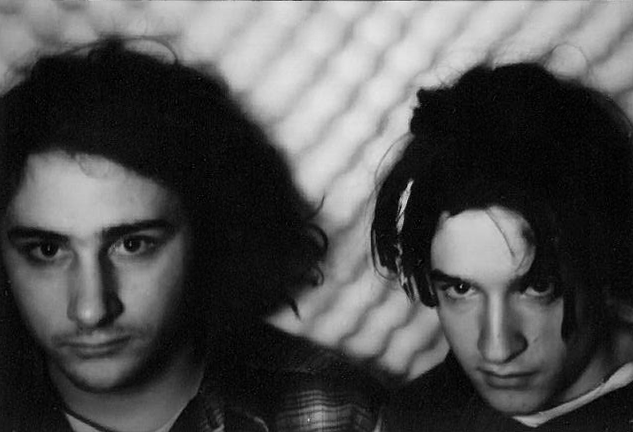 Eric Campbell & Nick Sheren
TH: Yeah. Eric was just back in Detroit here for Christmas, and we got to go and have lunch together, seeing each other for the first time in 30 years! We closed the place down. They had to make us leave (all laugh).
EC: Yeah, it was a breakfast/brunch type place. We were pushing them and they were getting close to get ready for dinner time.
TH: Where was I? Oh yeah, it really was like out of a movie when I was working at the local record store in Dearborn at this place called Dearborn Music. I got a message over the loud speaker, “Travis, you have a call on line two” or whatever, and I pick up the phone to this extremely animated guy. He was very excited to talk to me and tell me about how we’re going to go straight to the top. I replied, “Who, what, who is this? Who are you?” It was this guy named Rick Smith. He apparently had something to do with Aerosmith getting signed, Lenny Kravitz … all manner of things claim to fame that we’ve heard over the years (laughs). He called, and he was a friend of Kovan’s, and was shopping at Play It Again where he heard us. He had connections within the music industry and knew a lot of people in New York. He was particularly good friends with a guy at Columbia Records / Sony Records and he just completely cold called us and says, “Hi, I’m Rick Smith” and starts giving me the hard sell about how he’s going to do this and do that for us and we’re the best thing he’s ever heard, and how it took him back to the days of laying on his floor when his parents were yelling at him about the black light and listening to Pink Floyd. He really gave it to me! First, I’m getting in trouble being on the phone at work, but second, I was also equally excited, because it’s like every kid’s dream to get the big call randomly, like something in a movie, you think would never happen to you. But it did and so, sure enough, it turned out he wasn’t lying. So, that was our connection to Columbia Records, Dave Fridmann, and New York. All of that was Rick Smith. He was a lawyer, that was his day job.
EC: It was just funny because he was old enough to be our father. He had a completely different personality type than we did.
TH: It would remind you of a record company guy from the movies.
EC: Yeah, really. Absolutely.
JB: That is what was pretty mind-boggling to me. Here is this band on Constellation, and then all of a sudden they’re going to Sony? That’s a pretty big jump in such a short amount of time!
TH: Yeah, our idea from the beginning was just, let’s just try to keep making the best songs we can and if something like that goes down, then something like that will go down, and if it doesn’t, then that’s cool, too. But we’re just going to enjoy making the kind of music that we like and hopefully other people like it too.
JB: Your Sony story reminds me of another. They would sign these bands and then dump them, not even giving them a chance. There was a really great band out of Dublin called Whipping Boy and they signed with Sony, made one record and were dropped by them.
TH: I remember them. Yeah, they were great.
EC: During that later time when we became more well known around Detroit, Saint Andrews Hall was the place to play. Usually, we would be opening for somebody there, so we tried to get good opening gigs because Saint Andrews Hall would give you a good audience. That wasn’t like Pine Knob (amphitheater that seats 15K in Clarkston, MI), with shows with thousands of people. It was small, indie and right downtown. All the not-huge-yet bands would come through there, so we saw Smashing Pumpkins on their first tour there. You know, smaller shows. I think that you mentioned The Shelter earlier, isn’t it in the basement of Saint Andrews?
JB: Yeah.
TH: Eric, you wouldn’t believe it. I was just there on Monday, and you would not recognize the place inside. That’s the first time I’ve been inside in 20 years, and it is super nice. Remember how you go to the third floor upstairs? It was just that backstage area and the balcony to the main room was its own separate thing? They knocked the whole wall out. If you’re up in the balcony in the main room, you turn around and there’s a big opening so you can go into that third floor. It’s a beautiful bar area with seating. It’s unrecognizable from when we used to play there. I was telling Katy when we were getting our coats out of the basement, which was The Shelter, when I went there the first time in high school, it was unfinished. Like an unfinished basement with a gravel floor! I remember when The Shelter got redone it was a huge deal in the early ’90s, but in like ’89 – ‘90 it was just the hardcore alternative kids with Doc Martens running around the poles doing the chicken dance.
EC: That’s a good place for goth and industrial music, I think, right?
TH: Yeah, that was big time there. It was like going down into someone’s cellar back then. There was maybe a blue light on in the corner and gravel floor (all laugh), and now it’s gorgeous! Everything’s wood, and beautiful with multiple bars and chandeliers … super nice!
JB: I saw Ivy in The Shelter and Elliott Smith at Saint Andrews back in ’96 amongst others.
TH: Oh, wow!
EC: Nice!
JB: Yeah, I loved Saint Andrews. I haven’t been there since the late ‘90s.
TH: Those Verve shows were some of the best shows I’ve ever seen in my life. The Verve shows at Saint Andrews.
EC: They were fantastic live, definitely. They were a combination of all the right elements. Each member, I thought, was excellent in the way they played their instruments. You talk about instrumentation, the way they fit things together, but also, it wasn’t always extremely scripted it seemed. So, that’s what makes those good combinations when you have people like that. If you take one person out, it just doesn’t work the same. That ‘Urban Hymns’ record was just a little too produced. There’s some good stuff on there, but it was just a drastic shift from the previous two albums.
TH: The first two albums are just incredible and all the singles … “Where the Geese Go” ….
EC: And the b-sides. All the b-sides were great too.
TH: Oh, all the b-sides … “A Man Called Sun”? That’s a wrap! The bass on “A Man Called Sun” is so good. It was The Doors part two!
JB: “Feel,” “Let The Damage Begin”?
TH: Yeah!
JB: Catherine Wheel too. They were an exceptional b-sides band from that era (Travis agrees). You mentioned Third Man Records and ‘The Southeast of Saturn” compilation that they did. How does it feel to see Spectacle finally contextualized as part of that movement after 30-some odd years?
EC: There was stuff that on there that I wasn’t familiar with so it was nice to see that there was much more going on than even I was aware of! I thought it was great, after almost 30 years at that point, to come out and see the light of day. They suggested that song “She Doesn’t Believe” saying, “That’s what we’d like to put on there,” and we said, “Sure! Why not?” That seven inch single, there’s not too many of them out there so it was good to have that re-released. Yeah, it felt good, it puts it in perspective, it really was a special moment around Detroit at that time. Not just in that kind of music, I guess. Detroit techno was really up and coming at the same time (second wave and Underground Resistance or UR – JB).
TH: Yeah, definitely. That’s the big takeaway for me, too. Looking at those lists of names, I realize now, as is often the case when you’re in the middle of a scene, that we didn’t fully grasp what was happening at the time. Reading those names really brings back how special that era was for this music. It was a unique sound happening in an even more unique location. Shoegaze in industrial Detroit might seem like an odd fit at first, but in so many ways, it makes perfect sense.
JB: It’s bringing back a lot of memories for me. Some are still carrying the torch there though. Check out Clinic Stars and Bluhm! You brought up David earlier. What was it like working with him and what did he bring to the band from the production side of things?
TH: He was the consummate professional, all business. Extremely talented and a great listener from what I remember. He was very good at suggesting things here and there if we wanted a lot of suggestions or pulling back if we didn’t. The one story I remember about Dave that was great was we got to the studio one morning and he had been there for hours and we didn’t know it. He was staying at a hotel close to the studio, obviously from Buffalo, New York, and that was all he had going on in Detroit at the time. He showed up to the studio super early, and when we got there, he was on the floor with a huge chain of effects pedals, looping in different stuff. I remember he had Loren’s Digitech Whammy on the ground, messing with effects and feedback and loops. He was playing with an idea for some processing on a part we had recorded the night before and it was wild. He would just go to town with all the pedals and stuff to get something down on tape to share his ideas with us. He couldn’t have been a kinder guy. Very quiet.
EC: He seemed to me, from what I remember about him was, he was a fountain of ideas. He would be producing and listening to what we were doing, and it would give him ideas so he would offer tons of suggestions. He would be finding stuff, looking and pulling stuff up and having so many ideas. We ended up adopting many of them in terms of how to produce it and even what to add as some of the other background tracks that you start mixing in. He was really an engaged and active producer, putting in his creative vision into the process. It was really shaped by his imagination in a lot of ways.
TH: And he was able to do that without being pushy or seeming overbearing. He was very smooth at it. It was very collaborative.
EC: He was full of ideas and offered them freely. It never felt like he was taking over.
JB: ‘Melborne’ was supposed to be the Sony album and then, for whatever reason, they dropped you guys and this album sat unreleased? (Both agree).
TH: Steve Berkowitz was our A&R guy and he also had Booker T & The MG’s, The Tragically Hip and Jeff Buckley at the time, Tim Buckley’s son, who was just starting to come out. Those were all under Berkowitz and the story we got is that those artists weren’t producing the numbers that the higher ups at Sony were looking for. So, they put all of Steve’s projects on hold because he wasn’t pumping out number one hits. So, listening to our album, I highly doubt they thought that was going to be the pop savior for Columbia (laughs). So, they just put a hold on all this stuff and it was at a time when we were trying to figure out a bunch of different things like doing things with our sound. There were all sorts of different factors that came into it. I think everyone just got really frustrated and I think collectively, we lost interest and decided we had other interests afterwards. It was a little bit deflating after all that work and I think everyone also simultaneously had some varying interests, and we just never pulled it back together after that.
EC: Another part was, we recorded the album and leading up to Steve Berkowitz’s projects getting dropped, we were invited to play live for the president of Sony. Our manager drove us out in his, I don’t want to call it luxury van, but like a comfort van with the carpet on the walls and stuff. We stayed in a hotel near Sony, and we set up, and performed. I don’t remember seeing anybody really watching us, maybe they were behind glass or something. I don’t remember seeing many people, but apparently, we were playing for a small audience. Maybe that was them wanting to see how we were live because they already had the album so they could hear & see us and decide whether or not to keep to us. I don’t know if that was before they were thinking of getting rid of Steve or what happened with the order of things there. Maybe they were thinking about retaining us and they were thinking about leaving him. It’s hard to know the whole story.
TH: Who knows when you’re dealing with that level of money and corporate bureaucracy.
EC: Yeah, it was fun. It was a road trip for us to play in New York.
TH: Yeah, it was incredible. It was exactly like a show business cliché. I remember I hung out with Tony Bennett for a while that day (Eric laughs). He was just hanging out in the hallway. When we got out to walk in the door, in the morning, Luther Vandross walked out in front of us. He got out of his limo, and I remember being like, “Hey, Luther Vandross, let me get the door!” (All laugh) As soon as we walked in they were immediately asking, “What do you guys want for dinner? What do you guys want for lunch? What do you guys want for this?” People were taking down everything. Someone casually overheard us mentioning that we wanted pizza for lunch or dinner at one point. And next thing you know, ten pizzas showed up (all laugh). And Eric busted his kick drum head before the show and he had one delivered to him in like fifteen minutes. They sent someone out immediately to buy him a new kick drum head. It was super crazy.
EC: It has to be an Aquarian head (all laugh).
JB: No problem. How many would you like? (More laughter).
TH: We were just four barely out of high school kids.
JB: Are either one of you still in contact with the other two in the band?
EC: Very little. They’re both fairly hermetic. Nick has email, but I don’t think he has a smartphone or maybe he has a smartphone to check his email if he doesn’t have internet at home. And Loren, we can reach him through a common friend, one of the former members of the Thirsty Forest Animals is the point person for Loren. He kind of lays low so I’m not sure what he is up to.
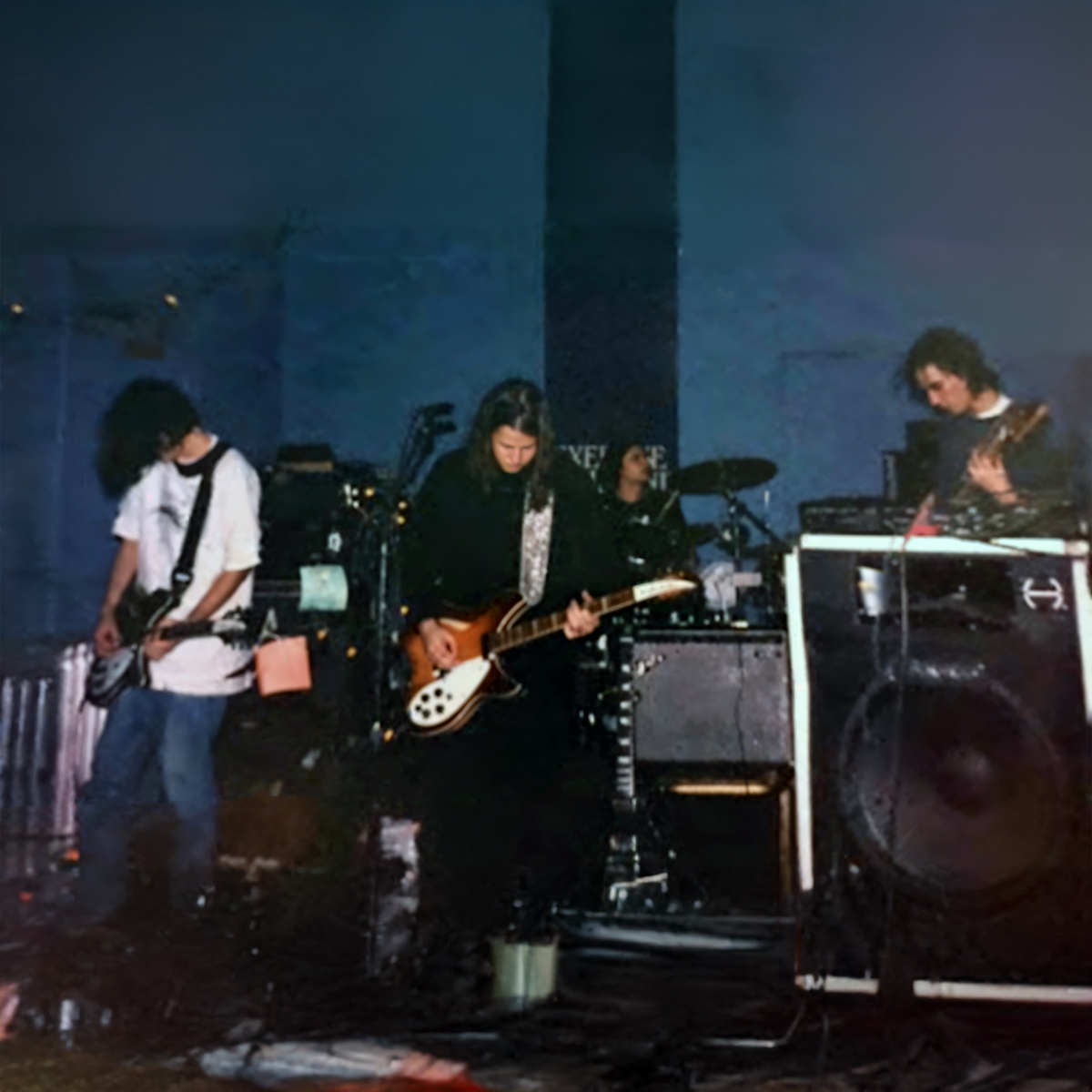
JB: It’s was just you two that helped Painted Air release this LP? (Both agree). So, how much of the original vision for the album sequence and artwork remained intact for the Painted Air release? Was any of it reimagined?
TH: The artwork and track order is almost 100% reimagined (all laugh). I’m not sure what of that holds over from our vision for it 30 years ago.
EC: We got a note that our friend, Andrew, sent from Loren, and apparently, we got three of the song names wrong. Just trying to put the pieces back together from memory.
TH: The masters that I have didn’t have labels on some of the tracks.
EC: The names he mentioned sounded familiar. So, I thought, “Oh, he’s probably right, he seems to remember.” Everybody remembers different stuff.
TH: Yeah, I do remember now, the one that we decided to call “Flight To Her Venus” and the reason we called it that is because there was an old picture of Eric’s practice space, and you could see on a whiteboard that was one of the songs we were working on, so we were like, “Well, at least we pulled it from a name that we were working on.” That was our ode to the Thirsty Forest Animals.
EC: I guess the other part of your question was about the artwork. I don’t remember ever having thought about the artwork. I don’t think we got that far originally.
TH: No, I think we just got lucky to find that picture that Matt had taken at that live show. That’s really the foundation for all of the artwork.
EC: Yeah, it was Mark Patterson who took that picture.
TH: Yeah, the drummer for Thirsty Forest Animals took that picture and I edited out a bunch of the other stuff. (Laughs) There was a bunch of crazy random stuff in the picture also. There was some weird head that was on the wall behind your head, Eric. It was weird. A big mural with some weird head on it. I just cleaned it up. I just simplified things a bit.
JB: So, there was really no archivist in the group who held on to things?
TH: Well, unfortunately, obviously the track titles we weren’t shooting 100% (all laugh), but as far as archival stuff, just after the project had already started going, coincidentally, I was cleaning out my basement and was about to throw away a huge box of stuff thinking, “I haven’t needed this in 30 years. Why would I need it tomorrow?” It’s going! Out of curiosity, I thought, “Let me just peek in here” and it was all the Spectacle stuff!
JB: Glad you stopped to look!
TH: Yes! So, the two-sided insert of the new record is from all that stuff. There were so many old gig flyers, there’s one that looks hand drawn and it says Spectacle, there’s three of them. There was this girl, Kelly, who I was talking to at the time, and I had met at Saint Andrews or something and she was an artist, and when we first got together, someone got a four-track recorder or whatever, and we were making our first four track. I had Kelly whip up some options for the cassette cover artwork. The other stuff in that box like all the photography of the statues and all that, those were all from photography sessions for our first seven inch record that came out on Vulva. So, luckily, I do have an archive of it. I went to Kinko’s for the first time in 25 years.
JB: Those are still around?
TH: (Laughs) It was crazy. It was such a time warp. To make it even crazier, I used the scanner for an hour and just stood there scanning everything we had, put it all on a USB drive and brought it home. Everything was a mess, so I had to clean everything up and manually paint everything. They were thirty-year-old pictures so there were tons of little pock marks, and chipped away pieces.
JB: How did getting this release out with Painted Air all come together in the first place?
EC: Michael Vitrano emailed me in, I think it was early 2023, maybe ‘24 because it took about two years to do this, right? I think about early 2024 I got an email from Michael saying, “I’m starting this new label and releasing some of the old stuff around the Detroit scene from the 90s. I heard you all had an album that was recorded for Sony and it never came out. Is that true and what ended up happening with that?” I said nothing happened with it, it’s all true, and that one of us should have the stuff. He was very interested in hearing it and checking it out. I think Travis had the masters.
TH: Coincidentally, it was only a few years back that I decided I didn’t have anything, and I called Tempermill and Dave Feeny had to actually crawl under the floorboards to get the reels out and he burned us CDs of it. So, here’s another interesting thing is that I was telling Andrew (Rose) this when he was wanting to know the chronology of things. We did two sessions with Dave Fridmann. It wasn’t just one. He came back to do another three or four songs that we picked, and I remember one of those things that we decided, just like we redid “Plum,” was we also redid “Grin” when Fridmann came back. And we don’t have that. That second Fridmann session is gone to the wind.
EC: Okay, I didn’t know that.
TH: Yeah, there was “Grin” and two other tracks, which I think may be “Falling Asleep With You” because that was a new, fresh one then.
EC: I don’t even remember that one.
TH: Did you see the footage that Andrew sent?
EC: Yeah.
TH: So, that’s the song other than “Plum” on the State Theater show. That’s “Falling Asleep With You.”
EC: Okay. I’ll check that out. Let me look through all those videos, because there’s like five or six at the Tempermill and a couple at the State Theater.
TH: Yeah, it’s the State Theater one. It was cool that someone also got Spectacle on the marquee at the State Theater too.
EC: Oh, nice!
JB: If anything ever happened to the studio, the masters along with who knows what else would have been gone?
TH: Oh yeah.
JB: That’s kind of scary.
TH: Yep, but Feeny is a great guy. He took the time, dug around and finally found them.
EC: I’m sure I have them on cassettes, but that wouldn’t be a great way to recover them.
TH: Yeah, honestly, I haven’t really dug through my DATs (Digital Audio Tape) and that old stuff. I may also have it, who knows? Maybe if I start digging one day and we run across it, maybe Michael will want to release a seven inch or something. I remember the re-make of “Grin” was really good. I thought we did a really good job on it.
EC: “Grin” … did that come out on the first EP we did?
TH” Yeah, that’s on the CD (‘Developing In A World Without Sound’, 1993).
EC: A different version, though?
TH: Yeah, we redid it with Fridmann, just like we did “Plum.”
JB: Anybody record Spectacle live back in the day?
TH: Yeah, so we just recently got a little bit of footage. As far as audio, tons of it. I have cassettes in the basement. I have tons.
JB: Sound quality is pretty iffy, though?
TH: Oh yeah (all laugh). Also, I don’t have a cassette player. I’ve got all the cassettes of the shows we did with Thirsties and Majesty Crush. I have a bunch of that stuff. But yeah, you can imagine the sound quality.
JB: It’s hard to fathom that ‘Melborn’ is a 30-year-old new release. Do you feel the album actually benefits from being heard now in a landscape that might finally be ready for this type of record? Is it pretty good timing for it with today’s shoegaze revival.
EC: I don’t know. I wasn’t really aware there was a shoegaze resurgence, so maybe, 30 years is kind of the life cycle when you start seeing bands get back together and tour again as late middle aged folks (laughs). I mean, it seems to be around that range, but I wasn’t aware there was a resurgence.
JB: Oh yeah.
TH: I actually just became aware of it a couple years ago and I’m familiar with some of the modern bands. At one point, I think I even looked up Spotify playlists for new shoegaze, and you quickly see who the recurring players are. It’s great. It’s kids doing exactly what we were doing, it’s super cool. From my perspective, to answer your question, it’s yeah, what better time? I heard some really good stuff.
JB: With the resurgence comes regurgitation too. There are bands that aren’t really doing anything with it other than sounding like what came before them while others are mind-blowingly good.
TH: Just trying to sound like My Bloody Valentine?
JB: Yep, plenty of that (Eric laughs).
TH: I’ve heard it amongst the new stuff. I hear it and it’s okay. It’s cool and it’s a cool sound, it’s just not your sound. (Laughing) Someone else made this, but whatever, it’s not like there’s only two swing musicians in the world.
EC: It’s good timing then! Slowdive and to a certain extent, Mojave 3 seemed to have some decent success, right?
TH: The early Slowdive stuff is … when we saw Slowdive live, it was some of the best stuff I’ve ever seen because, so you’re enveloped in their world. It was so good.
JB: Yeah, last time I saw them up in Phoenix, I was leaving after the show, and there were a handful of people actually crying. I think that’s what shoegaze has always been to me, you know?
TH: Yeah, it certainly is emotional.
JB: That’s a good sign, that it was a good show, I guess.
TH: Certainly. Chapterhouse is still playing? They’re still together?
JB: They did a handful of shows in 2010. I went out to West Hollywood and caught them at The Troubadour. They played with The Meeting Places and Ulrich Schnauss and they were wonderful, but then they disappeared again. Now, they’re back playing Slide Away and a bunch of other dates.
TH: The Global Communication remix of ‘Blood Music’ (Dedicated, 1993), is possibly my favorite record of all time.
JB: Really?
TH: Yeah, it’s up there. It’s top five, no question. For the longest time it wasn’t available and now you can listen to it on Spotify and stuff, but it wasn’t for years and years. The only way you could get it was with the import of ‘Blood Music,’ the regular album and it was wrapped in a CD single with it if you bought the import.
EC: It’s crazy how expensive vinyl is now. I have a bunch of these records from this place Car City Records. You could go in and just you could fill up a crate full of records. All these Smiths records, it’s like $6.75 for the used double LP ‘Louder Than Bombs.’
TH: I got the first Oasis import CD single ‘Cigarettes and Alcohol’ at Car City. I remember driving out to the east side to go get that ten-dollar two song CD.
JB: Is Car City still around?
TH: I don’t think so.
EC: It’s not, no. I looked it up at some point. (Closed in 2011 – JB).
TH: I didn’t even remember the name until Eric just said it. That was the spot.
EC: Vinyl wasn’t really in then, so you would find stuff in perfect condition.
JB: I’ve been to Car City a couple times, but that was a long time ago. Back in the ‘90s.
EC: Dearborn music’s pretty darn good right now, too. That’s a great place to go record shopping.
TH: I haven’t been there in awhile.
JB: Kalamazoo does the Kalamashoegazer Festival every year since 2007. I’ve never been to one, but I’ve been dying to go.
EC: Nice.
JB: It’s really interesting because you think you have a grasp on a genre like shoegaze, and then you get an email about a band called Spectacle out of Detroit from the early 90s, and it’s like, “How did I miss this?”
TH: We were pretty easy to miss (all laugh). We weren’t very visible.
EC: We were pretty low key.
JB: I’m really enjoying ‘Melborne.’
TH: Awesome! Glad you are! Yeah, it’s been nice to revisit. It is especially nice to get to listen to it after it got remastered and get to hear it the way it should have been heard.
JB: What is it like to hear your teenage selves in 2026?
TH: Oh, you just hope that other people will be forgiving (Eric laughs). You just hope that other people will remember what it was like being 20 (more laughter). No, I’m just kidding obviously, it’s funny. It’s great. It’s a snapshot in time. It definitely had its interesting moments. It’s kind of cool to get to listen to now.
EC: Yeah, I’m happy with it. I’m proud of it – the music, the art – I don’t have the record yet. So far, from what I saw of the art, I like it. I like the mixes and the mastering. I have two daughters that are just getting into, like being selective about music and it’s not their cup of tea necessarily it seems, but they get excited about it. It’s kind of special that we did that.
JB: How old are they?
EC: 15 and 13.
JB: I’ve got a 16 year old daughter and 18 year old son. Maybe one of them would like a record collection. They seem to get enjoyment out of doing the opposite.
EC: Yeah, kids can be like that. I think my older daughter will want my records and stuff. She’s really into The Smiths and the Pixies. We just got this place, it’s like a condo, and we were living in apartments forever, all through grad school, and then for about 10 years here in California. We got this condo, and we now have some space. I’ve moved my records and CDs for 30 years, I’ve moved them with me many times and it hadn’t been since 2006 that I actually had a record player set out and in use. I still had the CD player but it doesn’t really work. So, I got another CD player and I got a record player because the one I had was actually Loren’s old Technics record player. At some point, a student helped me move from one place to another, and it wasn’t working. It needed some work done on it, so I gave it to him. Then I got something to actually play the old stuff on, and my daughter’s favorite band is The Smiths. I’ve got all the albums on vinyl! So. she’ll take them over.
TH: That’s cool.
EC: And that’s exactly what I was listening to when I was 15. It would have been ‘89 so ‘Strangeways, Here We Come’ (Rough Trade, 1987), would have been out. She loves The Pixies too.
JB: My wife and I will be listening to music and my daughter will come out every once in a while and ask, “What is this? Who is this?” and then she’ll get on her phone and look it up. She loves jazz.
EC: I played The Stone Roses and both of them were, like, “What’s that? That’s good!” That’s one of those albums that’s just solid through and through.
TH: I just watched that documentary (‘The Stone Roses: Made of Stone,’ Picturehouse Entertainment, 2013) on them not too long ago. That’s a good one on Amazon Prime.
EC: Oh yeah?
TH: I stumbled across it one day, by accident. It’s really good.
JB: You brought up mastering earlier and that was Andrew Rose, right?
TH: Yeah.
JB: How close were you two in that process with Andrew?
TH: Just a few back and forths is all it took. He sent over a pass, and we had some notes, and he sent over another pass. We just did that a couple times and were good to go.
JB: Was it more about preserving what was captured 30 years ago?
TH: It was genuinely unmastered stuff originally, it had just been mixed. It had yet to go through the mastering process, like the project stopped before we got to that phase. The copies I have are just barely mixed to begin with, so it needed to be officially mastered. This was the first time for that with the same intention, as it would have been had we done it then. To master it and try to get it to sound as good as possible.
JB: No embellishing on anything using modern technology?
TH: There was a tiny bit of editing that had to be done to it, mainly for song length to fit on the record. For the most part, it’s all just mastered versions of the original mixes. There was plenty of tape hiss at the beginning of some tracks and stuff that we digitally edited out for this. You could hear the two-inch tape rolling. The masters still live at the Tempermill.
JB: So, the way it originally shook out was that it was recorded, mixed and sent to Sony and Sony said, no?
TH: That didn’t even happen. At some point, shortly after the recording process, we were told that Steve Berkowitz’s projects had all been put on hold by the label, for the time being and that included our project. I don’t know if Sony took a copy of anything and I don’t know if Rick sent them anything. That was all our manager, Rick Smith at the time, he was the one who did all the correspondence with Sony.
JB: Is Rick still around?
TH: Rick is around, actually. My friend Clark ran into him at a bookstore a few years ago. He was super nice, meant well enough, and did nothing, but right by us. He tried to do all kinds of cool stuff for us, and he loved our music and really helped us out as much as he could (Eric agrees).
EC: He was a classic kind of schmoozer guy, too. You know, he would talk to everybody. A schmoozer, b.s.-er kind of guy, but he treated us well and really supported us and advocated for us. So, it was good that we were able to work with him.
TH: He was very much of the same cut of person as Steve Berkowitz at Sony. There was no surprise that they were connected and good friends. At one point I went out to New York with some friends, and since I was there, I dropped in and had some meetings with them. It was classic. He took me to some old Italian restaurant and showed me a back room where people used to get shot (all laugh).
EC: Berkowitz?
TH: Yeah, it was the real deal. Old school Italian, Columbia Records, mafia money stuff, it was legit. It was so unreal.
JB: Between the four of you, was that even an aim of yours? To get as big as you could as fast as you could?
TH: That was the aim. There’s was a bookstore around here called Little Professor bookstore, and they had a big book that they would put out every year, called the “Recording Industry Sourcebook.” It had every record label, A&R person, phone numbers … everything and as soon as we started making music, I would go through it getting the ones we wanted. It was the love of this music that brought us together and so, at the same time, as we’re making all this music, we’re equally rabid fans of it. We were always at the record store and were very familiar with labels and quickly became familiar with all things Creation and 4AD. We became super educated by the guys down at Play It Again relatively quickly, so I would go through and keep track of all the people we wanted to contact (laughs), probably starting with the four-track cassette that was recorded a matter of weeks after being together. I would start sending it out to labels. I would then give it a week or so, and I would call those phone numbers and just ask to speak to the A&R guy, and it would always be some receptionist saying, “Okay, yeah, but who is this?” and I’m like, “Hey, it’s Travis Hawthorne” and that’s all I would say and she’d respond, “Okay … hold on,” and eventually someone would come back to the phone and I would say, “I sent you a package a couple weeks ago.” It was true, I was Travis Hawthorne and I wanted to talk to Steve Burkowitz. Eventually, he’s going to be like, “Who is this dude?” They’re not going to NOT answer it.
EC: You keep calling and dropping your name, eventually they’re going to start to recognize it!
TH: That’s what I would do when I called back. I would act just matter of fact about it. That is genuinely how a lot of stuff happens. Like we talked about earlier, we made a decision early on to just focus on getting good and practice rather than just doing the same circuit as the 10 bands that you would see in the Metro Times literally every weekend or over and over at different spots. We saw it was not working for them because they were still just playing bars or whatever the hell it was at the time. We thought, “What’s the point of that?” Let’s just get really good or at least try and play a handful of shows a year, but good shows with Majesty Crush or Thirsty Forest Animals. We were always trying to open for bigger bands here. I think I mentioned we, we played with Radiohead and Sebedoh. Those gigs for sure, we would take in a second when they would come along. But other than that, we weren’t too anxious about it. We would rather get the sound good.
JB: Do you consider this record to be the final closure for the band Spectacle?
TH: I don’t think there will be any new Spectacle music to come.
EC: I think it’s closure in the sense of I don’t think we’re going to do new music together, but maybe if this other Fridmann session comes to light, we could release something else. But I don’t think we’ll get back together.
TH: You never know. Next Christmas, Eric could come back here, and we could knock out an EP under another name (Eric agrees).
EC: Maybe we can get Simon (Jones) from Verve to sit in for Nick.
For more information, please visit Spectacle’s Bandcamp | Painted Air Records | Bluesky | Instagram.