Photo by Jackie Freeman
For a long time, it’s felt like local music scenes didn’t really matter anymore. Or at least, they didn’t matter in the way they used to. Everyone’s got the internet in their pocket now. You can watch a band play a show on the other side of the world without leaving your couch. A few clicks on Bandcamp and suddenly you’re deep into a scene from some small town you’ve never been to and probably never will. Geography kind of stopped meaning what it once did, and those legendary ’90s scenes (Chapel Hill, Chicago, Seattle) started to feel like these magical, never to be repeated moments in time.
But somewhere along the way, that changed. Or maybe it came back.
Maybe it was the pandemic. When touring stopped and young bands suddenly had nothing but time, space, and the same few rooms to play in. Whatever the reason, local scenes feel alive again in a way they haven’t for a while. Cities, real places, are home to tight circles of artists who share bills, share ideas, and sometimes even share band members. Sometimes they sound alike, sometimes they don’t at all, but they’re showing up at the same venues and pushing each other forward just by being there.
Take Burlington, Vermont. Not exactly the first place people bring up when talking about hotbeds of new music. Maybe you go back to the ’80s, when Phish formed at the University of Vermont and helped launch a whole wave of jam bands into the national spotlight. But quietly, starting just before the pandemic, a new group of college aged artists began making noise in Burlington and then, coming out the other side of lockdowns, started releasing records that people well outside Vermont were paying attention to.
Greg Freeman. Lily Seabird. Names that now get mentioned pretty regularly in indie folk Americana conversations, artists who’ve taken those Burlington roots and tested them out on long drives and coast to coast tours. And almost every time that Vermont scene comes up, there’s a third name in the mix. A band whose members overlap with those projects, play in each other’s bands, and move through the same spaces but whose music sounds like something else entirely.
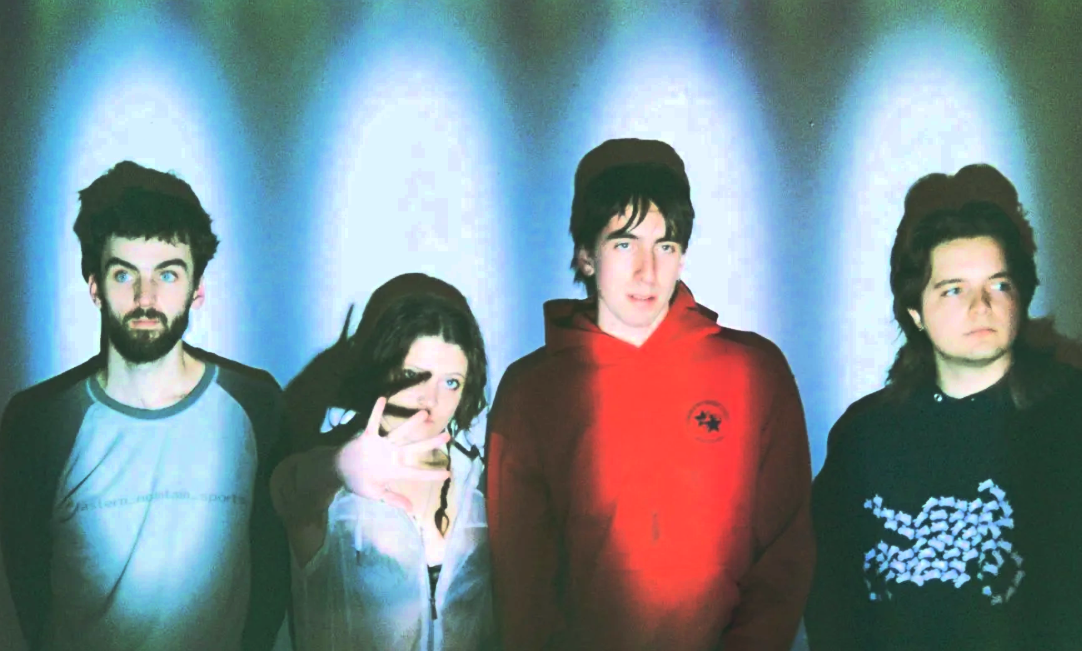
That band is Robber Robber.
Their new album, Two Wheels Move the Soul, out now on Fire Talk Records, kind of throws you off balance in a good way. It’s not an industrial album in any strict sense, and the band isn’t pulling directly from the big ’80s and ’90s touchstones like Skinny Puppy, Nine Inch Nails, or Ministry. There are no samplers or synths running the show. But the feeling is there. The drums are heavy and aggressive, right up front in the mix. Guitars loop and repeat, sometimes less like riffs and more like alarms. The bass can get fuzzy, distorted, uncomfortable. And through all of that, Nina Cates’s vocals arrive as this steady, grounding presence, something warm to hold onto while everything else crashes around it.
Across 11 tracks and a lean 30 minute runtime, Two Wheels Move the Soul covers a surprising amount of ground. It’s noisy but thoughtful. Abrasive but inviting. A record that feels like it’s making beauty out of tension instead of trying to smooth it away.
Burlington, after all, is a college town, exactly the kind of place where this sort of creative cross pollination can happen. And from where I’m sitting, in Columbus, Ohio, it all feels pretty familiar. Columbus is in the middle of its own moment right now, with bands like Villagerrr, Golomb, Gardener (from Yellow Springs, an hour from Columbus), and Big Fat Head starting to poke their heads out beyond the city limits. Scenes talking to other scenes. Bands meeting bands. Tours overlapping.
So it makes sense that Robber Robber has crossed paths with artists from my own backyard: playing shows together, touring together, building something that feels local but never insulated. From my basement in Columbus, I spoke with Nina Cates and Zack James, and we started the conversation by talking about those connections and what it feels like when scenes start to matter again.
You’ve played some shows with Columbus bands like Villagerrr and Golomb. Do you feel kinship with bands that are in your peer group or is there a scene in Vermont that you feel close to?
NINA: There is a bit of a scene in Vermont. Greg Freeman is one of our best friends, and Lily Seabird as well. There was a period where Zack, myself, Lily, and Greg all played as Lily’s backing band for about a year.
ZACK: We all went to college together. That’s the crew. We definitely feel kinship with the Columbus guys, because the first time we ever went on tour, we were such a tiny band that nobody knew about, and we played with Villagerrr and Golomb. It was one of Villagerrr’s first shows, and it was our first tour, and we were all just baby bands together. We somehow met each other and have all stuck with it since then.
NINA: We got such a lucky run on that tour. We played with Villagerrr for the first show with that name, they had just changed it, and we played with Wishy (from Indianapolis) when they had a different name, on that same tour.
ZACK: It was their second show.
NINA: We played with Golomb that run. Just so many connections that we made back then when we were all DMing each other. We’ve kept in touch, and it’s been really awesome. It’s one of my favorite things about touring as a musician, all of the friends that you make, and being able to keep tabs on them pretty easily because we keep flowing through town.
As a young band, what gave you the courage to book shows out of your comfort zone and in different cities or states?
NINA: I think having all of our friends together doing it. The fact that Lily started booking tours outside of town emboldened us and gave us more connections to start booking our own tours outside of town. It’s definitely a scary, jumping-off-the-cliff type scenario, but we were all in it together at that moment.
ZACK: It suddenly felt very normal and very natural to be touring. And there are so few places to play in Burlington, it just felt like the natural thing to do is play in other places.
It’s like, either you become the Friday Night Bar Band in Burlington, or you get out of town and take a chance.
NINA: Exactly. You can really feel the fatigue in Burlington when you play around here too much. It’s such a small city that you can’t draw the same amount of people out if you’re playing there every Friday night. There are some really healthy jam band scenes up here, I mean, it’s Phish royalty, but for indie rock especially, you’ve gotta get out of your local circle a little bit.
Venues everywhere are struggling right now but venues in Burlington have been visibly struggling. There have been a couple of venue closures downtown in the last year that has been a real blow to the scene. Our DIY scene didn’t really bounce back that well after COVID. Us and Lily and Greg, we’re all in the wave of people who started going to college right before COVID hit. We all were playing in basements and then COVID hit. After that it really felt like the only places to play were Boston or New York. We’re lucky that there are a lot of cities around Burlington, New York is like 6 hours away. We do that pretty regularly now and then you’re almost in Philly so you might as well hit that. We just toured out to the West Coast with (Zack and Nina’s other band) Dari Bay and talking to people in Colorado, it’s like anywhere you drive you have to go so far to get to another city. It made me grateful for our geographic location because we can hit Montreal, Boston, New York, Philly pretty easily and getting over to the Midwest isn’t that bad.
Have you played in Europe?
NINA: We did. Robber Robber went over to Europe like a year ago, we supported Julie, which is a great band. We were sussing out how to do that because there’s a lot of logistics and we’d never really considered it seriously before. Our friends were like, “The best thing about playing in Europe is that drives are nice and short.” The routing we got was absolutely insane. We wound up zig zagging back and forth. We started in Madrid and ended in Stockholm, we were chasing the bus too.
I saw Robber Robber’s music described as “industrial”. Do you agree with that classification?
ZACK: I don’t really know what industrial is supposed to mean. I just think of the sound of metal hitting another piece of metal, and we do a lot of that. There’s a lot of metallic, weird robot sounds and stuff. That’s my cartoon idea of what industrial means. I don’t actually know what industrial music is.
NINA: I kind of embrace that. We do have a lot of metallic or janky, clacky sounds. On the last record, we played around a little bit with putting broken cymbal sounds on stuff, or sheet metal, just layering textures of that. We loved that process, so we did it even more on this record. There’s more prepared guitar stuff. I totally get where it’s coming from. When we sit down to write a song, we’re not thinking, “This one’s gonna be industrial,” but I embrace that.
The drums are very prominent on the songs. Zach, you played most of the instruments on the album. Is that the hi-hat that I’m hearing in a lot of the songs?
RR: Yeah, I use the hi-hat pretty heavily. But I’ll also put a couple of broken cymbals on a cymbal stand — two or three different broken cymbals — and it makes a sound that’s kind of like a hi-hat, but almost like a snare drum/hi-hat, very trashy. It just sounds like a garbage can.
The first two songs on the record both have the word ‘sound’ in the title. Was that intentional?
NINA: First time I’ve thought about that. Someone just pointed out the other day that the first lyrics on the record are, “Wanna spend a while, just me and you,” and the last lyrics are, “Gotta go.” That wasn’t intentional either, but I like that too.
Was “Avalanche Sound Effect” a placeholder name or did you name it that because you wanted listeners to think of what an avalanche sound effect might sound like?
ZACK: That one was the name of the demo.
NINA: I think one of the first visual images that came to mind when we started working on that song was avalanche imagery, and that always felt pretty core to the mood of the song.
ZACK: I just called the demo “Avalanche Sound Effect.”
NINA: The whole time, I was like, let’s put an avalanche sound effect in this song, because we don’t really play with sound effects that much. I felt like it really suited the song. And then while we were tracking, I think the original lyric was something else there, and Zack said, “What if you just say “avalanche sound effect?” And I was like, “That’s awesome and kind of stupid, in just the right way. That’s perfectly silly.”
Where do you draw lyrical inspiration? Do you take inspiration from movies, TV, the news, or is it more stream of consciousness type stuff?
NINA: It’s almost never movies or TV or the news. I’m always inspired when other artists say that, or books or poetry, and I’m like, “Wow, I should really be thinking more about that.” I have a Notes document that I always add to throughout my days. If anything comes up that seems like it has a certain ring to it, I’ll write the words down, and often I’ll come back to them and expand on the ideas, or parse through my own journals and see if there’s anything in there. When I’m sitting down to work on a specific song, most of the time we have a demo before I do any of the lyrics. The music will inform what the lyrics are a whole lot. I’ll write out a ton of options and sort through them to see what feels accurate. It feels like chipping away at a block of stone. I’ll start with a ton of ideas and filter them until it’s something that feels really true. And anytime I’ll cut lyrics that, even if they create a lot of clarity to the meaning of the song, if they don’t phonetically sound right, I cut them. I think heavily about the sharpness of the words we settle on.
So you don’t have a lot of “first take final” lyrics.
RR: No, almost never, with me. I admire that so much though. I have some friends who just sit down front to back, pour out a song, and it’s in its final form. That is truly magical. I have a thousand iterations of things. Some of the songs on this record take a lot less time, I think “Bullseye” was pretty fast, but we might have changed that song ten times before we got to the final form.
This album is the whole package. There are a few songs that I hear in my head first thing in the morning when I wake up. Songs like “Pieces” and “Watch for Infection” sort of stress me out, in a good way. It’s a very anxious sounding record. What is the mindset when writing songs that sound like those two?
NINA: I think I was kind of in an anxious period in our life. Lyrically, it’s a mode for me to explore complicated feelings that I’m having about things. I almost never think to write songs about happy things. The music itself doesn’t really lend itself to being happy or love songs. Not that I don’t have a lot of happiness and love in my life, but there’s something that feels super accurate in another direction, and for me it’s kind of cathartic. It’s an avenue to explore how I actually feel about some of the more complicated and nuanced things that I’m going through.
A lot of where these songs were coming from was just sort of being like, “Well, I guess this is what we’re doing. We’re being creative in a world that’s really tough.” It’s tough to be an artist right now, it’s tough to be a young person, it’s tough to be a person right now. We have a really beautiful community, and I don’t want to make it sound like we’re all having a terribly horrible time, but there is quite a lot to process. For myself, it doesn’t feel that much like an anxiety record. I think it does maybe provoke anxiety, it’s like a warning, but it’s not like I’m scared of all of these things. It’s more like, these are things that are kind of crazy right now. This is me going through it. This is me carrying forward.
While the music of Robber Robber is sort of anxious, just talking to you makes me realize that you are very personable and relaxed. It feels almost like Robber Robber is a character. Does it feel that way? Does it feel like you have an onstage/musician personality and an off-stage personality that is opposite?
ZACK: There is a voice to it, it’s not really a character. Musically it reflects our tastes. We’ll choose things for really dumb reasons, like, “This riff sounds totally evil.” We’ll get a kick out of things like that.
NINA: I think there’s an unseriousness to the way we approach some of our decisions. We’ll use a can of peanuts as a percussive instrument and we’re like, “We’re going to keep that in the track because it’s kind of funny.”
ZACK: When I showed (guitarist) Will (Krulak) what I had come up with for “The Sound it Made,” the guitar parts, we were just cracking up. We were like, “This is garbage.”
NINA: I think we soloed that and showed them what we came up with and were jokingly like, “This is the best part.” It if makes us crack up, we tend to keep it because it’s more fun for all of us. I think you can maybe see the unseriousness a little more with the music videos that we release, like the “Talkback” one. It’s so funny when people see those and they think that we’re slightly more serious in tone than we are. I can totally see how they think that from the music we release, but if you watch the “Talkback” video closely, you’ll notice that none of the instruments we’re playing are in the record and none of them are plugged in.
ZACK: It’s like a bunch of samplers. We were thinking “What if we set up the room to look like we’re in Animal Collective or something like that.”
NINA: There’s funny moments like where my headphones are plugged into my guitar jack. We were looking to make it like a rocket ship, put as many buttons and knobs around us as possible.
We talked about some of the bands that are in the same circles as you, but I think you bring something different to your music and stand out among your peers. What’s cool is that I can’t identify where you’re from just by listening to the music.
NINA: Thank you. I think that’s kind of cool, too. That might be one of the strengths of Burlington music, though it’s maybe harder to pin down exactly what Burlington music is because of it. I don’t feel like any of us are aiming for the same target. We’re all inspired by how authentically each of us are following our own thing.
The song “Talkback” is probably as “pop” as you get on the record. It’s the least stress-inducing song for me to listen to.
NINA: I feel like ‘Again’ is that song for me. But yeah, “Talkback” is definitely pulling from some pop influence.
”Again” and “Talkback” are the prettiest songs on the record and they are pretty close together on the tracklist. How did you decide the sequence of the album?
NINA: There were some that we had instinctual ideas for. I always wanted “It’s Perfect Out Here in the Sun” to be the end of Side A, because it felt like a nice moment to take a breath while you’re flipping the record. Then we needed something that would get the momentum back up. We were definitely thinking Side A and Side B the whole time.
ZACK: “Pieces” felt like a good Side B opener.
NINA: For a while, we had “Avalanche” as the first song, and then a couple of friends we were showing the record to had the idea to put “The Sound It Made” first. It might have even been last at first. “Bullseye” was one we were confused about where to put, and it was Trevor from the label’s idea to put it last, and we were like, “That’s perfect.”
ZACK: We were thinking about what songs belong early and what songs belong later, how to establish expectations for the record as you’re listening to it, and then break those expectations. How can we line up these songs so that some of them are surprising? When “Again” comes on, it’s like how can it impact the listener? That’s one where i feel like we put it in a place where, by that point, you know what the record is.
NINA: If we put that song first, people might expect it to be a much gentler record than it is. Releasing singles and thinking about the order people hear things in, sometimes I think if you go too far left field up front, even if it grabs people attention and gets them interested in the record, there’s almost something dishonest about it.
ZACK: People might think all the songs are going to be like “The Sound It Made” because it’s the first song on the album.
NINA: There’s only so much control you can have over it. You can get so heady about the order that you put everything in.
How were you consuming music in high school? Were you listening to CDs or did you grow up in the streaming music era?
NINA: We were right on the brink. I had a ton of CDs in my car because my car still didn’t have a proper aux cable.
ZACK: When I was a kid, I had an iPod Nano. When I was in middle school, I started using Spotify. That definitely shaped my brain in strange ways.
In the CD era, it seemed like major label bands always put the singles as track 3 and track 7.
NINA: I guess it all depends on what the songs sound like. We always want to put a banger first and then something that will leave people craving a replay at the end, something that’s harder. We wouldn’t necessarily want to go out with an “Imprint” or “Again.”
What does the upcoming tour look like?
RR: It starts in Montreal, and then we loop over through the Midwest: Columbus, Detroit, Chicago, up to Minneapolis, then scoop down to Atlanta, and end up back in the Northeast.
ZACK: It’s a pretty comprehensive East Coast tour. It’s a routing we’ve done a bunch of times, but beefed up a little.
NINA: And it’s our first time ever really doing a proper headline tour.
I like to close all interviews with the same question. Is there a song that takes you back to something very specific in your life every time you hear it?
ZACK: When I hear “Get It Together” by the Beastie Boys, the one that has Q-Tip on it, it takes me back. My dad had a bunch of homemade mixtapes. He had a Jeep Grand Cherokee when I was really little, and he had all these rap mixtapes in it. I remember really liking that song, it had a cool jazz sample. I remember getting really hyped as a baby listening to it, and I still get really hyped.
NINA: It’s always the car, isn’t it? I had this Subaru that didn’t have an aux cable, so I had a ton of CDs. It was the year I was graduating high school, and I had some CDs on heavy rotation. One of them was Come On Pilgrim by the Pixies, which was a big formative record for me. I think that was around the time I started writing more music. I had just graduated high school, driving around with the windows open, and it was spring, so they were manuring all the fields in southern Vermont. I remember sometimes driving by a part and thinking, “Windows up right now!” And the song “Come On Pilgrim,” the title track. I misheard the lyrics. I thought it said, “Come on pilgrim, you know he loves you,” but I think it’s actually “she loves you.” At the time, I had a big crush on this guy, and it sort of motivated me to go for it. It was visceral, the beautiful sun, the hope of almost graduating high school, the manure fields, and I took the advice of the song.
So if you hear that song today, can you smell the manure?
NINA: Yeah, I think of driving in Dummerston, Vermont, around River Road down there.
ZACK: When I hear the album Jeffrey by Young Thug, it brings me right back to high school and driving in the car, speeding on dirt roads. Thinking about specific friends and smoking pot and stuff like that.
NINA: That first taste of freedom like, “I don’t have to be anywhere right now. I have my own car. I can do what I want.” Living in Vermont, we couldn’t get around ourselves without having a car so as soon as we could have one, you needed one. And once you had one, you’re like, “I can go places. I can go to the store. I can go to my friend’s house.”
I don’t know about you, but whenever I get a new car – and I mean new to me, not necessarily a brand new car off the lost – I am very intentional about what music I listen to on the first drive. I have to pick something out to christen the car. Have you ever done that?
NINA: Oh, wow, I’ve never been that deliberate but wish I had been. My very first car in high school was a red Subaru. I was driving it around on a really snowy, icy day and I got in a very minor car accident. I was going around a really extreme corner, and I was only going 25, but I caught it wrong and I hit this telephone pole and it totaled the car only because it bent in the wheel well. I was listening to Fashion Nugget by Cake, the whole CD. It’s the last thing I ever listened to in that car.