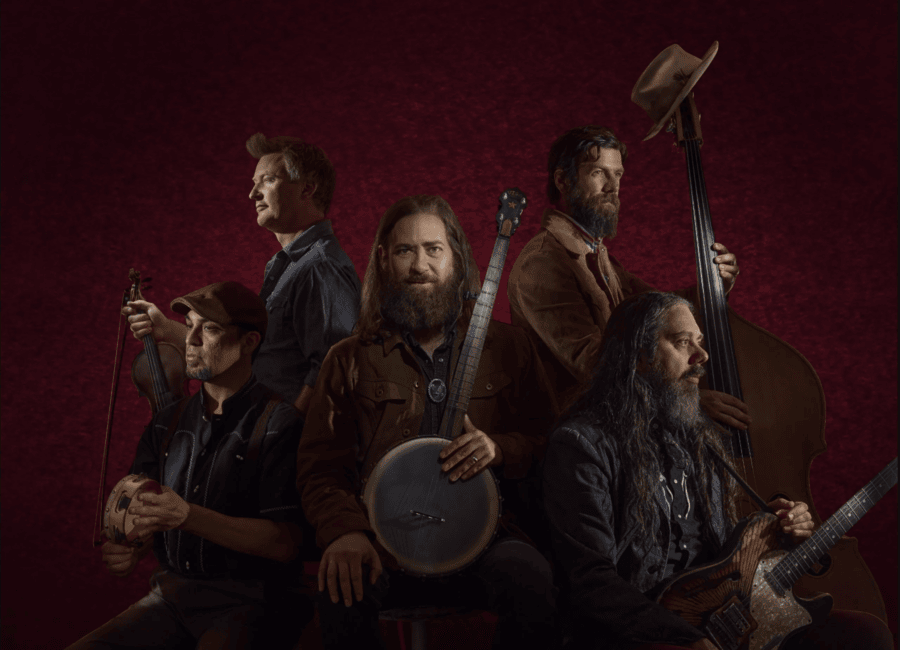
American Seams marks the fifth release from Rose’s Pawn Shop, arriving almost exactly three years after Punch-Drunk Life. When I last spoke with bandleader Paul Givant, we touched on the band’s signature blend of bluegrass, folk-rock, and Americana, a sound where fiddles, standup bass, and banjo converge into a cinematic atmosphere perfectly suited for Neo-Westerns like Yellowstone or Longmire.
In any interview, there’s always a thread you meant to pull but didn’t; as 2025 drew to a close, I had the chance to circle back with Givant. During our 2023 conversation, he mentioned that the ska-punk legends Fishbone were his favorite band in high school, so I figured there was no better place to pick things up.
I went back and read our previous interview to refresh my memory about what we talked about. You had mentioned that Fishbone was your favorite band in high school. I love Fishbone. I got to interview Angelo Moore in the last year, which was a bucket list interview for me.
PAUL: That’s awesome, man. Angelo is an amazing dude. To me, he is one of the few true artists. I really respect that guy. I’ve been lucky enough to run into him here and there over the years just being in LA. He just would be out and about, so I’ve got to talk to him. He gave me his phone number once and said we should jam. I never did take him up on it because I didn’t know how we would sync up musically. But those guys were definitely my favorite band in high school. I just loved their fusion of so many different styles into this crazy cacophony of sound.
Do you have a favorite album?
PAUL: The Reality of My Surroundings was probably my favorite, probably Truth and Soul second after that. I think Reality was the one that really got me into them, and from there I went through their whole discography, but that was the entry point for me.
I saw Scott Ian from Anthrax wearing a Fishbone shirt when I was flipping through a magazine in high school. I had no idea what this shirt was, so I went out and bought Truth and Soul. As a kid who listened to metal almost exclusively, Fishbone was like nothing I had ever heard in my life. I loved it.
PAUL: I was a metalhead, too, in junior high. I went through a real metalhead phase and broadened my horizons as I got into high school, but it always tripped me out when they would go down those metal pathways. I was probably more of a fan of the ska and funk stuff they did, but Give a Monkey a Brain… and He’ll Think He’s the Center of the Universe had a lot of metal on that one. Then all of a sudden, it would just break out as this really fun ska song. That’s why I just love them; they just took you on a journey all over the place.
When you say you were a metal kid, what were you into?
PAUL: It started off on the softer side. In my early junior high, I was into the hair bands. I loved Motley Crue. There was a time when Motley Crue was my favorite band in middle school, and Poison and Skid Row. Then I started getting into heavier stuff like Slayer and Sepultura at some point. I would say those were the two heaviest bands I was into. I think my segue from there in late middle school was when Primus came out, and they started veering more to weird alternative, like Primus and the early Red Hot Chili Peppers stuff. From there, my whole musical palette fully opened. I got into everything, but there was a time period that was mostly just hair bands and metal in middle school. I diverged from that, but Iron Maiden was always my favorite. I loved them for years, and then I kind of stopped listening to a lot of metal.
In the last five years, I have gotten back into Maiden because I just loved them so much as a kid. Last October, they came to LA, so I asked my wife for my birthday present to get tickets. I’d never seen them, and they played the Forum. It was kind of awakening my inner child. It was a real cool roundabout experience to see them live. I was so impressed; they’re getting up there, but the dudes still have a lot of energy and put on a great show. That was a really special concert. Even though I was so into it as a middle school kid, I never really would go see it live. It’s kind of funny at this point in my life to go see Maiden, but it was awesome.
Let’s talk about your record. You put out a solo album in April, and you’ve got this album coming out in February. Do you have two musical drawers that you pull from, or are you just a songwriter and it just depends on what fits the project, the timing, or who can play what? How do you determine what’s a solo thing and what’s a Rose’s Pawn Shop song?
PAUL: That’s a great question. Sometimes in recent years, there’s definitely been times I’m writing where I would want to challenge myself to write something different than what I’ve done before. I’ve spent two decades plus now in the Americana world as my primary outlet with Rose’s Pawn Shop, and I’ve focused a lot of my songwriting on that. I did put out a solo record in 2018 to try to do something different. I wasn’t totally pleased with the results there. In that case, the writing for that was initially supposed to be a Rose’s Pawn Shop record. I was writing that at a time when there was a lot of change in lineups—some guys who had been with me for a while were unable to tour—and I just didn’t know what to do with these songs. They did sound a little bit different than what Roses had done, so it became my first solo record. Again, I wasn’t totally pleased with how that came out, but it was at least dipping my toes in something a little different.
Then I decided to try to challenge myself to just write. We have spoken about all these different influences I had growing up—metal, folk, funk—and one thing I was really into was the singer-songwriters of the ‘60s and ‘70s, like Paul Simon and Cat Stevens. I always wanted to write a record leaning into that stuff. When I was first trying to become a songwriter, that’s where my first writing was coming from. Full circle, around 2022, I finished writing for the last Rose’s Pawn Shop record and I just started writing a lot of songs. I was allowing myself to lean more into that folksy stuff, and at some point, I decided I wanted to do a different project of my own. I also wanted to make another solo record that I was proud of. There were definitely some songs I wrote with the mind that I’m going to put this on a solo record, leaning into that ‘70s folk thing outside of the Rose’s Pawn Shop wheelhouse. There were other songs I would write and I was like, “This could go either way.” We could lean into the fiddle, the banjo, and the bluegrass harmonies. At some point, it was a matter of analyzing a batch of 30 songs and asking, “Where do these fit? How do they fit a narrative in terms of a collection of songs?” The short answer is: sometimes I’m writing with the idea of a specific project, and other times it’s like, “This could go either way, where does it fit with a group of songs?”
I got into ‘70s folk rock after buying a turntable 15 years ago. Back then, I could go into a used record store and pick up albums by artists like Paul Simon and Jackson Browne for cheap. I wasn’t familiar with many of those albums but could hear how they’ve influenced artists of today. It’s cool to discover stuff from the past like that.
PAUL: Absolutely. You hear a band like Dawes, who is pretty big, and obviously they’re hugely influenced by the Jackson Browne sound. It does have a timeless quality. It’s one of the reasons I love that style and the songwriting of that era. It was so specific. It’s funny now, I got a lot of positive feedback on my solo record, a lot of great reviews, but there were some people, like playlisters, and I told them, “I made a folk-rock record, these are some folk-rock songs.” They said, “This sounds old. It sounds like it was written in the ‘70s.” Which was what I was going for, but apparently there’s an “indie folk” sound that is not that now. They expect a different songwriting format; they don’t go for a verse that’s going to set up a chorus. It’s like, “Just get to the chorus.” It’s a weird change in format that is happening, but to me, those old songs and how they develop are beautiful. That’s what I wanted to emulate because it always had been a big influence for me.
You tracked the whole album in four days?
PAUL: For the new Roses record, the majority of the tracking was in four days. It was mostly live. There were overdubs that took place the week after for the lead vocals. The thing that took the most time was the harmony vocals. There were still extra days of tracking, but most of the instruments are live. There are very few overdubs of instruments. We really wanted to have good harmonies, so Zachary Ross and Jesse Olema, the fiddle player and the guitar player, went in and crafted these beautiful harmonies as well. The bulk of the tracking was done in four days. We went into Love Street Sound, which is Robby Krieger’s studio.
When you go in to start recording, is the material tight? Do you go in knowing you have a limited time and stick to the way you’ve been rehearsing, or is there room for experimenting and doing something different?
PAUL: We did not do much pre-production for this one just because of people’s schedules. There were three songs out of the ten that we had been playing live a little bit, but the other seven we hadn’t ever played live. We used two different drummers, Deacon Marrquin and Matt Lesser, because they have different styles and different availability. We had one pre-production day with Matt at his home studio and one pre-production day with Deacon at a rehearsal studio, and that was it. I had met with the producer, Eric Corne, just the two of us, going through the songs. I played him my demos, we talked about things we would like to change, and I took that back to the band. It was pretty limited time, honestly, but they are really good musicians. Everybody who plays in Roses is a working professional sideman for other projects all around LA. They have that ability to just get in the studio and go for it. Having Eric Corne as the producer helps; he can make a suggestion in the studio, and we just make the adjustment and hit record.
When did most of the work on the album take place?
PAUL: It was February 2025. We recorded in mid-February, and then some of those overdubs were done by the first week of March. After that, Eric went to mixing.
A year from finishing a record to it coming out seems to be pretty quick, all things considered.
PAUL: For us, it definitely is. It’s gone all sorts of different ways. The first record and the record before this one were recorded over longer periods of time with more experimentation and overdubs. We’ve also done records like this one where we just go in the studio and knock it out in two or three weeks. I prefer this way where we just say, “These are the songs, let’s make a record of what we came up with in this short period of time and let it speak for itself.” It’s better for me because otherwise, I start overthinking things. Let’s just get it down and make an imprint in time of this music.
Is it tough to sit on it for eight months once it’s done?
PAUL: Yeah, I want to get it out. I like the new “waterfall” release format where you release a single, let it live for a month and a half, and then release another one to give each song a chance to shine. I am always like, “I can’t wait for the next one to come out because that one’s gonna be even better.” The record is coming out in February, but I almost wish we could keep releasing singles to give every song a good listen. I was totally resistant to this a few years ago; I wanted to drop the record all at once as its own piece of art. Now I’m 180 degrees on that. I like this new approach where you lead your way up to the full record and let every song get its fair shake.
In 2019, I was talking with the guys in Blind Melon. They were working on new material and were planning to release a single every month or so for a year rather than a full length all at once. They said that nobody wants to listen to a 12-song album all in a row anymore. It’s an interesting way to do things, but it makes sense to me.
PAUL: It is, and it caters to two types of people. The majority of people are not album listeners and just want to hear the song, but the deep listeners who want to go through the whole journey of the record still get that opportunity. They go in being familiar with some of the songs, but they still get a full album experience.
How much input do you have into which songs are released?
PAUL: It was a mix of us and the label. We had a meeting with Eric the producer, some of the label heads, me, and the bass player, Stephen Andrews. We talked through what we thought were the right ones to release. We actually already made a pivot; we were going to release a different single in January, but we decided to release the title track, “American Seams,” as the final single prior to the full record in February. I thought these were the most representative ones to start putting out.
I noticed that with the first track, “American Seams,” you sort of make a grand statement. Growing up during the CD era, track three was usually the single and you built up to it. For two albums in a row now, you’ve come out swinging right off the bat.
PAUL: Of the collection, I thought it was the one that packed the most punch. It was a song that looks back at where we’ve been and analyzes the current moment—both personal and political. It’s looking at what’s going on with me, the band, and the world right now, all packed into one song. I thought it was the right one to kick things off and come out the gate swinging.
It will be 20 years since your first album came out. When I was in high school in 1989, twenty years before that was the era of the Stones, the Beatles, and the Who. Now, your first album would be “classic rock.” I have a hard time reconciling that. Kids today think Blink-182 is a classic rock band. They feel brand new to me, but you’ve been around for two decades.
PAUL: Blink-182 for me was like, “Oh, these guys are just like Green Day was when I was a kid.” It’s weird how time keeps moving. A lot of my peers have thrown in the towel, but I just don’t know what else to do other than keep doing it. I’m passionate about it. Our level of success has stayed on the lower rungs compared to some of my peers, but we still have a fan base that is hungry for more music. I just don’t see an end to it. It’s been two decades of going at it.
As long as you’re getting something out of it, there’s no reason to stop. I’ve interviewed people who didn’t get the success they wanted and dropped out cold turkey. I don’t know if they got burned out, but I would think I would have to keep writing stuff.
PAUL: I think it’s different for everybody. There are some people who just cannot not do it, and I’m one of those people. But it can burn you out. What you’re called to do as a musician involves a lot more hats now. We have to do the social media stuff in a way that we didn’t have to before. It’s a lot of energy. There are times where I have to slow down for a week or two and give myself a break. It has been harder to find time to write because I’m doing social media and some of the booking. It’s ripe for burnout, so I don’t fault anybody who calls it quits, but for me, I get a lot out of it. Let’s keep going for it.
How much do you think geography plays into the music you create? Do you think you would make the same record if you lived in Minnesota or in Columbus, Ohio?
PAUL: Probably not. I think that the geography and culture of places definitely plays a part. As we’ve talked about, just the influence of all the different music that was happening in LA, especially in my influential years, like high school and college, I took a lot in. I think I’ve integrated a lot of things from a lot of different styles into how I write. That might happen for a kid in the Midwest, but I do think there’s influence. I think the California sound makes a big difference. Being around the level of musicianship in LA, I’m lucky to have access to other musicians because you get some of the best in the world here. If you’re lucky, they’ll play your music. I don’t know what it’s like out in the Midwest, but maybe it would be a different approach where you have fewer players to collaborate with and you work in a more focused way. LA has definitely had a big influence on my writing and how I approach music.
With songs titled “The Summer’s Over” and “Autumnize,” I found it interesting that the album is coming out in the winter. Was it always planned to come out in February?
PAUL: It was. Our last record came out in February, too. I felt like the autumn theme kept coming up for me. It might have something to do with it being two decades of doing this. I’m not a spring chicken anymore. Growing up, having different concerns, and having a lot of water under the bridge, I feel like I’m getting close to entering the autumn parts of my life. I think there’s a bit of that metaphor going on. I actually really love autumn, it’s probably my favorite time of year, but it has a bit of melancholy to it. Being a California person who has lived most of my life in the sun, I have a lot of optimism, but I’ve always carried a bit of melancholy. That’s just part of my personality. In a way, it’s kind of cozy. I like a little bit of sadness while still not being in the depths of despair. I connect with that. That theme seemed apt and made its way into a lot of the songs. There are three different songs that actually reference the autumn: “Darken My Door,” “Autumnize,” and “The Summer’s Over.”
Last time I asked you if there were lyrical Easter eggs hidden, influenced by a book you read or a movie you saw. Is there anything like that on this record that a listener might not pick up but that references something I could connect to?
PAUL: There is a secret lyric, not secret, but a lyric in one that might actually be controversial, so I don’t even want to speak to what it is. If people find it, they find it. It’s in there. It’s not a statement of anything I support; it’s almost like reporting on the news of the current state of things. I’m going to leave that to listeners to see if they can find what I’m talking about. Overall, the lyrics of this record are speaking to a new stage of my life. A lot of early records are about wild nights drinking in my 20s and life on the road. There’s a little bit of that, but I’ve grown up. I’m a bit of a family man now. I have new concerns and it’s that time of life for taking stock of where I’ve been and thinking about where I am going.
I am not a big bluegrass music fan, but I love the record. It’s not a bluegrass record; it has bluegrass sounds and influences, but you really pull from a lot of different sounds. This is a very pleasant listen.
PAUL: I’m glad. I really like “Escape Artist” as well. That might be the focus track for when the album fully drops. That was a fun one to write, and I love the way it came out. The beginning of the song was supposed to be kind of free time before the whole song kicks in. My producer, Eric, said, “Well, just sing it right now real quick.” I was in my little ISO booth and I just sang it. He said, “Cool, we got it.” We built the rest of the song off that little moment. I was really pleased with how that one came out and the Harry Houdini vibe of it.
In terms of touring, the landscape has changed a bit post-COVID. It feels like it’s coming back, but older artists have said they don’t need to be out on the road eight months out of the year. It’s more selective: a week here, a week there. Do you have 2026 mapped out?
PAUL: Somewhat. We are returning to the East Coast for the first time in a long time in April. We’ll be starting in Nashville, heading to Atlanta, and then up the East Coast to hit a lot of places we haven’t been in seven years. I know there have been fans out there asking us to come back, so it’s going to be good to finally make good on that. We’ll be getting out there in mid-spring. We’re also going back to the UK and Scandinavia this summer. We have a couple of festivals out there. That’s going to be a big part of our touring in 2026. We also have festivals in the Mountain States. Most of our touring in the States is targeted extended weekends or a week or two here and there. That feels doable and avoids the burnout we were talking about.
With 20 years and multiple albums under your belt, when you play these dates, is the setlist heavily focused on the new record or a greatest hits compilation that spans your history?
PAUL: It will be a mix. We’ll definitely be playing off the new record, probably two or three songs from it every night, and then we’ll try to mix and match different songs from the record on different nights. Then there are certain songs that are our most popular that fans who have been with us for a long time want to hear. We’ll make sure those are in the set, and then we’ll try to mix it up with some randoms. It has been a priority for me to work back in a lot of songs from our earlier records that have fallen out of the set. I want to make it a little bit more unique every night and throw some curveballs in there.
Have you had songs placed in movies or TV shows?
PAUL: A little bit. I had a couple of songs on the CW show Hart of Dixie, which was popular at one point. We’ve had a few songs on reality shows. Nothing too big and nothing recent, but I have been talking with a publishing company that is interested in working with us. I won’t say more for now because it’s still in play, but I’m hoping they found these new songs are ripe for placement. We’ll see what happens, but hopefully, we’ll get more stuff, especially because there are shows like Yellowstone out there that lend themselves to where we’re coming from.
That’s why I asked. I felt like this album is very cinematic; it feels like these songs could fit into shows like you were talking about.
PAUL: That’s another nice way to get music out there these days when it’s so difficult to get above all the noise. If you get placed in something, it helps you stand out.
Looking back at 2025, what are some things that stand out as highlights?
PAUL: First thing that came to mind is that I’ve been on a Turnpike Troubadours kick lately. I never went that deep with them before. We actually came up somewhat as peers; I remember running into them at a gas station on tour in 2009. We talked to them, van and trailer to van and trailer, and said hello. They certainly graduated out of the tour van! I’ve been blown away with the songwriting and overall sound. I also loved the Gillian Welch and David Rawlings record, Woodland. They are two of my favorite musicians of all time and a huge influence. They announced touring, and of course, the LA date was right when I was on tour with Roses. I was so bummed, so I told my wife, “We just gotta go.” We flew out to Santa Fe, New Mexico, and saw them two nights in a row. That was an incredible 2025 musical experience.
I have a final question I’ve been asking everyone lately. Is there a song, artist, or album that, when you hear it, takes you back to something very specific?
PAUL: That’s a great question. The first thing that came to mind was the Paul Simon record The Rhythm of the Saints and “The Obvious Child.” I remember hearing that for the first time in my bedroom in the ’90s and having a nostalgic feeling. But the better story is a Radiohead song called “The National Anthem” from the Kid A album. In the early 2000s, they were playing a sold-out show at the Hollywood Bowl. I was broke and couldn’t get tickets, but you used to be able to go up in the hills above the Bowl and just listen. Me and a few friends went up there, and right as they opened with “The National Anthem,” security came into the woods to kick everyone out. We all started running, and I ended up sliding down a hill and jumping over a weird wall. Next thing I know, I’m inside the Hollywood Bowl. I just ran into the crowd. I didn’t try to break in; I accidentally broke in. With the adrenaline rushing and that song playing, realizing I was about to see Radiohead for free, that sticks out as a high-adrenaline moment. Anytime I hear that song, I get pumped up.