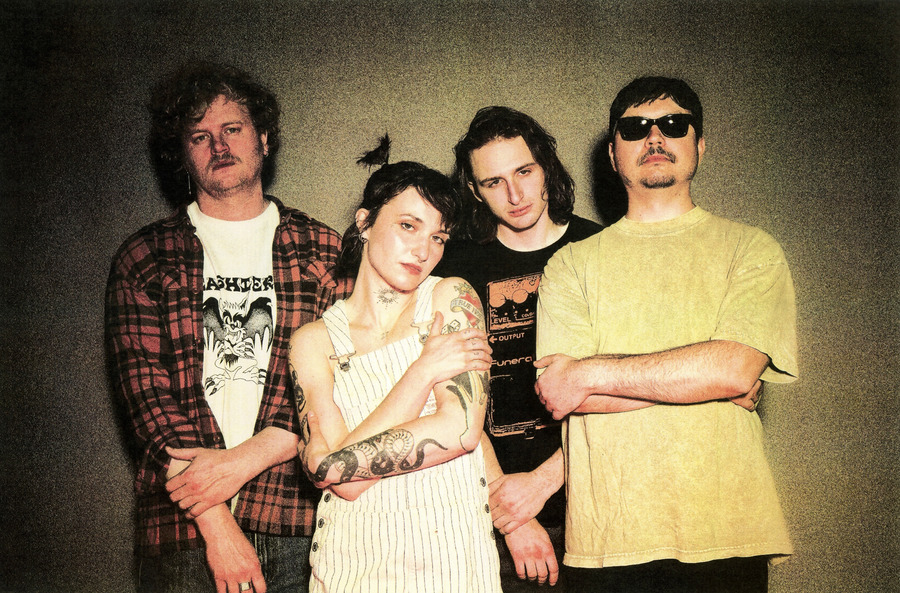
Photo by Luke Ivanovich
MX Lonely’s new album, All Monsters, released via Julia’s War Records, pulls from ’90s alt-rock, grunge, and shoegaze without sounding trapped in revivalism. Where much of the current shoegaze wave leans into aesthetics – walls of distortion, vocals buried beneath layers of fuzz – MX Lonely treat the voices of Rae Haas and Jake Harms as central to the band’s sound. Their voices don’t hide in the mix; they cut through it. That clarity is what separates MX Lonely from many of their peers.
Haas and Harms first connected in 2019. While some press has suggested they met at an AA meeting, the real story is simpler: Haas attended a show by a band Harms was playing in. They hit it off, bonded over shared influences, and soon began writing together. That same year, they released an EP under the name v0id b0ys, channeling Elliott Smith, emo, and goth textures. The project became a proving ground, allowing them to explore each other’s strengths as writers and vocalists. In hindsight, the v0id b0ys material feels like a sketchbook; many of the core elements are present, but the guitars are more restrained and the arrangements less expansive than what would follow. Still, it offers a revealing glimpse into the duo’s foundation.
All Monsters follows 2022’s Cadonia and 2024’s Spit EP and stands as MX Lonely’s most fully realized statement to date. It captures a band that has found its footing and sharpened its identity. On a roster as strong as Julia’s War’s, MX Lonely feel poised to be its breakout, an act capable of drawing wider attention while elevating the scene around them.
I thought I was going to be listening to a punk band based on your press photos, but when I listened to the music, I realized that is not what this is. Have you ever been called “Shoegazi”?
JAKE: Is that a mix of shoegaze and Fugazi?
Shoegaze and Fugazi, yeah.
RAE: I’ve said that as a joke, like describing a band, “very Shoegazi” but I’ve never heard somebody say it as a term. We get “grunge-gaze” and things like that. Shoegaze just kind of blew up, and now everyone is trying to figure out what the sub-genre is. Alternative rock has been feeling more right lately.
JAKE: We don’t really like any of the terms, but we loosely categorize as shoegaze because that seems to be something that people can understand. Shoegaze has been getting rebranded by bands that are doing it in a heavier way. What people are calling shoegaze right now is closer to alternative rock being played by the Smashing Pumpkins, where there are heavy drums and a heavy rhythm section, but guitars with a ton of air in them.
MX Lonely is different from a lot of that stuff because we do stuff that’s folky. We have prominent vocals and vocal melodies with a lot of character and lyrics that you can actually hear.
RAE: It’s performative in a way that shoegaze is not really. It’s not about dissociation; it’s meditative, but a little bit more engaging.
Having two vocalists creates a dichotomy. You work well together, but you both stand alone as singers. In ’90s shoegaze, there was usually one singer whose lyrics were buried in the mix while the guitars swelled over everything. That sets you apart from that era and even what is going on today.
JAKE: We’re not anti-performance. In a deliberate way, a lot of those bands try to cut down on personality to decentralize the idea of there being a focal point vocally. With two singers, we are trying to present something where there are obviously two different viewpoints, but ideally, the listener isn’t thinking about that too much. You’re intaking this as a complete musical idea. Whether it’s Rae singing or me singing, you’re not that focused on who it is, but just taking it in.
RAE: I think of us both writing for MX Lonely almost as a character. MX Lonely is its own inner world that is a composite of both our experiences: angels and demons and the inner psyche things that come from writing.
JAKE: If we were co-authoring a book, you wouldn’t say the book is a direct distillation of two viewpoints; you would say it’s a novel that happens to be written by two people. MX Lonely happens to be two people singing, but it should feel like one object or one idea with a lot of facets. In our live performance, we lean more into Rae being the lead singer because we think that’s cooler and more sick than being unengaging and ignoring your audience. TAGABOW (They Are Gutting a Body of Water) is our label boss, and I love the anti-performance style, but we’re more interested in the way hardcore bands perform, where somebody is almost like a circus conductor or a guide.
RAE: Performance is not selfish. A lot of people, outside of it, I think would be like, “Oh, you’re the lead singer. You’re a star. You’re trying to show off, or show up.” There’s a lot of music that has that energy to it where it’s like you’re being a bad bitch and people are feeding off of that. I think of our performance as more collective and about the audience.
Is that your offstage personality? Are you extroverted?
RAE: No, I would say I’m an extraordinarily strange person. We’re all pretty introverted, but the performance is extremely sincere. We are dead ass about it. That is where I feel I communicate and connect with people the most, in this character that we found in MX Lonely. I’ve got depression and anxiety and low self-esteem, which is not always the best concoction for being a lead singer, but there is something that makes it more important because it is outside myself.
It feels a little contradictory that MX Lonely is a character, yet your lyrics seem to be extremely personal.
JAKE: You could say Elliott Smith is an autobiographical songwriter, but if you sat down with him, he would probably say his songs are stories. He used pieces of information from his real life to create a feeling and an idea. Certain songs lean more autobiographical because that’s what you do as a songwriter, you mine your personal experiences, but I would never say this is literal, note-for-note truth or that it’s definitively about real people. As a storyteller, I’m not trying to create something that is that literal. I’m trying to create something bigger than that, a feeling that people who are not intimately familiar with the details that created these songs can still understand. That’s more important than fact-checking it.
I talked to a songwriter who said he wrote songs about his own life from the perspective of someone else looking at his life. The stories were based on fact, but the outside person was filling in holes. It’s based in truth, but it’s how someone else is seeing that truth.
RAE: A lot of times I’m trying to write from what I think somebody else’s perspective is.
JAKE: I love the idea that in a song you have the right to flip perspectives. You could be talking from the first person and then flip it to the second person. I don’t think we’re necessarily trying to make it that easy to understand. I’m happy to talk about it, but I’m not trying to go through songs line by line and say, “This is from this day in 2021 when somebody made me upset.” MX Lonely is a vessel for both of our thoughts.
Do either of you write lyrics and then pass them off for the other to sing?
RAE: Yep. We met in 2019 and immediately started making music. Jake asked me to do some harmony vocals, and we just had that connection where it’s really easy to write for each other.
JAKE: You immediately came in with a bunch of really good lines. It’s interesting talking to people who write about music, because I don’t think musicians and songwriters think the same way. We think about how a line feels and sounds on a subconscious level. The first line Rae ever brought in was, “I’ll eat the sun for you.” I didn’t necessarily know what that meant, but it was inspiring and I wrote a whole song around it. It was inspiring to try a bunch of lines that previously hadn’t occurred to me.
I love being able to collaborate lyrically. It opens up the possibilities and makes you feel less stuck. Sometimes it’s just nice to sing things that are not your own, or be able to write an idea and have it sung by somebody else when you don’t necessarily have the guts to sing that idea yourself.
I read the bio, and the origin story is that you met in AA, is that right?
JAKE: No, we didn’t meet in AA, we met at a show, but we got sober after meeting. We both have relationships with AA and the program, but the way that MX started is that I was very freshly into AA. We were both going to meetings. The band, when it started, was all people who were going to meetings. Our joke was that MX band practice passed for an AA meeting because it had more than two alcoholics in it.
RAE: It was a learning thing and an outlet to play music with people.
JAKE: It was easier to jam with people who weren’t drinking. Every interaction prior to the pandemic and prior to getting sober, every band practice I had ever participated in was just a big excuse to drink a lot of beer on a weeknight. It’s really nice to be in a room with people who didn’t also drink.
I’m curious about the first time the two of you met. Did you have mutual friends that introduced you, or was it a situation where you were at a show and thought that person looks cool? If it had been AA, my question would have been: are you able to look at somebody and know they have the creative talent you’re looking for?
RAE: I was at a show that Jake was playing. There was just something interesting about Jake. We were talking and I was reading some super esoteric Freud book. We were talking about psychology and poetry.
JAKE: Rae seemed weird and smart.
RAE: Jake still has pretty big hair, but when I met him in 2019, he had huge, crazy hair. I was just interested in him as a person. I saw him as this big, giant, blonde dude. I had bright purple hair and a bunch of tattoos. I was always out at a bunch of shows and would be up in the pit.
Talking to Jake, I was more open. I had been seeing DIY music, but I came into music later in life. I had all of these lyrics and melody ideas that I didn’t quite have a musical foundation for. I had notes, but I knew this is not a band or a thing yet. I really wanted to front a punk band. I had a whole different idea of what I wanted to do.
JAKE: Rae wanted to play really loud, noisy music, and then the first thing that we wrote together was this really sad, really introspective album that we both still like a lot.
It’s kind of like emo-folk. When we started performing it live, the songs had a really good live energy. Rae saw me playing in a noisy punk band and wanted to do noisy punk rock, and I was like, “But what if we did something that sounded like Elliott Smith, but with our vocals?”
RAE: It was the first time I had played music with anybody. I had all these journals and had been manically writing. I had all this stuff I needed to get out. I think of music as a spiritual practice where things come through you.
I respect that so much because I have zero music talent and zero creativity. In 7th grade, I loved Eddie Van Halen and took a music class. They handed out acoustic guitars, and I hit a note and thought, “This does not sound like Eddie Van Halen.” I had zero patience because I thought you could pick it up and learn to be a guitar hero in one day, so I gave it up fast. I respect anybody that can take songs or lyrics to somebody and say, “I’m gonna try to sing this.” I would be so afraid to do that.
RAE: Music shouldn’t feel inaccessible if you’re not a virtuoso on an instrument. We have so much technology to make music now.
JAKE: We also have a really good situation. I’ve been doing it forever, and Rae is a really gifted singer and melody writer.
RAE: The lack of training serves me in some ways; I approach things with no sense of music theory.
JAKE: I’ve been recording and performing music since I was ten, and Rae is a really natural recording vocalist. Some people have a lot of trouble with it, but Rae knew how to do stuff that you usually have to teach people without even having to be taught. That has made the musical relationship easier. Rae has this baked-in, very strong sense as a songwriter and melody writer that was there right from the start.
A lot of people who are really technically accomplished musicians have no idea how to perform. Rae is a trained actor and went to acting school and had a ton of experience understanding how their performance would be perceived in space. It was really cool to start a band with somebody who understands that there’s a visual component beyond the music-nerd aspect of it. To this day, we’ve been able to develop the visual component equally with MX Lonely. We shoot music videos and Rae represents the band visually in a way that enhances the music. It is as important as how it sounds.
I can pull up YouTube and see a ten-year-old kid in his bedroom who can technically nail something. But taking the step to say, “We’ve got these songs, now I’m ready to present them to people,” and then getting a van to take it outside of your comfort zone is another thing. What was the turning point where you decided you were good enough to tour?
JAKE: I had spent ten years touring in other bands. This band played locally for a year before we went on our first tour. For me, I was the last one to come around to it. Both Gabe and Rae were asking when we were touring. When we started playing out, I was 32, now I’m 35, and I thought I was way too old to go play DIY shows. Then six months later, I’m loading a 612 Emperor cab into a basement in Binghamton and deafening teenagers. I haven’t looked back.
RAE: Everything I wanted to do in theater, I found in the DIY scene. I love having that real connection with people. I did a lot of immersive theater which is interactive with strangers. Bringing it on tour was about having more experiences, whether they be awesome or awkward. I love bringing it outside of just your friends and people who have seen it. In small towns, you might only have three or four local bands, so having somebody come through is a gift. It feels like our community and network is much larger than just New York.
Rae, with an acting background, are you playing a role as a singer on stage, or is what we’re seeing the real you?
RAE: In acting school, you are trying to drop in and find the truth. Every show, I’m trying to find the truth in every song. Every time I’m singing, it’s very emotional. I try to go there and have a real experience that people can feel. It’s less about playing a character and more about being myself, but going through these songs as if I’m feeling it in that moment. It’s the emotion more than it is a character. I probably should have a little more of that bad bitch energy.
If you were born in the early ’90s, you probably missed out on how important labels were back then. I turned 20 in 1991. Labels were so important. After discovering Nirvana, I bought everything that came out on Sub Pop just because it was on Sub Pop. In the last twenty years, we’ve lost that identity with labels where you want to own everything they put out. You guys are on Julia’s War, which is starting to get a name. I think people are listening to music from anyone on that label just because of the label name.
JAKE: Working with Julia’s War was a good decision for that reason. I’ve known Doug since 2014. I had another band called What Moon Things, and he used to book my band in Albany before he even played in bands. When I was getting back into music after getting sober and Rae and I decided to do this band, Doug was one of the first people I talked to. He helped us hook up with Candle Pin Records, which was a sister label to Julia’s War.
We were talking to a bunch of different people when we were shopping All Monsters, but we’ve always played Julia’s War showcases. Doug hit me up after South by Southwest last year and asked why we had never worked together. It felt like an easy confluence of things for us. Here is somebody we know is firmly in our corner; even if we didn’t release a record on Doug’s label, he would still be supportive.
His label has taken a big step to become more legitimate this year. We were trying to move beyond the DIY label thing with this release. When we started talking to Doug, I thought Julia’s War was still a tape label, but they’ve started doing more for the artists in the past year. We are an early facet of that. We aren’t the biggest band on Julia’s War, but we’ll be a bigger band there and it works nicely for both of us. We can bring attention to the label, and the label has a name that’s trending.
We also talked to New Morality Zine out of Chicago, which is an incredible label. I would definitely say pay attention to labels. There are so many good scenes. That thing you described with Nirvana and Sub Pop is still very much happening and is very important.
I don’t disagree. It’s just that without radio support or MTV, it’s harder for me to discover a label and dive into their catalog until I hear a band on a label and then do my own digging to find out what other bands are on the label.
JAKE: It takes a band from Julia’s War, or even TAGABOW having the release cycle they just had, to shine attention on the label. My parents, who are in their late 60s, saw that the band we were playing with was written up in the New Yorker and the New York Times. Those cultural touchstones matter. Partisan has Geese and Idles. It’s a cool, not-super-huge, label that suddenly has bands that are really sick.
It is harder to gain access to stuff. If I’m booking a tour and trying to find bands regionally, I’m basically looking at show posters on Instagram in regions where I know bands exist. There’s not an easy way to figure it out, but that’s how I book bills, looking at posters and wondering, “What is that?”
As a writer, the publicist is important to me. Your publicist, Kenzie, seems to work with a lot of bands I like. Even though I’m one of 800 journalists getting an email, it feels personal to my taste. If she’s sending something, I’m going to check it out.
JAKE: Kenzie worked with our friends in the band Shower Curtain, also a sick band worth checking out, back in 2023, when we were doing the rollout for Spit. I was unhappy with our PR person. I saw Kenzie doing PR for Shower Curtain’s release and realized she was aware of all these tiny labels on the East Coast. We were too far along to switch then, but when we started talking to Julia’s War and found out Kenzie would be doing the PR, it was a big relief.
RAE: Kenzie is a boss. She has great taste and she takes the time to ask what you want to share and what you’re comfortable with. She really supports and protects you. Even though she’s working with a lot of people, she takes that time, and not everyone does.
Are there songs that mean a lot more to you, that you wish people would focus on?
RAE: They all have a different vibe. I have a different favorite every month. “All Monsters Go to Heaven” is the heart of the record, which transitions into “Blue Ridge Mtns.” They are all different facets of the same thing. “Anesthetic” has been my bop lately because it’s our pop song.
My phone makes me a better photographer because of the instrument, even though I’m not a photographer at heart. Are there instruments or production techniques that have made you a better band just because of something you plugged in?
JAKE: No. I firmly don’t think so. Nothing replaces years of playing together.
RAE: I was playing on a vintage Kawai keyboard that we wrote Cadonia with, but it was hard to tour with because old technology fails live. Now I play on a Yamaha ModX. For me, it’s just about having gear that is reliable.
JAKE: Gear should be transparent. We went through crazy maximalist amp-buying phases, but simpler is better. The less it gets in the way of you doing your job, the better your band is going to sound. I spent four months trying to find a backup for a Stratocaster I’ve played forever; I bought all these weird guitars, sold them, and then just bought another Strat. Music is simple. Having limitations is good for art.
You turn on the radio and you hear things put together entirely because of technology.
JAKE: I don’t want to be controversial, but that’s not real music to me. Even amazing hip-hop artists who rely on DI inputs still have to be able to do it. If your laptop breaks, you should still be able to perform. My brother sent me a photo of a lawyer’s jam room filled with vintage Marshalls, Junos, and a wall of pedals. That’s “lawyer gear,” it’s expensive, it sounds amazing, and it stays in his den. I play a Peavey Butcher from 1983 because it has never failed me at a show in two years of touring. Having gear that doesn’t break allows me to do my job.
The tour starts in March?
JAKE: The release show is February 28th, but the first on-the-road date is March 5th. We’ll be out until April 7th.
I sometimes feel self-conscious going to shows because I’m the “old guy.” I’ve seen a bit of a backlash lately against older, taller dudes standing right against the stage.
JAKE: I saw that Die Spitz posted about that. I’m a big, tall dude, and I don’t stand at the front unless it’s a room that isn’t super full. You have to read the room. If you’re at a Die Spitz show and you’re my size hogging the front while shorter people are behind you, that sucks.
We were at a Protomartyr show in Philly where the audience was dead. Protomartyr is one of my favorite bands, so I’m not going to sit in the back while a bunch of dudes just stand there. I’m going to go to the front and move around. But that’s not a Die Spitz show; it’s a different audience.
RAE: It’s like the “Fems to the Front” idea. It’s about awareness of where you are in space and making sure people can have a good experience.
It drives me crazy when people stand in the front and film the entire show. I take a couple of pictures and videos, but I don’t do the whole show.
JAKE: It’s all about context. All bands are struggling and need people to buy tickets, so it’s better to go out and support them.
We played a show in Santa Ana, and in the next room, there was this performance where there was more light coming from phones in the audience than from the stage. Someone tried to crowd surf and nobody caught them because they were too busy filming. Everyone just filmed the kid falling on his ass.
Is there a specific song that takes you back to a very specific memory?
RAE: For me, it’s “The Killing Moon” by Echo & the Bunnymen. I had a very specific feeling hearing it right after my dad passed. I found a bunch of CDs in the garage. I read that the phrase “fate up against your will” just came to Ian McCullough through the ether. There was something that felt oddly connected to that presence. It was one of the first times I had a super out-of-body experience with music. That song brings me right back to Florida; I can smell the grass being cut.
JAKE: In high school, I found that Side A of the self-titled Elliott Smith record was the perfect amount of time between calling someone on the house phone for a ride and them actually arriving. That was my “hype music”—listening to half of this incredibly sad record before going out to hang with friends. “Clementine” evokes some pretty strong stuff and still holds up as a huge part of what MX Lonely does musically.
We listen to Either/Or more now. The self-titled record is a great high-school record because it’s melodramatic. It starts with “Needle in the Hay”—the suicide song from The Royal Tenenbaums. It’s a crazy song.
Where are you with Heatmiser?
JAKE: I enjoy Heatmiser. “Plainclothes Man” is a cool song. I’ve never fully listened to a record, but I’ve heard their version of “Christian Brothers.” Elliott Smith was obviously on the way to a better execution of his vision. Roman Candle is an interesting merging point because it’s equal parts soft grunge and surfy folk.
Do you have a CD player in your tour vehicle?
JAKE: We’re renting a van for the first time, so maybe. A lot of new ones don’t have them. We’ve done every other tour in a Honda Pilot or a Dodge Grand Caravan with a trailer, but touring is destroying our personal cars. You drive across the desert between Texas and San Diego enough times in your personal vehicle and you start to ask yourself questions about what you’re really up to.
I’ll bring you Heatmiser CDs when I see you.
JAKE: If you give us a CD, it will get listened to. I promise you. We definitely listen to CDs.
*************************
MX LONELY LIVE 2026
FEBRUARY
28 – New York, NY – Market Hotel %
MARCH
5 – Philadelphia, PA – Nikki Lopez
6 – Pittsburgh, PA – Funhouse at Mr Smalls $
7 – Fort Wayne, IN – Bug House $
8 – Dayton, OH – Yellow Cab $
9 – Chicago, IL – Empty Bottle $
11 – Atlanta, GA – The Earl
12 – Nashville, TN – DRKMTTR
13 – Birmingham, AL – Firehouse
14 – New Orleans, LA – Siberia
15 – Houston, TX – Starseed Hostel
16-18 – Austin, TX – SXSW
19 – Denton, TX – Rubber Gloves
22 – Phoenix, AZ – Linger Longer Lounge
23 – San Diego, CA – Soda Bar
24 – Los Angeles, CA – Permanent Records
25 – San Francisco, CA – Neck of the Woods !
27 – Seattle, WA – Black Lodge !
28 – Portland, OR – High Water Room !
29 – Boise, ID – Treefort Festival !
30 – Salt Lake City, UT – DLC
31 – Denver, CO – 7th Circle
APRIL
2 – Kansas City, MO – Farewell
3 – Minneapolis, MN – Como Garden
4 – Milwaukee, WI – Anodyne Coffee
5 – Grand Rapids, MI – Zabhaz
6 – Toronto, ON – The Baby G
7 – Albany, NY – No Fun
! – with Sour Widows
$ – with bloodsports
% – with shower curtain, bloodsports and Wiring