
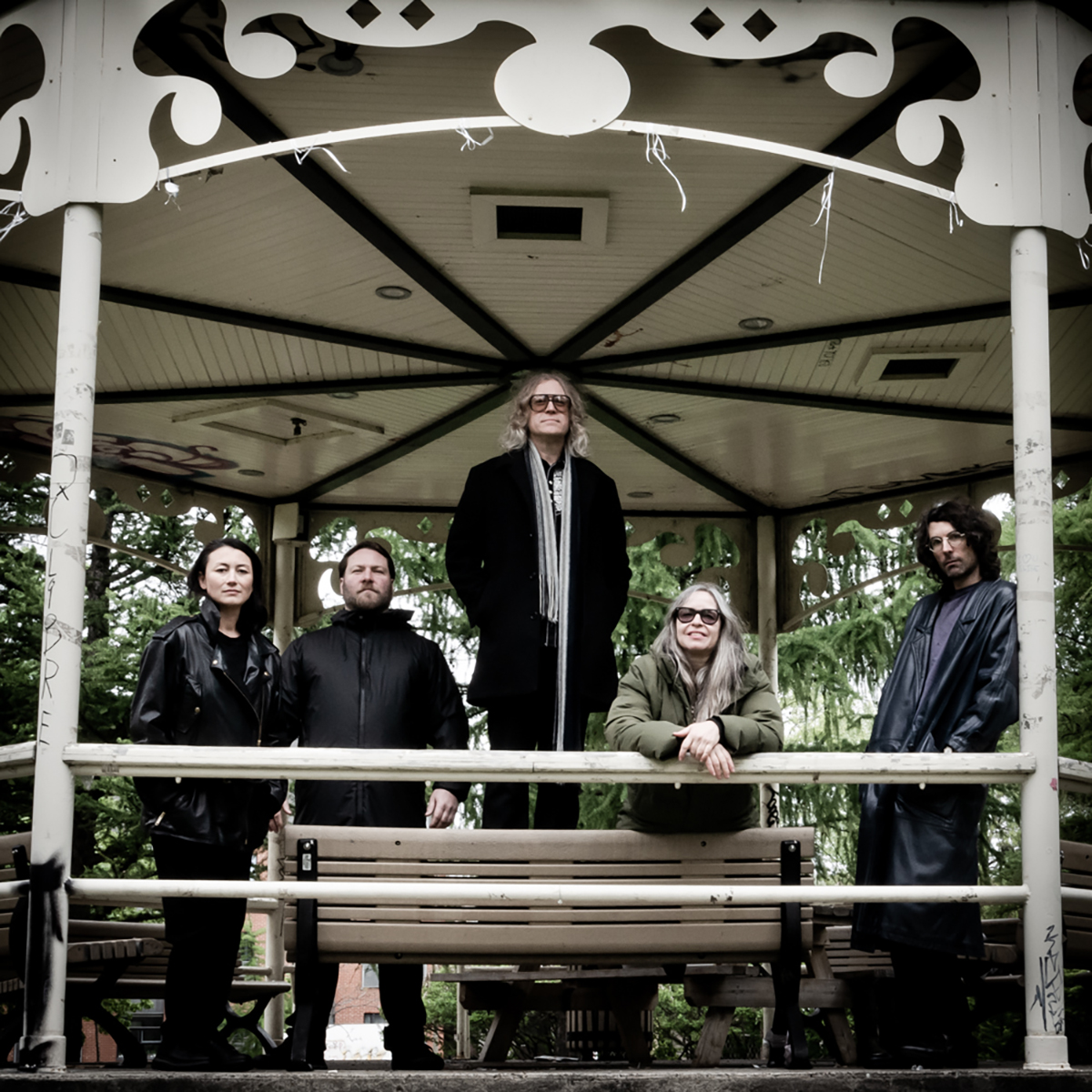
Photos courtesy of The Besnard Lakes
Listening to The Besnard Lakes is like surrendering to a beautiful, heavy atmospheric pressure where the line between the physical world and the spectral blur is intentionally thin. In the lush, analog depths of Breakglass Studios and the secluded Lost River Studio, Jace Lasek and Olga Goreas have refined a sound that feels less like music and more like a living environment. Their latest transmission, ‘The Besnard Lakes Are the Ghost Nation,’ emerges as a high-fidelity seance where the core quintet of Lasek and Goreas alongside Kevin Laing, Gabriel Lambert, and Sheenah Ko, navigates the debris of human progress and the threat of cultural erasure. This record trades the sprawling thunderstorms of their past for a paradoxical lightness, grounded in the tactile warmth of vintage consoles and the organic spontaneity of recording in the Laurentian forest of Canada.
The album’s architecture is built on tracks that function as psychological waypoints. The opener, “Calling Ghostly Nations,” acts as a slow-blooming portal of rolling synths and arpeggios, setting a stage where Goreas emerges like a spectre from another world. This transitions into the more urgent, pop-inflected “Chemin de la Baie,” where Lasek’s androgynous falsetto and Goreas’s grounding harmonies navigate ghostly echoes akin to a storm approaching in slow motion. Lyrically, ‘the ghost nation’ serves as a metaphor for a community under siege, a meditation on whether we are evolving or merely dissolving into a state of being where identity is under threat, a theme heavily explored in the clanging, Mellotron-driven “Carried It All Around.”
The specific textures of this record are dictated by Lasek’s dual role as both the master architect and a vulnerable performer. While often utilizing a prized 1968 Neve germanium mixing console to capture the band’s signature “wall-of-sound,” Lacek allows for the subtle accidents and mistakes to be preserved on analog tape. Throughout the record, the interplay of players is vital; Sheenah Ko’s ethereal synth work and Gabriel Lambert’s beautifully bizarre guitar solo on the single “In Hollywood” provide a sharp contrast to the band’s traditional density, leaning into a desert-psych atmosphere that feels caught between dusk and dawn. By the time the record reaches its climax with the looped string figures of “Give Us Our Dominion,” the dense psych-rock textures have given way to a collective, transcendental exhale.
Special thanks to Stephanie Weiss for coordinating and to Jace for his empathy!
James Broscheid: When I first started dating my wife, we were both living in Phoenix at the time, and Besnard Lakes was the first “indie” band that I took her to because she wasn’t all that familiar with underground/independent music at the time. I took her to see you at Paper Heart. Do you remember that venue?
Jace Lasek: Was it outdoors?
JB: You’re thinking of Sail Inn in Tempe. You did play outdoors there, but Paper Heart was like an art gallery and performance space.
JL: Oh yeah! I remember it.
JB: It was a great show. She walked away completely blown away, so she’s been following the band ever since that show.
JL: That is so awesome. One fan at a time!
JB: Absolutely! Do it the hard way.
JL: Exactly! Do it the hard way for 20 years (both laugh)!
JB: Thankfully, you aren’t too dissuaded by that.
JL: No, it’s in our blood. It’s part of our lifestyle, part of our therapy …
JB: As a fan I can say thank God the Besnard Lakes are still putting out work. That helps me get out of the weird headspace we’re in now.
JL: Yeah, it’s pretty crazy.
JB: The title, ‘Are The Ghost Nation’ was mentioned as a way of addressing the death of nations. Can you elaborate on the symbolism of ‘Ghost Nation’ and how that feeling of societal anxiety informed the album’s creation?
JL: You know, we’re not really a political band, we’ve never really engaged in it. We try to keep our politics out of things, but the last few years have been really hard to ignore. I’d have to say it’s this far-fetched notion of a world without borders, and it seems like those borders are the things that everybody wants to put a fence up somewhere, so those things seem to create problems, and the more that borders get reinforced, the more other nations get picked on. For me, the “Ghost Nation” feels like we’re sort of lost in our nation. That is, it’s not really a physical border, it’s more like a mental state. There’s a community of people out there who feel and think the same way that we do about the way that the world is and the way that we would like the world to be and. You know, calling ghostly nations is kind of like a call to those people saying, “We’re here, we see you. We’re your community too. Let’s join and get through this together in whatever way we need to get through it.”
JB: My family and I picked up on that vibe on a recent trip to Vancouver and the surrounding area. There’s a lot of good people in the U.S, and our current situation doesn’t reflect who we are and those who we spoke with in Canada got that.
JL: Yeah. I have friends who are not going down to the states to tour or are talking about not going down to the states to tour. They’re asking us if we’re going to go down there and we respond, “Of course, we’re coming down there to tour!” I was talking to a friend the other day who had just got back from the states on tour, and they were saying, there is still a large community of people who have their hands in the air going, “This is not our fault. This is not on us,” and that is part of the Ghost Nation. People still like to go to shows and see us, you know? Whatever politics they have, music is supposed to just lift us away from that pile of garbage. All of it, both sides, you’re getting fed such garbage. The propaganda now with social media is really horrible, especially now with AI.
My mom is 82, and it just terrifies me because she doesn’t know the difference between a real human being and an AI person telling her that her computer’s broken and she needs to call this number. Ten years ago it was just a blank screen that most of us would recognize there is a problem, but everything is advancing so fast that there’s a sense of illusion everywhere. Where’s the truth? I’m reading left-wing news, I read right-wing news to try to get into the heads of, like why people think these ways. I’m generally a curious person, and I want to be able to understand all of it. I don’t want to condemn anybody either. People are fed up. They’ve been fed up for years. I think people are bored too and social media gets people into a fever pitch. And they, and they, they, you know, they have people that they can. Everybody loves to watch the train wreck or watch the car crash, so they get into the echo chamber, and it makes them feel good, but the truth is … who knows?
And it has always kind of been that way, you know? Newspapers were always propaganda filled in a way. There were always the left-leaning paper and the right-leaning one. Then there’s the AP (Alternative Press) that’s supposed to be non-partisan. There’s so much more junk piled on top of the things that are actually going on now, and also on top of the fact that things are able to move so much quicker now. I feel like people are, like I said earlier, throwing their hands up in the air and asking, “What can we do?” It’s like it’s propelling itself. This thing whatever it is.
JB: Throw religion on top of all that. It’s just mind-boggling to me how people are contradicting what their faith teaches them. I don’t get it. I don’t get how taking away people’s rights, health and happiness are good things. Rights that were fought for for over a century.
JL: Yeah, it’s totally crazy!
JB: One thing I was curious about with this record was the fact that the word “simplicity” was like a mantra for the band when recording the record. The Besnard Lakes are known for their layers and complex arrangements and things like that. So, what prompted the different direction on this record?
JL: I had gone back to some of our older records for some reason, I can’t remember why, I opened up the sessions when we had recorded them. I was pretty blown away by how simple a lot of the tracking was. Not a ton of frills and gimmicks. We still love those songs, and we love those records. We ended up becoming quite a maximalist band over the years. So, I don’t know if it was originally part of the mantra, but as we were making it, I kept thinking in my mind, “Do we need to add more stuff?” Us engineers and producers, we like to play this game called the mute game, where you pile a whole bunch of crap onto a track and then you mute it all and see what stuff should stay and what stuff is superfluous.
We played that game, and we never really done that before. In doing so, I think we came to a very concise moment for each of the songs, and also we made the songs with the understanding that if they can’t fit in a not so maximalist form and we’re fighting to make them great, then maybe we should set them aside for later. I wanted this record to be fun. We really labored over ‘thunderstorm,’ (‘The Besnard Lakes Are the Last of the Great Thunderstorm Warnings,” Flemish Eye / FatCat / Full Time Hobby, 2021). That was a double record, my dad had died … there was just a heaviness around it. We had all these songs, we lost Jagjaguwar, our record label, and so we asked ourselves, “Are we gonna still be a band?”
Then ‘thunderstorm’ came out and everyone really loved it. We felt like we still belonged in the world of music. People still wanted us to play and liked it, and that made us feel really great. For this record, we said, “Okay, we can do this. Let’s not bury ourselves in the depths of sadness and despair (laughs), let’s try to have some fun and be playful with this record.” So, we did something that we’d never done before. Oggy (Olga Goreas) and I usually put the songs together in a pretty realized form before we take them to the rest of the band. Arrangements are usually there and we’ll have a bunch of rough sketches and stuff, but for this, there were a few songs where I left them in pretty raw states.
We took the band up to my friend Rebecca Foon’s studio in Lost River (Quebec) which is up in the Laurentians, and she’s got this gorgeous 3,000 square foot barn. I work out of there. So, we were able to go up for a few days and workshopped the songs with the band together and all the families came up. It was wintertime, so it was quiet and it was probably the first time that us as a band in this current lineup were in a creative room together for like five days, and we came up with some really gorgeous stuff. We basically finished the record up there. If Oggy and I had been here at home trying to labor over it, it may not have been done yet.
JB: Wow!
JL: We would still be working on it! All of these fresh ideas were like such great flash points for us. It was so exciting, we were like, “Okay, this feels like a cohesive record!” Some of the ideas like guitar licks and stuff were pulled out of my phone that were like 10 years old that I never thought I was ever going to use. We reimagined them, reworked them, brought them to the band, and finished the arrangements. Then we basically got back, I had a few extra little things to add and then mixed it. It was probably the fastest recording process from beginning to end that we’ve maybe ever done. So, it was pretty cool. I’m getting a lot of people coming out of the woodwork, texting me and emailing me, who I haven’t heard from a lot in a long time saying, “I love this record!” Some I haven’t heard from in years. I thought that was really, really cool and hopeful.
JB: That is great! You were saying you and Oggy typically came up with the basic structure of the songs. Before this album, was that where you spent a lot of time laboring over songs to the point where there wasn’t much input from others in the band so, was one challenge letting go as far as that control?
JL: Yeah, totally! One of the things that I recognized, with Oggy in particular on this record is how clutch she is – like coming up to the plate, bases loaded with two outs, and she can hit the grand slam every time. There were two songs, “Give Us Our Dominion” and “Battle Lines”, and there’s actually more. Anyways, for “Dominion,” I had the guitar part figured out but I was like, “I don’t know where this is supposed to go. I don’t have a Melody, vocal line for this at all.” She sat down and wrote the bass line and then I thought, “Oh, that’s the whole melody for the song, and then she put a vocal on it and all of a sudden I saw the whole song and I was able to add my vocals to it. After hearing it, I said, “I can play off of what you have just sung. I can be the answer!” I was clueless. I had no idea on “Ghostly Nations” too. I didn’t know what to sing and carried it all around.
Same thing, every time. It always seems like, especially with this record, but obviously over the years, whenever I had a sticking point where I didn’t know where to go with something. I usually start the song and kind of get it rolling. I will call in Oggy and I’ll say, “Look, I don’t know where to go. Can you try to sing something here, or add a bassline? Or “Is there something in this that’s terrible? Would it be better if it wasn’t there?” She’ll play around and figure it all out, so we’re such a good team. That way, we’re able to get these things figured out. Sometimes it takes a long time. We have to sit with it and the great thing about us is we don’t have any pressure from labels ever, so we just make when we make and finish when we finish, which is so great. It makes the process so much more fun and it’s also frustrating but I kind of like that in a way. There’s something to look forward to. It keeps your mind going. Oggy is great that way.
JB: You two have always come across that way whenever I caught the band live. Is it safe to say this latest record had the most input from the other band members?
JL: Yeah, absolutely. Like “Pontiac Spirits,” this sort of “centerpiece” of the record, I wanted it to be a crescendo-like tune, like “Shine A Light” from Spiritualized off of ‘Lazer Guided Melodies’ (Dedicated, 1992). That has always been one of my all-time favorite albums.
JB: I was so happy to see that record referenced in the press release. I love that record too.
JL: I’ve been really trying to do Spiritualized my entire career, you know, and so I was, like, “Okay, let’s just go into ‘Pontiac Spirits’ like that.” I had the idea of what I wanted the arc of the song to be, and it was a very skeletal thing. I had just a drum machine to keep the beat and I don’t even think there were guitars. I think it was just that piano ostinato, and I said to the band, “This is what I want it to be, and this is where I wanted to get to.” We jammed it and then we figured out the parts. And again, Oggy, the song doesn’t change, it’s the same chords, which is classic Spiritualized, from beginning to end, but Oggy changes the bass line three times, which creates this massive shift in the song through the three sections that makes you feel like it’s a new part that’s happening but it’s the same shit (both laugh). That’s what is also really great about her, she literally came up with those bass lines in 20 minutes. Then we jammed to sort them out. And it’s just like, holy shit!
JB: That is awesome.
JL: Then we’re on a roll and we’re having fun letting the song develop. That was really fun doing it that way because we had done some jamming out of songs during the ‘Coliseum’ era (‘A Coliseum Complex Museum’, Jagjaguwar, 2016) and that was pretty cool, but this was great to actually figure out the forms playing together instead of learning our songs after it was already done.
JB: Who’s in the band now, and what do they play?
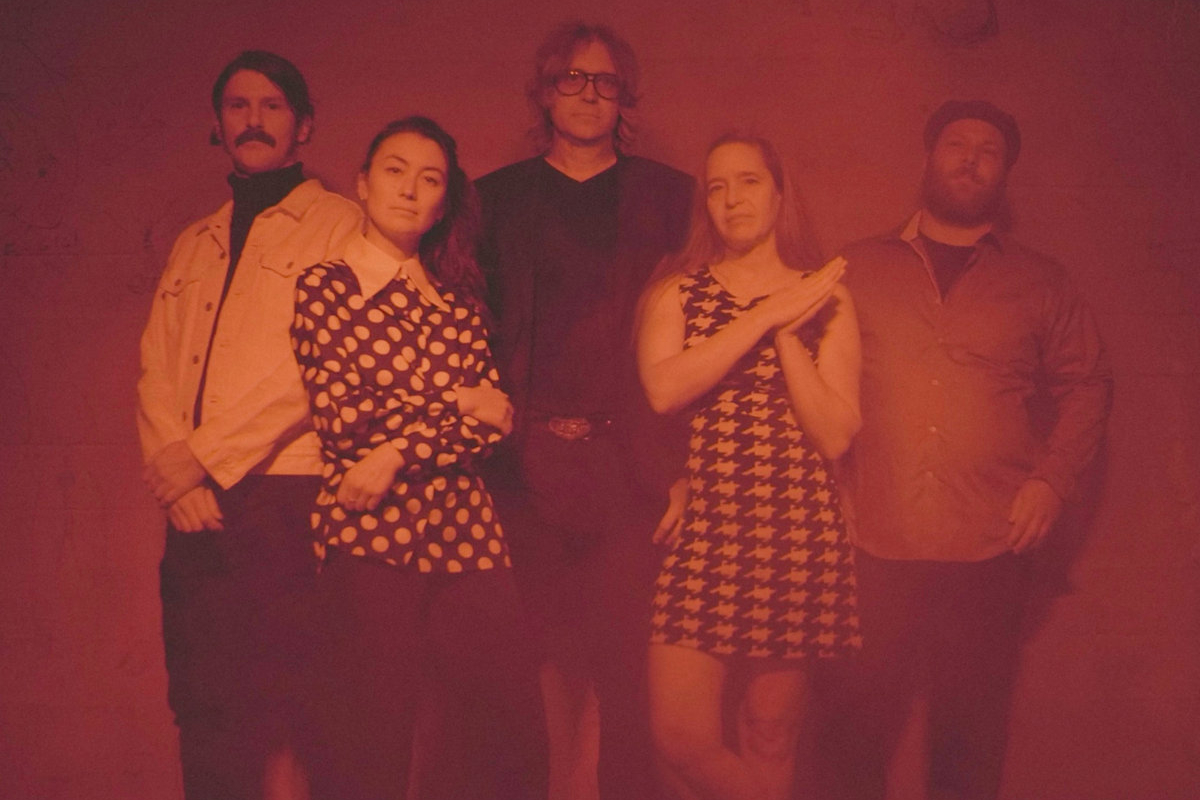
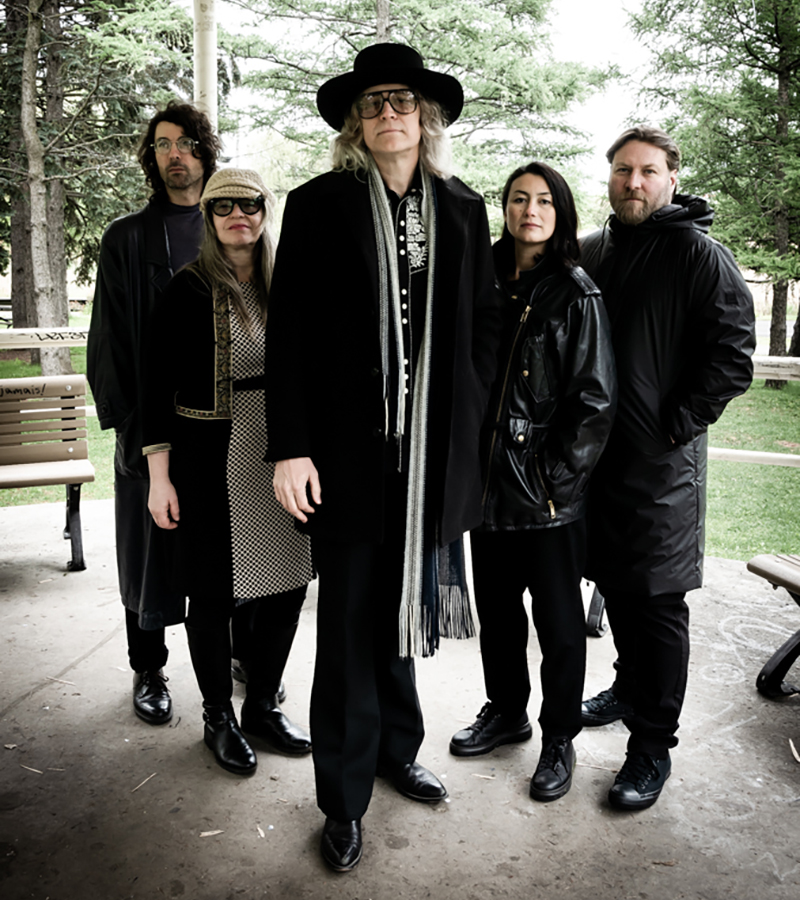
JL: So, it’s me and Oggy (bass, vocals). Kevin Laing is our drummer, who’s been our drummer forever. Sheenah Ko is our keyboard player, and Gabriel Lambert is our guitar player.
JB: You mentioned those five days at Lost River. What was it about that relaxed setting and short timeline that allowed for such a creative environment for the band?
JL: As we get older, it gets harder for all of us. They have kids and families and jobs and it gets harder for us to be in a creative environment for extended periods of time. It’s such a joy to have the opportunity to do that, but like I said, we don’t really get to do that. Being able to go up there and the idea that everybody was available was wild enough as it is. The families and everybody to come up and do it. I think we did it over a weekend and took Friday / Monday off. For all of us to be able to be in a creative environment, where we’re 24/7. We’re thinking about the songs, we’re talking about them, we get up in the morning and go for a walk to discuss, “What are we going do today?” There are no other distractions. We were in the woods so it was very quiet. If there is an emergency, the families are there. It was nice to be able to be secluded in a way that allowed us to focus. It’s always been an important thing for me. I go to Besnard Lake (northern Saskatchewan), for a month every summer. I turn off all the garbage. There’s no cell phone signal. I live in a tent, and we turn off. I’ve always said I feel that’s one of the most important things to have, like a pilgrimage, somewhere that you look forward to every year.
JB: I agree.
JL: And this was sort of like a mini pilgrimage. We went up in January, but we’ve been talking about it since October or November. We were having a little chatter about, “Can we make this happen? Is it going to work?” People were getting excited about it, and it was something to look forward to. When everybody got there, I had already sent them the songs, so everybody was really excited to just be creative. It’s just something that, as a society too, we just don’t really get the opportunity to do that. We do have granting agencies here that help us do that, which I think is important, but to be creative and to be an artist you need time. You need time to sit and think, which is part of the process and still just as important as picking up and playing.
JB: Yeah, my mother is still in Ohio, so I always enjoy traveling the back roads to get there from Arizona and take a different way home. I have been enjoying visiting the graves of musicians and places of historical note when it comes to music. I find spirituality in nature as well as the history of people and places. Camping, getting away and unplugging is just as important.
JL: Yes, absolutely. The Grandeur of Nature!
JB: You mentioned the families came up during the recording of the band. Did they enjoy it?
JL: Yeah, they did. Kevin just got married to Annie (Valin), our tour manager, so she was up there. She has obviously been on tour together with us, so she’s been around it and she loved it. Kevin brought his daughter up, and she is an oboe player. She was maybe 10 or 11 or 12 at the time and is already an incredible oboe player. As with mantra, after we finished tracking “Pontiac Spirits,” I asked her to come in. We’re gonna put the song on a loop, and we’re gonna get her to play some oboe. She ripped those two oboe lines side by side in about five minutes perfectly in tune; I didn’t tune them at all. Then I stacked them on top of each other, and it was this beautiful harmonic melody line. And then, we also got it on “Chemin de la Baie.” She’s in the verses (laughs)! She’s such a musical talent. It was really great.
JB: She wasn’t timid at all being in the studio?
JL: Nope. We’re trying to get her up on stage now these days, and she’s a bit more intimidated by that! Maybe she’ll get the bug (both laugh)!
JB: Does the band often let chance steer direction, like the creative direction?
JL: Yeah, I love chance. As a producer, it’s one of my favorite things. I have a lot of broken machines, tape machines, guitar pedals and if we’re ever stuck for an idea we’ll try using one of these machines to see what spits out the other end. I also have plug-ins on the computer that create random sounds from something that was simply generated. I LOVE that stuff so much. I have an old Echoplex (tape machine with two heads, one repeating milliseconds after the first), sitting right beside me where we put basically every single guitar solo through on the record. That machine is pretty old and rickety, and it makes things really woozy. It has dropouts, wow and flutter, and the notes modulate. Every time Gabs set up to do a solo, I plugged him into the thing, and then we would play with the machine as he was doing his solo. So, all these weird sounds and feedback notes and things would just kind of pop out! I was also heavily inspired by this Québécois artist named Catherine Leduc. The last two albums she’s put out, there’s one called ‘Un Bras de Distance Avec le Soleil’ (_Grosse Boîte, 2017). It’s such an incredible record. All the vocals are put through a Leslie (speaker that combines tremolo, vibrato and phasing by rotation, throwing sound in different directions), and the keyboards are through a tape machine making everything else warbly and weird. It sits on a layer of really gorgeous, ‘Dark Side of the Moon’ era Pink Floyd tunes. I thought, “I want to make this record sound a bit broken but playfully, not in a sad way.” Even the beginning, or at the very end of “In Hollywood,” where the guitar solo falls apart, it’s kind of just a little piece of musical humor, (both laugh). We’re playing around, we’re not serious people, but the band comes across as being a bit serious. I wanted to not be super-serious this time. I wanted to be like, “We’re actually, really fun people to be around!” (Both laugh).
JB: That was going to be my next question, are you guys fun? (Uproarious laughter). You mentioned “In Hollywood,” and it was noted as being a typical track in The Besnard Lakes canon with the drop d tuning and a melody that was circulating for years. Why was now the right time, and the right project to fully realize that track?
JL: Yeah, again, up to chance. There’s always one troubled child that comes into the making of an album that I say, “Okay. We’ve put this aside for too long. It’s time to finish it.” On ‘Thunderstorm’ it was “Heads” (“Our Heads, Our Hearts On Fire Again”), and there was one on ‘Coliseum’ too. So, for “In Hollywood,” I had that riff for probably 25 years old but I didn’t think it really suited the band. I’ve always really loved it. And I’ve always thought in my mind, “If I ever finish it, it’s going to totally be a hit.” As we got into this record and thinking it was going to be more like a Spiritualized record, that riff was. I was, like, okay, well, it can just be that riff like it doesn’t have to be anything else. Let’s just turn it into a rollicking groove, we’ll make it dirty, Gab will put a solo on it and that’ll be that. (Laughs) That was it! It felt a bit different to me just because of the feel of the tune. In the end, I realized I can only write stuff that sounds like Besnard, because that’s what I am. So, no matter what it ends up being, it’s always gonna feel like it fits into it. It was finally nice to get it out, which was good. There’s a bunch more (laughs) of those problem children.
JB: Do you have anything leftover from ‘Dark Horse’ era?
JL: Well, “Our heads, our hearts” off of ‘Thunderstorm’ was from that era. That was a troubled song that we had written right after ‘Dark Horse’ was finished. We were going to put it on ‘Roaring Night’ (Jagjaguwar, 2010), and then we abandoned it for three records. I have stuff that’s pretty old that is still sitting around. I even have an old cassette recorder that was like a Walkman, but a microphone on it with a record button. I have a suitcase full of tapes that are just ideas of guitar licks and stuff that I’ve been keeping since, I don’t know, 1990. Since I started playing guitar. Some of it is hilarious punk rock garbage and some of it’s actually pretty interesting. So that’s another place I go for a source of inspiration. I’ll go into this suitcase and pull out some tapes. It’s also interesting too, because I’ll be listening through the cassettes going, “Oh, that’s ‘Rides The Rails’,” or “That became, ‘Because Tonight,’ or “That ended up being ‘And This Is What We Call Progress’,” or It’s pretty cool. So, we do that on our “Patreon”:https://www.patreon.com/thebesnardlakes/. We give people a lot of outtakes, because I have multiple mixes of all of our songs ever so in my studio here, I can bring up an early version of a demo before we realized the song as we were writing it. Patreon people get, for example, “Like The Ocean…,” that’s just drums, bass, and guitar with some mumbled vocals. It’s cool that way because you can. I’m a bit of a music nerd and I like to collect bootlegs and rarities. Mostly Prince stuff, but I love hearing the rehearsal things that people steal and bootleg. Hearing how they’re working out the songs since I’m fascinated by that shit. Hearing early versions of demos of songs and things, I love that stuff so much.
JB: What is it about Prince that draws you in?
JL: He’s a genius. Part of it is because I’ve been a fan since I was 12 years old and it was the soundtrack to my childhood. He is so in me now but what drew me to him, even when I was 12, I remember looking at the records, flipping them over and it always said, “Produced, arranged, composed, and performed by Prince.” I thought, “Holy shit! This guy’s doing everything himself!” Even when I was that young, I knew this was how I wanted to make music, and I wasn’t even a musician yet! I was well on my way with karaoke and I had a hockey stick that was my guitar.
JB: I had a tennis racket.
JL: When I start writing songs, I need to be able to do it by myself. As I got older and started going into studios and having people record us before I knew how to record, I was always just constantly disappointed. I was like, “Why can’t these people make it sound like the way we want it to sound?” I guess we didn’t have the language to tell them. We would bring in references and it would never pan out. And I realized, “I need to understand why I can’t get the sounds that I want.” So, I figured out how to do it myself, and that’s just how we do it. I’ve had people ask me over the years to produce us. Maybe it’s a terrible idea to say no. One of the guys from Beck ‘Morning Phase’ (Capitol Records, 2014) asked to produce us. I’ve had John Agnello, who is a buddy of mine and does a bunch of the Dinosaur Jr. records, he’s asked to mix our records before. I’m like, ”John, you’re such a sweetheart, but I can’t let go.” I got it. I need it. I need to have it (laughs). It’s part of my thing. I love mixing my own music, it’s just part of the whole puzzle. If I gave it away someone would end up hating me because I would be terrible to work with (James laughs).
JB: Do they still ask?
JL: No. No one has asked in a while (both laugh).
JB: That is an interesting question. How would a Besnard Lakes album sound with somebody else producing or mixing it?
JL: Yeah, I’ve thought about it. I found it very curious. I’m just as curious as anybody else would be just to see how that would work, but the thing that scares me is, and it’s why I’ve never done a side project or a solo album, what if I feel like we have could have had something if I had gotten my own hands on it, but because someone else got their hands on it, it didn’t turn out the way that it should have, and then we missed the mark. That eats at me. I’d rather be responsible for my own failure than have someone else or feeling like I could blame somebody else.
JB: You mentioned “Battle Lines” earlier. I understand it began as a solo album session for Amy Millan (Stars, Broken Social Scene)?
JL: I was working on an album for Amy, her solo album that came out a few months ago (‘I Went To Find You’, Last Gang Records). We had actually done it over a few days up at Lost River, and we were playing the mute game a lot with her record. It’s pretty heavily piano-driven. Her co-songwriter, Jay McCarrol, is this insanely good, Berkeley-trained piano player, and so a lot of the tunes are very heavily driven with that sweet piano push. When I started “Battle Lines,” I said, “Let’s try to do something that has smooth grooves, like, piano-driven soft rock.” I transposed the parts from the riff I had written on guitar onto piano and then wrote it from there because I was so inspired by Amy’s record, which is an absolutely gorgeous album. That song came together quite quickly because the creative sparks after her record was finished was one of the things that I’m grateful for. When I’m not doing Besnard, I get to work with other people producing and mixing and engineering, and then I get inspired by other people’s creative juices. So, when I get in to do Besnards stuff, I can be pretty lit up at times doing my own thing.
JB: Regarding your production work, are there other artists you’re working with now?
JL: I always have stuff on the go. I’m just about finished mixing the new Beatrice Deer album. She’s an Inuit artist from Northern Québec, incredible tunes. Bucky Wheaton is the producer of the record. He’s their drummer and original drummer in Land Of Talk. Chris McCarron is also the co-producer. He’s the guitar player in Stars. It’s just beautiful. Beatrice is an amazing songwriter. Those guys add such cool stuff, and it’s gonna be an amazing record. I was up pretty late last night, actually, with these guys finishing up the mixes. I have to rehearse tonight, too for Besnard. We’re gonna start figuring out how to play.
JB: This is kind of in that same vein, but I wanted to ask about your work with Inuit musicians. When we spoke last, I think you spent some time up near the Arctic Circle, which I thought was really cool. Listening to the music is also fascinating. I think it’s great to hear you’re still working with native artists.
JL: Yeah, I’m pretty locked in up there now. My friend Andrew Morrison runs a record label up there called Aakuluk Music. He lives in a town called Iqaluit in Nunavut. It’s on what was formerly known as Baffin Island, but it’s way up there past the top tip of Québec. We built a recording studio in his garage. We’ve been talking about doing it and he really wanted to have it done. I said, “Let’s make you a really perfect, soundproof room. Let’s get you gear that is the best, so there’s absolutely no excuse anymore to not record great music up north.” I go up there twice a year, usually to record. He lets anybody who’s local up there record for free, so I just go up, and we make records. It’s a really compact studio, but it’s really beautiful, and it has everything unique to it. Its got great mics, great mic-preamps, compressors … everything is pro. It’s not semi-pro garbage like they had in the past. So, it’s amazing, because now there’s so much creative output coming out of Iqaluit. It is the main hub of that area, I think maybe 8,000 people so it’s not huge, but the amount of creativity coming out of there over the last 10, 15, 20 years has just been incredible. Even all down to fashion designers and artists, not just music. There are some incredible painters, jewelry makers, photographers, and filmmakers. It’s such a cool vibe when I go up there. It’s Tundra, there’s not a tree around, you know, but I love it. It’s just magical. I love the cold and get to dress warm. In the winter, there’s like three, four hours of sunlight. You get cozy at work and someone’s always bringing in an Arctic char that we’re smoking or eating raw like sushi. It’s just a fantastic magical place.
JB: It sounds similar to an Alan Lomax (American ethnomusicologist) approach with his field recordings throughout the south of the U.S.
JL: Sure, yup.
JB: Who would have heard it if he didn’t record it?
JL: Thank God he did. We would not have had all that stuff.
JB: I couldn’t imagine a life without that stuff.
JL: No (both laugh). We wouldn’t have had the British Invasion. It wouldn’t exist. Beatles, Rolling Stones? Nope, none of those. Jimi Hendrix? Nope. None of that stuff would have been around. It would never have been recorded.
JB: Agreed. The album features incredible performances from Gabriel’s bizarre and trippy solo work on ‘In Hollywood’ to Sheenah’s keyboard work. As a band leader, how much direction do you give your bandmates as collaborators, and at what point do you kind of step back and simply let their creativity take over?
JL: Usually, Oggy and I will take the songs … it’s kind of the next logical extension of what happens with Oggy and I. I’ll get to a point, Oggy steps in and we take them to the finish line to the best of our ability before sending them to the band. We’ll say, “Okay, here they are. This is where we think we need this something here, something here, but let’s just see what happens.” So, they have free reign, but I give them ideas of where I think we need filling in. Sometimes I will purposefully leave things out just to see what might happen. I may have something in mind, but I won’t say anything. I’ll just leave it just to see what happens. Nine times out of ten, it’s better than my idea anyway. For example with Gab for soloing, I usually know where a solo will be but I never give him any guidance as to what to play. It’s always his creative mind happening and the same with Sheenah and Kevin too. Oggy and I are pretty terrible drummers, but we can lay down a rough version, and then Kevin takes it to the next level, just to usually give him an idea of like what we’re feeling and how we think it should go. As a drummer, he can actually put some polish on it and make it into his own his own beat.
JB: And they can feel invested in the track.
JL: Yeah, totally, exactly.
JB: ‘Give Us Your Dominion,’ I thought, was a powerful example of the collaborative spirit we talked about at the beginning, but particularly with Oggy, how did translate into the the musical structure of the song? How did the bass line and melody help you finally resolve the tracks long-standing and unresolved title?
JL: I have a recording of that song on the beach at Besnard Lake, and it’s the first time I was trying to figure how to resolve it. I called it “Unresolved, Resolved,” and it’s from 2010. That’s how long it’s been to make it happen and so, I had the line done and then I called in Oggy, and I was asked, “Now, what do I do?” She sat down, and in 20 minutes, she had that bassline, which makes the whole song. And then I thought, “Okay, well there it is.” And then asked her, “Can you sing something?” (Both laugh). Oggy’s Greek so we have a love of old, Greek tunes, and they have this pattern we’ve always called the Greek beat, which is a phrase in five (bar) and a phrase in four (bar). We had tried to use that in other songs, we had tried to do it in “Alamogordo,” (‘Until In Excess, Imperceptible UFO’, Jagjaguwar, 2013), at the end of that song. We didn’t do it right, and we realized after that it wasn’t the correct pattern (laughs). I said to Oggy, “I really want to do something that digs into your roots a little bit.” That’s another playful part about this record is we’ve always been pretty static. But Gab has a bazookie. We’ve never played it or used a bazookie before. Once we built the verse, I said to Oggy, “I want to write the chorus as a Greek beat of five/four, four/four alternating pattern.” And so I did, then Oggy filled in. The cool thing about that beat is if you do it properly, you don’t hear the odd shifting. She laid the bass line down and that smoothed it out a little bit better even still. Then I said to Gab, “Can you play a classic style line over top?” Again five or ten minutes later, he’s got that signature line that goes over top of the chorus. Then we thought this is the coolest (laughs)!
JB: Do you think as you move forward with this project, you’ll start utilizing different instrumentation?
JL: Yeah, I think so. I mean, Gab started. He’s got a lot of really cool, weird acoustic instruments, but we’ve always been so electric that we’ve never really dug in, but that was one of the cool things about going up to Lost River this last time. He’s said, “I’m just gonna bring a bunch of things to play around with!” because in the back, you know, back to the other records. It would always be like, show up with your guitar, you know, where? We don’t know, bring everything, bring your Bazookies, bring your 12 string acoustic, you know. Bring your little tiny acoustic guitar from 1935. Yeah. That
JB: Do you think the band will venture out west?
JL: Yes, we will slowly. We have the first half of our dates done, and we’re working on the next half. So, we go to Europe this month, and then we’ve just been invited to go to Spain and Italy in April. So, right after that, we’re working on Chicago, West Coast states, Minneapolis. And then, you know, the classic run of Seattle, Portland, San Francisco, L.A. And then, of course, any pending festivals. We’ll see where we get to, but we’re gonna hit everything. It’s just gonna take us into the new year.
Upcoming live dates:
April 3: Québec, Canada at L’Anti Bar & Spectacles
April 4: Saguenay, Canada at Centre d’Expérimentation Musicale
Visit The Besnard Lakes | Soundcloud | Youtube | Facebook | X for more information.