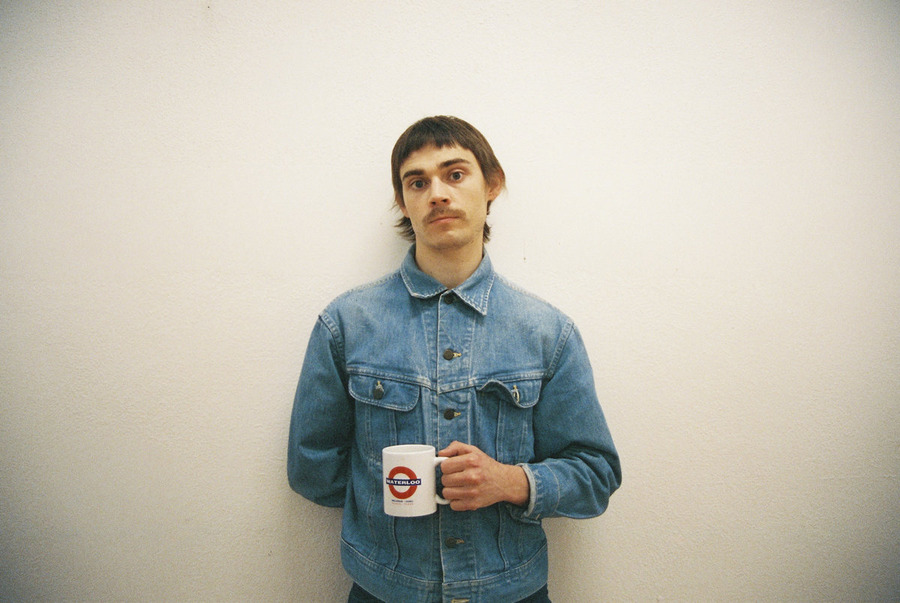
Ramsey Thornton’s folk-based music mirrors the way he lives his life: observant, quiet, introspective, and deeply attentive. His songs linger in everyday moments – half-caught conversations in a tour van, watching the goings on of the neighborhood while pedaling a bike down the street; the kinds of things most people don’t stop to take notice of. Lyrics like “My backyard/Why’d you cut down that tree?/Don’t you remember/That used to be our spot,” from the song “Backyard,” are delivered in a plainspoken manner that carries weight and evokes feelings; it’s a casual stroll through everyday American life. That’s the gift running throughout Thornton’s debut album, I Called It!, the ability to make the ordinary feel quietly alive.
Thornton’s musical journey didn’t happen overnight. He started playing drums at the age of 4 before picking up the banjo as a college freshman, as he explains, almost by accident. He eventually settled into playing guitar and songwriting, though his earlier musical experiences have never really left – he strings his guitar like a banjo and finger picks, giving his music a percussive, rhythmic quality that feels like all three instruments at once. The guitar isn’t just accompaniment, it’s a second voice, weaving countermelodies that give songs like “Riverside” a dreamlike quality as the tempo shifts beneath you. It calls to mind the fingerstyle intimacy of Nick Drake and the quiet intricacy of Adrianne Lenker’s solo material.
I Called It! moves through different moods the way a quiet day does, not dramatically but perceptibly. “Drinking Coffee” is the kind of song that belongs on every indie-folk playlist, while “Fourth of July” has the feel of a grey sky afternoon that isn’t quite ready to part to allow the sun to shine, the bass holding slow and steady while the guitar picks faster above it. “Tony’s Song,” a duet with Ken Pomeroy, whose live band Thornton’s a member of, stands apart simply by virtue of adding another voice; two people singing alongside each other, unhurried and pretty.
As a lyricist whose ideas and inspiration are built from fragments of overheard conversations and moments that stick long after they’ve passed, Thornton’s music feels patient, deliberate, and deeply human, not because it’s trying to be, but because it reflects the way he pays attention to the world around him.
When we spoke, we talked about writing, Tulsa, and how Thornton turns small details into songs. Thanks to Kurt at Gar Hole Records for the introduction and helping make this conversation happen.
I know nothing about Tulsa, Oklahoma. Tell me a little bit about it.
RAMSEY: It’s a cool town. In Oklahoma, there’s Tulsa and Oklahoma City, and then everything else is really small. Both of those are big enough to be considered cities and have some cool stuff. But, we were just in Chicago last week, and it’s like, okay, Tulsa is small. There’s a cool music scene going on here. There may not be a ton of active touring musicians out of Tulsa, but there’s a lot of cool local music, and there’s a lot of guys that are just a bit older that used to tour, and now they’re just in Tulsa doing some local gigs. It’s a cool town with a cool music scene and interesting history. In the ‘70s, Leon Russell was here, and he had all the people that he was associated with come through town and record and stuff. It’s kind of a quiet city, but there’s a really cool music scene and a cool history to the town.
Is Tulsa a younger city, or is it full of people who grew up there and never moved?
RAMSEY: I feel like it’s probably both. I was born here and I’ve just stayed. But there are a few different parts of town that definitely seem like there’s a younger demographic making up the majority. And there are several initiatives throughout the town to have incentives for people to move here for business, and it seems like a lot of that has been happening. There’s a lot of cool restaurants that have been opening up recently, people that are moving here and opening stuff. But there’s also a lot of people that are just from here and stay here. I’ve definitely thought about moving to different spots. If you’re touring and traveling a lot, it is nice to be centrally located. For now, I enjoy being here.
Was the childhood dream to be a “rock star”? Is this something you always knew you wanted to do or did you stumble into it?
RAMSEY: It was what I wanted to do from a really young age, but I didn’t know that it was going to be this avenue. I started playing drums when I was 4. My brother is 4 years older than I am, and he started playing drums when he was 6, so there was always a drum kit around growing up. Even before middle school, I would have said my dream was to just be a drummer when I grow up. The only instrument that I played until I was 18 was drums. I started playing banjo when I was 18, and then I moved to guitar a couple years later. I didn’t start writing songs until I was 18 or 19. Once that started, I was more like, “I want to try to pursue writing my own songs,” having a solo career of my own, instead of being a session musician or something. There was also a little period in high school where I just wanted to get a corporate job and do that. But by and large, for a lot of my life, I kind of always knew I was going to be pursuing the music thing.
You and your brother were young when you started playing drums! Did your parents buy a drum kit and shove it in the basement to give you something to do or did you have a family member who thought it would be a fun way to torture your parents by giving you a drum kit?
RAMSEY: To my parents’ credit, they were, for some reason, cool with having two different drum kits in their house. They bought my brother his first kit. And then I had a baby drum kit that I literally got when I was 3 or something, there are pictures of me in my mom’s scrapbook. Then there was a period where I was playing my brother’s kit. I think I got my first real one, it was like a Gretsch Catalina Club maple, or something like that, in 5th or 6th grade. The majority of the time my brother and I were living at my parents’ house, there were two different drum kits. And our house didn’t have a basement or anything like that, so it was just right by the living room.
Are your parents musicians?
RAMSEY: My mom sings, and there was a period when she was a little kid, this is actually kind of crazy, she kind of locally toured in the Midwest and had this band. There’s definitely some gray areas I’m not totally knowledgeable about, but she had a touring van and I think her band was called something like the Teddy Bear Band. She was just going around bars and singing with this band. I’ve heard stories that there was a point where she was offered some kind of record deal, and they wanted too much control over her, so her parents wouldn’t let her sign it. I feel like that’s a story that’s easily added to over time, so that’s probably not even accurate, but that’s the story I’ve gotten. My dad kind of played guitar a little bit, but nothing serious. He went to Oklahoma State University in the ‘80s, and he claims to have one time played guitar with Garth Brooks. Who knows if that’s true?
You said when you were 18 or 19, the idea was that you wanted to start writing your own stuff. When you say write your own stuff, was that writing the music, or was that lyric writing?
RAMSEY: Both. I started playing banjo first, and there’s a way of playing banjo, it’s more of an old-time, traditional style called Claw Hammer. I think originally it’s from African-American players in the Appalachian area. Instead of picking, it’s almost like you’re slapping the high string a little bit, and then you usually just have one finger you’re striking with. That’s what I started with first, and I got to know the instrument for maybe a year. Then I pretty quickly started to try to write songs. I also always sang, so I was like, “Now there’s actually a melodic instrument that I can sing to.” I was encouraged pretty quickly to try to write stuff on it, because I could accompany my voice with something. Pretty quickly it became, “Oh cool, I can write songs now.”
So it wasn’t really the Dave Grohl path, where you’re a drummer, then all of a sudden you become a frontman.
RAMSEY: I played little gigs here and there in high school where there’d be 3 of us, and the guitarist would sing, and I would sing some. So, to a small extent, I had already been doing a little bit of that.
Did lyric writing come pretty naturally to you or was it difficult when you started?
RAMSEY: Most of the songs I write now, for me to get to the point of wanting to finish them, I at least feel good about them. I feel like it maybe took a couple of years to get to that point. I’m sure if I looked at most of the songs I was writing when I was 18, 19, 20, probably even up to 24, I’m 28 now, I would cringe if I read any of that. It definitely took time. Not to say that I’m anywhere now, but it’s definitely a learning curve with actual lyric writing.
I don’t know if the internet accelerated it, but I feel like there are a lot of artists who write their first song and record it, they put it up somewhere and it gets a million listens. They don’t have that growing period where you can learn what your voice is: your physical voice, but also your voice as a person, the story you’re trying to tell. I think it is sort of good that maybe that stuff makes you cringe, because that means you’re learning.
RAMSEY: Definitely. I’ve struggled with looking back on older songs, because I’m sure that to an extent that will always be the case; 10 years from now, I could totally not like this album. I put out my first little EP back in 2021 or so. I did take it off of some streaming platforms, but it’s still up on others. Even though I did take it off of some of them, I think there is something to be said about just leaving it up there. Even if you hate listening to it and think it’s objectively bad, it’s at the very least a testament of your trajectory.
I’ll admit to having a certain bias against the banjo. When I see a photo of band with a banjo player, I instantly assume they’re a bluegrass band and, at least up to this point in my life, I’ve just never been a big fan of that style of music. But, hearing your stuff, I wouldn’t call it bluegrass.
RAMSEY: I appreciate bluegrass and bluegrass banjo playing, but it’s definitely not what I gravitate toward. When I’m playing banjo, I definitely don’t play in that style partly because it’s just hard and I probably can’t. But I also just never really naturally gravitated toward it. I play banjo right now for maybe about half of the set for Ken Pomeroy. I kind of think of it as just another stringed instrument, and try to strip it from any preconceived notions or baggage it might have. I approach it similarly to the way that I play guitar. When I’m picking, I pretty much play it the same way as I would a guitar. My guitar is pretty much strung like a banjo, because that’s just what I started playing first. I have 6 strings instead of 5, but when I play guitar, I take off the lowest string, that low E string, and I replace it with just a high drone string, which is what a banjo has, just to keep that same picking pattern feel that I got used to on the banjo. At this point, the way that I’m playing banjo and the way that I’m playing guitar are pretty similar. I just feel more comfortable with the guitar as a lead instrument, so all of my songs are kind of guitar songs, and banjo is more of an accompaniment thing.
I read that your introduction to the banjo came from seeing one at a friend’s house and just picking it up and playing around with it.
RAMSEY: It always kind of bothered me that I didn’t know how to play guitar. All of my early teenage years, I always thought of myself as a musician. I played drums and I would always be intimidated around a guitar, and think, “Why have I not taken the time to learn how to play this?” It was my freshman year of college. My best friend for a really long time played guitar and just had a banjo, and we were roommates. I think I was more encouraged or less intimidated by it, because in a standard banjo tuning you just strum it open and it’s a G. So a little bit of me starting to play the banjo was just like, “I’m less intimidated to try to learn this.” It’s definitely not easier to play banjo than guitar, but the fact that I could just not do anything and be like, “Here’s a chord,” I guess I was more encouraged to try to learn it.
Were there any artists that influenced you to where you are today? Or, and I don’t want this to sound negative, were there artists you saw in your local scene that you were like, “If they can do it, I can do it better”?
RAMSEY: I don’t know if this is a good example, but the first person that comes to mind is the Avett Brothers. I used to really be into them in middle school and high school. Scott Avett plays banjo a lot for a lot of their songs, which, weirdly seems like it would be why I started playing banjo, but I kind of don’t think of it that way. I think it was more just that there happened to be a banjo in the apartment I was living in at the time. But, at least for a brief moment, maybe 10 years ago, I was like, I respect him as a songwriter and a musician, and he’s definitely not doing anything difficult. So, I think for at least a couple of years, Scott Avett kind of served as some encouragement for me, because I was like, “I really enjoy his writing and his playing, and he’s just not doing anything crazy at all.” While I was getting my bearings on stuff, I feel like that was maybe an example of that. That’s really the only person I can think of off the top of my head.
You describe your lyric writing as “overheard,” as in you overhear things around you and that stuff works its way into your songs. Are you literally picking up words and phrases and inserting them into lyrics or is it more like you’re watching people in a park and translating the feelings and emotions that you’re seeing into words?
RAMSEY: It can be both. I remember there’s a song on my album called “Home Base,” and I was on a tour with an old band that I used to play drums for, and we were just driving to the next show. I had my headphones in, so I couldn’t really hear, but the driver and the guy in the passenger seat were having a conversation about just getting older, and your relationship with money changing. It was kind of very vague, but I remember being in the backseat and just the phrases that I heard in their conversation, the ones I caught that I thought were interesting, I typed down in my Notes app. And then I think that ended up being the second verse of that song. So there definitely have been times where it’s literally I’m just hearing people, and if there’s anything that catches my interest, I’ll write it down and try to later formulate it into some type of coherent thing. But also, there’s just feelings, instead of literal things that I hear someone say, just feelings that are kind of vague, and trying to formulate those into words.
I am more of an intent listener than someone leading conversations. I feel like you can learn a lot by eavesdropping. I know that’s probably a negative term, but if there are conversations happening around you that you’re not part of, and people are talking loudly, you can’t escape it. Are you more of an intent listener or more outgoing?
RAMSEY: Definitely more of the quiet person. iIf it’s just me and another person, I can definitely hold my own in a conversation. But anytime I’m in a social situation, being with my brother is a perfect example, anytime I’m with other people and my brother, I let him take care of the talking. And I feel like that’s probably made its way into other relationships that I have with people. I’m more comfortable sitting back and letting everyone else do the talking, and just listening. A lot of people meet me for the first time and think I’m shy, which is a totally fair assessment, but I don’t think of myself as shy. I think I just prefer to listen to what people are saying.
Your lyrics are personal, but relatable. I may not have the type of life experiences to relate to everything you write about, but I understand your storytelling and I find that appealing.
RAMSEY: I feel like a lot of my songs don’t have big themes. They’re at least inspired by very, very specific things that I either hear or whatever. I feel like because of that, I’d never do very well as a songwriter for other people or trying to write a pop song, I’d be so bad at that. But because some of the things I write are so specific, maybe that makes it where, if I’m spelling it out that clearly, at least for one line, then it’s easy, at least for a second, for the listener to get in there.
That makes a lot of sense. You’re not leaving it abstract, you’re not making me try to figure out what you’re doing. You said there’s no theme, and I know there isn’t, but I did catch a couple of songs where you talk about phones or phone calls. In “Riverside” — “list my accomplishments while I’m on a call” — in “Chase After You” — “rather explain it there than try to on the phone” — and in “Hotshot” — “don’t pretend to be on the phone.” Is that just a lucky coincidence?
RAMSEY: I don’t know, I guess. I think that is all just coincidence, but I feel like talking about a cell phone or something in a song is really specific and random, or just pieces of technology in general. I’m also usually writing songs on a phone, so there’s definitely a lot of phone influence throughout my day.
Talking about the record, I like it all, but sonically there are a couple songs I find myself really drawn to: “Riverside,” “Homebase,” “Window,” “Fourth of July.” I think what makes some of the songs appealing is they have counter melodies. Is that the right way to describe what I’m hearing?
RAMSEY: Yeah, it makes sense to me. I’m also not very technical, but counterpoint is a thing, having a melody and then picking harmonies off of that main melody. I think that’s technically considered counterpoint, so countermelody works. It’s cool to hear that you specifically enjoy “Fourth of July,” because an insecurity of mine is that the last quarter of the album is whether it’s too heady, or just not interesting enough. So it’s nice to hear that you’re enjoying some of the stuff from closer to the end.
I feel, in my position as an interviewer, that I owe whoever I’m going to be talking to the respect of listening to an album top to bottom. At least the first time through, and then I’ll start picking out songs I want to go back to. I want to hear the complete work, and I really do try to pay attention to the last half of the record, just to get the full picture.
RAMSEY: That’s awesome. I try to do the same. And there are a few on there where in that same part, they all go together, so the whole shuffle thing is definitely not ideal for the listening experience of this album.
Back in the iPod days, I loaded an album onto my iPod and listened to it a bunch. When the album was officially released, the track order was totally different. It was only then that I realized that when loading it, the songs were in alphabetical order. It was an entirely different listening experience even though it was the same songs. I never realized how important the track order was before this.
RAMSEY: For sure, and that’s maybe not something I ever thought of until I had to do it. Then there’s also the industry side of things. I feel like usually the most poppy, wide-reaching song is usually the second song, and then side B is usually a song that would kind of kick it back up again. But yeah, it’s just something you don’t really have to think about until you have to.
I’ve heard one of my favorite songwriters, Robin Pecknold of Fleet Foxes, say, which I’m sure is half joking, half not, that the perfect album always has one skip song, one song that you always skip. And I feel like he would place it about three-fourths of the way through. I always thought that was funny.
The other thing that really appeals to me, because of the way you play guitar, is that the guitar is another voice.
RAMSEY: Yeah, I think a lot of the guitar parts could just be instrumentals. For me to like a song enough to finish it, the guitar part has to be satisfying or interesting enough on its own. Vocal melody, I feel like I hardly spend time thinking about that. Literally the first melody that I think of is usually going to be the one. So the guitar part is definitely the main component of all of these songs, and my hope would be that maybe they could stand alone as an instrumental, especially with the rest of the full band stuff. Vocals are thought of as more of just an addition to that.
“Riverside” is one of the most beautiful songs I’ve heard this year. I get lost in it. It feels like there’s some tempo change, and it’s a little bit longer, but I’m on board for the whole journey. It’s such a warm, pleasant-sounding song.
RAMSEY: Thank you. I do like the feeling of songs not having a steady tempo. All of these songs were live-tracked, not as a whole ensemble together, but live-tracked with me playing guitar and singing, and then we built on top of it. There were a handful where it was me singing and playing guitar and then another guy named Isaac Stalling also playing guitar, but that’s always the core thing, and then we just dub everything else on top of that. I try not to think too much about tempo and try not to be crazy about staying right on time. Tempo fluctuations are cool, and just whatever naturally happens. It can make it sometimes more difficult when you’re going and trying to track stuff on top of it, but to keep some of the essence of a live recording, maybe embracing some of that is worth the minor inconvenience.
There are a number of videos of you on YouTube performing with just your guitar. Is that out of necessity, because it’s easier to play by yourself in these situations than work around other band members’ schedules or would you prefer to play as a full band?
RAMSEY: Both. I love playing with a band, but it’s just easier to go, “I just wrote this song, let me just set up my phone really quickly and get this video.” Not to say that my songs are difficult, but if there are tempo changes and stuff, I feel like there’s probably at least a decent amount of rehearsal that has to go into that as a whole band. Because of that, I think I’m at a point right now where I just prefer playing by myself. I know that it’s just me that has to make these decisions, and I don’t have to hope that everyone else is going to follow me. That being said, I do love playing with a band. I have two album release shows in Tulsa in a couple weeks, and that’s going to be, I think, a 5-piece. So it’s fun, I love doing it, it’s just more work. And I think the songs can work as a solo arrangement, so I don’t know if I prefer either one, it’s just easier to do solo.
Your music feels super intimate. Does your music translate well in larger venues? Have you played larger venues as a solo artist?
RAMSEY: The biggest venue that I’ve played as a solo artist has been maybe a 700-capacity room. Mid-sized, I guess. I think probably the 500-capacity rooms are, as long as you have a respectful audience that’s not going to be drinking and talking over your music, ideal. But it’s also awesome just to have a room of 30 people if they’re attentive. The biggest room I’ve played was when I did a tour exactly a year ago with John Moreland. The one that comes to my mind was the Haw River Ballroom in Saxapahaw, North Carolina. There were only about 300 people there, but his audiences are very respectful. He plays solo, just an acoustic guitar. I feel like it comes down to the audience, and not how many people are in the audience. We did a trio tour last week opening for this band called Flyte, they’re out of London, I think. Their fans were super quiet but really into it, really excited after you finished your song. More than anything, it’s just how respectful the audience is. If it is solo guitar music, it doesn’t really work if the back half of the audience is talking. I played a gig recently where that’s exactly what happened, and that’s always kind of a bummer.
I’m not asking necessarily about influences, but in your bones, in your blood, in your DNA, who are the artists that sort of make you who you are?
RAMSEY: I don’t mean for this to come off as conceited, and it’s not like I’m 100% original, but I can’t think of a lot of artists. Pinegrove is a band that I think is awesome, songwriting and sonically, and I suppose I’ve tried to emulate that in some instances. Are you familiar with the songwriter whose stage name is Tallest Man on Earth? Kristian Matsson is his name. He’s another songwriter that I’ve listened to for a really, really long time, and I was really into him as a middle schooler and high schooler. I feel like he’s been a big influence on me, and I don’t even really know how, maybe guitar playing a little bit. And then, and it’s so weird to say, the Avett Brothers, because I kind of don’t like them anymore. But there was a long period of my life where I was really inspired by that band.
We are not quite halfway through the year. If I call you again in December and you say, “Man, let me tell you about the last 6 months,” what would make you say you had a good year?
RAMSEY: I do feel like I’m at a point where I kind of need to start touring more. If it were December, hopefully the small team I’m working with right now has been pitching me for tours here and there. I have a few smaller things confirmed, but if between now and then I’d had maybe a couple, two or three week-and-a-half, two-week runs with another artist that I respect, I feel like that’s the main thing. If there was one thing that is most pressing right now, it’s just the touring aspect, and just trying to convince some of the powers that be that I’m doing this for real and I’m a serious artist. Which, some of that is stupid, that you have to convince one person who has enough power that you’re legitimate, and then things open for you. But that’s also just how the business works. I also really enjoy touring as part of Ken’s band. We’re out for all of July this summer. I feel like there’s a small chance I could be a part of Pickathon as a solo act, and that’d be great. But in general, just starting to solidify some of those festival dates and opening slots for tours, specifically opening slots for artists that I admire. That’s the main part of the thing I’m trying to get right now.
I’ve been asking this question of everybody I talk to. There are songs that trigger specific memories, like when you hear it, it takes you back in a specific moment in your life. What song is that for you?
RAMSEY: The one coming to my mind right now, I want to say it’s by Conway Twitty, but I could be wrong. I also don’t remember what the song is called, but I know how it goes. It’s a song about the songwriter’s dad dying, and he’s reflecting on their relationship when he was a kid, and basically the dedication that his dad had to him. I remember hearing that song for the first time as a 7-year-old, coming back from soccer practice with my dad in the car, and I was just quietly, secretly crying in the backseat. That happens to me every time I hear it now. I think the song is probably called “That’s My Job,” because the chorus starts with “That’s my job…” And if it’s not Conway Twitty, it just might as well be. Having that memory of coming back from soccer practice and, I think for the first time, being moved like that by a song. I don’t really think of myself as someone who often gets emotionally moved by a song, but that was maybe the first time that happened, and now it just happens every single time I hear it. “Alright, here it comes, don’t let it happen” and it just does.
Also, any early 2000s, late ’90s country music, specifically Shania Twain, that’s what my parents listened to all the time. It just makes me think of being in the parking lot at the Walmart that doesn’t exist anymore in our town . Or “Drops of Jupiter” by Train, that song makes me really think of being at Walmart in 2003 or something.